
AI Video Wedding Invitation India 2026: The Enterprise Playbook for Planners and Bureaus
Estimated reading time: ~11 minutes
Key Takeaways
- 2026 is the tipping point for AI wedding invitations in India, driven by WhatsApp-native habits, market scale, and automation.
- Multilingual, hyper-localized personalization (language, dialects, honorifics, motifs) is now a “made by family” standard.
- Enterprise workflows—data-to-video pipelines, batch rendering, and WhatsApp API distribution—enable scale with quality.
- ROI outperforms traditional videography on cost, speed, personalization depth, scalability, and analytics.
- Privacy, consent, and brand safety (ISO/SOC compliance, moderation, licensed music) are critical for bureaus and planners.
The Indian wedding industry, currently valued at approximately ₹10 lakh crore ($130B), is undergoing a seismic digital transformation. As we move into the peak season, the AI video wedding invitation India 2026 trend has evolved from a DIY novelty into a mission-critical enterprise standard. For wedding planners, marriage bureaus, and event entrepreneurs, the ability to deliver high-quality, personalized video content at scale is no longer optional—it is the primary driver of guest engagement and client satisfaction in a WhatsApp-first ecosystem.
In 2026, static cards are being replaced by dynamic, multilingual video experiences that resonate with the cultural nuances of a diverse India. Whether it is a save-the-date for a destination wedding in Udaipur or a video biodata for a high-profile matrimonial match, the demand for automation is skyrocketing. Platforms like Studio by TrueFan AI enable event businesses to bridge the gap between traditional hospitality and modern technology, ensuring that every invitation feels like a personal outreach from the family, even when sent to thousands of guests simultaneously.
Why 2026 is the Tipping Point for AI Wedding Video in India
The year 2026 marks a definitive shift in how Indian weddings are communicated. Several factors have converged to make this the “Year of the AI Invitation.”
1. The WhatsApp-Native Culture
With over 500 million active users in India, WhatsApp has become the primary medium for wedding logistics. Research indicates that personalized video messages on WhatsApp see a 5x higher conversion rate compared to traditional email or physical mailers. In 2026, guests expect “one-tap” access to venue locations, RSVP links, and ritual schedules, all wrapped in a visually stunning video format.
2. Market Scale and Economic Impact
The Indian wedding industry remains the second-largest consumer spend category after food and grocery. According to ET Retail on Indian wedding spend scale, the sheer scale of these events—often involving 500 to 2,000 guests—makes manual personalization impossible. Enterprise-grade automation tools are now required to handle the volume of data generated by modern guest lists.
3. The Rise of the "AI Planning Stack"
Indian wedding planners are increasingly adopting AI-driven stacks for guest management and ceremony planning. As noted by Wedd.AI on AI planning tools, the integration of AI into the planning workflow has created a natural expectation for AI-generated visual content. By 2026, nearly 75% of top-tier planners will use some form of AI media generation to streamline their operations.
4. ROI and Efficiency Metrics
In 2026, the ROI of AI video is quantifiable. While traditional videography for an invitation pack can cost between ₹50,000 and ₹2,00,000 and take weeks to edit, AI-driven batch rendering reduces the cost-per-video to as low as ₹40, with a turnaround time of minutes. This efficiency allows planners to allocate budgets toward high-impact physical experiences while maintaining a premium digital presence.
Source: HubSpot State of Marketing Report 2026
Multilingual and Cultural Personalization: The "Made by Family" Standard
In the context of an Indian wedding, an invitation is not just a notification; it is a gesture of respect. The primary challenge for an Indian wedding video automation tool is maintaining this “human touch” while scaling.
Language as a Bridge
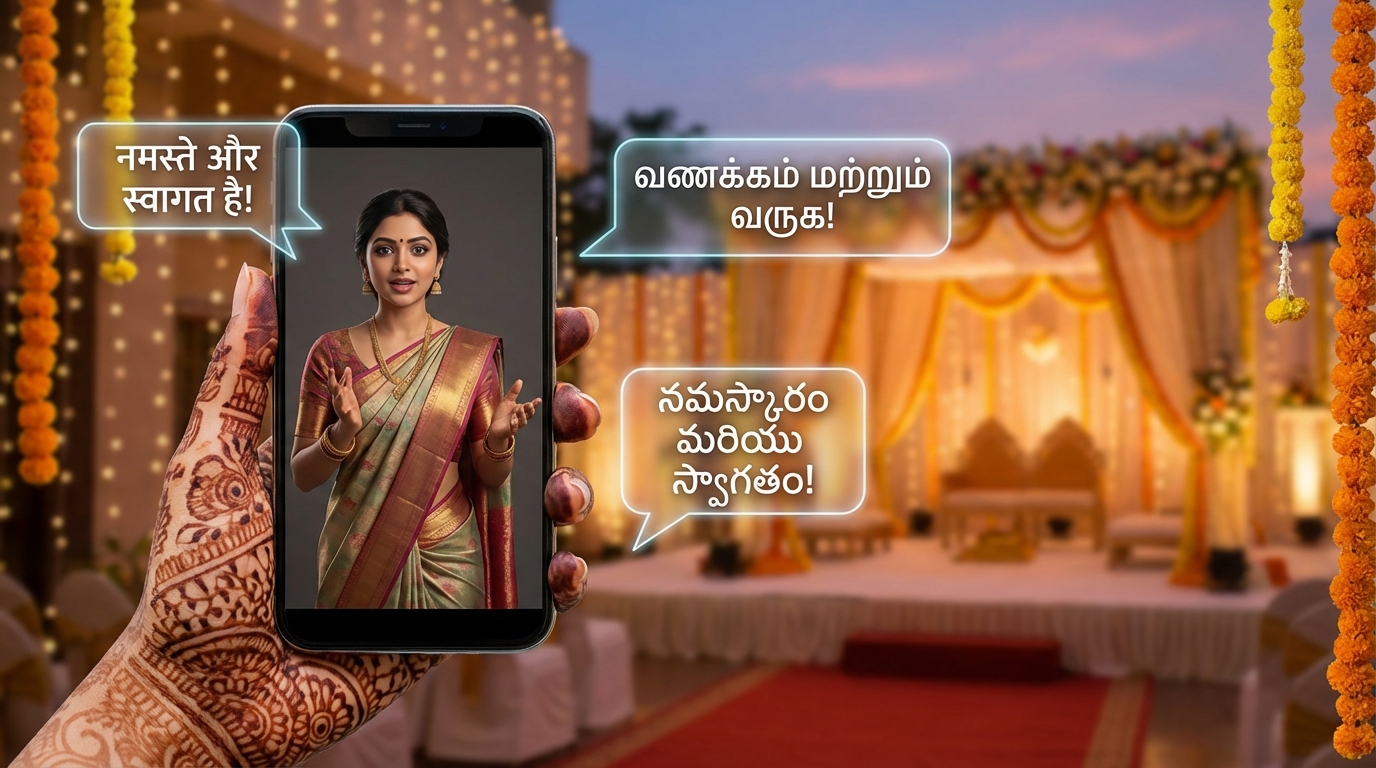
India’s linguistic diversity requires invitations that speak the guest's language. A generic English invite often fails to connect with elder family members in regional hubs. In 2026, the standard is “Hyper-Localization.” This involves:
- Scripting in Native Fonts: Using Devanagari, Tamil, Telugu, or Bengali scripts within the video overlays.
- Dialect-Specific Voiceovers: Moving beyond standard Hindi to include regional nuances like Rajasthani, Marathi, or Punjabi (see AI voice cloning for Indian accents).
- Perfect Lip-Sync: Ensuring that the AI avatar’s mouth movements match the regional phonemes perfectly, avoiding the “uncanny valley” effect (see emotion-aware avatar videos).
Studio by TrueFan AI's 175+ language support and AI avatars provide the technical foundation for this level of personalization. By using real influencers as AI avatars, the platform allows planners to choose a “face” that fits the family’s social standing or the wedding’s theme (see real-time interactive AI avatars in India).
Mapping Family Honorifics
One of the most significant content gaps in generic AI tools is the lack of “Family Role Mapping.” In 2026, advanced enterprise tools allow planners to map specific honorifics to guest segments. For example:
- To the Groom’s Uncle: “Pranam Chachu, Shreya aur Arjun ki shaadi mein aapka swagat hai.”
- To a Friend: “Hey [Name], can't wait to see you at the Sangeet!”
This level of detail ensures that the AI-generated video doesn't feel like a mass broadcast but like a one-on-one invitation.
Regional Motifs and Aesthetics
The visual language of the video must match the ritual. A Mehendi invitation might feature intricate henna patterns and pastel palettes, while a Sangeet video uses vibrant stage lighting and dhol-tasha soundtracks. In 2026, prompt-driven design—as highlighted by Media.io’s guide to AI wedding prompts—allows for the rapid generation of these ritual-specific backgrounds.
From Invites to Biodata: Core Use Cases for Event Businesses
The application of AI video in the Indian wedding ecosystem extends far beyond the initial “Save the Date.”
1. Wedding Invitation Video Generator AI (Hindi + Regional)
The core product is a 20–40 second video (9:16 ratio) optimized for WhatsApp Stories. It includes:
- Couple Reveal: High-quality imagery or AI avatars of the couple.
- Ritual Slate: Clear dates, times, and venues for Mehendi, Sangeet, and the Phere.
- Interactive Elements: QR codes for Google Maps locations and RSVP links.
2. Save the Date Video AI India
A shorter, 10–15 second “teaser” designed to lock the calendar months in advance. These videos focus on the couple's monogram and the city of the wedding, often using a minimalist, elegant aesthetic.
3. Shaadi Video Biodata Creator AI
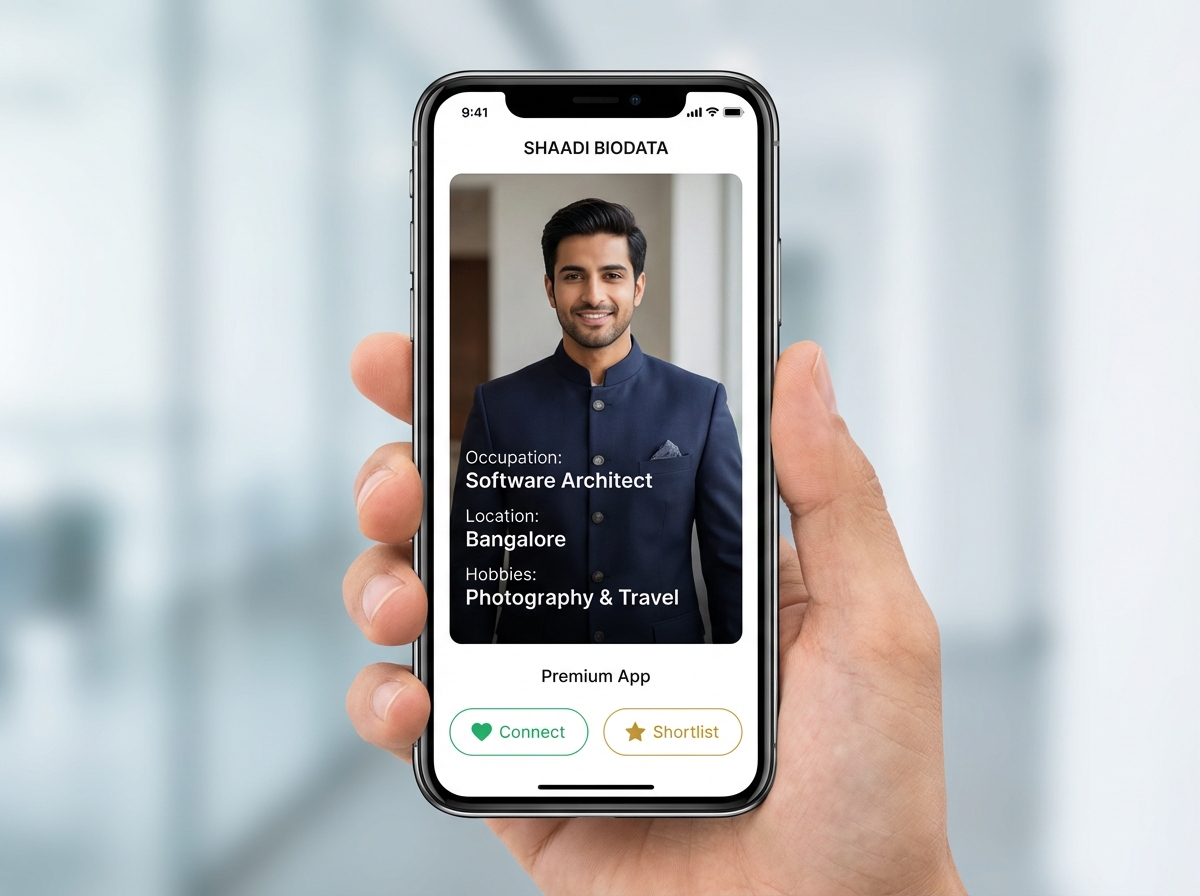
For marriage bureaus and matrimonial consultants, the “Video Biodata” is the new resume. Instead of a static PDF, bureaus are now generating 30–45 second narrative videos that highlight:
- Professional Background: Education and career achievements.
- Family Values: A brief introduction to the family's background and community.
- Interests: Personal hobbies and lifestyle preferences.
This format has seen a 40% increase in “interest clicks” on platforms like BharatMatrimony and Jeevansathi, as it provides a more holistic view of the candidate (see AI avatar wedding biodata in India).
4. Family Introduction Video Matrimonial AI
In arranged marriage contexts, the family's introduction is as important as the individual's. AI allows for the creation of montage videos where close family members (parents, siblings) are introduced with their respective roles and a warm greeting. This builds immediate trust and rapport between the two families.
5. Personalized Mehendi/Sangeet Videos AI
Planners use these to send “reminder” videos 24 hours before an event. They can include dress code reminders (e.g., “Wear Yellow for Haldi!”) and performer shoutouts, creating a sense of excitement and community among the guests.
Source: Tashography Blog on Indian Biodata Trends
Scaling the "Big Fat Indian Wedding": Enterprise Automation Workflows
For an agency handling 50 weddings a season, manual video creation is a bottleneck. The solution lies in a governed, automated pipeline.
The Data-to-Video Pipeline
- Data Ingestion: The planner uploads a CSV or syncs their CRM (like Wedd.ai) containing guest names, relations, and preferred languages.
- Template Selection: A “Ritual Pack” is selected, defining the music, visual motifs, and avatar spokesperson.
- Batch Rendering: The system generates hundreds of unique videos in parallel. In 2026, short clips can render in as little as 30 seconds, allowing for last-minute guest list additions (see fastest avatar video generator).
- Quality Assurance: AI-driven moderation filters check for script errors or profanity, while human planners can perform spot checks via a “Walled Garden” approval dashboard.
- Distribution: Integration with the WhatsApp Business API allows for automated delivery, tracking “delivered,” “read,” and “clicked” metrics.
Technical Superiority in 2026
Modern enterprise solutions must offer:
- API/Webhook Integration: To trigger video generation the moment a new lead enters a marriage bureau's database.
- Cloud-Agnostic GPU Backends: Ensuring 99.9% uptime during the frantic “Saaya” (auspicious) dates when thousands of planners are rendering simultaneously.
- HD/4K Default: As mobile screens improve, 720p is no longer acceptable for high-end clients.
Solutions like Studio by TrueFan AI demonstrate ROI through their ability to handle these massive seasonal spikes without compromising on the production-grade lip-sync and voice quality that luxury weddings demand.
The ROI of Innovation: AI vs. Traditional Videography
The transition to AI is driven by a simple mathematical reality: traditional methods cannot scale to the personalization demands of 2026.
| Feature | Traditional Videography | AI Video Automation (Enterprise) |
|---|---|---|
| Cost per Video | ₹5,000 - ₹15,000 (for variants) | ₹40 - ₹300 |
| Turnaround Time | 3–7 Days | < 5 Minutes |
| Personalization | Limited to “Couple Name” | Guest Name, Relation, Language, Ritual |
| Scalability | Max 5–10 variants | 10,000+ variants |
| Analytics | None | Watch time, Click-through, RSVP tracking |
Measurable Uplift
By using an Indian wedding video automation tool, bureaus and planners are seeing:
- 30% Increase in RSVP Speed: Guests respond faster to personalized video prompts.
- 50% Reduction in Logistics Queries: Clear, visual information about venues and dress codes reduces the volume of “Where is the hotel?” phone calls to the family.
- Higher Engagement for Bureaus: Video profiles are shared 3x more often than text-based biodata.
Source: Kaltura 2026 Marketing ROI Report
Privacy, Governance, and Brand Safety in 2026
As AI becomes more prevalent, the ethical handling of data—especially sensitive matrimonial biodata—is paramount.
1. Consent-First Models
In 2026, “Deepfake” concerns are addressed through strict consent protocols. Enterprise platforms ensure that any avatar used is either a fully licensed digital twin of a real influencer or a fictional character. For family-specific avatars, explicit “likeness consent” must be captured before rendering.
2. Data Security Standards
Marriage bureaus handle highly personal information, including age, income, and family background. It is critical to use platforms that are ISO 27001 and SOC 2 certified. This ensures that guest lists and biodata are encrypted and never used to train public AI models.
3. Content Moderation
Real-time profanity filters are essential to prevent the generation of inappropriate content. This is particularly important for public-facing marriage bureaus where users might attempt to bypass community guidelines (see real-time interactive AI avatars in India).
4. Rights-Managed Assets
Using “Bollywood” music without a license is a significant legal risk for event businesses. Enterprise AI tools provide libraries of “brand-safe,” rights-cleared music that mimics the energy of popular tracks without the copyright infringement risk.
Conclusion: The Future of the Indian Wedding Experience
The AI video wedding invitation India 2026 landscape is defined by the balance of scale and soul. By leveraging automation, planners and bureaus can move away from the administrative burden of logistics and focus on what truly matters: the celebration of union. As the ₹10 lakh crore wedding economy continues to grow, those who embrace enterprise AI will set the new standard for luxury, personalization, and cultural resonance in the digital age.
For more information on how to automate your wedding or matrimonial video workflows, visit Studio by TrueFan AI.
Frequently Asked Questions
How do I make a Hindi wedding card video maker flow quickly for a large guest list?
To scale quickly, use an enterprise dashboard. Upload your guest list as a CSV, select a “Hindi wedding card video maker” template, and map the “Guest Name” and “Relation” fields. The system will batch-render the videos, which you can then distribute via a WhatsApp API integration. Studio by TrueFan AI allows for this level of batch automation, ensuring you can generate 1,000+ personalized invites in under an hour.
What fields does a shaadi video biodata creator AI use to generate a profile?
A comprehensive video biodata typically uses fields such as Name, Age, Height, Education, Profession, City, and Family Background. You can also include “Partner Preferences” and “Interests.” The AI then weaves these into a narrative script, often in the candidate's mother tongue, to create a compelling 45-second reel.
Can I create Tamil or Telugu outputs with avatars that look culturally appropriate?
Yes. Modern platforms offer a library of diverse AI avatars representing different age groups and styles. You can select an avatar that fits the regional aesthetic and pair it with a Tamil or Telugu voice clone. Ensure your script uses localized greetings like “Vanakkam” or “Namaskaram” for maximum impact.
What is the best “Save the Date” video format for 2026?
The 9:16 vertical format is the gold standard for 2026. It should be 10–15 seconds long, featuring a high-impact visual of the couple or a monogram, the wedding date, and the city. Always include a clear call-to-action (CTA) like “Details to follow on WhatsApp” with a short RSVP link.
How do marriage bureaus automate family introduction videos without losing the “personal” feel?
Bureaus use “Template Mapping.” By creating a base script that leaves placeholders for the family member's name and their relation to the bride/groom, the AI can generate unique videos for each family. Using a warm, natural-sounding AI voice clone ensures the video feels like a genuine introduction rather than a robotic broadcast.
Is it possible to integrate these videos with my existing CRM?
Most enterprise-grade AI video tools offer Webhook and API support. This means when a client fills out a form on your website or a new match is made in your bureau's database, the video generation can be triggered automatically, sending the personalized invite or biodata directly to the user's WhatsApp (see two-way conversation AI video).



