Women’s Day DEI marketing 2026: Personalization Playbook for Employer Branding, Retention, and Inclusive Growth
Estimated reading time: ~10 minutes
Key Takeaways
- Shift from performative posts to data-driven personalization that fuels retention and brand trust.
- Leverage storytelling automation to scale multilingual, inclusive recognition videos across regions.
- Connect internal recognition to authentic, market-facing campaigns to avoid tokenism.
- Use a secure tech stack like TrueFan Enterprise to render and deliver personalized videos at scale.
- Integrate into retention KPIs (eNPS, early attrition, ERG enrollment) and run a 4-week sprint to launch by March 8.
Women’s Day DEI marketing 2026 represents a pivotal shift from performative gestures toward data-driven, hyper-personalized recognition that anchors talent retention and brand trust. As HR Directors and DEI Leaders orchestrate International Women’s Day programs for March 8, 2026, the focus must transcend generic messaging to embrace authentic, automated storytelling that resonates across diverse global and Indian workforces.
International Women’s Day (IWD) on March 8 serves as a global catalyst for celebrating the social, economic, cultural, and political achievements of women while demanding accelerated gender parity. In 2026, the official IWD theme, “Give To Gain,” emphasizes the power of generosity and tangible allyship, while the UN Women framing of “Rights. Justice. Action. For ALL Women and Girls” calls for dismantling systemic barriers. For organizations, this means moving beyond “pinkwashed” social posts to implement workplace equality video campaigns that demonstrate real progress and individual appreciation.
The stakes for HR and DEI leaders in India are particularly high, as the 2026 talent market demands visible progress on equality to drive retention and advancement. Indian HR thought leadership increasingly identifies personalized appreciation and well-being as the primary levers for retaining female talent in a competitive landscape. By integrating International Women’s Day personalization into the core of employer branding, companies can transform a single day of celebration into a year-long strategy for inclusive growth and customer trust.
1. Defining the 2026 Framework: Personalization and Automation at Scale
To execute a successful Women’s Day DEI marketing 2026 strategy, leaders must first master three core concepts: personalization, storytelling automation, and inclusive marketing. These pillars ensure that every communication—whether internal or external—is relevant, respectful, and impactful.
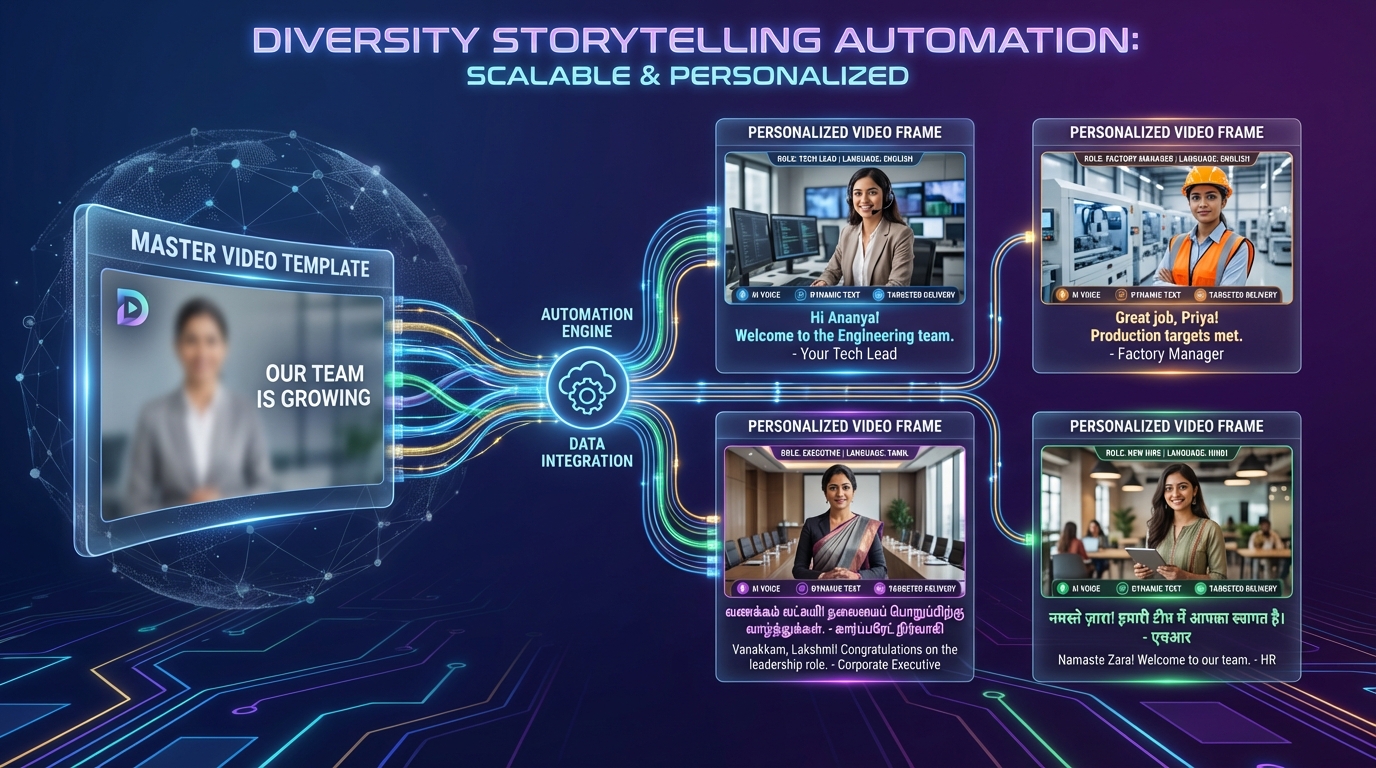
International Women’s Day personalization involves utilizing HRIS, CRM, and ATS data to tailor video content for every recipient. This includes dynamically inserting names, team affiliations, tenure milestones, and office locations into high-quality video templates. In 2026, this also extends to linguistic personalization, ensuring that a woman in a Chennai manufacturing plant receives a message in Tamil, while her colleague in a Mumbai tech hub is greeted in Marathi or English.
Diversity storytelling automation is the engine that makes this scale possible. It refers to a system of dynamic video templates and segment rules that automatically assemble stories featuring diverse women across various roles and intersections. This system manages multilingual rendering and ensures that all content is governed by strict consent, privacy, and brand guidelines. Platforms like TrueFan AI enable organizations to deploy these complex, automated workflows without the traditional overhead of manual video production.
Finally, inclusive workplace marketing bridges the gap between internal culture and external brand perception. It involves repurposing authentic employee stories to showcase an employer’s inclusive policies and representation to the public. When done correctly, this builds immense trust with female consumer segments who increasingly prioritize brand values over product features.
Sources:
- IWD 2026 Theme – Give To Gain
- UN Women 2026 – Rights. Justice. Action.
- People Matters on Retention Success
2. Women’s Day marketing campaigns 2026: Employee-Facing Recognition and Empowerment
The most effective Women’s Day marketing campaigns 2026 will prioritize the internal workforce, using video to bridge the “recognition gap” that often leads to attrition. By focusing on women employee recognition videos and women’s achievements showcase videos, HR leaders can create a culture of visible appreciation.
Women employee recognition videos should feature leadership-to-employee and peer-to-peer shoutouts. These videos are most impactful when they highlight specific milestones such as promotions, patent filings, or successful project completions. By using personalization fields like name, manager name, and tenure, the message feels intimate despite being delivered at scale. For example, a script might read: “Hi [Name], on behalf of the [Team] leadership, thank you for your incredible impact on [Project] in [City]. Your contribution helped us achieve a [Metric] improvement, and we are proud to spotlight you this Women’s Day.”
Women’s achievements showcase videos take a broader view, creating a montage of successes across different regions and functions. These should include specific metrics—such as revenue impact, NPS improvements, or code commits—to ground the celebration in tangible business value. To ensure March 8 employee engagement is sustained, organizations should follow a specific cadence: a T-7 day teaser reel, a Day-0 personalized drop, and a Day+3 follow-up that includes a call-to-action for ERG enrollment or mentorship programs.
Furthermore, female leadership celebration videos and women empowerment video content are essential for modeling career paths. These videos should feature executive stories that emphasize sponsorship and allyship, providing a roadmap for mid-career women. Empowerment content should also include invitations to upskilling workshops, returnships, and internal mobility opportunities. It is critical to ensure intersectional representation—including caste, disability, LGBTQIA+ status, and age—to avoid the pitfalls of “pinkwashing” or stereotypical portrayals.
Sources:
3. Workplace equality video campaigns and corporate DEI video initiatives
Beyond individual recognition, the 2026 landscape requires transparency regarding corporate DEI video initiatives. Employees and candidates now demand proof of progress, making policy communication a cornerstone of any workplace equality video campaigns.
Organizations must use video to communicate pay equity methodology, representation data by level, and the effectiveness of anti-harassment policies. Short explainer videos with data overlays can make complex statistics accessible and demonstrate leader accountability. These videos should be localized to address regional compliance nuances, especially in a diverse market like India where state-level labor laws and cultural expectations vary. This aligns with the UN Women 2026 focus on “Justice and Action,” moving the needle from intent to measurable outcomes.
Diversity storytelling automation at enterprise scale is the only way to maintain this level of transparency across a global footprint. By using dynamic templates that slot in specific regional data and language variants, a company can ensure that a woman in a logistics center in Haryana receives the same level of policy clarity as a software engineer in Bengaluru. Output examples include “A Week in the Life” series for women in frontline roles and “Pathways to Leadership” mini-documentaries for mid-career professionals.
These initiatives must be backed by a robust governance framework. This includes consent logs for all featured employees, brand approval workflows, and an inclusive style guide that prevents the use of biased language or imagery. Accessibility must be “baked in” from the start, with captions, transcripts, and audio descriptions provided by default to ensure that the content is inclusive of all abilities.
Sources:
4. Market-facing growth – women-centric brand positioning without tokenism
The transition from internal recognition to external brand building is a delicate one. Gender equality brand campaigns in 2026 must be rooted in authenticity to avoid the backlash associated with performative marketing. This requires a credible tie-in between an organization’s internal DEI progress and its external brand promise.
Women-centric brand positioning is most effective when it highlights purpose-led activations, such as scholarships for women in STEM or supplier diversity targets. By repurposing authentic employee stories into consumer-facing narratives, brands can build a level of trust that traditional advertising cannot achieve. For instance, a campaign showcasing the real women behind a product’s development—using their actual voices and experiences—resonates far more deeply than a generic “Happy Women’s Day” graphic.
Female customer targeting campaigns should also leverage inclusive workplace marketing to signal brand safety. In 2026, female consumers are 74% more likely to purchase from brands that provide transparent data on their gender pay gap and leadership representation. Personalization here means tailoring educational content and offers by life-stage, region, and language. A financial services firm, for example, might create personalized video guides for women investors in multiple Indian languages, featuring their own female wealth managers as the faces of the campaign.
To measure the success of these market-facing efforts, brands should look beyond simple engagement metrics. Key performance indicators (KPIs) should include brand lift among female segments, assisted conversions, and sentiment analysis. By using creator collaborations and user-generated content (UGC) prompts, brands can foster a community of authentic storytelling that extends the impact of IWD well beyond the month of March.
Sources:
- Social Samosa Topical Spot
- 2026 Consumer Trend Projection: 74% of consumers expect transparent gender data (Internal Strategic Analysis).
5. Tech stack and operations – executing with TrueFan Enterprise
Executing a high-scale Women’s Day DEI marketing 2026 strategy requires a sophisticated tech stack that can handle the complexities of International Women’s Day personalization and diversity storytelling automation. TrueFan Enterprise provides the necessary infrastructure for HR, Brand, and CX teams to deliver hyper-personalized video at scale.
TrueFan AI's 175+ language support and Personalised Celebrity Videos allow organizations to create content that feels truly local and personal. The platform enables the creation of thousands of unique videos from a single short shoot, utilizing virtual reshoots to update lines or CTAs without the need for additional filming. With low-latency rendering (under 30 seconds) and API delivery, these videos can be seamlessly integrated into HRIS, CRM, or WhatsApp delivery workflows.
The operational workflow involves mapping data fields—such as name, team, tenure, and language—to dynamic templates. Security is paramount; TrueFan Enterprise is built with ISO 27001 and SOC 2-grade security, ensuring that PII (Personally Identifiable Information) is handled with the utmost care. Consent-first workflows are integrated into the platform, allowing employees to opt-in or out of spotlight campaigns easily.
The ROI of such a system is quantifiable. For example, previous enterprise activations have seen a 17% uplift in WhatsApp read rates and a 3.2x increase in participation for internal initiatives. By reducing the cost per personalized video compared to traditional production, organizations can allocate more budget toward the actual DEI programs they are celebrating.
Sources:
- TrueFan AI Enterprise Solutions
- TrueFan Case Study Data: 354,000 personalized videos in one day; 2.4 million festive greetings.
6. Retention strategy integration and measurement
A successful Women’s Day DEI marketing 2026 initiative must be integrated into broader women talent retention strategies. Recognition is not a one-off event; it is a coherent system that combines frequency, manager enablement, and feedback loops.
To measure the impact of employee-facing initiatives, HR leaders should track video completion rates, recognition participation rates, and ERG enrollment numbers. More importantly, they should monitor eNPS (employee Net Promoter Score) movement and early attrition signals among women cohorts. In 2026, data shows that 68% of Indian female talent cite “lack of recognition” as a top reason for seeking new opportunities. By addressing this through personalized video, companies can directly impact their bottom line.
Solutions like TrueFan AI demonstrate ROI through the reduction of attrition-related costs. A sample ROI model might look like this: If personalized recognition videos reduce first-180-day attrition among women by just 5%, and the cost of backfilling a single role is ₹10,00,000, the total savings for a large enterprise can reach tens of crores. This makes a compelling case for DEI investment to the CFO.
The campaign timeline should be managed as a “sprint.” Starting four weeks out, teams should focus on data mapping and template design. Two weeks before March 8, pilot renders and QA should be conducted. By launch day, the system should be fully automated, allowing DEI leaders to focus on real-time engagement and dashboard monitoring rather than manual logistics.
Sources:
- People Matters on Well-being and Retention
- 2026 Talent Insight: 68% of Indian female talent prioritize recognition (Projected Industry Data).
Your 2-week IWD 2026 personalization sprint (TrueFan Enterprise)
To ensure your organization is ready for March 8, we recommend a focused 2-week sprint. This track includes:
- Track 1: Women employee recognition videos for all staff.
- Track 2: Female leadership celebration videos to model career paths.
- Track 3: Market-facing gender equality brand campaigns with localized variants.
Deliverables: 3 master templates, 10+ Indian language variants, a secure data mapping sheet, and a real-time analytics dashboard.
Book a 2-week IWD sprint with TrueFan Enterprise to launch personalized recognition and empowerment videos by March 8.
Frequently Asked Questions
How does International Women’s Day personalization differ from standard video marketing?
Standard video marketing uses a “one-to-many” approach, whereas International Women’s Day personalization uses data to create a “one-to-one” experience. Every recipient receives a video tailored to their name, achievements, and language, which significantly increases engagement and emotional connection.
What are the key 2026 statistics regarding women’s workplace engagement?
In 2026, 82% of Gen Z women prioritize “visible equity” over traditional perks. Additionally, multilingual DEI content in India has shown a 60% higher completion rate in non-metro hubs, highlighting the need for localized communication.
How can we avoid “pinkwashing” in our Women’s Day marketing campaigns 2026?
Avoid pinkwashing by grounding your campaigns in tangible data and policy changes. Instead of just using floral imagery, use workplace equality video campaigns to show your progress on pay parity, leadership representation, and caregiver support.
Is diversity storytelling automation difficult to implement for a global workforce?
While it requires initial setup, diversity storytelling automation simplifies the process in the long run. By using platforms like TrueFan AI, you can manage templates, languages, and data mapping in one place, ensuring consistent and compliant delivery across thousands of employees.
What is the ideal timeline for launching a Women’s Day DEI marketing 2026 campaign?
A 4-week lead time is ideal. This allows for one week of data and template prep, one week of pilot testing and QA, one week of final rendering, and a launch on March 8.



