Summer appliance urgency marketing 2026: Weather-triggered AC and cooler conversions with EMI and instant cooling solutions
Estimated reading time: ~13 minutes
Key Takeaways
- Activate weather-triggered campaigns using live and forecast signals to convert heat spikes into sales.
- Leverage BEE 2026 norms and price hikes to create “buy-now” urgency with pre-summer automation.
- Win Tier-2/3 markets with vernacular creative and frictionless EMI financing education.
- Use weather-responsive shoppable videos that update overlays for temp, stock, and local offers in real time.
- Align marketing with ops via SLA-aware orchestration and predictive inventory to avoid over-promising.
In the high-stakes landscape of summer appliance urgency marketing 2026, Indian retailers can turn a rising heat index into instant conversions using temperature-based marketing automation, regional heat wave targeting, and shoppable, weather-responsive commerce videos. As the Indian subcontinent prepares for what meteorologists predict to be one of the most intense cooling seasons on record, the ability to synchronize marketing spend with real-time atmospheric conditions is no longer a luxury—it is a survival mandate for Consumer Durables brands.
The 2026 summer season represents a critical inflection point for the industry. With the India home appliances market projected to reach USD 54.60 billion this year, the competition for the "first-time cooler buyer" and the "premium AC upgrader" has reached a fever pitch. Marketers must now navigate a complex web of stricter energy norms, shifting consumer credit behaviors in Tier-2 cities, and a demand for instant cooling solutions that can be fulfilled within hours, not days. This playbook outlines the strategic framework for dominating the 2026 summer market by leveraging data-driven urgency and hyper-localized creative execution.
Market Dynamics: Why Urgency Will Peak in India Summer 2026
The Indian appliance sector is undergoing a structural transformation driven by both climate realities and regulatory shifts. According to recent industry forecasts, the market is set to grow at a CAGR of 5.65%, reaching over USD 71.85 billion by 2031. This growth is underpinned by a massive "penetration headroom," particularly in the air conditioning segment, where household penetration still hovers between 10% and 20%. For CMOs, this represents a vast untapped audience that is highly sensitive to temperature spikes and price fluctuations.
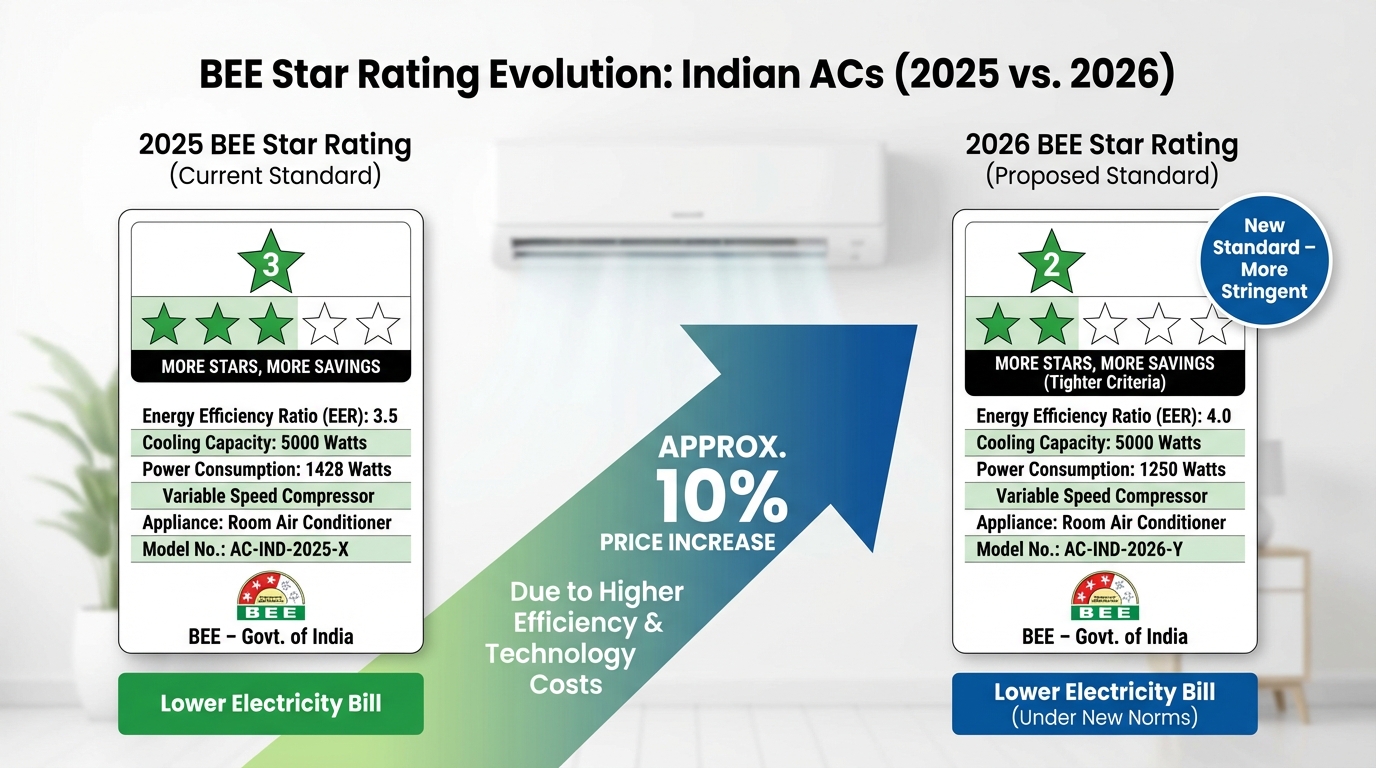
A significant catalyst for urgency in 2026 is the implementation of stricter Bureau of Energy Efficiency (BEE) star-rating norms, which became effective on January 1, 2026. These new standards are expected to push AC prices up by approximately 10% and refrigerators by 5%. Smart marketers are using this regulatory shift to drive pre-summer sale automation, encouraging consumers to "beat the price hike" by investing in energy-efficient appliance videos and products before the peak heat sets in. This "buy now or pay more later" narrative is a powerful psychological lever in a price-conscious market like India.
Furthermore, the trend of premiumization continues to reshape the category. Consumers are no longer just looking for "a cooling machine"; they are seeking smart, climate-adaptive product marketing that highlights features like air purification, dehumidification for coastal regions, and AI-driven energy savings. As policy stability sustains growth, the focus has shifted toward Tier-2 and Tier-3 cities, where rising disposable incomes and the normalization of EMI culture are powering aspirational purchases.
Sources:
- India Home Appliances Market Size & Share - Mordor Intelligence
- Premiumisation and Smart Products to Drive Appliances in 2026 - ET BrandEquity
- BEE New Star Ratings to Push AC Prices Up - Business Standard
- Godrej Builds Growth on Premiumisation - BestMediaInfo
The Blueprint for Temperature-Based Marketing Automation
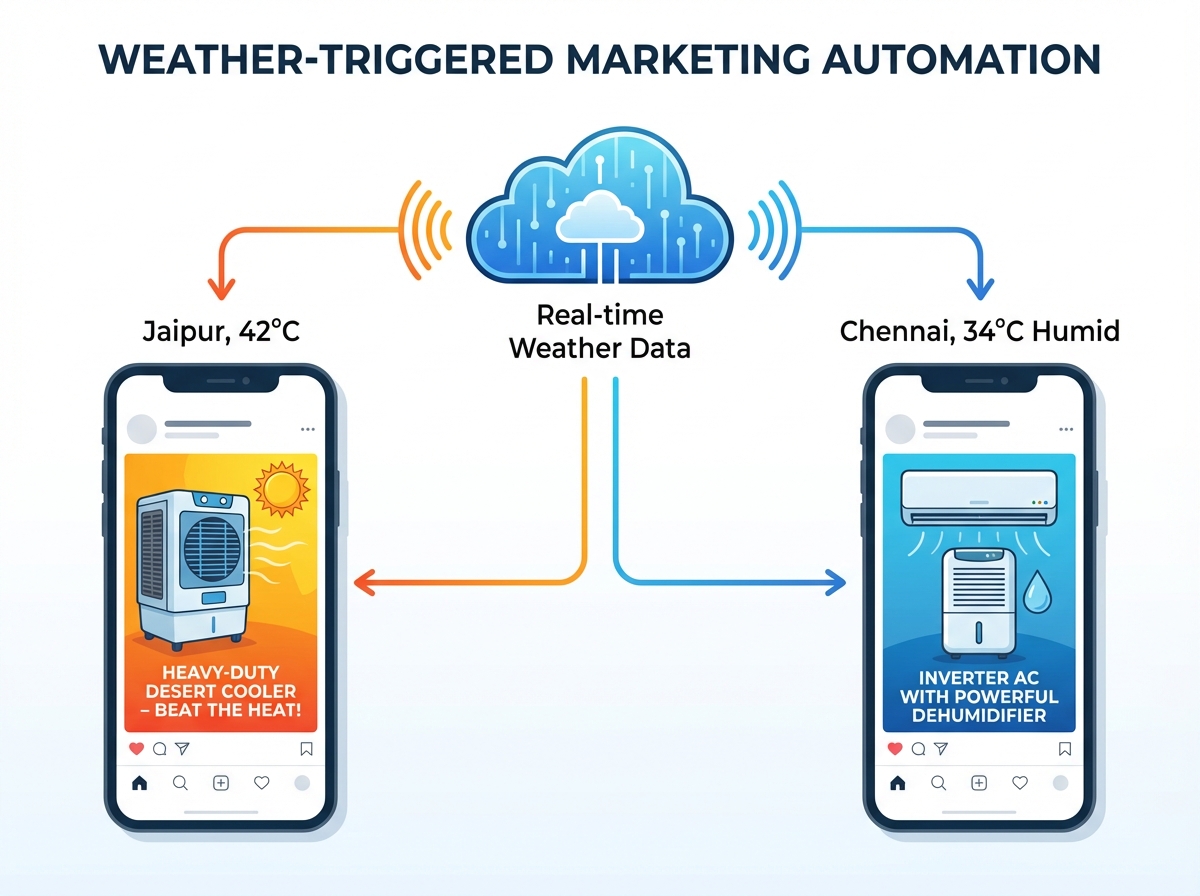
To capture the fleeting windows of high intent during a heatwave, brands must move beyond static seasonal campaigns. Temperature-based marketing automation is the process of using real-time and forecasted weather signals—such as the heat index, wet-bulb temperature, and multi-day heat streaks—to auto-trigger contextually relevant media and offers. This ensures that a consumer in a 42°C Jaipur suburb sees a different ad than a consumer in a humid 34°C Chennai neighborhood.
Weather prediction commerce takes this a step further by integrating IMD (India Meteorological Department) 5-to-10-day outlooks into the commerce orchestration layer. By predicting when a heatwave will hit a specific sub-division, brands can pre-position inventory, pre-approve EMI limits for local customers, and schedule content drops that land exactly when the discomfort begins. This proactive approach transforms marketing from a reactive expense into a predictive revenue driver.
Platforms like TrueFan AI enable brands to synchronize creative assets with real-time meteorological shifts, allowing for the rapid generation of video content that reflects current local temperatures. For instance, a trigger can be set where if the temperature in a specific pin code exceeds 38°C for two consecutive days, the system automatically launches an "Instant Cooling Solutions" campaign featuring desert coolers and portable ACs. If the heat index crosses 45°C, the messaging shifts to high-tonnage inverter ACs with "No-Cost EMI" to alleviate the financial burden of an emergency purchase.
Sources:
Regional Heat Wave Targeting: Pin-Code Activation and Vernacular Scale
India is not a monolithic market; it is a collection of distinct climatic zones, each requiring a unique regional heat wave targeting strategy. The arid North-West requires messaging around high-airflow desert coolers that can withstand dry heat, while the humid coastal regions demand inverter ACs with superior dehumidification capabilities. In 2026, the battle for market share will be won in the Tier-2 and Tier-3 cities, such as Lucknow, Coimbatore, and Bhopal, where demand growth is outstripping metros.
To effectively reach these markets, vernacular-first creative is essential. Consumers in these regions respond more favorably to content in their native tongue, which builds trust and reduces the cognitive load of understanding complex technical specifications or EMI terms. TrueFan AI's 175+ language support and Personalised Celebrity Videos allow for hyper-local resonance in Tier-2 markets, enabling brands to deliver messages that feel personal and culturally relevant.
Financing acts as the ultimate friction remover in these emerging markets. With the entry of new players like Poonawalla Fincorp into the consumer durables loan market, and the general normalization of EMI behavior, aspirational buys are becoming more accessible. A successful regional strategy must include "how EMI works" micro-videos and instant eligibility checks embedded directly within the marketing collateral. By addressing the "affordability gap" in the local language, brands can convert high-intent browsers into confirmed buyers during peak heat alerts.
Sources:
- Why Tier-2 and Tier-3 Cities are Driving Tech Sales - ET Retail
- Poonawalla Fincorp Enters Consumer Durables Market - Economic Times
- India’s Growing Love for EMI - GoKiwi
Creative Excellence: Weather-Responsive Commerce Videos
In 2026, the standard for engagement is weather-responsive commerce videos. These are shoppable, data-driven videos that automatically update their overlays based on live weather and inventory feeds. Imagine a video ad that displays the viewer's current city name, the exact temperature outside, and a real-time "In Stock" badge for the nearest retail outlet. This level of AC cooler personalization campaigns creates an undeniable sense of urgency and relevance that static banners cannot match.
Beyond just cooling appliances, smart marketers are exploring cross-category attach strategies. For example, beverage cooling campaigns can be triggered alongside AC ads, offering "Chill in 15 minutes" timers or combo discounts on mini-fridges and soft drinks during weekend heat spikes. Similarly, summer fashion video marketing can highlight breathable fabrics and UV-protection gear as add-ons, acquiring households at a lower CAC through lifestyle content before retargeting them with high-value cooling SKUs.
Energy-efficient appliance videos are also crucial for addressing the long-term concerns of the 2026 consumer. With rising electricity tariffs and the new BEE norms, scripts should focus on "Total Cost of Ownership." Highlighting how a 5-star inverter AC can save a specific number of units per month based on local power rates provides a rational justification for a premium purchase. These videos should serve as both an educational tool and a conversion engine, bridging the gap between "I need to stay cool" and "I need to stay within my budget."
Sources:
- Home Appliances Outlook 2026 Asia-Pacific - NielsenIQ
- BEE Star Rating System Explained - Croma Unboxed
Operational Orchestration and Seasonal Inventory Optimization
The success of summer appliance urgency marketing 2026 depends heavily on the backend integration of marketing and operations. Seasonal inventory optimization is the process of aligning SKU-level demand forecasts with weather outlooks and service capacity. If the IMD predicts a severe heatwave in Central India, the marketing engine should automatically prioritize those regions while the logistics team forward-positions stock in local warehouses.
A critical component of this orchestration is the management of Service Level Agreements (SLAs). During a heatwave, a "24-hour installation guarantee" is a more powerful conversion tool than a 10% discount. However, over-promising can lead to brand erosion. Marketing systems must ingest real-time installer bandwidth data; if slots in a particular city are full, the creative should automatically swap from "Install Tomorrow" to "Book Your Slot Now" or shift focus to "Instant Cooling Solutions" like plug-and-play fans and coolers that don't require professional installation.
Solutions like TrueFan AI demonstrate ROI through increased click-through rates and reduced customer acquisition costs during peak heatwaves by ensuring that the creative is always aligned with both the weather and the operational reality. By using dynamic video overlays to show real-time delivery ETAs and EMI opt-in rates, brands can maintain transparency with the consumer while maximizing the conversion potential of every heat-triggered impression. This closed-loop system ensures that marketing spend is never wasted on out-of-stock items or unserviceable regions.
Sources:
- Union Budget 2026: HVAC AI Adoption and Energy Efficiency - Thermal Control Magazine
- Deadlines for Stricter AC Energy Efficiency Standards - LegalitySimplified
Implementation Playbook: A Step-by-Step Guide for 2026
To operationalize this strategy, brands should follow a structured implementation roadmap that begins well before the first heatwave of 2026.
- Data Wiring and Trigger Mapping: Connect your marketing stack to a reliable weather API and the IMD's advisory feed. Define your trigger thresholds: for example, a "Heatwave Watch" (48-72 hours out) triggers pre-summer sale automation, while a "Heatwave Warning" (active) triggers "Cool Now, Pay Later" creatives. Map every pin code in India to its corresponding IMD sub-division.
- Audience Schema Development: Segment your database into first-time buyers (focus on coolers and entry-level ACs), upgraders (focus on 5-star inverter ACs), and EMI-reliant cohorts. Use CDP data to identify which customers are in high-heat zones and have a history of seasonal purchases.
- Creative Library Construction: Develop a modular creative library with at least 10 video templates. These should cover various product categories (ACs, coolers, fans) and be available in at least 6 major Indian languages. Ensure that overlays for temperature, city name, and EMI offers are dynamic and can be updated in real-time.
- Channel and Measurement Plan: Deploy a multi-channel strategy that includes search with weather modifiers, social media with auto-swaps, and WhatsApp broadcasts for direct-to-consumer engagement. Track KPIs such as the EMI opt-in rate, regional sell-through, and the percentage of installations completed within the promised SLA.
By following this blueprint, retailers can transform the annual summer surge from a chaotic period of reactive selling into a precision-engineered campaign that maximizes both volume and margin. The integration of weather prediction commerce with hyper-personalized creative is the definitive strategy for winning the 2026 cooling season.
Recommended Internal Links
Frequently Asked Questions
How does temperature-based marketing automation differ from standard seasonal ads?
Standard ads are scheduled based on the calendar (e.g., "April is Summer"). Temperature-based automation uses real-time data to launch ads only when specific weather thresholds are met in specific locations. This ensures that your budget is spent when the consumer's "thirst" for cooling is at its peak, leading to significantly higher conversion rates.
What are the most effective triggers for AC cooler personalization campaigns?
The most effective triggers include a combination of current temperature (≥38°C), the heat index (how it actually feels), and multi-day streaks (3+ days of high heat). Night-time temperatures are also a missed opportunity; if the minimum temperature stays above 28°C, sleep discomfort peaks, making it the perfect time to trigger ads for "Silent Sleep Mode" inverter ACs.
How do the BEE 2026 norms impact summer appliance urgency marketing 2026?
The BEE 2026 norms introduce stricter energy efficiency standards, which typically lead to a 5-10% price increase. Marketers can use this as a "regulatory urgency" lever in February and March, encouraging consumers to buy existing stock at lower prices before the new, more expensive models become the market standard.
Can weather-responsive commerce videos be used for small appliances?
Absolutely. In fact, instant cooling solutions like table fans, mist fans, and even beverage coolers are perfect for quick-commerce and impulse buys during sudden heat spikes. Weather-responsive videos can show "Delivery in 30 minutes" badges, which are incredibly effective for low-ticket items when the temperature suddenly jumps.
How does TrueFan AI handle high-volume video rendering during sudden heat spikes?
TrueFan AI is built on an enterprise-grade infrastructure designed for massive scale. During a nationwide heatwave, the platform can render thousands of personalized, weather-triggered videos in seconds. This allows brands to maintain a real-time presence across millions of unique consumer touchpoints without any latency in the creative delivery.
What is the role of EMI in Tier-2 city summer offers?
EMI is the primary driver of "aspiration" in Tier-2 and Tier-3 cities. For many households, an AC is a significant capital expense. By offering "No-Cost EMI" and "Zero Down Payment" through weather-triggered ads, you remove the immediate financial barrier, allowing the consumer to prioritize their comfort during a heatwave.
How can brands avoid over-promising on installation times during peak demand?
The key is integrating your marketing triggers with your service/logistics dashboard. If your local installation team is overbooked, the automation system should automatically update the video overlays and ad copy to reflect a more realistic timeline or shift the focus to products that don't require professional installation, such as air coolers.