Summer appliance urgency marketing 2026: Weather-triggered, video-first playbooks for India’s heatwaves
Estimated reading time: ~11 minutes
Key Takeaways
- Activate weather-triggered automation using IMD data to time offers across temperature bands for maximum conversion.
- Use geo-personalized commerce videos with live stock, delivery ETAs, and BEE ratings to drive “relief-now” actions.
- Prioritize Tier-2 city journeys with COD, EMI, vernacular creatives, and WhatsApp-led bookings.
- Build inventory-aware creatives that auto-swap SKUs and update SLAs to prevent waste and frustration during stockouts.
- Ensure governance and compliance on BEE claims and consent-led personalization; measure lift vs. always-on baselines.
Summer appliance urgency marketing 2026 is no longer a seasonal luxury; it is a high-velocity operational mandate defined by the Indian Meteorological Department’s (IMD) daily heat bulletins and the rapid digital evolution of Tier-2+ markets. As the Indian home appliances market scales toward a projected USD 54.6 billion in 2026, the window for capturing consumer intent has collapsed from days to mere hours. Marketers must now navigate stricter BEE energy-efficiency norms and a consumer base that prioritizes instant relief over long-term deliberation.
In this landscape, “temperature anxiety” serves as the primary psychological driver for conversion. This phenomenon describes the rapid, situational spike in purchase intent triggered by local UV indices and heat health warnings. When the mercury climbs, shoppers demand immediate cooling solutions, energy-efficient performance, and same-day delivery. To win, brands must deploy a playbook that is hyper-local, time-bound, and powered by climate-adaptive product marketing.
This comprehensive guide outlines the strategic framework for executing weather-responsive commerce videos and automated triggers that turn heatwaves into high-margin growth opportunities. Explore our climate-adaptive marketing guide for India 2026. By aligning creative assets with real-time weather data and inventory availability, enterprise brands can achieve unprecedented relevance in a crowded marketplace.
1. The temperature-anxiety curve: Why heat wave triggered offers India convert
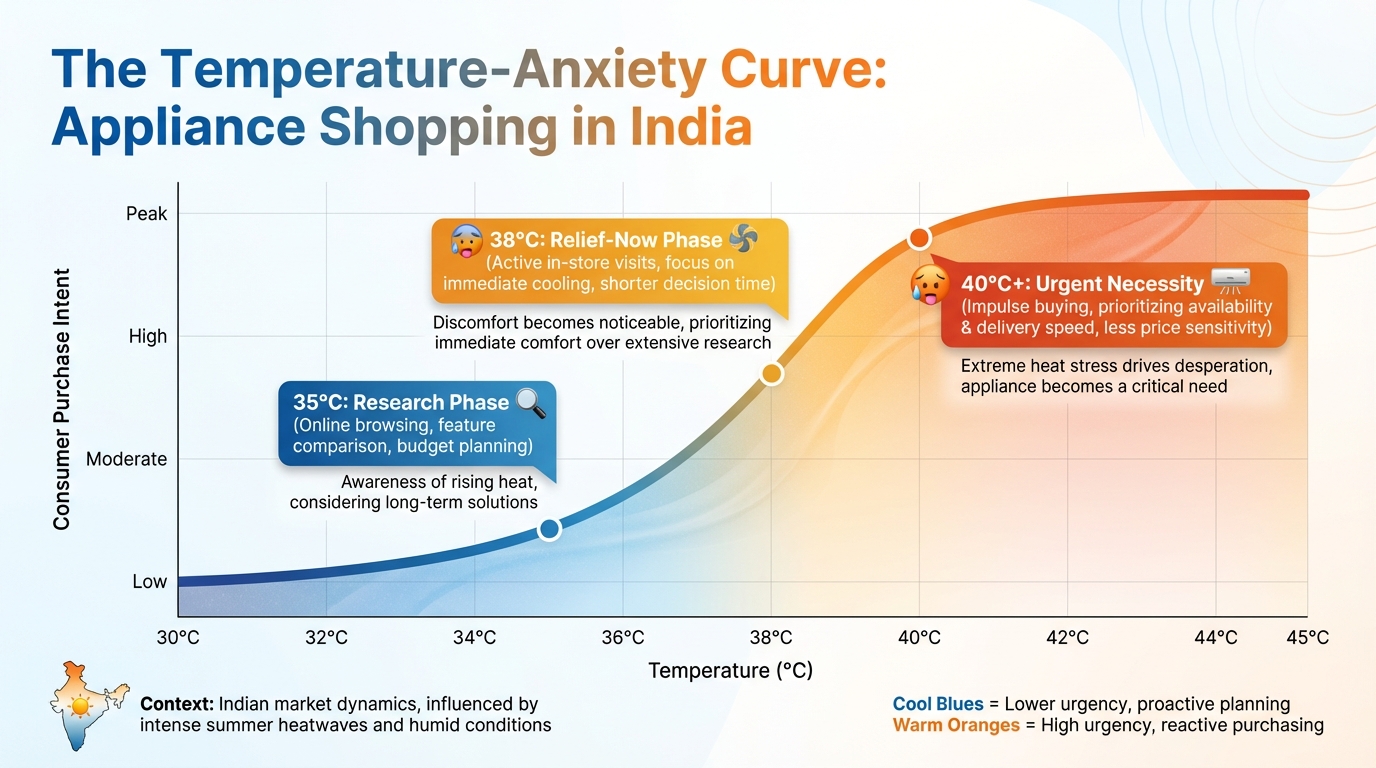
The correlation between ambient temperature and consumer spending in the appliance sector is nonlinear. Data indicates that conversion rates and Average Order Value (AOV) begin to rise sharply once local maximum temperatures cross the 35–37°C threshold. This is the “research and compare” phase, where heat wave triggered offers India should focus on pre-summer sale automation and 5-star energy savings narratives.
As temperatures escalate into the 38–40°C band, the consumer mindset shifts from comparison to “relief-now.” At this stage, messaging must pivot toward rapid delivery, flexible EMI options, and guaranteed installation windows. The urgency peaks at 40°C+, where health advisories and increased indoor time make cooling a necessity rather than a comfort. Here, instant cooling solutions bundles—pairing ACs with stabilizers or water purifiers—see the highest traction.
To capitalize on these shifts, marketers must utilize IMD sub-division warnings and extended forecasts to pre-signal creatives 48–72 hours ahead of predicted spikes. By anticipating the heat, brands can secure the “first-mover” advantage in the consumer’s mind before the local grid becomes overwhelmed. This proactive approach ensures that the brand is seen as a partner in heat management rather than just a vendor.
Sources:
- IMD Daily Heatwave Guidance
- India Home Appliances Market Forecast – Mordor Intelligence
- IMD Sub-division Warnings
2. Automation blueprint: Temperature-based marketing automation system design
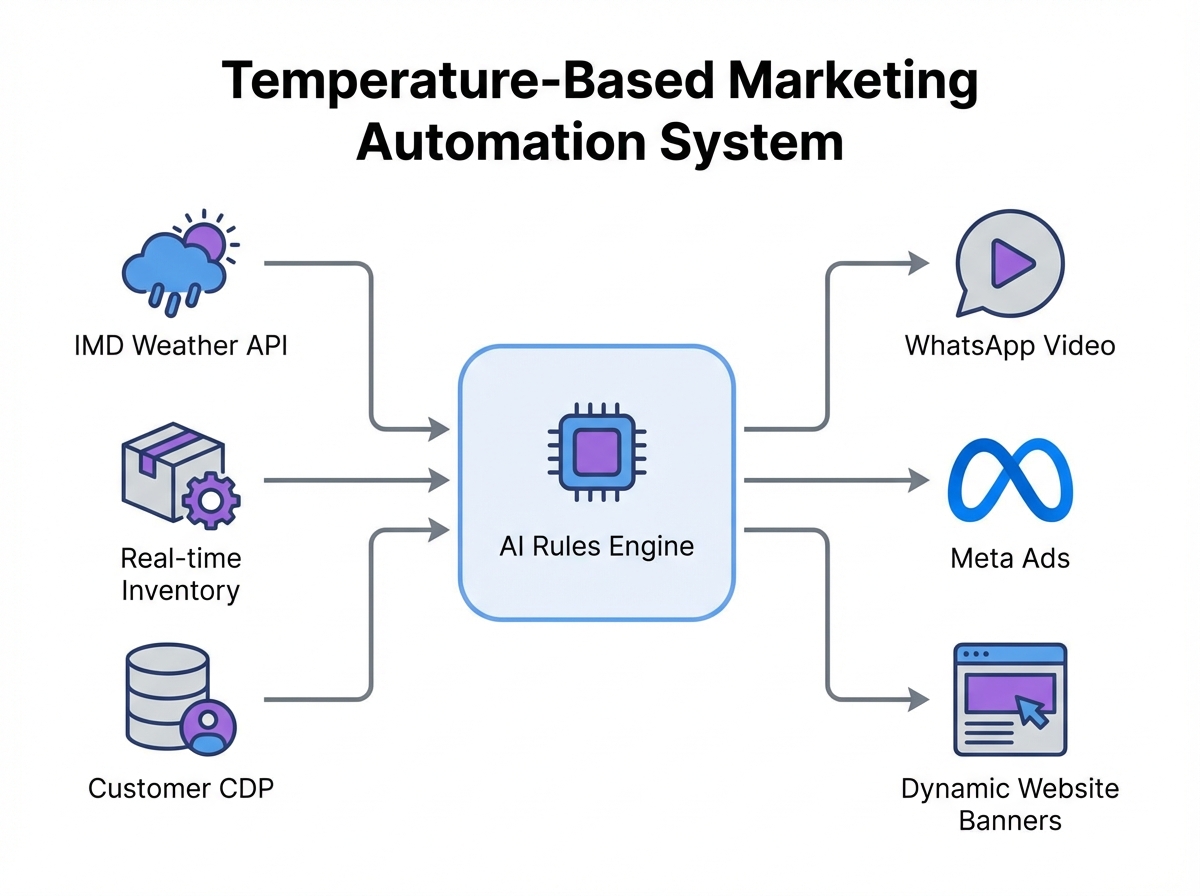
A robust temperature-based marketing automation system functions as a rules engine that ingests IMD APIs, first-party CDP data, and real-time product catalogs. This engine auto-orchestrates channel messages and video variants based on specific location and temperature triggers. The goal is to eliminate manual intervention, allowing the brand to respond to a heatwave in one city while suppressing ads in another experiencing unseasonal rain.
The trigger schema should be categorized into distinct bands. Band A (35–37°C) triggers highlight BEE 5-star efficiency and nudge consumers toward “booking an installation slot” to avoid the peak-season rush. Band B (38–40°C) automatically swaps creatives to emphasize “delivery within 24 hours” and integrates live EMI calculators directly into the video canvas. Band C (40°C+) focuses on priority delivery and heat-safety overlays, often mentioning official IMD advisories to build trust.
Channel orchestration is critical for the success of regional heat wave targeting. Performance ads on Meta and YouTube should be synchronized with dynamic site banners and WhatsApp personalized video links. See our WhatsApp Business commerce automation 2026 guide. This multi-touchpoint approach ensures that the message follows the consumer from their morning weather check to their evening social media browsing. Platforms like TrueFan AI enable brands to automate this creative generation at a scale that was previously impossible.
Sources:
3. Creative engine: Weather-responsive commerce videos that convert
The modern consumer expects more than a static banner; they require weather-responsive commerce videos that reflect their immediate environment. These auto-generated, geo-personalized videos feature dynamic overlays such as local temperature badges, city names, real-time stock levels, and delivery ETAs. By showing a consumer in Jaipur that a specific 5-star AC is “In Stock at Malviya Nagar” while the temperature is 42°C, the brand bridges the gap between digital discovery and physical fulfillment.
For energy-efficient appliance videos, the script must quantify the value proposition. Instead of generic “save energy” claims, 2026 creative strategies focus on the monthly rupee delta between 3-star and 5-star models. Explaining inverter technology and decibel levels for bedroom use helps justify the premium price points associated with the 2026 smart-product tilt. These videos serve as both a sales tool and an educational resource, aligning with stricter BEE norms.
In AC cooler personalization campaigns, the creative must adapt to the climate zone. For hot-dry zones like Rajasthan, videos should highlight desert coolers with high CFM and honeycomb pads. Conversely, for hot-humid zones like Mumbai or Chennai, the focus shifts to inverter split ACs with advanced dehumidification. TrueFan AI’s 175+ language support via our regional language video SEO playbook and Personalised Celebrity Videos allow these messages to be delivered in the local dialect, significantly boosting trust and engagement in diverse Indian markets.
Sources:
4. Expansion plays: Tier-2 city summer offers and cross-category synergy
The growth of India’s e-commerce sector in 2026 is heavily driven by Tier-2 and Tier-3 cities. Consequently, tier-2 city summer offers must be tailored to local nuances, emphasizing Cash on Delivery (COD), easy EMI, and store-pickup promises. Vernacular creatives that highlight the proximity of service centers and WhatsApp-based booking systems are essential for converting first-time digital buyers in these regions. Learn more in our Tier-2 festival commerce automation guide.
Beyond cooling appliances, beverage cooling campaigns offer a significant secondary growth lever. Refrigerator marketing should pivot to “fast-cool” modes and mini-fridges for the growing PG and hostel clusters in education hubs. Combo deals—such as a beverage subscription paired with a high-efficiency cooler—can increase the basket size during peak heat months. This cross-category approach ensures that the brand captures multiple touchpoints of the consumer’s summer lifestyle.
Furthermore, summer fashion video marketing can be integrated into the broader cooling ecosystem. By pairing breathable fabrics and UV-protected apparel with climate-adaptive product marketing for ACs, brands can create a holistic “summer survival” narrative. Geo-personalizing UV index badges on fashion ads alongside cooling appliance offers creates a synergistic effect, positioning the brand as the ultimate destination for summer comfort.
Sources:
5. Commerce ops: Pre-summer sale automation and inventory optimization
Success in summer appliance urgency marketing 2026 requires a seamless integration between marketing and operations. Pre-summer sale automation should begin 6–8 weeks before the peak, focusing on exchange programs, old AC buybacks, and installation pre-booking. This phase builds a custom audience of high-intent viewers who can be retargeted with high-urgency offers once the first heatwave hits.
Seasonal inventory optimization is the backbone of this strategy. Live product feeds must be used to automatically suppress out-of-stock SKUs and promote available substitutes. If a specific 1.5-ton inverter AC is sold out in Delhi, the system should automatically pivot the creative to a 2-ton model or a high-end air cooler that is currently in stock. This prevents wasted ad spend and consumer frustration, ensuring that every click has a path to purchase. Use our quick commerce festival marketing 2026 guide.
For instant cooling solutions, delivery SLA logic must be integrated into the creative. Banners and videos should dynamically update to show “Delivery in 4 hours” or “Installation by tomorrow morning” based on the consumer’s pin code and the current load on the service network. Rerouting demand regionally based on temperature bands and inventory levels allows brands to maintain high service standards even during the most intense heatwaves. See how to orchestrate quick commerce for peak heat.
Sources:
- India Home Appliances Market Outlook – Insight Pro Analytics
- Electronics Battleground: Reliance, Samsung, LG – Economic Times
6. Measurement, Governance, and TrueFan AI Integration
To validate the effectiveness of climate-adaptive strategies, brands must track KPIs beyond traditional ROAS. Key metrics include view-through-to-add-to-cart latency, city-specific conversion lifts during heat alerts, and stockout prevention rates. Solutions like TrueFan AI demonstrate ROI through template-level lift studies, comparing “heat-triggered” cohorts against “always-on” control groups to quantify the exact value of weather-responsive personalization.
Governance is equally critical, especially regarding BEE-aligned claims and data privacy. Every automated video must be verified against the latest energy-efficiency documentation to ensure compliance. Furthermore, personalization must be consent-led, particularly when deploying videos via WhatsApp or SMS. Using ISO 27001 and SOC 2-compliant pipelines ensures that consumer data is handled with the highest level of security and transparency. Dive into WhatsApp catalog video marketing best practices.
TrueFan AI provides the enterprise-grade infrastructure needed to execute this vision. By connecting IMD feeds, CDPs, and product catalogs via APIs, the platform enables the generation of millions of localized, vernacular videos with under-30-second render latency. Whether it is swapping offers post-shoot via virtual reshoots or deploying AC cooler personalization campaigns across 175+ languages, the platform ensures that brands remain agile, relevant, and secure throughout the summer season.
Conclusion: The 2026 Summer Playbook
The success of summer appliance urgency marketing 2026 hinges on the seamless alignment of IMD-triggered automation, inventory-aware creative, and hyper-local personalization. Brands that can effectively bridge the gap between a rising thermometer and a digital offer will dominate the market. By moving away from static, one-size-fits-all campaigns and embracing climate-adaptive product marketing, enterprises can turn the challenges of an Indian summer into a predictable engine for growth.
The transition to weather-responsive commerce videos and instant cooling solutions is not just a trend but a fundamental shift in how consumer durables are sold in a digital-first India. As we look toward the peak heat of 2026, the winners will be those who have built the infrastructure to respond to the mercury in real-time.
Ready to transform your summer strategy? Request an Enterprise demo and a 14-day pilot setup to see how heatwave automation can scale your brand’s impact. Connect your IMD feeds and product catalogs today to launch your first weather-triggered campaign in under two weeks.
Frequently Asked Questions
How does temperature-based marketing automation work?
It is a rules-based system that connects real-time weather APIs (like IMD) to your marketing stack. When a specific temperature threshold is met in a geographic area, the system automatically triggers pre-approved ad campaigns, personalized videos, or SMS alerts tailored to that climate condition.
What is climate-adaptive product marketing?
This is a strategic approach where product messaging, offers, and creative assets are dynamically adjusted based on local weather patterns. It ensures that consumers see the most relevant products (e.g., air coolers vs. ACs) at the exact moment their environmental need is highest.
How can TrueFan AI help in AC cooler personalization campaigns?
TrueFan AI enables the mass-personalization of video content, allowing brands to insert local city names, real-time temperatures, and vernacular voiceovers into high-quality video templates. This level of localization significantly increases engagement and conversion rates in Tier-2 and Tier-3 markets.
What are the key benefits of weather-responsive commerce videos?
These videos provide higher relevance, leading to improved click-through rates (CTR) and lower Customer Acquisition Costs (CAC). By showing real-time data like “Delivery in 2 hours” or “Only 3 units left in [City],” they create a genuine sense of urgency that drives immediate action.
How do I ensure compliance with BEE energy norms in automated ads?
By integrating your product information management (PIM) system with your creative automation tool, you can ensure that every video dynamically pulls the correct BEE star rating and energy-saving statistics directly from the official product specifications.