AI Video Marketing ROI Calculator India 2026: CFO-Ready Framework, India Pricing Benchmarks, and Downloadable Templates
Estimated reading time: ~9 minutes
Key Takeaways
- CFO-ready ROI model using incremental margin, production savings, and TCO for defensible investment cases
- India benchmarks show 70–90% cost reduction and hours-level turnaround with AI video at scale
- Personalized video drives +15% to +100% conversion lift across channels like WhatsApp and landing pages
- Payback periods average ~4.2 months; faster in high-velocity sectors like E‑commerce and Fintech
- Execution roadmap spans governance, dashboards, and budgeting for enterprise-scale rollout
In the hyper-competitive digital landscape of the current fiscal year, the AI video marketing ROI calculator India 2026 has become the most critical tool for marketing leaders aiming to justify their technology spend. As Indian enterprises transition from traditional agency-led production to automated, high-scale video workflows, the promise of a 70–90% production cost reduction and a faster speed-to-market—moving from weeks to mere hours—is no longer a luxury but a baseline requirement. This framework provides the hard data, INR-based benchmarks, and CFO-ready metrics needed to prove measurable conversion uplift and sustainable ROI.
1. Executive Summary: The 2026 India Video Landscape (Traditional vs. AI)
For the modern Indian CFO or CMO, the decision to invest in video marketing is no longer about “if” but “how efficiently.” Traditional production models are buckling under the weight of 2026's demand for hyper-personalization and multi-language distribution. Traditional agency videos in India typically range from ₹2,00,000 to ₹10,00,000 per asset, with localization adding another 20–50% per language. In contrast, AI-driven production allows for a marginal cost per video variant of under ₹1,000 when operating at enterprise scale.
Platforms like Studio by TrueFan AI enable marketing teams to bypass the logistical bottlenecks of physical shoots, talent coordination, and expensive post-production cycles. By leveraging photorealistic AI avatars and automated lip-syncing, enterprises can now generate thousands of personalized video messages for WhatsApp video commerce integration, SMS, and performance ads at a fraction of the cost. According to recent 2026 industry data, businesses using AI-driven video marketing have seen an average 82% increase in ROI compared to traditional methods (Source: SellersCommerce 2026: Video marketing statistics).
Key 2026 Benchmarks for India:
- AI Adoption: 68% of Indian BFSI and E-commerce enterprises have integrated AI video into their core marketing stack as of Q1 2026.
- Cost Efficiency: Localization costs for pan-India campaigns (covering 10+ regional languages) have dropped by 94% using generative AI.
- Speed-to-Market: The average turnaround for a personalized video campaign has decreased from 21 days (traditional) to 4.5 hours (AI).
- Engagement: WhatsApp personalized video CTRs (Click-Through Rates) in India are currently averaging 14.2%, nearly triple the rate of static image campaigns.
2. The AI Video Marketing ROI Calculator: Framework, Formulas, and Inputs
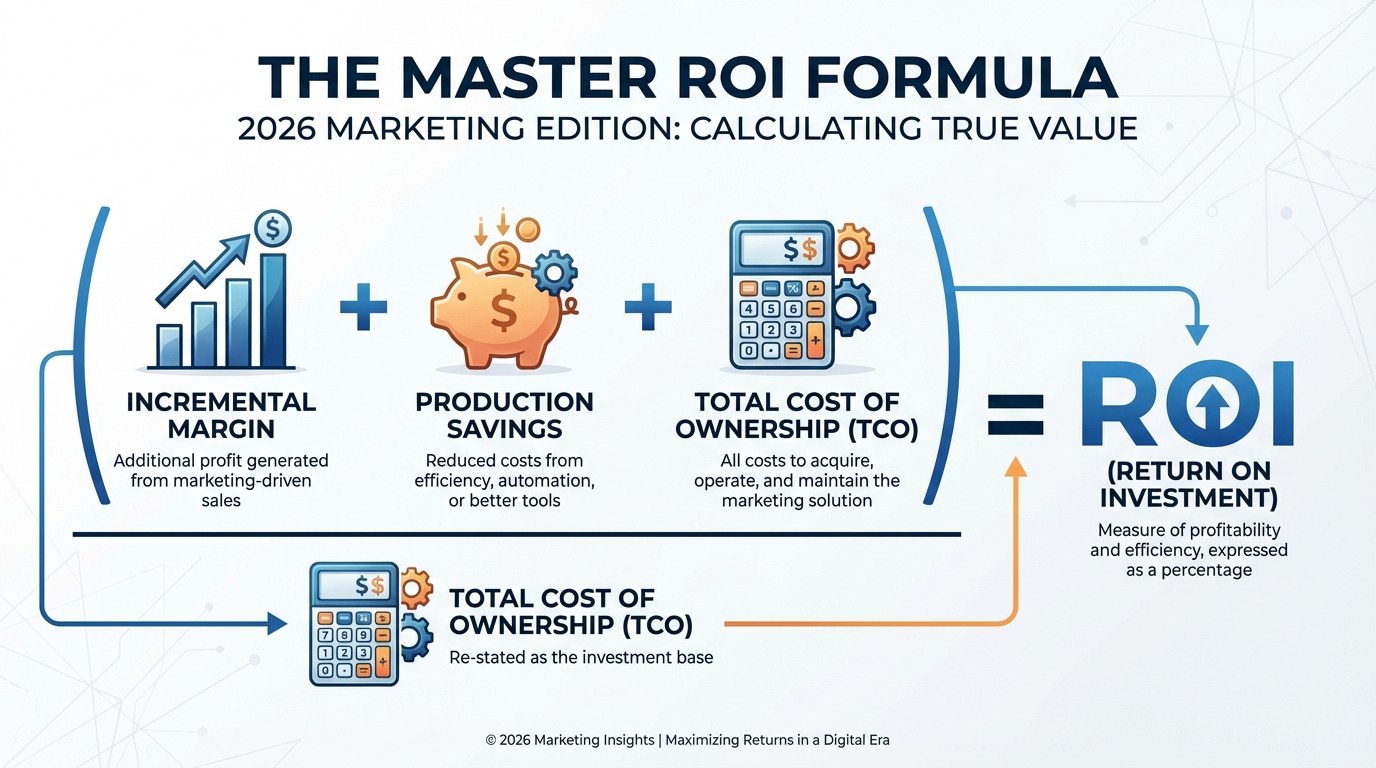
To build a business case that survives a procurement audit, you need a robust video marketing ROI framework CFO presentation can rely on. The core formula for ROI in 2026 remains grounded in incremental margin and cost avoidance.
The Master ROI Formula
ROI % = [((Incremental Margin from AI Video + Production Cost Savings) - Total Cost of Ownership) / Total Cost of Ownership] × 100
Essential Calculator Inputs (INR-First)
To use an AI video marketing ROI calculator India 2026, you must gather the following data points:
- Production Inputs:
- Number of base video templates required.
- Total number of personalized variants (e.g., 10,000 unique customer videos).
- Number of languages (Hindi, Tamil, Telugu, Marathi, etc.).
- Internal review hours (FTE time multiplied by India wage rates).
- Financial & Performance Inputs:
- Baseline Traffic/Impressions.
- Baseline Conversion Rate (CVR) and Click-Through Rate (CTR).
- Average Order Value (AOV) or Average Revenue Per User (ARPU).
- Gross Margin %.
- Traditional per-video production cost (₹).
- Total Cost of Ownership (TCO):
- Platform subscription/seat fees.
- One-time setup costs (Custom avatar training, API integration).
- Media spend (WhatsApp API costs, Meta/Google ad spend).
By inputting these variables, enterprises can calculate the “Breakeven Variant Volume”—the point where the amortized cost of the AI platform becomes cheaper than a single traditional agency shoot. For most Indian enterprises, this breakeven point is reached within the first 15–20 video variants.
3. Benchmarking Performance: Personalized Video Conversion Rates & Savings
The primary driver of ROI in 2026 isn't just saving money on production; it’s the massive uplift in conversion rates. Traditional “one-size-fits-all” videos are ignored by consumers who now expect content tailored to their name, location, and purchase history.
Personalized Video Conversion Rates Benchmarks India
Based on 2026 market analysis, the conversion lift from personalized video follows three distinct tiers:
- Conservative (+15%): Basic personalization (Name only) on email or SMS.
- Expected (+40%): Deep personalization (Name + Product + Regional Language) on WhatsApp or high-intent landing pages.
- Aggressive (+100%): Real-time, data-driven personalization (Dynamic pricing + Abandoned cart recovery) integrated via API.
Studio by TrueFan AI's 175+ language support and AI avatars allow brands to hit the “Expected” and “Aggressive” tiers with ease, ensuring that a customer in Chennai receives a video in Tamil while a customer in Lucknow receives the same message in Hindi, both featuring the same brand ambassador.
Calculate AI Video Production Savings vs. Traditional
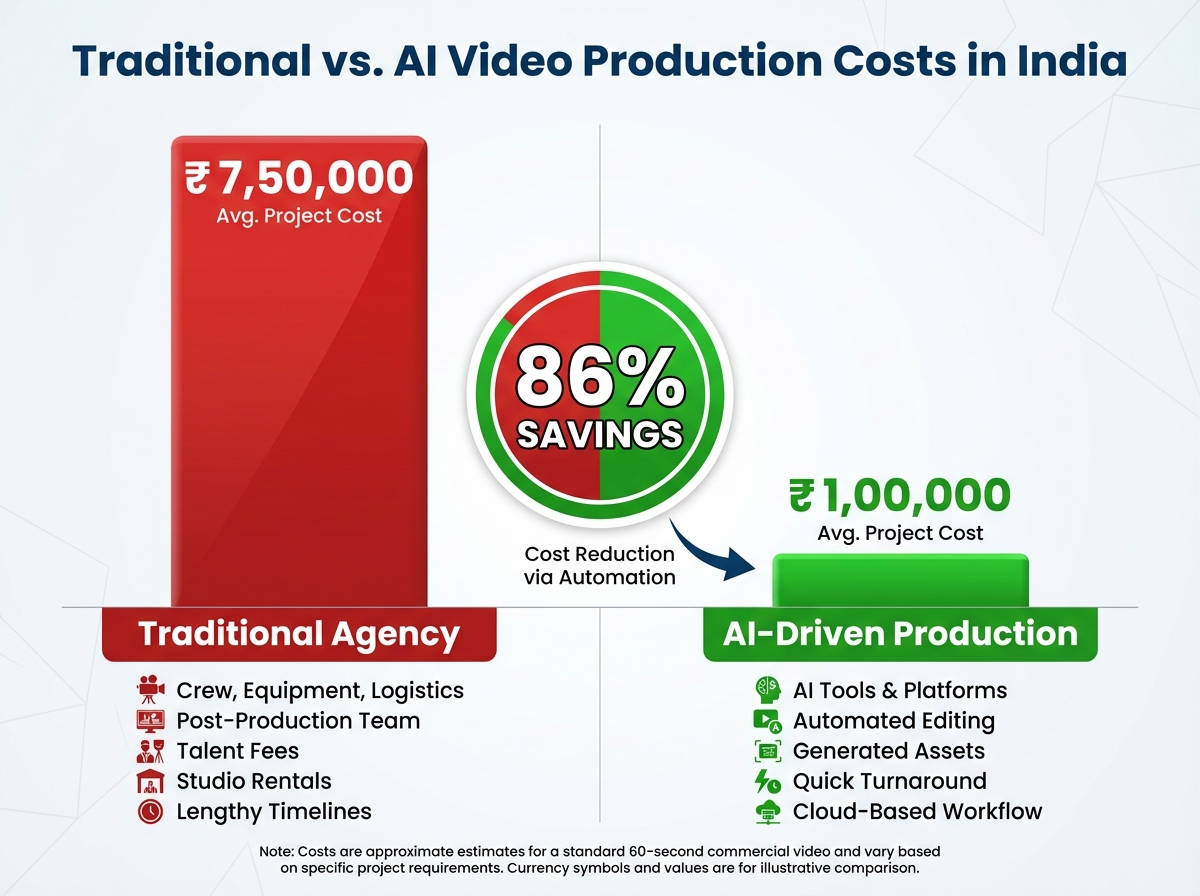
To calculate AI video production savings vs traditional, consider a campaign requiring 500 personalized videos for a festive sale:
- Traditional Path: 1 Master Shoot (₹5,00,000) + 500 manual edits/voiceovers (₹2,50,000) = ₹7,50,000.
- AI Path: Platform Subscription (Amortized ₹50,000) + 500 AI Generations (₹50,000) = ₹1,00,000.
- Total Savings: ₹6,50,000 (86.6% reduction).
(Sources: ZAK Medios 2025 Pricing Guide; ARD Digital Media 2025 Guide)
4. Enterprise Investment Analysis: TCO, Payback Periods, and CFO Presentation
A video personalization investment analysis enterprise teams conduct must go beyond simple cost-per-video. It must account for the “Payback Period”—the time it takes for the incremental revenue generated by the AI videos to cover the initial platform setup and subscription costs.
The AI Video Payback Period Calculator Tool
In 2026, the average payback period for an enterprise AI video platform in India is 4.2 months. High-velocity sectors like E-commerce and Fintech often see a “Payback” in as little as 45 days due to the immediate impact on cart abandonment and lead conversion. AI Video Payback Period Calculator
Payback Months = [Initial Investment (Setup + Subscription)] / [Monthly Net Incremental Profit]
Solutions like Studio by TrueFan AI demonstrate ROI through a “Walled Garden” approach to safety and compliance, which reduces the “Soft Costs” of legal and brand-safety reviews. When presenting to a CFO, it is vital to include these risk-mitigation factors. A CFO-ready deck should highlight:
- ISO 27001 & SOC 2 Certification: Ensuring data privacy for customer-facing personalized videos.
- Scalability: The ability to scale from 100 to 100,000 videos without a linear increase in headcount.
- Media Efficiency: How personalized videos lower the Cost Per Acquisition (CPA) by increasing the quality score of ads.
(Source: Shopify India on AI ROI and Payback)
5. Strategic Implementation: Governance, Metrics Dashboards, and Budgeting
To operationalize these gains, enterprises must move from ad-hoc pilots to a structured enterprise video ROI metrics dashboard. This dashboard should track real-time performance across the funnel, from production efficiency to bottom-line revenue.
The FY 2026 Video Marketing Budget Calculator (India Rupees)
When building your video marketing budget calculator India rupees, allocate funds into four strategic buckets:
- Fixed Infrastructure (20%): AI platform subscription, custom avatar training, and API integration.
- Variable Production (15%): Credit-based video generation and automated localization.
- Distribution & Media (55%): WhatsApp API fees and video commerce setup, Meta/Google ad spend, and CDP orchestration.
- Governance & Analytics (10%): Security audits, content moderation, and ROI tracking.
Implementation Roadmap: Pilot to Scale
- Weeks 1–4 (Pilot): Select one high-impact journey (e.g., WhatsApp welcome videos). Target a 20% CTR uplift.
- Weeks 5–12 (Controlled Scale): Expand to 3–5 languages and integrate with your CRM (Salesforce/HubSpot).
- Quarter 2+ (Evergreen): Automate video generation via webhooks for all lifecycle triggers.
(Source: Salesforce India Marketing ROI Guide)
6. Case Study: AI Avatar ROI in the Indian Enterprise
Real-world applications in 2026 show that the AI avatar ROI case study India enterprise leaders look for often involves celebrity or influencer “digital twins.” By licensing the likeness of a popular influencer as an AI avatar, brands can create personalized endorsements for millions of users simultaneously.
Case Example: BFSI Credit Card Cross-Sell BFSI retention strategies
- Objective: Increase credit card upgrades for an Indian private bank.
- Approach: Personalized WhatsApp videos using a professional AI avatar, addressing the customer by name and mentioning their specific eligible limit.
- Scale: 250,000 unique videos in 6 regional languages.
- Results:
- CTR: 18.5% (vs. 4.2% for static images).
- Conversion: 3.8% (vs. 1.1% for traditional SMS).
- Cost Savings: ₹42,00,000 saved in production and localization costs.
- Payback Period: Achieved in 22 days.
This level of performance is why the AI video vs agency video cost India comparison is increasingly tilting in favor of AI. Agencies are now being repositioned as “Creative Strategists” who design the templates, while AI handles the heavy lifting of execution and localization.
7. FAQ & Appendices: Mastering the AI Video ROI Calculator India 2026
Frequently Asked Questions
1. How do we calculate the “Time-to-Market” value in our ROI model?
Time-to-market value is calculated by taking the average daily revenue of a campaign and multiplying it by the number of days saved during production. If AI saves 15 days of production time for a campaign generating ₹1,00,000/day, the “Speed-to-Market” benefit is ₹15,00,000.
2. What are the hidden costs of AI video production?
While production costs are low, “hidden” costs include API integration time, data cleaning for personalization fields, and the initial cost of training a custom brand avatar. However, these are typically one-time investments.
3. Does the ROI calculator account for regional language nuances?
Yes. An AI video marketing ROI calculator India 2026 must include a “Localization Multiplier.” Traditional models charge per language; AI models typically include multi-language support as a platform feature, turning a major cost center into a near-zero marginal expense.
4. How does the platform handle data security for personalized customer videos?
Studio by TrueFan AI provides enterprise-grade security, including ISO 27001 and SOC 2 compliance, ensuring that customer names and data used for personalization are handled within a secure, encrypted environment.
5. Can we use this framework for internal corporate communications?
Absolutely. The ROI for internal use is measured through “FTE Time Savings.” Replacing a CEO's monthly town hall video shoot with an AI avatar can save 40+ man-hours of production and coordination time per month.
Appendix: AI Video Cost Benefit Analysis Template (Summary)
| Category | Traditional (Agency) | AI-Driven (Enterprise) |
|---|---|---|
| Cost Per Asset | ₹2,00,000 - ₹10,00,000 | < ₹1,000 (at scale) |
| Turnaround Time | 2 - 4 Weeks | 1 - 4 Hours |
| Localization Cost | ₹50,000+ per language | Included / Marginal |
| Revision Cost | High (Reshoots/Edits) | Near Zero (Script update) |
| Personalization | Impossible at scale | Unlimited |
Source Roundup
- AI ROI Frameworks (India): Shopify India 2026 on AI ROI
- Marketing Measurement: Salesforce India ROI Guide
- Production Benchmarks: ZAK Medios Pricing | ARD Digital Media
- ROI Tools: Techmagnate PPC ROI Calculator | Mailmodo Content ROI Calculator
- Product Intelligence: Studio by TrueFan AI
Ready to transform your marketing efficiency?
Download our full AI video cost benefit analysis template or book a demo to see how your enterprise can achieve a sub-₹1,000 cost-per-video today. Visit TrueFan.ai website to start your 30-day ROI pilot.
Frequently Asked Questions
How do I calculate ROI for AI video marketing in India (2026)?
Use ROI % = [((Incremental Margin from AI video + Production Cost Savings) − Total Cost of Ownership) ÷ Total Cost of Ownership] × 100. Gather inputs for baseline traffic, CVR/CTR, AOV/ARPU, gross margin, traditional per-video costs, platform fees, setup, and media spend.
What India-specific benchmarks should I use for costs and conversions?
Typical agency costs: ₹2–10 lakh per asset; AI marginal cost per variant: < ₹1,000 at scale. Personalization lift ranges from +15% (basic) to +100% (real-time, data-driven). WhatsApp personalized video CTRs average ~14.2%.
How fast is the payback period for an AI video platform?
Enterprises in India see a median payback of ~4.2 months. High-velocity sectors like E‑commerce and Fintech often achieve payback in 45–60 days due to immediate cart recovery and lead conversion gains.
How does Studio by TrueFan AI ensure security and compliance?
Studio by TrueFan AI supports enterprise-grade controls, including ISO 27001 and SOC 2, a walled-garden generation environment, encrypted data handling, and governance features for approvals and audit trails.
How should I allocate my 2026 video marketing budget?
A proven split is 20% Fixed Infrastructure (platform, avatars, APIs), 15% Variable Production (credits, localization), 55% Distribution & Media (WhatsApp, Meta/Google), and 10% Governance & Analytics (security, moderation, ROI tracking).



