Answer Engine Optimization Video 2026: AI Overviews SEO Strategy, Zero-Click Optimization Techniques, and Schema Markup for Voice Search
Estimated reading time: ~11 minutes
Key Takeaways
- Answer-first video scripting is essential for AI Overviews—deliver a 40–90 word summary upfront for easy extraction.
- Use schema markup (VideoObject, FAQ, HowTo) with transcripts, timestamps, and entities to maximize machine readability.
- Zero-click optimization relies on short Q&A clips, chaptering, and jump links to win voice and AI citations without a click.
- Earn citations with E-E-A-T authority: original data, expert credentials, and consistent on-page/off-page signals.
- Build AEO content clusters (hub-and-spoke) with multilingual variants to establish dominant topical authority.
The digital landscape has undergone a seismic shift, making answer engine optimization video 2026 the primary directive for enterprise marketing leaders. As we navigate a search environment dominated by generative AI, the traditional goal of ranking blue links has been superseded by the need to be the definitive source for AI-synthesized responses. By 2026, AI Overviews have become the central interface for information retrieval in major global markets, including the United States and India.
Enterprises must now prioritize engineering video assets—including scripts, on-screen text, chapters, and structured data—to ensure AI interfaces can extract accurate answers and cite the brand as the primary authority. This evolution requires a sophisticated blend of AI Overviews SEO strategy and zero-click optimization techniques to maintain visibility in a landscape where the user often finds their answer without ever leaving the search results page. Winning in this era demands a commitment to E-E-A-T authority building and the strategic deployment of voice search video marketing to capture the growing volume of conversational queries.
Sources:
1. What is AEO for Video in 2026 (vs. SEO) and Why it Wins on AI Surfaces
To succeed in the current climate, one must distinguish between Search Engine Optimization (SEO), Answer Engine Optimization (AEO), and Generative Engine Optimization (GEO). While SEO focuses on ranking a URL within a list of results, AEO is the discipline of ensuring your content is extracted and quoted as the direct answer by AI assistants. GEO takes this further by optimizing for Large Language Models (LLMs) that synthesize multi-source answers, emphasizing machine readability and the likelihood of being cited as a primary source.
Natural language video SEO has become the cornerstone of this transition, requiring scripts and subtitles to mirror everyday phrasing at an 8th to 10th-grade reading level. By aligning video content with conversational query patterns, brands ensure that voice assistants can easily parse and present their information. This strategy involves including verbatim questions on-screen and within H2/H3 headers, allowing AI to align the video’s intent with the user’s specific search.
Conversational SEO videos are now a vital component of the enterprise toolkit, characterized by short, Q&A-led clips where the host delivers a citation-ready answer within the first ten seconds. In the Indian market, this strategy is amplified by the need for multilingual variants, including Hindi and regional languages, to boost comprehension across diverse locales. These AEO content clusters allow brands to dominate the "zero-click" landscape by providing immediate, authoritative value that AI engines prefer to highlight.
Sources:
2. AI Overviews SEO Strategy: Making Your Videos Inclusion- and Citation-Ready
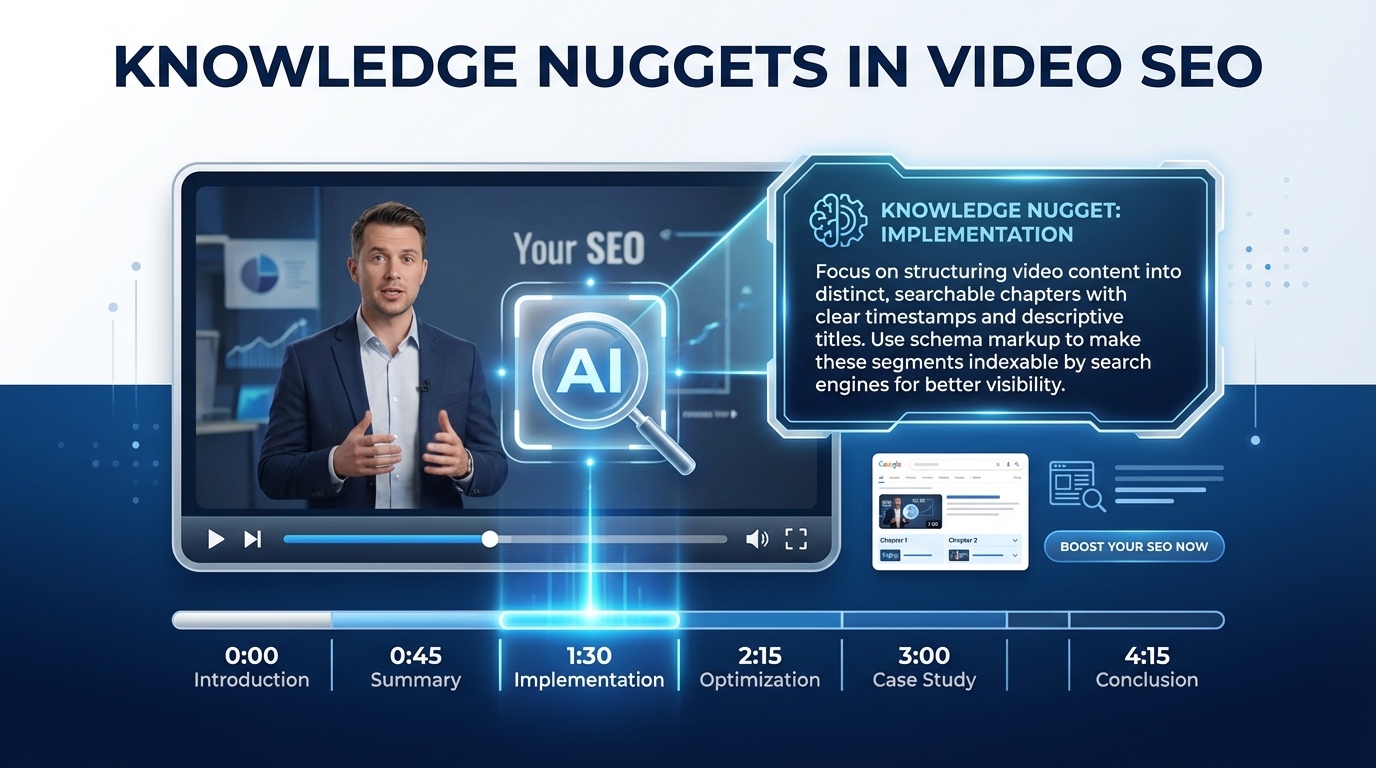
Structuring video content for extractability is no longer optional; it is a technical requirement for visibility in AI Overviews. An effective AI Overviews SEO strategy begins with answer-first scripting, where the video opens with a 40–90 word summary that is both spoken and captioned. This concise paragraph acts as a "knowledge nugget" that AI engines can easily lift and present as a summary in search results.
Timestamped chapters are equally critical, as they allow AI to deep-link to precise moments within a video that answer specific sub-questions. By mapping chapters to queries—such as "00:38 Steps to Implement..." or "02:05 Pros and Cons"—you provide a roadmap for the AI to navigate your content. Furthermore, transcripts must be "high-entropy" and entity-rich, containing specific brand names, industry standards, and quantitative data to increase the semantic match during the AI’s synthesis process.
Page architecture must support these video assets by placing a "TL;DR" box above the fold that repeats the core answer in text format. Co-locating the video with its transcript, key takeaways, and relevant FAQs on a single URL creates a high-authority hub that AI engines trust. For enterprises operating in India, publishing per-language pages with appropriate hreflang tags (such as hi-IN or ta-IN) ensures that localized examples and currency units are correctly interpreted by regional AI models.
Sources:
3. AI Answer Citation Strategies and E-E-A-T Authority Building
To earn citations from AI engines, brands must produce original, citable material that goes beyond generic information. This includes publishing unique statistics, proprietary frameworks, and mini-studies with explicit methodology sections visible both on-page and on-screen. AI answer citation strategies rely on the ability to provide "source-of-truth" hubs that LLMs can identify as the definitive origin of a specific data point or concept.
E-E-A-T authority building is the framework through which these citations are earned, requiring a transparent display of expert credentials. Every video should feature the expert’s name and organization in lower-third graphics, which must be mirrored in the Person and Organization schema of the page. Precise quantification—using exact numbers like "15–45 seconds" rather than vague terms—makes your content more "quote-friendly" for AI models looking for specific facts.
Enterprise-grade trust is further established through editorial transparency, such as "Reviewed by" sections and clearly stated last-updated dates. Maintaining consistent naming conventions for products and people across all digital assets helps AI engines disambiguate sources and associate your brand with specific expertise. In 2026, the integration of ISO 27001 or SOC2 compliance notes on "About" pages also serves as a subtle but powerful signal of organizational reliability to both users and algorithms.
Sources:
4. Zero-Click Optimization Techniques for Voice Search Video Marketing
As zero-click searches now account for over 65% of mobile queries in 2026, mastering zero-click optimization techniques is essential for maintaining brand mindshare. On-video techniques include using answer-first intros and descriptive labels for chapters that directly correspond to common user questions. Creating 15–45 second "snackable" clips from longer videos allows these segments to appear in Shorts, Reels, and as featured video snippets in AI-driven SERPs.
On-page techniques must complement the video by utilizing question-led subheadings and jump links that allow users (and AI) to navigate directly to specific answers. Co-locating FAQs with embedded Q&A clips ensures that the page serves as a comprehensive resource for voice search video marketing. When a user asks a voice assistant a question, the assistant is more likely to pull from a page that has a clearly defined, short video clip paired with a text-based answer.
Aligning YouTube content with "SeekToAction" markup is another critical step for enterprise visibility. By adding detailed timestamps in descriptions and ensuring video titles match target questions, brands can unlock "Suggested Clips" eligibility. This ensures that even if a user does not click through to the website, the brand’s video is the one providing the answer directly on the search interface, reinforcing authority and awareness.
Sources:
- Movinnza: Zero-click and AI Overviews changing SERPs
- Prabhat Soft: Video-first and voice trends in 2026
5. Schema Markup Implementation for Maximum Machine Readability
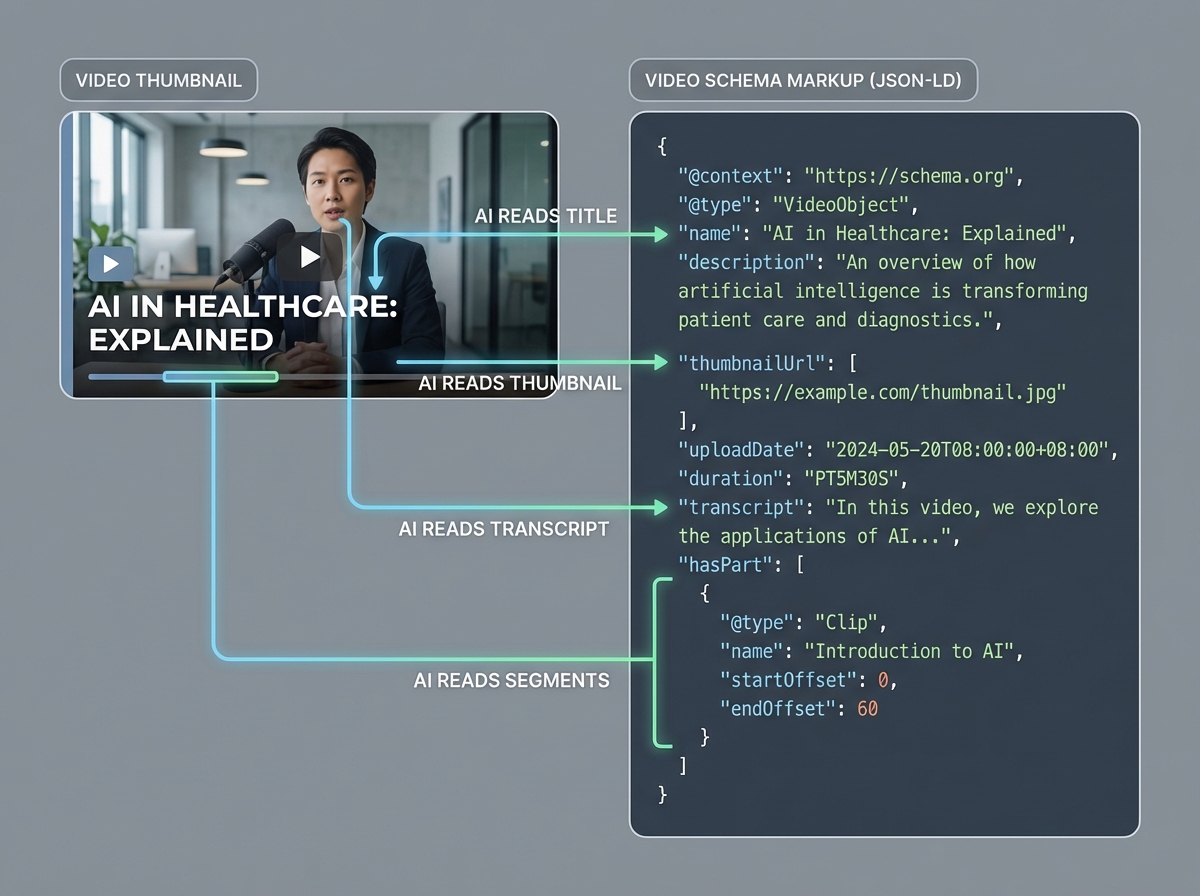
The technical backbone of AEO is a robust schema markup implementation that translates visual content into a language AI can digest. The VideoObject JSON-LD is the primary requirement, and it must be populated with answer-first descriptions, accurate durations, and high-quality thumbnail URLs. However, to truly excel in 2026, enterprises must go beyond the basics by including the full transcript and entity-rich keywords within the schema.
FAQ schema video content should be used to pair each question with a concise answer and an embedded Q&A clip. This structure is highly favored by AI Overviews as it provides a clear, structured path to information. Similarly, HowTo schema optimization should be applied to procedural videos, defining every step with text, images, and specific video timestamps to ensure the AI can guide a user through a process step-by-step.
Governance of schema is a critical enterprise function, requiring regular validation through the Rich Results Test and monitoring via Search Console. As schema policies shift, maintaining a centralized template within the CMS ensures that all video assets remain compliant and visible. This technical rigor ensures that your video content is not just "seen" by users, but "understood" by the AI engines that control the flow of information.
Sources:
6. Semantic Search Strategies and AEO Content Clusters
Winning the AEO game requires moving from isolated keywords to comprehensive semantic search strategies. This involves building AEO content clusters—a hub-and-spoke model where a central pillar page covers a broad topic, while interlinked spoke pages answer narrowly scoped, high-intent sub-questions. For example, a pillar page on "Answer Engine Optimization Video 2026" would link to spokes like "How to implement VideoObject schema" or "AI answer citation strategies for enterprise."
Internal linking within these clusters must be strategic, using contextual links within transcripts and TL;DR boxes to guide both users and AI crawlers. Each spoke page should feature a relevant micro-clip and 3–5 links to related questions, creating a web of topical authority that is difficult for competitors to displace. This approach is particularly effective for multilingual markets, where localizing each spoke ensures the cluster remains relevant across different cultural and linguistic contexts.
By saturating a topic with these clusters, an enterprise demonstrates a depth of knowledge that AI engines prioritize for citations. The goal is to become the "entity" that the AI associates with a specific subject matter. When the AI synthesizes an answer, it looks for the most complete and authoritative cluster of information, making the hub-and-spoke model the most effective way to capture and hold AI Overview real estate.
Sources:
7. Conversational SEO Videos: Scripting and Enterprise Integration
The production of conversational SEO videos requires a disciplined script blueprint: Question, Answer, Proof, and Call to Action (Q-A-Proof-CTA). The host must read the verbatim question, deliver a 40–90 word answer immediately, cite a specific proof point, and then direct the user to further resources. This pattern is optimized for both human retention and machine extraction, ensuring the core value is delivered before any potential drop-off.
Platforms like TrueFan AI enable enterprises to scale this production by generating high-quality conversational videos from a single short shoot. By applying enterprise scripting templates for FAQs and HowTos, brands can ensure consistency and compliance across thousands of video assets. TrueFan AI's 175+ language support and Personalised Celebrity Videos allow for unprecedented localization, ensuring that answer-first content resonates in every regional market with perfect lip-sync and cultural nuance.
Solutions like TrueFan AI demonstrate ROI through the ability to rapidly update messaging via virtual reshoots without the need for expensive physical production. This agility is vital in 2026, where search trends and AI algorithms evolve weekly. Integrating these AI-driven production tools with automated schema markup implementation and FAQ schema video content generation creates a seamless pipeline from content creation to AI Overview inclusion, ensuring the enterprise remains at the forefront of the answer engine revolution.
Sources:
Conclusion
The transition to answer engine optimization video 2026 represents the most significant shift in digital strategy since the advent of mobile search. For enterprises, the goal is no longer just to be found, but to be the voice that provides the answer. By combining sophisticated AI Overviews SEO strategy with technical schema markup implementation and high-authority E-E-A-T building, brands can secure their place in the future of search. The era of the blue link is fading; the era of the definitive answer has arrived.
Frequently Asked Questions
What is the difference between SEO and AEO in 2026?
SEO focuses on ranking a website in search results to drive clicks, while AEO (Answer Engine Optimization) focuses on providing the direct answer that AI engines extract and present to users, often resulting in a zero-click interaction.
How do I optimize video for AI Overviews?
Use answer-first scripting, include high-entropy transcripts, and implement detailed VideoObject and Clip schema. This allows AI to understand the context and deep-link to specific answers within your video.
Why is schema markup important for voice search?
Schema markup provides the structured data that voice assistants need to identify the most relevant answer to a spoken query. Without it, your video content remains "invisible" to the algorithms that power voice search.
How does TrueFan AI assist in AEO?
TrueFan AI enables enterprises to create thousands of localized, conversational SEO videos structured for AI extraction, helping your brand provide the definitive answer across AI surfaces in 175+ languages.
What are the key KPIs for AEO success?
Track AI Overview inclusion rate, assistant citation count, featured snippet wins, and zero-click impression share to measure how often AI engines use your brand as the primary source.