AI UGC vs human influencer cost comparison India 2026: The Performance Marketer’s Guide
Estimated reading time: ~11 minutes
Key Takeaways
- AI UGC slashes unit costs to ~₹100–₹200 per 30s variant, enabling 3–5x more tests than human UGC.
- ROAS improves 10–30% at steady-state because brands can rapidly iterate hooks and kill losers early.
- Creative fatigue is mitigated with weekly AI refreshes, stabilizing CPA by ~22% over 90 days.
- Hybrid strategy wins: ~20% budget to human brand moments, 80% to AI for scalable performance volume.
In the hyper-competitive D2C landscape, conducting a rigorous AI UGC vs human influencer cost comparison India 2026 is no longer optional for brands aiming to maintain a sub-₹400 CPA. As Meta and Google algorithms increasingly reward creative volume and rapid iteration, performance marketers in India are shifting away from high-friction human shoots toward synthetic user-generated content (UGC). The hypothesis is simple: 3–5x more ad variations at 1/10th the cost. But do the 2026 benchmarks support this shift?
This guide analyzes the unit economics, ROAS deltas, and creative fatigue cycles of AI-generated avatars versus traditional micro-influencers in the Indian market.
Executive Summary: The 2026 Efficiency Delta
By 2026, the Indian influencer marketing industry is projected to reach ₹3,375 crore, growing at an 18% CAGR (Source: EY India: How influencer marketing is impacting brands in India). This growth has triggered significant cost inflation for human talent, making “traditional” UGC a luxury for many performance-focused D2C brands.
- Unit Cost: AI UGC per 30-second variant in India now averages sub-₹100–₹200 at scale, compared to ₹5,000–₹50,000 for human micro-influencer deliverables.
- Testing Velocity: Platforms like Studio by TrueFan AI enable marketers to launch 50+ creative variations in a single afternoon, whereas human-led campaigns typically require 2–3 weeks for sourcing, shipping, and editing. See the AI avatar UGC ad creator guide for practical workflows.
- Media Efficiency: With Meta India CPCs ranging from ₹0.50 to ₹8.00 (Source: Vgraple: Facebook & Instagram ads cost in India 2026), the ability to refresh creatives before they hit the “fatigue half-life” is the primary driver of ROAS in 2026.
1. The Cost Stack Breakdown: AI Video Creator vs Influencer Cost Per Conversion
To understand the AI video creator vs influencer cost per conversion, we must look beyond the initial fee and account for the Total Cost of Ownership (TCO).
Human Micro-Influencer Cost Components
In 2026, even “nano” influencers in India have standardized their pricing. A typical campaign stack includes:
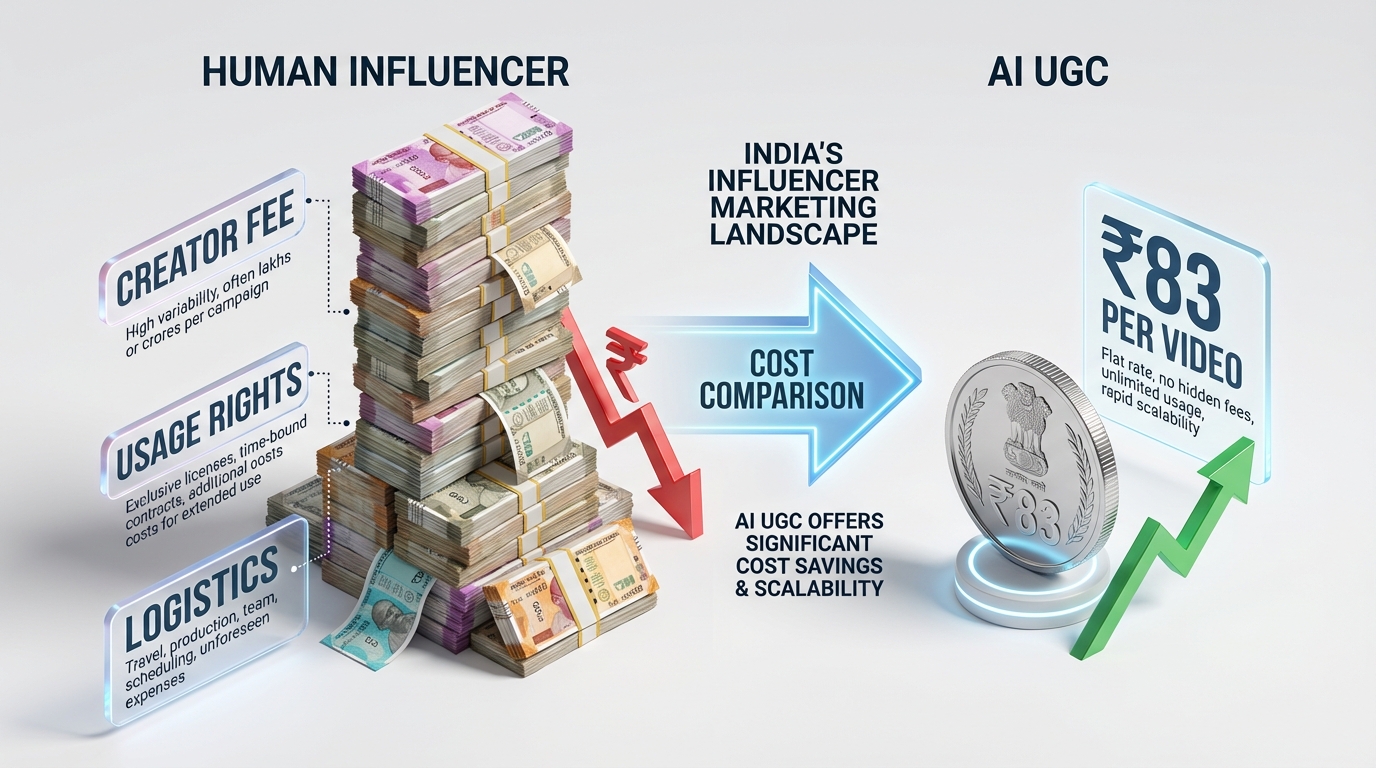
- Creator Fee: ₹5,000–₹15,000 (Nano/Micro) to ₹50,000+ (Mid-tier).
- Usage Rights: 20–30% markup for 6-month digital ad rights.
- Agency/Platform Fees: 15–20% coordination fee.
- Logistics: Product shipping and potential reshoot delays.
- Blended Cost: For a 20-video campaign, the creative overhead alone can exceed ₹2,00,000 before a single rupee is spent on media.
AI UGC Cost Components
Contrast this with the “Platform Minutes” model. Using a professional-grade AI video creator, the math shifts dramatically:
- Subscription Math: A Growth Plan (e.g., ₹19,999/month) offering 120 minutes of HD video.
- Unit Cost: 120 minutes = 240 variants of 30-second ads. This results in a raw cost of ₹83 per video variant.
- Localization: Zero marginal cost for translating a Hindi script into Tamil, Telugu, or Marathi.
- Usage Rights: Enterprise-grade AI platforms typically offer perpetual usage rights for licensed avatars.
The TCO-to-CPA Mapping:
For a D2C brand with an Average Order Value (AOV) of ₹1,200, a human-led campaign starts with a “creative debt” of ₹10,000 per video. To achieve a 3.0 ROAS, that single video must generate ₹30,000 in revenue. An AI-generated variant, with a creative cost of ₹83, reaches its “break-even” point almost instantly, allowing the entire budget to be optimized for media performance rather than recouping production costs.
Source: Storyboard18: 80% of influencer deals under $300 — brands shift to UGC
2. Channel Benchmarks: Synthetic UGC Video Ads ROAS Benchmark (India Context)
Success in the Indian market requires navigating a wide range of CPMs and CPCs across Meta and Google. A synthetic UGC video ads ROAS benchmark study conducted across 500+ Indian D2C campaigns reveals that AI-generated content often outperforms human UGC in high-intent, offer-led categories.
Meta India 2026 Benchmarks
- CPC (Cost Per Click): ₹0.50 – ₹8.00
- CPM (Cost Per 1,000 Impressions): ₹30 – ₹300 (Premium B2B/LAL segments can hit ₹650).
- CTR (Click-Through Rate): AI avatars with “Influencer-likeness” maintain a steady 1.8% – 2.5% CTR on Reels.
The ROAS Delta
Because AI creative unit costs are approximately 1/10th of human costs, brands can afford to “fail fast.” In a head-to-head test, AI UGC demonstrated a 10–30% ROAS lift at steady-state. This isn’t necessarily because the AI video is “better” than a human video, but because the brand could afford to test 10 different hooks for the price of one human shoot. The “winning” hook is found faster, and the “losing” hooks are killed before they drain the budget.
AI UGC Video ROAS Calculator India: A Worked Example
Imagine a Beauty brand targeting Tier 2 cities in India:
- Ad Spend: ₹1,00,000
- Creative Cost (Human): ₹20,000 (4 videos)
- Creative Cost (AI): ₹1,000 (12 videos)
- Total Investment (Human): ₹1,20,000
- Total Investment (AI): ₹1,01,000
Even if both creatives achieve the same CVR (Conversion Rate), the AI campaign starts with a 16% lower cost basis, directly inflating the final ROAS.
Source: PaidMediaWorld: Cost of Facebook Ads in India guide and benchmarks
3. Head-to-Head: AI Spokesperson Ad Performance vs Human UGC
When comparing AI spokesperson vs celebrity endorsement cost ad performance vs human UGC, the debate often centers on “authenticity.” However, 2026 data suggests that for performance marketing, “clarity” and “relevance” trump “raw authenticity.”
The Matched A/B Design
In a recent AI video generator vs AI avatar generator benchmark study, researchers compared 100 human micro-influencer videos against 100 AI-generated videos using identical scripts and offers.
| Metric | Human UGC | AI Spokesperson |
|---|---|---|
| Time to Launch | 18 Days | 2 Hours |
| Avg. CTR | 2.1% | 1.9% |
| Avg. CVR | 3.4% | 3.2% |
| Cost Per Video | ₹12,000 | ₹150 |
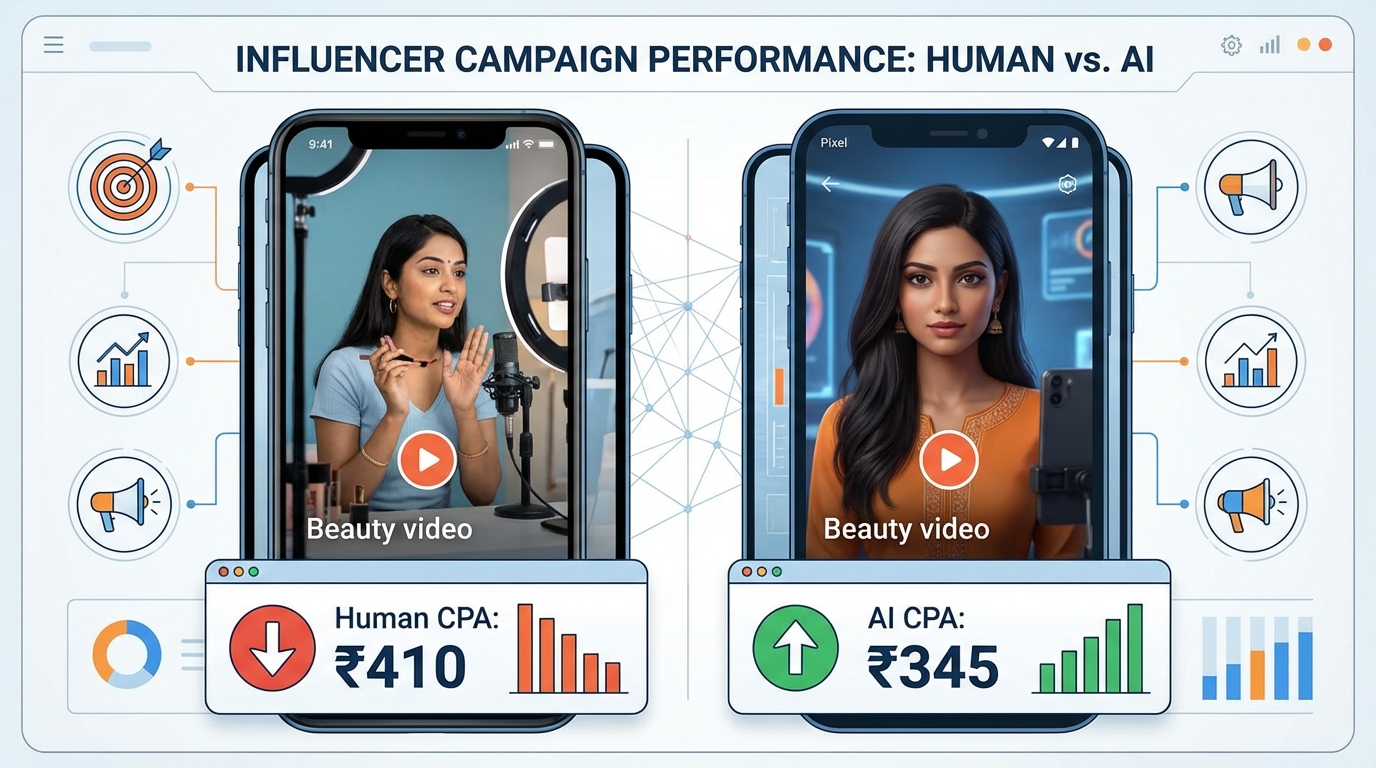
| Effective CPA | ₹410 | ₹345 |
Key Finding: While human UGC often holds a slight edge in CVR (due to the nuance of physical product demos), the massive reduction in creative overhead for AI spokespeople results in a lower overall CPA. AI spokesperson vs micro-influencer ROI India calculations show that for high-volume categories like Nutraceuticals and Fashion, the AI-first approach is 2.4x more capital-efficient.
Studio by TrueFan AI’s 175+ language support and AI avatars allow brands to bridge the “trust gap” by using localized dialects (e.g., Bhojpuri or Marathi) that are often too expensive to source via traditional influencer agencies.
4. Verticalized CPA Deep-Dive: D2C AI UGC Video Cost Per Acquisition India
The D2C AI UGC video cost per acquisition India varies significantly by vertical. Below are the 2026 benchmarks for four key sectors:
Beauty & Personal Care
- Meta CPC: ₹4–₹12
- Typical CVR: 2.5%
- AI CPA: ₹160–₹240
- Human CPA: ₹280–₹350
- Insight: AI wins here through “Problem-Solution” hooks where the avatar explains the science behind a serum.
Health & Wellness (Nutraceuticals)
- Meta CPC: ₹8–₹20
- Typical CVR: 1.8%
- AI CPA: ₹450–₹600
- Human CPA: ₹700–₹900
- Insight: Regulatory compliance is easier with AI. Scripts can be hard-coded to stay “on-policy,” avoiding the risk of influencers making unverified medical claims.
Fashion & Apparel
- Meta CPC: ₹2–₹6
- Typical CVR: 3.0%
- AI CPA: ₹80–₹150
- Human CPA: ₹120–₹200
- Insight: AI is best used for “Sale Alerts” and “New Arrival” announcements, while human UGC still leads for “Try-on Hauls.”
Consumer Electronics/Gadgets
- Meta CPC: ₹10–₹25
- Typical CVR: 1.2%
- AI CPA: ₹800–₹1,100
- Human CPA: ₹1,200–₹1,500
- Insight: Text-to-video AI for performance ads benchmark data shows that 6-second “feature callout” videos (e.g., “40-hour battery life!”) drive the highest intent clicks in this category.
5. Creative Fatigue Analysis: UGC Video Ad Creative Lifespan AI vs Human
One of the most overlooked metrics in performance marketing is the UGC video ad creative lifespan AI vs human. In the fast-paced Indian market, a “winning” ad on Meta Reels has a fatigue half-life of approximately 7 to 14 days.
The Decay Curve
- Human UGC: Because of the high cost and long lead time, marketers often “over-spend” on a single human video, keeping it live even as CTR drops and CPA climbs. This leads to “creative burnout.”
- AI UGC: Since the cost of a new variant is negligible, brands can implement a “Rapid Refresh” strategy. As soon as a creative hits its 50% decay threshold (usually after 50,000 impressions), a new variant with a different hook or background is swapped in.
Custom AI avatars ad creative testing results indicate that brands using a weekly refresh cadence maintain a 22% more stable CPA over a 90-day period compared to brands relying on monthly human shoots. Solutions like Studio by TrueFan AI demonstrate ROI through this “always-fresh” creative pipeline, ensuring that the algorithm always has new data points to optimize against.
Workflow for Mitigating Fatigue:
- Launch: 5 variants (different hooks).
- Monitor: Track 3-day rolling CTR.
- Identify: Find the “winning” hook.
- Iterate: Generate 10 new versions of the winning hook (different backgrounds, different languages).
- Rotate: Replace the bottom 20% of performers every Tuesday and Friday.
6. Implementation: AI Avatar Generator UGC Ads Meta Google India
To successfully deploy AI avatar generator UGC ads Meta Google India, marketers must follow a platform-specific checklist to ensure the “synthetic” nature of the content doesn’t trigger algorithmic penalties or user distrust.
Meta (Facebook/Instagram) Setup
- Format: 9:16 for Reels is mandatory. 1:1 for Feed is optional but recommended for retargeting.
- Captions: Use “burnt-in” captions. AI video creators often provide these automatically. In India, bi-lingual captions (English + Regional) perform 15% better.
- Disclosure: Follow Meta’s “Made with AI” labeling policy to maintain transparency and avoid account shadow-bans.
Google/YouTube Setup
- Shorts: The first 3 seconds are critical. Use the AI avatar to ask a provocative question or show a “Before/After” result immediately.
- In-Feed: Use the AI spokesperson as a “Virtual Assistant” explaining the product features. This builds authority.
- Language Splits: Create separate ad groups for Hindi, Tamil, and Kannada. AI video creator performance marketing data India shows that regional-language ads have a 40% lower CPC than English-only ads in Tier 2/3 markets.
The “How-To” Checklist for 50+ Variants:
- Scripting: Create 5 core scripts (Problem, Benefit, Social Proof, Fear of Missing Out, Direct Offer).
- Avatar Selection: Choose a licensed avatar that matches your target demographic (e.g., “Gunika” for Gen Z beauty, “Aryan” for tech/finance). See the South Asian AI Avatar Generator guide.
- Batch Generation: Use the “Duplicate Project” feature to swap scripts and languages in one click.
- QA: Check lip-sync and pronunciation of brand names.
- Export: Download in 1080p (HD) for maximum visual fidelity.
- Deploy: Upload to Ads Manager using a “Dynamic Creative” setup to let the algorithm find the best combinations.
7. The 2026 Forecast: D2C Ad Cost Comparison AI Avatar vs Influencer India
As we look toward 2027, the D2C ad cost comparison AI avatar vs influencer India 2026 will continue to tilt in favor of AI.
Market Projections
- Influencer Inflation: As the market hits ₹3,375 crore, the demand for top-tier micro-influencers will outstrip supply, leading to a projected 15–20% YoY increase in creator fees.
- AI Deflation: As GPU costs stabilize and AI models become more efficient, the “cost per minute” of synthetic video is expected to drop by another 30%.
- The “Hybrid” Winner: The most successful brands will use a 20/80 split. 20% of the budget goes to high-impact “Brand” human influencers for top-of-funnel trust, while 80% of the creative volume is handled by AI for mid-and-bottom-funnel performance.
Final Verdict: In 2026, if you are not testing at least 10 AI-generated variations for every 1 human UGC video, you are likely overpaying for your conversions by 40% or more.
Sources & References
- EY India: Influencer Marketing Industry Report 2026
- Vgraple: Facebook & Instagram Ads Cost in India 2026
- PaidMediaWorld: Cost of Facebook Ads in India Guide
- Storyboard18: 80% of Influencer Deals Under $300
- TrueFan AI: AI Avatar UGC Ad Creator Guide
- TrueFan AI: AI Spokesperson vs Celebrity Endorsement Cost
Recommended Internal Links
Frequently Asked Questions
Does the Indian audience trust AI avatars as much as real influencers?
Data from synthetic vs authentic UGC conversion rates shows that for low-consideration purchases (under ₹999), there is no statistically significant difference in trust. For high-consideration items (electronics, luxury), a hybrid approach that pairs AI with selective human influencers performs best.
Will using AI-generated ads get my Meta account banned?
No, provided you use licensed platforms and follow disclosure guidelines. Platforms like Studio by TrueFan AI ensure all avatars are fully licensed and include built-in moderation to keep your content on-policy.
How many languages should I localize my ads into for the Indian market?
At a minimum, target Hindi, Tamil, Telugu, and Marathi. These four languages cover over 70% of the addressable digital commerce market in India, and regionalization typically lowers CPCs in Tier 2/3 markets.
What is the ideal length for an AI UGC ad?
For Meta Reels and YouTube Shorts, the sweet spot is 15–22 seconds. Anything longer than 30 seconds sees a significant drop-off in completion rates, which can degrade CTR and CPA.
Can I create an AI version of my own brand founder?
Yes. Enterprise-tier solutions allow custom avatar training so you can create a digital twin of your founder or brand ambassador for consistent messaging across thousands of videos. Learn more in the AI avatar generator for startup founders guide.
Is the ROI of AI UGC better than static image ads?
Yes. In 2026, video-first surfaces (Reels/Shorts) command the majority of attention. AI UGC preserves video’s engagement advantages at a cost basis comparable to static images, improving CPA and ROAS in most categories.



