AI Video A/B Testing Framework India 2026: Scientific, Automated Creative Testing for 2–5x ROAS on Meta and Google
Estimated reading time: ~11 minutes
Key Takeaways
- Adopt a scientific testing foundation with clear hypotheses, stable splits, and pre-registered metrics.
- Use multivariate testing (MVT) to evaluate hooks, CTAs, and offers, supported by proper sample-size calculations.
- Leverage platform-native playbooks: Meta’s exploration-validation loop and YouTube Campaign Mix Experiments.
- Scale creative output with automation and localized variants via Studio by TrueFan AI to drive 2–5x ROAS.
- Ensure DPDP compliance with lawful consent, data minimization, and transparent governance.
In the hyper-competitive digital landscape of the subcontinent, the AI video A/B testing framework India 2026 has become the definitive standard for brands seeking to dominate the attention economy. As Indian D2C brands and enterprises pivot from manual production to automated intelligence, the ability to execute scientific creative testing video ads is no longer a luxury—it is a survival requirement. By 2026, the shift toward social and online video as the primary driver of digital spend is absolute, with projected ad expenditures in India crossing the $21 billion mark, driven largely by short-form video and regional language penetration.
Platforms like Studio by TrueFan AI enable performance marketers to bridge the gap between creative intuition and statistical certainty, ensuring that every rupee spent on Meta and Google is backed by rigorous data. This guide outlines the architectural blueprint for a 2026-ready testing framework designed to unlock 2–5x ROAS through scientific precision.
1. The 2026 Reality: Why Scientific Video Testing is Non-Negotiable
The Indian market in 2026 is characterized by “Hyper-Personalization at Scale.” According to recent industry data, over 85% of successful Indian D2C brands now utilize AI-driven creative workflows to manage the sheer volume of content required for modern algorithms. The 2026 reality check reveals that the “one-size-fits-all” video ad is dead. Consumers in Tier 2 and Tier 3 cities now command 45% of the total e-commerce spend, demanding content that speaks their language—literally and culturally.
The Shift to Data-Driven Video Creative Optimization
The traditional method of “launch and pray” has been replaced by data-driven video creative optimization. In 2026, the cost of customer acquisition (CAC) on Meta and Google has stabilized at a high plateau, meaning profit is found in the margins of creative efficiency. Marketers must now navigate:
- Festive Season Volatility: With 60% of annual sales occurring during the Diwali and Big Billion Days window, disciplined cross-platform budget allocation is critical.
- Language Fragmentation: 72% of Indian consumers now prefer video ads in their native tongue, making regional localization a primary testing variable. Translate YouTube videos with AI
- Short-Video Dominance: Reels and YouTube Shorts account for 70% of mobile video consumption in India, requiring a specific video hook testing optimization strategy. YouTube Shorts automation with AI
As highlighted in the Ipsos State of Digital Marketing in India 2025-26 report, online video remains the top spend category. To win, brands must adopt an AI video A/B testing framework India 2026 that treats every ad as a scientific experiment rather than a piece of art.
2. The Scientific Method: Building Your Testing Foundation
Before scaling, a brand must establish a foundation of scientific creative testing video ads. This involves moving away from vague “vibes” and toward hypothesis-driven experiments. A creative hypothesis testing video is a formal statement: “If we change the opening hook from a product feature to a regional influencer testimonial, then the thumb-stop rate will increase by 20%.”
The Core Measurement Stack
To achieve ROAS optimization video testing India, your measurement stack must be pre-registered before any campaign goes live. In 2026, we focus on three tiers of metrics:
- Attention Metrics (The “Thumb-Stop”): 3s view rate, 25/50/95% view-through rates, and the critical “Thumb-Stop Ratio” (3s views / Impressions). Viral Thumbnail Generator AI
- Prospecting Funnel Metrics: CTR (Click-Through Rate), CPC (Cost Per Click), and post-click CVR (Conversion Rate).
- Bottom-Line Metrics: AOV (Average Order Value), CPA (Cost Per Acquisition), and ROAS.
Incrementality and Guardrails
True scientific testing requires controlling for variables. In 2026, the use of Conversion API (CAPI) and event deduplication is mandatory to ensure data integrity. Marketers should maintain stable audience splits and avoid “peeking” at results before reaching statistical significance. Studio by TrueFan AI’s 175+ language support and AI avatars allow brands to test these variables across diverse demographics without the prohibitive costs of traditional production, ensuring that the only variable being tested is the creative itself.
3. Multivariate Methodology and Statistical Significance
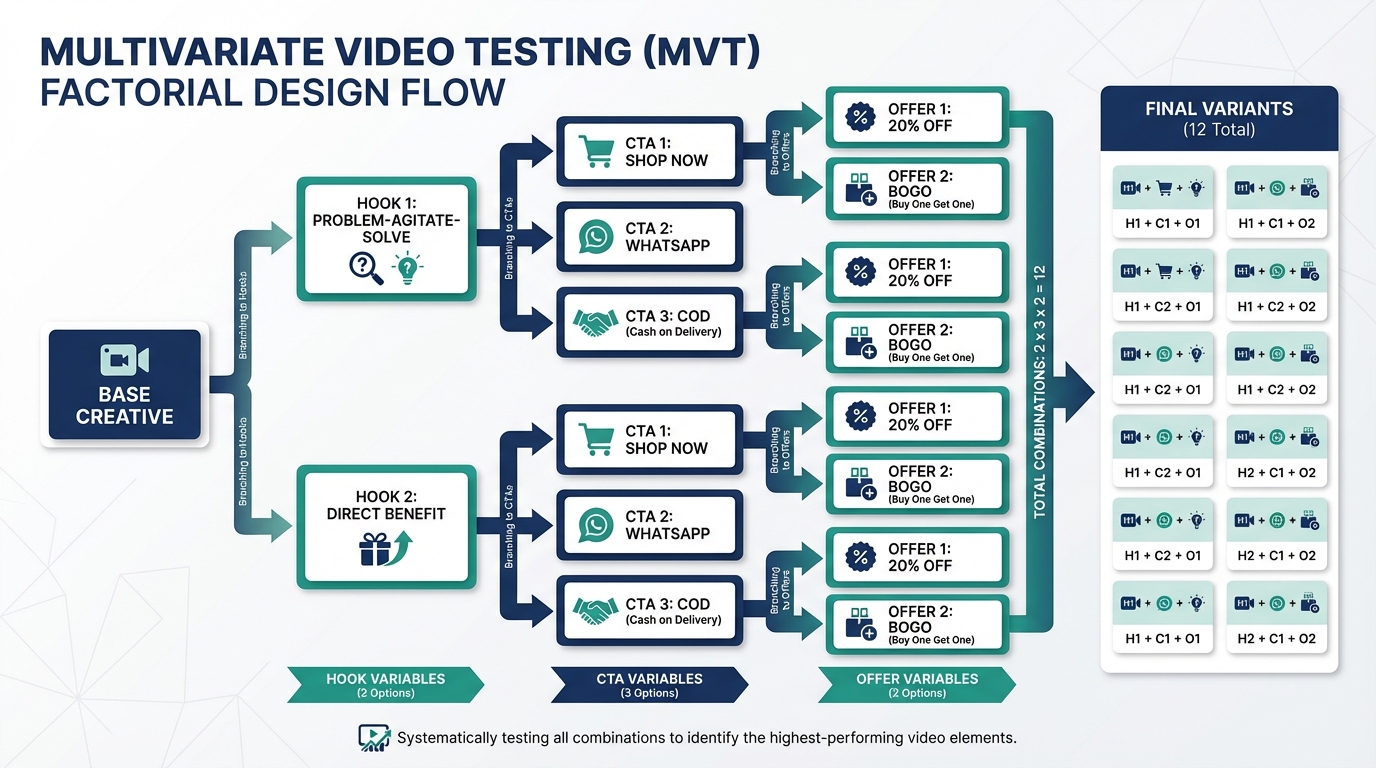
While simple A/B testing is useful for isolated variables, the multivariate video testing methodology is what separates market leaders from laggards in 2026. This approach allows you to estimate the main effects and interactions of multiple factors simultaneously—such as Hook style × CTA copy × Offer.
Factorial Design Patterns
For a D2C brand in India, a typical 2×3×2 MVT might look like this:
- Hook (2 variants): Problem-Agitate-Solve vs. Direct Benefit.
- CTA (3 variants): “Shop Now,” “WhatsApp Us,” “Order COD.”
- Offer (2 variants): “Flat 20% Off” vs. “Buy 1 Get 1.”
By using orthogonal encoding in filenames and UTMs, brands can feed this data into a video ad performance analytics framework to see exactly which combination drives the highest ROAS.
The Video Ad Testing Sample Size Calculator
One of the most common failures in creative testing is making decisions on insufficient data. To avoid false positives, marketers must use a video ad testing sample size calculator.
The Formula for Proportions (CTR/CVR): To calculate the required sample size (n) per arm: n = ((Z{alpha/2} + Z{beta})^2 × [p1(1 − p1) + p2(1 − p2)]) / (p1 − p2)^2
Where:
- p1 = Baseline conversion rate (e.g., 1.2%).
- p2 = Target rate based on Minimum Detectable Effect (MDE).
- Z{alpha/2} = Significance level (usually 1.96 for 95% confidence).
- Z{beta} = Power (usually 0.84 for 80% power).
Practical Example (Meta Reels India):
- Baseline CTR: 0.8%
- Target MDE: 20% relative lift (to 0.96%)
- Confidence: 95% | Power: 80%
- Required Clicks: ~3,800 per variant.
- Estimated Impressions (at 0.8% CTR): 475,000 per variant.
For validation of these metrics, tools like the AdTestingTools Sample Size Calculator provide a quick way to verify if your budget supports your testing ambitions.
4. Platform Playbooks: Meta and Google/YouTube 2026
The Meta video ad testing framework and the Google Video Experiments ecosystem have evolved significantly by 2026. Each requires a distinct tactical approach to maximize the AI video A/B testing framework India 2026.
Meta: The Exploration-Validation Loop
On Meta, the strategy is divided into two phases:
- Exploration: Use Ad Set Budget Optimization (ABO) with equal budgets across 5–8 variants. This prevents the algorithm from prematurely favoring one ad based on early, non-significant signals.
- Validation: Once a winner is identified with statistical significance video campaigns, it is moved into a Campaign Budget Optimization (CBO) or Advantage+ Shopping Campaign (ASC) for scaling.
In India, this must include “COD Reassurance” badges and WhatsApp-integrated CTAs, which have shown to increase conversion rates by up to 30% in the 2026 landscape. As noted by DWAO on Meta ad formats, the synergy between vertical video and interactive elements is the primary driver of ROAS.
Google & YouTube: Campaign Mix Experiments
Google has introduced “Campaign Mix Experiments” (beta 2026), allowing brands to test YouTube Shorts against Performance Max (PMax) allocations.
- Shorts Strategy: 9:16 aspect ratio, fast-cut edits (under 2s per cut), and creator-style framing. YouTube Shorts editor for Android in India
- PMax Integration: Using AI-generated video assets to fill the “video gap” in PMax campaigns, which often default to low-quality slideshows if high-quality video isn’t provided.
According to Search Engine Land’s 2026 update, these cross-campaign tests are essential for understanding the blended ROAS of a full-funnel video strategy.
5. The Automation Backbone: AI-Driven Creative Iteration
The core of a modern D2C creative testing platform India is the ability to iterate faster than the competition. This is where creative testing automation AI and AI video experiment automation become the engine of growth.
Closed-Loop Iteration
The goal is an “Insight-to-Brief” pipeline. If the data shows that “Hinglish” hooks outperform “English” hooks by 40% in North India, the system should automatically generate 10 new Hinglish variants with different background music or CTAs. Solutions like Studio by TrueFan AI demonstrate ROI through their ability to produce 1,000+ localized video variants in hours, a task that would take a traditional creative agency months.
TrueFan AI: Enterprise-Grade Testing
For Indian enterprises, the AI video A/B testing framework India 2026 requires more than just “cool” videos; it requires governance and scale. Studio by TrueFan AI provides:
- Batch Generation: Create hundreds of variants for MVT in one click.
- API-First Orchestration: Connect your testing framework directly to Meta and Google APIs for automated launching.
- Safety & Compliance: ISO 27001 and SOC 2 certifications ensure that brand assets and customer data are handled with enterprise-level security.
- Regional Excellence: Hyper-realistic AI avatars that can speak 175+ languages, ensuring your “India-first” strategy covers every corner of the country.
6. Governance, Compliance, and DPDP-Ready Frameworks
In 2026, the Digital Personal Data Protection (DPDP) Act 2023 is fully enforceable in India. Any AI video A/B testing framework India 2026 must be built with privacy and ethics at its core.
DPDP Compliance for Marketers
Marketers must ensure:
- Lawful Consent: Clear disclosure if AI is used to personalize content based on user data.
- Data Minimization: Only collecting the data necessary for the experiment.
- Right to Erasure: Ensuring that user data used for training or targeting can be deleted upon request.
The official MeitY DPDP Act text and DPO India’s 2025 guidelines emphasize that “Consent Managers” will play a huge role in how ads are served.
Ethical AI Governance
Beyond legalities, brand safety is paramount. 2026 consumers are wary of “deepfakes.” Transparent watermarking and the use of licensed AI avatars (like those provided by TrueFan AI) protect the brand from reputation risks. Automated content moderation filters must be active to prevent the generation of non-compliant or culturally insensitive content, which is a high risk in a diverse market like India.
7. Implementation SOP: Your 4-Week Roadmap to 5x ROAS
To implement the AI video A/B testing framework India 2026, follow this structured Standard Operating Procedure (SOP).
Week 1: Foundation and Hypothesis
- Define your primary KPI (e.g., ROAS) and MDE (e.g., 15% lift).
- Audit your tracking (CAPI, Pixel, UTM taxonomy).
- Write 10 hypotheses focusing on the “Hook” and “Offer.”
Week 2: Batch Production and Launch
- Use Studio by TrueFan AI to generate 12–15 video variants based on your hypotheses. InVideo vs Pictory for YouTube
- Set up ABO campaigns on Meta and Video Experiments on Google.
- Ensure budgets are sufficient to reach the sample size calculated in Section 3.
Week 3: Data Collection and Significance
- Monitor the “Thumb-Stop Ratio” daily.
- Do not make any changes to the campaigns.
- Use a Bayesian or Frequentist calculator to check for statistical significance video campaigns.
Week 4: Scale and Iterate
- Identify the winning creative “DNA.”
- Move winners to CBO/ASC campaigns with 70% of the total budget.
- Feed the learnings back into the AI creative iteration automation loop to start the next round of testing.
Sources:
- Ipsos: The State of Digital Marketing in India 2024-25
- Graas: Meta vs Google Ads Indian Festive Budget Allocation
- DWAO: Best Ad Formats for Meta Conversions in India
- Search Engine Land: Google Adds Cross-Campaign Testing (2026)
- MeitY: Digital Personal Data Protection Act 2023 Official Text
Recommended Internal Links
- Harnessing YouTube Shorts Automation AI
- The Ultimate Guide to Translating YouTube Videos to English with AI in 2025
- Viral Thumbnail Generator AI: Boost CTR for YouTube India
- YouTube Shorts editor Android India: budget AI picks
- InVideo vs Pictory for YouTube: Pricing, Features 2026
- AI YouTube Thumbnail Creator Hindi: Boost CTR in 2026
Frequently Asked Questions
How much budget should I allocate to the AI video A/B testing framework India 2026?
In 2026, we recommend a “70/20/10” rule. 70% of your budget goes to proven “Winner” creatives, 20% to testing variations of those winners (Iterative Testing), and 10% to “Wildcard” testing (completely new concepts or hooks).
How do I handle testing for the Indian festive season?
Start your testing 4–6 weeks before the peak (e.g., pre-Diwali). Use this time to identify the winning “Offer” and “Visual Style.” By the time CPMs spike during the festival, you should only be running your statistically proven winners. As Graas suggests, analytics-led decisioning is the only way to manage festive budget volatility.
Can I use AI avatars for high-ticket D2C products in India?
Yes. In 2026, AI avatars have reached a level of realism where they are indistinguishable from human creators. For high-ticket items, focus the AI on “Expert” or “Consultant” personas to build trust, and use regional languages to establish a local connection.
What is the most important metric for video hook testing optimization?
The “Thumb-Stop Ratio” (3-second views divided by total impressions). If you can’t stop the scroll in the first 3 seconds, the rest of your video—no matter how good—will never be seen. For better scroll-stopping visuals, see AI YouTube Thumbnail Creator in Hindi.
How does automation reduce the cost per experiment?
Platforms like Studio by TrueFan AI enable brands to bypass the costs of studio rentals, actors, and manual editing. By reducing the “Cost Per Variant” by up to 90%, you can afford to run 10x more experiments, which mathematically increases your chances of finding a 5x ROAS winner.