Ramadan Marketing Campaigns India 2026: Culturally Sensitive Personalization That Drives Revenue
Estimated reading time: ~12 minutes
Key Takeaways
- Build faith-first experiences that respect fasting, prayer, and charity while aligning promotions with Ramadan’s rhythms.
- Use 30-day journey mapping to sequence consent capture, trust-building, pre-iftar nudges, and Eid conversions.
- Deploy iftar offer video automation and hyperlocal inventory to time offers 60 minutes before local sunset.
- Personalize Eid fashion and gifts by region, price tiers, and history; leverage multilingual, celebrity-led videos.
- Scale with enterprise-grade video personalization and halal-aware recommendations to maximize ROI.
The landscape of festive commerce is undergoing a seismic shift as we approach the mid-2020s, with Ramadan marketing campaigns India 2026 set to be defined by a sophisticated blend of religious sensitivity and hyper-personalized automation. For enterprise retail and e-commerce leaders, the challenge lies in navigating the delicate balance between high-velocity sales and the profound spiritual significance of the Holy Month.
In 2026, the intersection of agentic AI and consumer expectations for “halal-first” digital experiences will separate market leaders from those who merely participate. Success requires more than just a change in creative assets; it demands a fundamental restructuring of the customer journey to align with the unique temporal and emotional rhythms of fasting, prayer, and community.
Platforms like TrueFan AI enable enterprises to bridge this gap by delivering personalized, language-accurate video content that respects the sanctity of the month while driving measurable conversion. This playbook provides the strategic framework necessary to master the 30-day journey, from suhoor-timed meal subscriptions to the final peak of Eid shopping.
1. Cultural Context and Religious Sensitivity Marketing in 2026
Understanding the temporal shift of Ramadan is the first step in effective planning. In 2026, Ramadan is projected to begin around February 18 or 19, with Eid al-Fitr falling near March 20. This timing places the Holy Month in a unique seasonal window in India, requiring brands to adjust their logistics and creative themes to account for regional weather patterns and earlier sunset times.
Religious sensitivity marketing is not merely a compliance checkbox; it is a commitment to “faith-first” framing. This involves recognizing Ramadan as the ninth month of the Islamic calendar, a time dedicated to sawm (fasting), salat (prayer), and zakat (charity). Enterprises must ensure their messaging reflects these values by prioritizing community and generosity over aggressive commercialism.
Operationalizing this sensitivity means adhering to strict “Do’s and Don’ts.” Brands should showcase authentic family gatherings and support local charity initiatives while avoiding appetite-triggering creatives during daylight hours. Furthermore, ensuring that all food-related promotions carry verified halal certifications is non-negotiable for maintaining trust with the Muslim consumer base.
Sources:
- Times of India: Ramadan 2026 expected dates and seasonal shifts
- Aladhan: New Delhi Ramadan 2026 prayer times
2. The 30-Day Customer Journey Mapping: From Awareness to Eid
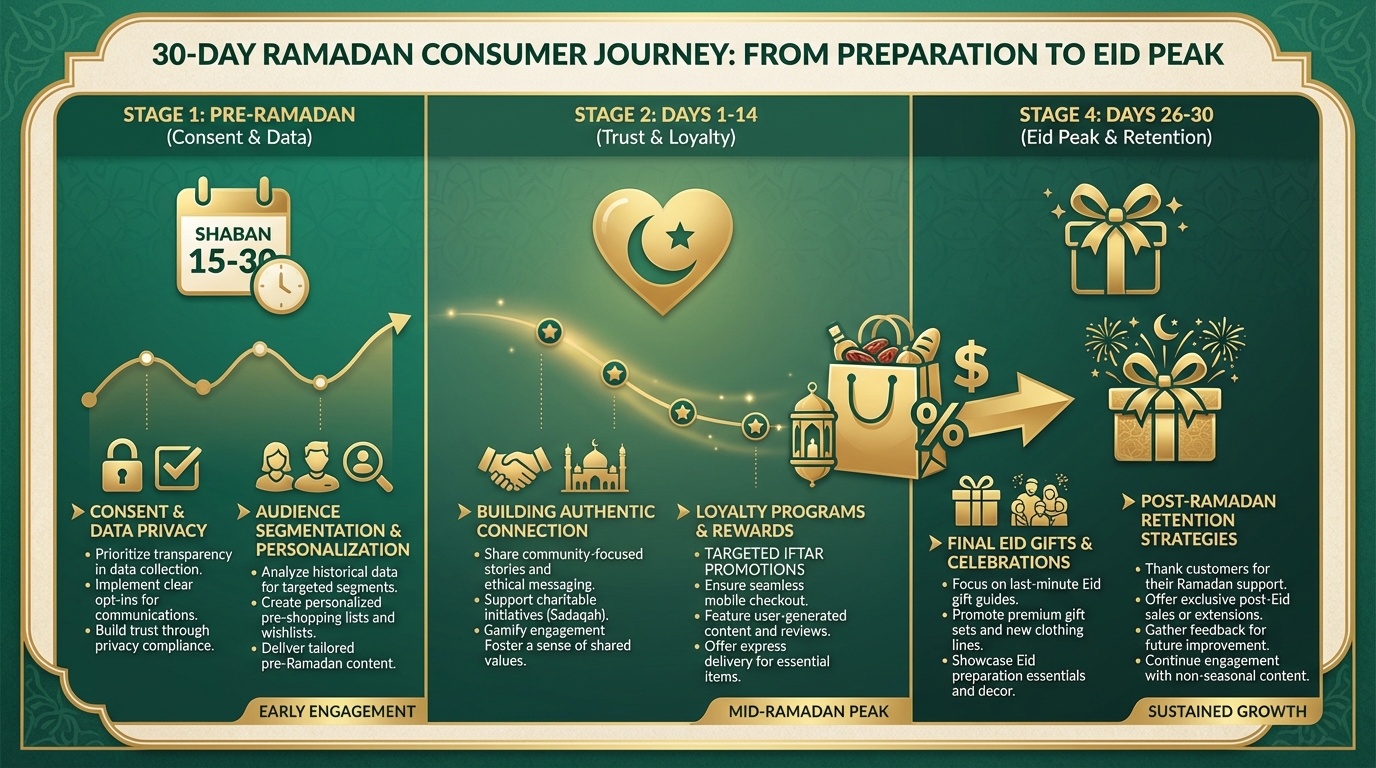
A successful 30-day customer journey mapping strategy for 2026 treats the Holy Month as a four-stage evolution of consumer intent. Enterprises must move away from static “Ramadan Sales” and toward a dynamic calendar that nudges users based on their spiritual and physical needs at each stage of the month.
Phase 1: Pre-Ramadan Warm-up (Feb 10–17)
The focus here is on consent and preference capture. Brands should use this window to refresh user data, identifying preferred languages, halal product categories, and clothing sizes. This is the optimal time to offer opt-ins for exclusive Ramadan deals via WhatsApp catalog video marketing and app notifications, ensuring that subsequent outreach is welcomed rather than intrusive.
Phase 2: Days 1–14 (Trust and Consideration)
The first two weeks are characterized by a focus on brand values and community. Content should highlight halal sourcing transparency and introduce Ramadan loyalty programs that reward consistent engagement. As consumers begin building their “Eid baskets,” brands should deploy gift guides and fashion previews, using suhoor-timed nudges (pre-dawn) to capture attention when digital noise is lowest.
Phase 3: Days 15–25 (Conversion Peak and Q-Commerce)
As the month progresses, the urgency for Eid preparation intensifies. This period sees a massive surge in quick commerce demand. See quick commerce festival marketing 2026 tactics. Enterprises must capitalize on this by deploying iftar offer video automation that triggers personalized deals exactly 60 minutes before local sunset times.
Phase 4: Days 26–30 (Eid Peak and Retention)
The final days are dedicated to Eid greeting personalization and last-mile logistics. Messaging should shift toward “last chance” delivery cut-offs and pickup windows. Post-purchase, the journey continues with “Thank You” videos and loyalty bonuses designed to convert seasonal shoppers into year-round brand advocates.
3. Iftar Offer Video Automation and Quick Commerce Iftar Delivery
The 2026 consumer expects immediacy, particularly during the high-stress window leading up to iftar. Quick commerce iftar delivery is no longer a luxury; it is a baseline expectation. To dominate this space, enterprises must integrate hyperlocal inventory personalization strategies with automated video generation to create a seamless path to purchase.
Iftar offer video automation allows brands to deliver time-sensitive, geo-targeted content. By utilizing API triggers linked to local sunset times, a brand can send a personalized video to a user in Mumbai at 6:15 PM and a user in Delhi at 5:45 PM, each featuring the specific items available in their nearest dark store. This level of precision reduces friction and significantly increases the Average Order Value (AOV).
Tactically, these videos should feature dynamic countdown overlays. A sample script might read: “As-salaam alaikum [Name], sunset in [City] is in 45 minutes. Your favorite Iftar platter is ready at our [Neighborhood] store. Order now to ensure delivery before the Maghrib prayer.” This approach combines religious respect with a clear, time-bound call to action.
Sources:
4. Eid Shopping Personalization Strategies and Fashion Marketing
As the focus shifts from fasting to celebration, Eid shopping personalization strategies must account for the diverse regional aesthetics of the Indian subcontinent. A “one-size-fits-all” approach to Eid fashion will fail in 2026; instead, brands must deploy dynamic lookbooks that reflect local styles, such as Lucknowi chikankari for North Indian markets versus specific silk traditions in the South.
Eid fashion collection marketing in 2026 will be driven by “try-and-buy” logistics and size-prediction AI. Personalized videos can showcase outfits based on a user’s past purchase history and style preferences. For instance, if a user has previously bought modest wear, the AI should prioritize high-end Abayas or long-form Kurtas in their personalized video feed, complete with local delivery cut-off times.
Furthermore, Ramadan gift recommendation videos serve as a powerful tool for cross-selling. By categorizing gifts into price tiers (e.g., ₹999, ₹2499, ₹4999) and recipient types (parents, siblings, children), brands can simplify the decision-making process. TrueFan AI's 175+ language support and Personalised Celebrity Videos can be leveraged here to have a recognizable figure deliver these recommendations in the user's native tongue, significantly boosting engagement and trust.
5. Halal Product Personalization and Zakat Automation
In an era of heightened consumer awareness, halal product personalization is a critical component of E-E-A-T (Experience, Expertise, Authoritativeness, and Trustworthiness). Enterprises must ensure that their recommendation engines are “halal-aware,” meaning they automatically filter out non-compliant products and highlight trust badges, certification bodies, and ingredient transparency in all marketing collateral.
This compliance extends to the financial aspects of the month. Zakat donation campaign automation allows enterprises to integrate charitable giving directly into the checkout flow. By providing automated, scheduled reminders during the last ten days of Ramadan (Ashra), brands can help users fulfill their religious obligations while demonstrating corporate social responsibility.
Community iftar sponsorship videos further solidify this bond. Brands that sponsor local masjids or community centers can use automated video updates to show the impact of these sponsorships. This localized storytelling, delivered through Muslim consumer engagement videos, fosters a sense of belonging and shared purpose that transcends traditional transactional relationships.
6. Scaling Enterprise ROI with TrueFan AI and 2026 Trends
The future of Ramadan marketing campaigns India 2026 lies in the ability to scale intimacy. As highlighted by Campaign Asia, 2026 marketing trends emphasize agentic creative optimization—AI that doesn't just generate content but iterates on it based on real-time performance data. This is where enterprise-grade video personalization for quick commerce becomes the ultimate competitive advantage.
Solutions like TrueFan AI demonstrate ROI through their ability to handle massive scale—such as rendering millions of personalized videos in a single day—while maintaining ISO 27001 and SOC 2 security standards. For an enterprise, this means the ability to launch a nationwide Eid campaign that feels like a 1-on-1 conversation with every single customer, regardless of their dialect or location.
Implementation Roadmap for Jan–Mar 2026:
- January: Data schema readiness. Ensure your CDP can trigger events based on language preference and halal attributes.
- Early February: Creative QA. Finalize video templates and ensure all 175+ language translations are culturally nuanced.
- Mid-February: Load testing. Simulate the pre-iftar traffic spikes to ensure that your iftar offer video automation triggers don't experience latency.
- March: Real-time optimization. Use performance data to swap out underperforming SKUs or adjust delivery messaging based on real-world logistics performance.
Sources:
Conclusion: The Path to Ramadan 2026 Success
Winning the Ramadan and Eid season in 2026 requires a shift from “broadcasting” to “listening.” By implementing a 30-day customer journey mapping strategy that respects the temporal and spiritual boundaries of the month, enterprise leaders can drive unprecedented loyalty and revenue.
The integration of iftar offer video automation, halal product personalization, and Eid greeting personalization creates a holistic ecosystem where the consumer feels seen, respected, and valued. As the digital landscape becomes increasingly crowded, the brands that leverage high-authority personalization tools will be the ones that define the future of festive retail in India.
Ready to scale your Ramadan 2026 strategy?
Book an Enterprise Demo with TrueFan AI today to see how our hyper-personalized video engine can transform your festive ROI.
Frequently Asked Questions
When should I start my Ramadan marketing campaigns for 2026?
Planning should begin in Q4 2025, with active data collection starting in January 2026. Launch a warm-up phase at least 7–10 days before the expected moon sighting around February 18, 2026.
How can I ensure my marketing is religiously sensitive?
Avoid showing eating or drinking during daylight hours. Focus on family, reflection, and charity. Clearly mark halal certifications for food and offer easy opt-outs for Ramadan-specific communications.
What role does video play in Eid shopping personalization strategies?
Video showcases texture, fit, and styling effectively. Personalized videos mentioning the user’s name and preferred size can lift click-through rates by 17%+ in enterprise benchmarks.
Can TrueFan AI handle the scale of a national Eid greeting campaign?
Yes. TrueFan AI supports rendering millions of personalized videos, 175+ languages, and integrates with CRM and WhatsApp Business API, meeting ISO 27001 and SOC 2 standards.
What are the peak hours for quick commerce during Ramadan in India?
Expect significant surges between 5:30 PM–7:00 PM (pre-iftar) and 3:30 AM–4:30 AM (suhoor) for meal subscriptions, fresh produce, and essentials.