AR Try-On Video Marketing India 2026: Cut Returns by 40% and Boost Conversions with Immersive Shopping Experiences
Estimated reading time: 8 minutes
Key Takeaways
- AR try-on videos deliver immersive shopping experiences that boost conversion and reduce returns across fashion, jewelry, beauty, and eyewear.
- AR return reduction strategies close the “expectation vs. reality” gap, enabling 20–40% fewer returns and higher customer confidence.
- A robust asset toolkit—augmented reality shopping videos and 3D product interaction—should be deployed omnichannel for maximum impact.
- Enterprise success depends on virtual product experience personalization, governance, and scalable implementation across SKUs and journeys.
- Follow a phased 2026 AR roadmap from pilot to continuous optimization to prove ROI and scale effectively.
In India’s 2026 e-commerce landscape, AR try-on video marketing India 2026 is a critical CX and P&L lever—unlocking immersive shopping experiences that boost conversion and reduce returns across fashion, jewelry, beauty, and eyewear. As the digital economy matures, brands are moving beyond static images toward interactive, video-first environments that bridge the gap between digital browsing and physical trial.
The shift toward augmented reality is no longer a luxury for premium brands but a fundamental requirement for any enterprise seeking to dominate the Indian market. With the rapid expansion of 5G infrastructure and a consumer base that increasingly demands high-fidelity product interactions, the integration of AR into the marketing mix has become the primary differentiator for market leaders.
1. The 2026 Breakout: Why AR Try-On Videos are Redefining Indian Retail
The convergence of AI-led personalization, the explosion of retail media, and the ubiquity of 5G has created a “perfect storm” for augmented reality shopping videos. By 2026, India’s advertising market is projected to reach ₹1.15 lakh crore, with a significant portion of digital spend shifting toward immersive formats that offer measurable utility rather than just impressions.
Consumer behavior in India has recalibrated toward “discovery-based commerce,” where the journey from social media scrolling to purchase is compressed. In this environment, 3D product interaction videos serve as the bridge, providing the tactile reassurance that was previously missing from online shopping. The ability to visualize a product in one's own environment or on one's own body in real-time is the ultimate friction-reducer.
Furthermore, the rise of the metaverse and spatial computing has primed Indian consumers for these experiences. Platforms like TrueFan AI enable brands to orchestrate these complex, high-fidelity interactions at an enterprise scale, ensuring that the technology is accessible across various device tiers, from budget smartphones to high-end devices.
The macro tailwinds are clear: the AR/VR market in India is accelerating at an unprecedented rate, driven by a mobile-first population that spends an average of six hours a day on digital platforms. Brands that fail to adopt AR try-on video marketing India 2026 strategies risk obsolescence as competitors offer more transparent, engaging, and accurate shopping journeys.
2. The Business Case: AR Return Reduction Strategies and Conversion Optimization
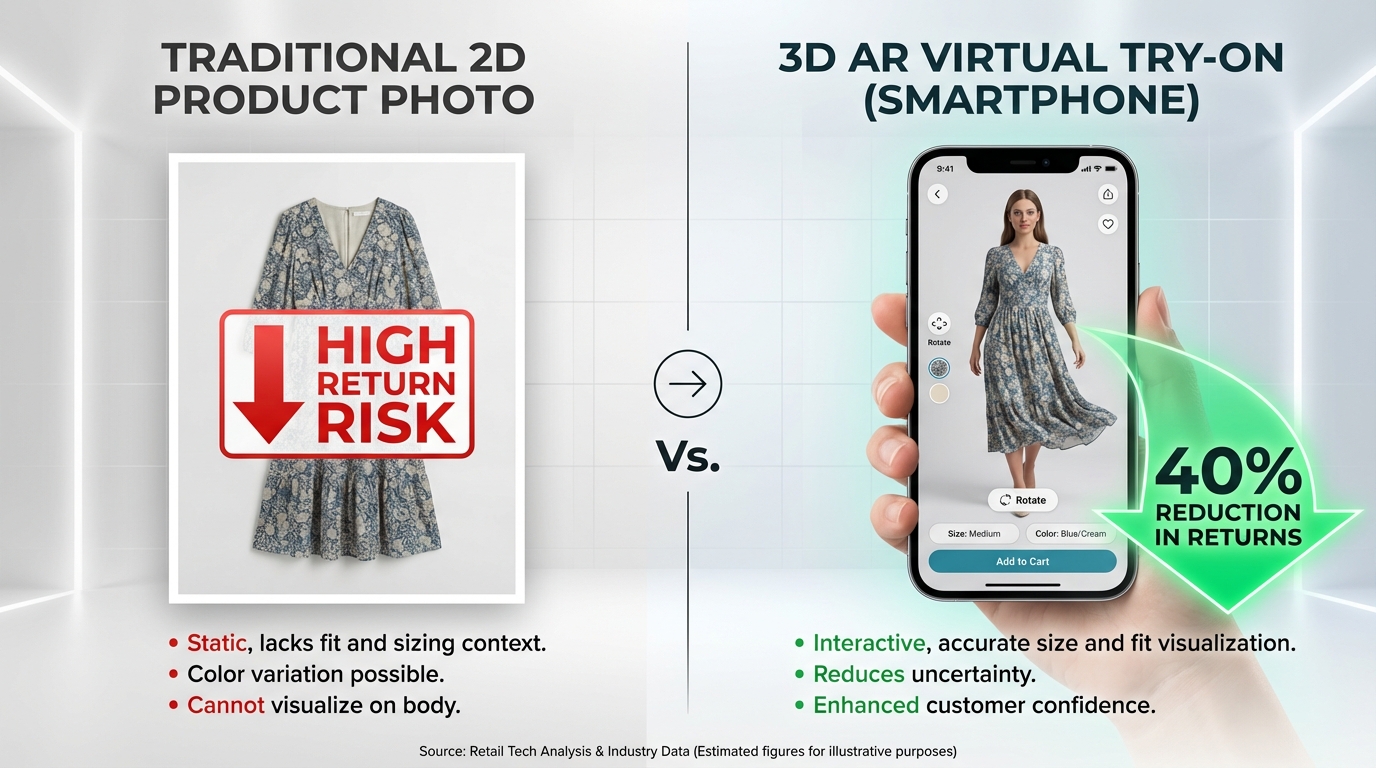
For Indian e-commerce enterprises, the two most significant hurdles to profitability are high Return-to-Origin (RTO) rates and low conversion on high-consideration items. AR return reduction strategies address the root cause of these issues: the “expectation vs. reality” gap. By providing a photorealistic virtual trial, brands can ensure that the customer has a precise understanding of fit, color, and scale before the transaction occurs.
AR conversion optimization India focuses on leveraging these interactive assets to drive intent. Data from 2026 pilots indicates that brands utilizing AR try-on features see a 30–40% higher purchase intent compared to those using traditional photography. This is particularly effective in the Indian context, where “touch and feel” is a deeply ingrained part of the shopping culture.
The financial impact of reducing returns by even 10% is massive for large-scale retailers. When you factor in the logistics costs, refurbished inventory losses, and the carbon footprint of reverse logistics, AR becomes a sustainability initiative as much as a commercial one. By implementing immersive shopping experiences, brands can target a 20–40% reduction in return rates, directly impacting the bottom line.
Moreover, the Average Order Value (AOV) typically sees a lift of 15–20% when AR is involved. This is because customers feel more confident in bundling products—such as matching a lipstick shade with a foundation or pairing earrings with a necklace—when they can see the combined effect in a virtual showroom personalization setting.
3. The Asset Toolkit: Augmented Reality Shopping Videos and 3D Interaction
To execute a successful AR try-on video marketing India 2026 strategy, brands must develop a robust toolkit of digital assets. This begins with augmented reality shopping videos—shoppable, short-form content that overlays AR elements directly onto the user's camera feed. These videos allow for a “try-before-you-buy” experience natively within mobile apps or web browsers.
Complementing these are 3D product interaction videos. Unlike static 360-degree spins, these are interactive viewers that allow users to manipulate the product, zoom in on craftsmanship, and see how materials react to real-time lighting. For an enterprise, these assets must be exportable as high-performance WebGL or glTF viewers to ensure they load instantly on India’s diverse range of mobile devices.
Deployment of these assets should be omnichannel:
- Product Detail Pages (PDPs): Embed a prominent “Virtual Try-On” button alongside the traditional image gallery.
- Social Media & Ads: Use AR “before and after” sequences in Instagram Reels or YouTube Shorts to stop the scroll.
- Messaging Platforms: Leverage WhatsApp Business API to send click-to-AR flows, allowing customers to preview products without leaving the chat.
4. Industry Playbooks: Tailoring AR for Fashion, Eyewear, Jewelry, and Beauty
Each retail vertical requires a nuanced approach to AR try-on video marketing India 2026. A one-size-fits-all strategy fails to account for the specific anxieties and decision-making processes of different consumer segments.
Fashion: Virtual Fitting Rooms and Sizing Automation
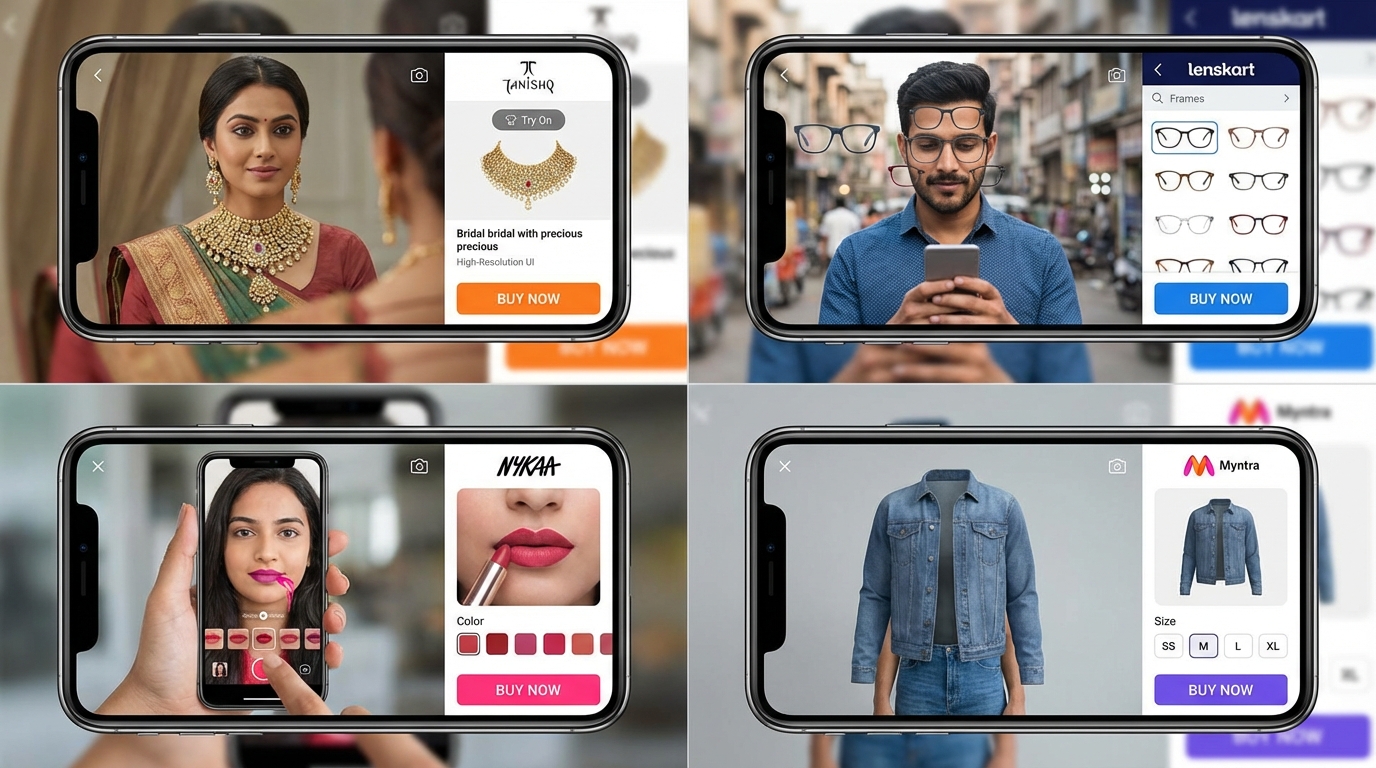
In the apparel sector, virtual fitting room campaigns are the gold standard. These campaigns use camera-based silhouette overlays to help users preview how a garment drapes on their specific body type. To further reduce returns, brands are integrating virtual sizing recommendation automation. By analyzing historical return data and user-provided measurements, the system can auto-suggest the perfect size directly within the AR overlay. This level of fashion AR video campaigns ensures that the customer isn't just seeing the style, but confirming the fit.
Eyewear: Frame Confidence and PD Capture
Eyewear brands like Lenskart have pioneered eyewear virtual try-on videos. In 2026, the focus has shifted toward “fit confidence” scores and automated Pupillary Distance (PD) capture. By providing a 3D comparison of different frame shapes on the user's face, brands can significantly increase the conversion rate for high-index lenses and premium frames. The UX now includes recorded 20-second clips that users can share with friends for feedback, further socialising the shopping experience.
Jewelry: High-AOV Visualization and Showrooms
For high-ticket items, jewelry visualization marketing India relies on photorealistic rendering of precious metals and gemstones. The challenge is capturing the “sparkle” and scale accurately. virtual showroom personalization allows customers to enter a curated digital space where they can try on entire collections based on their regional tastes or upcoming occasions (e.g., wedding season). This immersive approach is vital for building the trust required for high-AOV transactions online.
Beauty: Shade Matching and Makeup Application
The beauty industry has seen a revolution through AR beauty try-on automation. Using advanced face-landmark tracking, brands like Nykaa allow users to test hundreds of lipstick shades or foundation colors in seconds. Virtual makeup application marketing takes this further by offering “complete look” tutorials where users can apply a full face of makeup virtually and then “add all to cart” with a single tap. This reduces the primary barrier in beauty e-commerce: the fear of a shade mismatch.
5. Enterprise Scale: Personalization and Implementation
Scaling AR across thousands of SKUs and millions of users requires a sophisticated orchestration layer. Virtual product experience personalization is the process of tailoring these AR interactions based on the user's unique profile. This includes dynamic voiceovers in regional languages, personalized offers based on past purchase history, and even adjusting the lighting of the AR environment to match the user's current location.
TrueFan AI's 175+ language support and Personalised Celebrity Videos provide the infrastructure for this level of hyper-personalization. By integrating with an enterprise's CRM and CDP, the platform can trigger personalized AR try-on videos at critical moments in the customer journey, such as after a cart abandonment or as part of a loyalty reward program.
Implementation at the enterprise level also demands rigorous governance. Security standards like ISO 27001 and SOC 2 are non-negotiable when handling user biometric data (like face scans). Furthermore, the ability to perform “virtual reshoots”—updating the promotional content or offers within an AR experience without needing to re-render the entire asset—is crucial for maintaining agility in the fast-paced Indian market.
6. The 2026 Roadmap: From Pilot to Continuous Optimization
Transitioning to an AR-first marketing strategy should be executed in phases to ensure measurable ROI at every step. The AR try-on video marketing India 2026 roadmap typically follows a four-stage progression:
- Phase 1: The Pilot (Months 1-3)
Select 1–2 high-impact categories (e.g., best-selling eyewear or bridal jewelry). Deploy AR try-on for the top 50 SKUs and establish a baseline for conversion and return rates. - Phase 2: Scaling (Months 4-8)
Expand the AR capabilities to the entire category. This is where virtual sizing recommendation automation should be introduced to tackle fit-related returns. - Phase 3: Automation (Months 9-12)
Implement trigger-based journeys. For example, if a user views a watch three times without purchasing, trigger a personalized AR video showing the watch on a wrist, delivered via WhatsApp. - Phase 4: Continuous Optimization (Ongoing)
Use multivariate testing to refine the experience. Test different lighting models, CTA placements, and even the “virtual salesperson” avatars.
Frequently Asked Questions (FAQ)
Do AR try-ons actually reduce return rates in India?
Yes, they are highly effective. Indian brands adopting AR try-ons report 20–40% return reductions. This is achieved through better fit/shade visualization and virtual sizing recommendation automation.
What’s the best way to measure AR conversion optimization in India?
Track Video Through Rate (VTR), add-to-cart rate specifically from the try-on interface, conversion rate uplift versus non-AR journeys, and the delta in Average Order Value (AOV). Also monitor return rate changes and RTO impact.
How well do AR try-ons perform on budget smartphones and variable networks?
Modern AR pipelines use lightweight assets (e.g., optimized WebGL/glTF) and adaptive streaming to ensure smooth performance on budget Android devices and fluctuating 4G/5G networks. Preloading and compression further reduce latency.
What data privacy standards should brands follow for face scans and biometrics?
Adhere to ISO 27001 and SOC 2 controls, minimize data retention, use on-device processing where possible, and secure consent with clear disclosures. Encrypt data in transit and at rest, and allow easy opt-outs.
Where should AR try-on be integrated in the customer journey?
Prioritize Product Detail Pages (PDPs), then extend to social ads, WhatsApp click-to-AR flows, and post-purchase experiences. Use personalization triggers from CRM/CDP to time AR nudges for maximum impact.