Corporate training video AI for enterprises: Personalized learning, multilingual scale, and 90% time reduction
Estimated reading time: ~9 minutes
Key Takeaways
- Corporate training video AI automates scripting, production, and localization, enabling up to 90% faster training content delivery.
- Personalized learning videos adapt by role, skill, and region while scaling to 175+ languages with accurate lip-sync and voice cloning.
- Enterprises can automate day-0 to day-90 onboarding and ongoing engagement via HRIS-triggered, role-specific video workflows.
- Governance and compliance are enforced through audit logs, RBAC, SSO/SCIM, and consent-first use of virtual instructors.
- Proven ROI includes better time-to-proficiency, higher completion rates, and measurable engagement lifts across global teams.
CHROs and Heads of L&D currently face a mandate to achieve faster creation, personalization, and compliance at a global scale without increasing headcount. With corporate training video AI, enterprises can now auto-generate personalized learning videos, automate day-0 to day-90 onboarding, and localize content to 175+ languages. This shift enables a 90% time reduction training model that directly impacts executive metrics like time-to-proficiency, completion rates, and employee engagement.
The Evolution of Corporate Training Video AI: From Static to Strategic
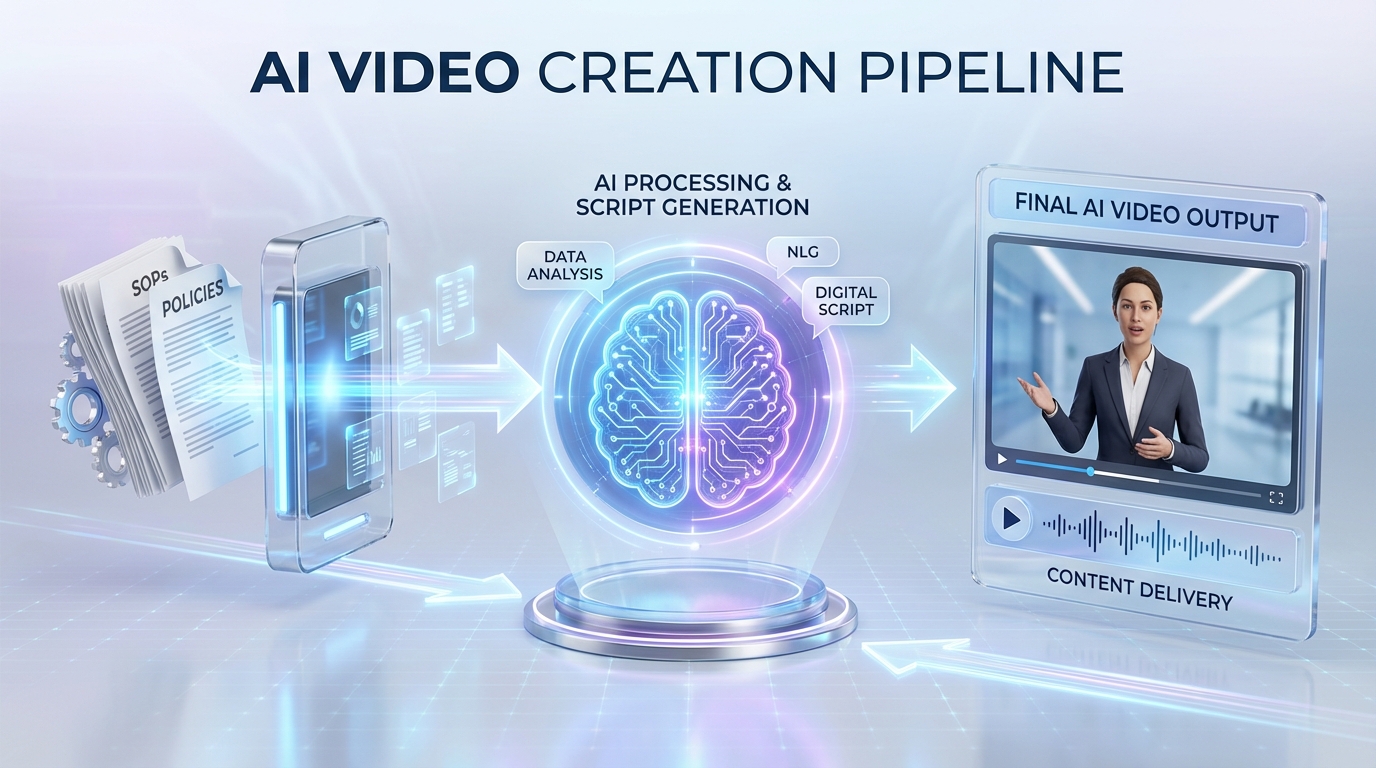
Corporate training video AI represents the use of generative and agent-based AI to transform raw inputs into branded training assets. This technology parses policies, SOPs, and HRIS data to automate scriptwriting, on-brand voice synthesis, and multilingual localization. Platforms like TrueFan AI enable enterprises to move beyond traditional production bottlenecks by using diffusion-based face reanimation and voice cloning.
The core pipeline of this technology begins with content ingestion and knowledge extraction. AI agents chunk complex policy documents into skills-based modules, ensuring that every video aligns with specific compliance topics. Following this, the system generates role-specific scripts with variable placeholders for names, roles, and regional data.
Synthetic presenters and virtual instructor AI then deliver this content using consented talent or leadership likenesses. These avatars maintain brand tone while providing auto-captioning and accessibility layers for a diverse workforce. The final stage involves multilingual rendering, where text and voice are translated into target locales with perfect lip-sync integrity.
Enterprise-grade stacks now require alignment with SSO/SCIM, RBAC, and strict audit logs to ensure data residency. By 2026, industry data suggests that AI will be integrated into approximately 43% of all corporate learning systems. This integration allows for under-30-second rendering latency, making real-time content updates a reality for global organizations.
Sources:
- People Matters: The future of learning & development: 2026 and beyond
- iSpring: eLearning Statistics for 2026: Corporate Trends and Insights
- TrueFan AI: Enterprise Generative AI Solutions
Automating the Employee Lifecycle: Onboarding and Engagement at Scale
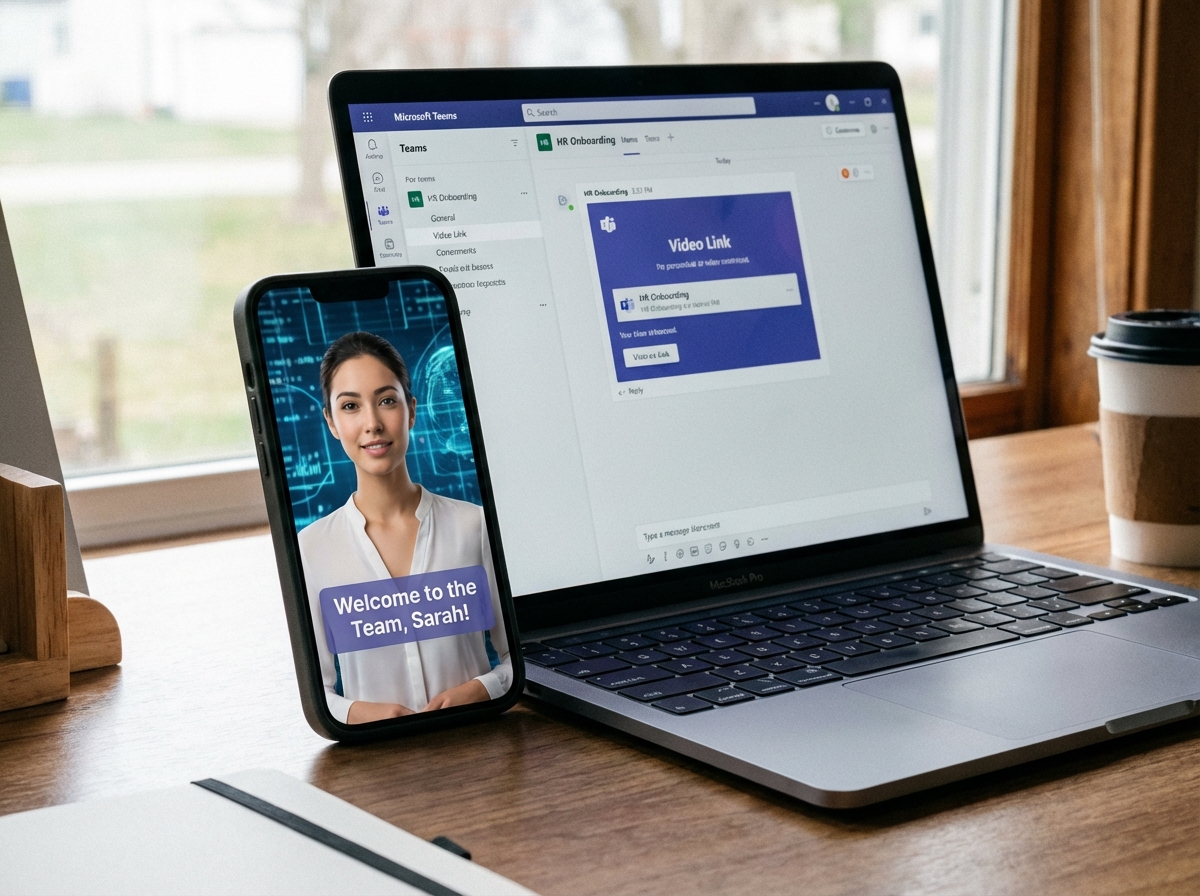
Automated employee onboarding videos are AI-generated modules triggered by specific HRIS events, such as an offer acceptance or IT provisioning. These videos guide new hires from day-0 to day-90, providing personalized introductions to company culture, facilities, and role-specific milestones. By automating this flow, managers save hundreds of hours typically spent on repetitive orientations.
The workflow begins when an HRIS event calls a video generation API with tokens for the hire's name, manager, and start date. The resulting content includes company policies and IT setup guides, often featuring a welcome message from the CEO. These videos are distributed via Teams, Slack, or WhatsApp, ensuring the employee receives the right information at the right time.
Employee engagement videos further enhance this lifecycle by providing personalized recognition and leadership messages. These are timed to milestones, wins, and pulse survey insights to maintain high sentiment across remote teams. In 2026, 85% of enterprises are expected to use AI agents for role-specific training and engagement.
Tracking these interactions allows L&D leaders to identify early attrition risks and engagement signals. View-through rates and quiz scores are surfaced to managers, allowing for data-driven interventions. This automated approach ensures that every employee, regardless of location, receives a consistent and high-quality introduction to the organization.
Sources:
- People Matters: How microlearning and LXPs are shaping corporate training
- Dataversity: Data Management Trends in 2026
- People Matters: Inside Amazon India’s talent transformation
Personalized Learning and Multilingual Training Content: The Global Enterprise Standard
Personalized learning videos are dynamically generated modules that adapt content, difficulty, and language to a learner’s proficiency. These experiences use inputs like role, location, and prior assessment performance to scale difficulty in real-time. TrueFan AI's 175+ language support and Personalised Celebrity Videos demonstrate how global brands can maintain a consistent voice across diverse markets.
Multilingual training content is no longer just about translation; it involves cultural adaptation and accurate pronunciation. AI ensures that on-screen text, metric formats, and scenarios are localized for regional offices, improving comprehension and inclusivity. This is particularly vital for PAN-India rollouts where language diversity is a significant barrier to traditional training.
Microlearning video automation supports this by converting long-form SOPs into 2–5 minute, objective-aligned clips. These "right-sized" modules are delivered in the flow of work, featuring interactive prompts every 60–90 seconds. This method has been shown to increase knowledge retention by up to 40% compared to traditional long-form video.
The ROI of this approach is visible in the reduction of rework and errors across the workforce. By providing content in a learner's native tongue and at their specific skill level, enterprises see a significant lift in CSAT scores. Managers can also use A/B testing on script lines to determine which instructional styles drive the best performance outcomes.
Sources:
The AI-Powered L&D Platform: Governance, Security, and Compliance
An AI-powered L&D platform functions as an enterprise learning stack where generative copilots accelerate content creation. This architecture includes a knowledge layer for SOPs, an intelligence layer for skill taxonomy, and an orchestration layer for delivery. These platforms integrate directly with LMS and LXP systems to automate the assignment of refreshers and nudges.
Compliance training automation is a critical component of this stack, ensuring that training is always current and audit-ready. When a policy or regulation changes, the AI detects the update and auto-generate a "delta" module. This module is then pushed to relevant employees with automated deadlines and attestation tracking.
Security and privacy are paramount in these systems, requiring ISO 27001 and SOC 2 certifications. Content governance includes template approval workflows and moderation filters to block unapproved or offensive material. Audit logs maintain a clear lineage of every content version, ensuring that the organization is always ready for regulatory inquiries.
By 2026, the demand for responsible AI use guidelines will drive significant investment in data management processes. Enterprises must ensure that any synthetic media used for training is backed by a consent-first framework. This protects the brand from legal risks while maintaining the trust of the employees being trained.
Sources:
Virtual Instructor AI: Human Presence and Ethical Automation
Virtual instructor AI utilizes consented synthetic presenters to deliver lessons and micro-coaching with a consistent brand tone. These presenters can be modeled after company leaders, SMEs, or external talent to provide a human-centric feel to automated training. Use cases range from CEO welcome messages to safety drill simulations and sales pitch practice.
The ethical use of this technology requires a consent-first model where every likeness is used under a formal contract. Visible disclosures and content watermarking are essential to distinguish synthetic media from live-action footage. This transparency builds trust and prevents the misuse of leadership likenesses for unapproved messaging.
These virtual instructors allow for "virtual reshoots," enabling L&D teams to iterate on scripts without re-filming. If a product feature changes, the AI can alter the presenter's speech and lip movements in existing footage. This agility ensures that training content never becomes obsolete, even in fast-moving industries.
In 2026, the focus will shift toward human-centric L&D augmented by AI, where technology handles the scale and humans handle the strategy. Virtual instructors provide the "face" of the organization at a scale that was previously impossible. This results in higher engagement rates, as learners respond more positively to a human presence than to text-based modules.
Sources:
Measuring the Impact: 90% Time Reduction Training and ROI Benchmarks
Solutions like TrueFan AI demonstrate ROI through a 90% time reduction training model that cuts production cycles from weeks to hours. Traditional video production involves briefs, scripts, shoots, and manual localization, often taking 4–6 weeks per module. AI-enabled production automates these steps, allowing for rapid iteration and deployment across global teams.
Evidence of these efficiency gains is found in the thousands of creative hours saved by enterprise partners. For instance, one major brand reported saving 3,888 hours of production time by using AI-generated revisions instead of traditional editing. This speed-to-market allows organizations to respond to market changes or internal policy updates almost instantly.
Key performance indicators (KPIs) for these platforms include time-to-proficiency, completion rates, and cost per completed learner hour. Real-world data shows that personalized video nudges can result in 17% higher read rates on communication platforms like WhatsApp. Furthermore, participation in training contests can increase by 3.2x when invitations are delivered via personalized video.
An implementation roadmap typically begins with a 30-day pilot focusing on a high-impact use case like compliance. By day 60, the organization scales to multilingual content and integrates HRIS triggers for automated onboarding. By day 90, the system is optimized through A/B testing and deep analytics, delivering a fully automated learning ecosystem.
Sources:
Executive FAQ: Navigating the AI Video Transformation
What is corporate training video AI and how is it different from traditional production?
Corporate training video AI uses generative models to automate the entire video creation process, from scripting to rendering. Unlike traditional production, which requires physical shoots and manual editing, AI allows for instant localization and personalization. This results in a 90% time reduction training capability for global enterprises. See an overview of corporate training video AI.
How do we automate compliance training without compromising audit readiness?
Automation is achieved by linking the AI platform to internal policy monitors. When a change is detected, the system generates a delta module and assigns it to the relevant workforce. TrueFan AI ensures audit readiness by maintaining detailed logs of every video generated, including timestamps and learner attestations.
What is a virtual instructor AI and how do we ensure ethical use?
A virtual instructor is a synthetic presenter created from the likeness of a consented individual. Ethical use is ensured through formal contracts, clear disclosure that the content is AI-generated, and moderation filters. These filters prevent the avatar from being used to generate unapproved or harmful content.
How do we ensure multilingual training content is accurate and culturally appropriate?
Accuracy is maintained through advanced voice cloning and lip-sync technology that retains the original speaker's tone. Cultural appropriateness is managed by involving regional SMEs in the template review process. This ensures that idioms, formats, and examples resonate with the local workforce. Explore best practices for multilingual training content.
What results can CHROs expect in 90 days?
Within 90 days, enterprises typically see a 70–90% reduction in video production costs and time. Completion rates for mandatory training often see a 20–30% lift due to the personalized nature of the content. Additionally, time-to-proficiency for new hires is significantly reduced through automated onboarding flows.
Conclusion
The transition to corporate training video AI is no longer a luxury but a necessity for enterprises operating at scale. By integrating an AI-powered L&D platform, organizations can deliver personalized learning videos and multilingual training content that drives real business outcomes. The future of L&D is automated, personalized, and human-centric.
Sources:
Frequently Asked Questions
What is corporate training video AI?
It is the use of generative and agent-based AI to convert policies, SOPs, and HRIS data into branded training assets—automating scripting, presenters, voice, and localization. This enables rapid, consistent learning content across regions and roles.
How does it reduce production time by 90%?
AI automates traditionally manual steps—briefs, scripts, shoots, edits, and localization. Virtual reshoots update scripts and lipsync without filming, shrinking cycles from weeks to hours while preserving brand standards.
How is compliance and governance managed?
Enterprise platforms support SSO/SCIM, RBAC, audit logs, and approval workflows. When policies change, AI generates “delta” modules with deadlines and attestations, maintaining an auditable trail for regulators.
Is multilingual localization accurate?
Yes. Advanced voice cloning and lip-sync ensure natural delivery, while regional SMEs validate terminology, formats, and examples. Content scales across 175+ languages with cultural adaptation.
What results can L&D expect in 30/60/90 days?
In 30 days, launch a compliance pilot; by 60, scale to multilingual and HRIS-triggered onboarding; by 90, optimize with A/B testing and analytics—achieving faster time-to-proficiency and higher completion rates.



