Cross-selling automation videos 2026: Behavioral AI playbook to maximize AOV in enterprise e-commerce
Estimated reading time: ~14 minutes
Key Takeaways
- 2026 marks the shift to video-first cross-selling, powered by real-time, shoppable personalization.
- A robust AI product recommendation engine connects behavioral signals to dynamic video CTAs and scenes.
- Complementary and intelligent bundling videos lift AOV via lifecycle-aware segmentation.
- A 30-60-90 rollout drives measurable cross-sell conversion optimization and margin-weighted results.
- Enterprise success requires governance, consented data use, and multi-channel orchestration (including WhatsApp).
The landscape of digital commerce has shifted from static product grids to dynamic, motion-first experiences where cross-selling automation videos 2026 serve as the primary engine for average order value growth. Enterprise leaders are no longer satisfied with basic “frequently bought together” text links; they are now deploying an AI product recommendation engine to generate shoppable, hyper-personalized video content in real-time. By leveraging customer value maximization through recommendation engine videos, brands can transform passive browsing into high-intent purchasing cycles across WhatsApp, PDP overlays, and post-purchase journeys.
1. Why 2026 is the inflection point for cross-selling automation videos 2026
The convergence of short-form video (SFV) dominance and generative AI has reached a critical mass, making 2026 the year video becomes the default format for cross-sell and upsell logic. In the Indian ecosystem, the rapid expansion of video commerce has fundamentally altered how consumers discover products, moving away from search-based intent toward discovery-led browsing. This shift necessitates personalized upsell video campaigns that mirror the aesthetic of social media while maintaining the transactional rigor of enterprise e-commerce.
Data suggests that India’s live commerce and shoppable video market is projected to reach a staggering $4–5 billion by 2027, driven by a consumer base that prioritizes authenticity and creator-led content. As brands move toward revenue expansion automation, the ability to overlay behavioral cross-sell triggers onto short-form video assets allows for a frictionless transition from engagement to conversion. This trend is particularly potent on platforms like WhatsApp, where conversational commerce and personalized video delivery accelerate decision-making for high-consideration categories.
Furthermore, purchase pattern targeting has evolved from simple historical analysis to real-time predictive modeling. Merchants are now using product discovery personalization to ensure that every video served is contextually relevant to the user's current session and long-term affinity. This level of automation reduces the creative bottleneck, allowing enterprises to scale thousands of unique video variants that address specific customer segments with surgical precision.
Sources:
- Redseer: India’s short-form video market and video commerce
- Exchange4media: Why Indian e-commerce is becoming a media business
- IBEF: India’s live commerce industry growth projections
- Shopify India: 2026 e-commerce trends and predictions
2. Architecture of an AI product recommendation engine for video
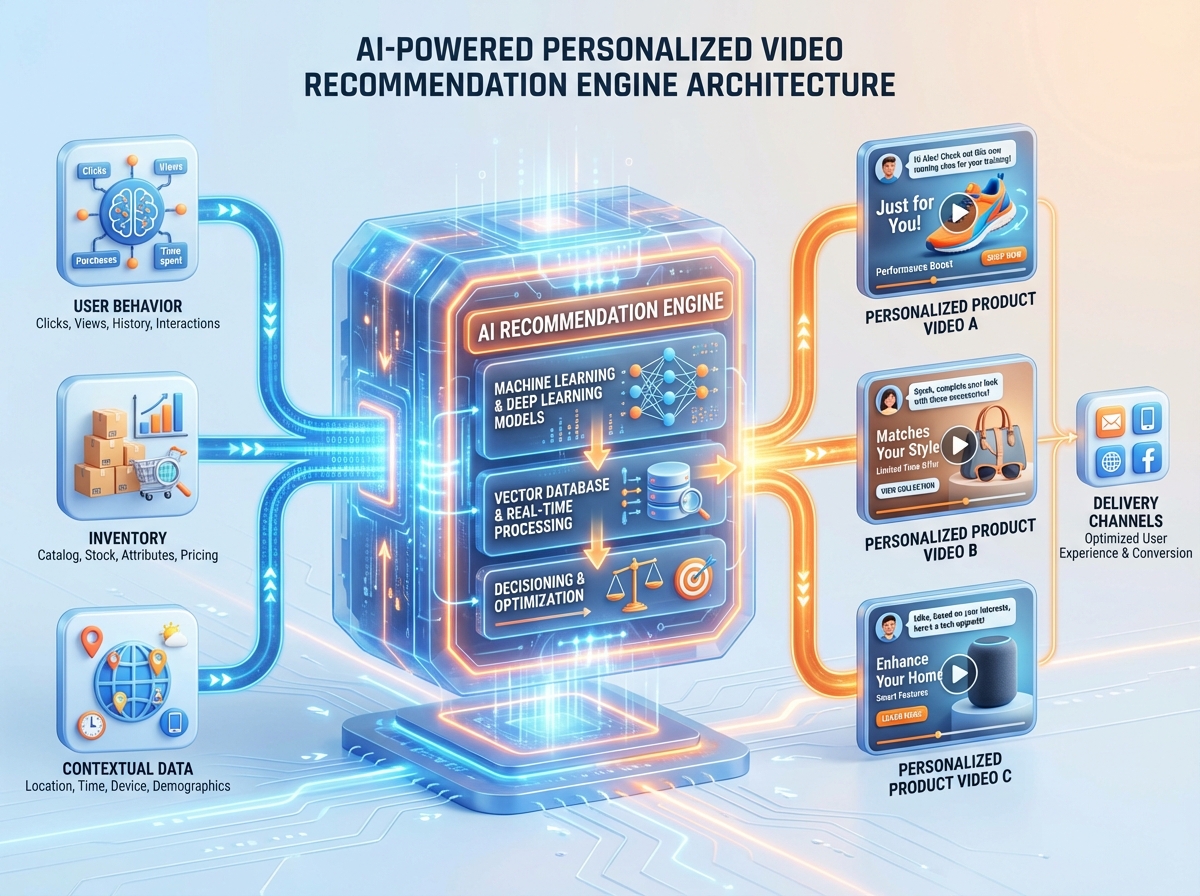
To achieve sustainable average order value growth, an enterprise must build a robust data architecture that bridges the gap between raw behavioral signals and creative output. The AI product recommendation engine acts as the central nervous system, ingesting multi-dimensional data streams—including product catalogs, inventory levels, margin data, and real-time event streams—to compute the next-best-action for every user. This engine does not merely suggest products; it generates the logic that populates recommendation engine videos with dynamic scenes and personalized CTAs.
A sophisticated purchase behavior analysis framework is essential for identifying the optimal timing for a cross-sell intervention. By analyzing PDP dwell time, cart addition sequences, and historical return rates, the system can determine whether a user is a prime candidate for complementary product videos or if they require a more complex bundle offer. This decisioning layer uses collaborative filtering and co-purchase graphs to ensure that the recommended items are not just related, but are statistically likely to increase the total basket value without cannibalizing the primary purchase.
The creative assembly process is where the technical meets the tactical. Once the recommendation engine identifies the target items, it triggers a video rendering pipeline that populates pre-defined “product slots” within a high-quality video template. These personalized upsell video campaigns can include localized voiceovers, dynamic pricing overlays, and even user-specific loyalty rewards. This end-to-end automation ensures that the creative remains fresh and relevant, even as inventory and pricing fluctuate in real-time.
Sources:
- MoEngage: WhatsApp marketing and personalization for B2C
- Plotline: 2026 stack notes and channel readiness
3. Basket size optimization strategies for the 2026 consumer
Successful basket size optimization strategies in 2026 rely on the strategic differentiation between complementary product videos and intelligent bundling videos. Complementary videos are most effective when they highlight low-friction add-ons that enhance the utility of the anchor product, such as suggesting a specialized lens for a newly purchased camera. These videos should be short, punchy, and feature a one-tap “Add to Cart” functionality to minimize cognitive load during the checkout process.
In contrast, intelligent bundling videos are designed for high-consideration categories or repeat buyers where the goal is to present a curated “solution” rather than a single item. By using price anchoring and demonstrating perceived savings, these videos encourage users to opt for a higher-tier bundle that offers better value than individual purchases. For enterprise brands, these bundles must be margin-aware, ensuring that the discount offered does not erode the profitability of the transaction while still providing a compelling reason for the customer to spend more.
Dynamic segmentation plays a pivotal role in how these strategies are deployed. For first-time buyers, the focus should be on trust-building and social proof, utilizing creator-style video formats that feel authentic and low-pressure. For loyal repeat customers, the strategy shifts toward customer value maximization through exclusive “early access” bundles or personalized replenishment offers. By tailoring the creative variant to the user's lifecycle stage, brands can significantly improve their cross-sell conversion optimization metrics.
Sources:
4. Revenue expansion automation and orchestration across the journey
The true power of revenue expansion automation lies in the orchestration of behavioral cross-sell triggers across multiple touchpoints. A well-mapped journey begins on the Product Detail Page (PDP), where a micro-video overlay can be triggered if a user spends more than 90 seconds viewing an item without adding it to their cart. This intervention provides the necessary nudge by showcasing how the item pairs with other popular products, effectively using product discovery personalization to overcome indecision.
As the user moves to the cart and checkout stages, the orchestration shifts toward urgency and convenience. In-cart recommendation engine videos can highlight “last-minute additions” that qualify the order for free shipping or a specific discount threshold. Post-purchase, the journey continues through high-engagement channels like WhatsApp. Sending a personalized upsell video within 24 to 48 hours of an order—offering a complementary accessory that ships with their current order—has proven to be one of the most effective ways to drive incremental revenue.
Channel mix is equally critical for enterprise-scale success. While on-site modules capture immediate intent, WhatsApp and SMS are superior for time-sensitive replenishment and post-purchase cross-sells. In the Indian market, where WhatsApp is the primary communication tool, integrating personalized upsell video campaigns into chat threads allows for a seamless, conversational shopping experience. This multi-channel approach ensures that the brand remains top-of-mind throughout the entire customer lifecycle, maximizing the potential for average order value growth.
Sources:
- MoEngage: WhatsApp as a high-read channel in India
- TrueFan AI: Voice commerce and personalization in India
5. Cross-sell conversion optimization: Measurement and the 30-60-90 day rollout
To achieve peak cross-sell conversion optimization, enterprises must adopt a rigorous measurement framework that goes beyond simple click-through rates. The primary KPI should be the “Cross-sell Attach Rate,” which measures the percentage of orders containing at least one recommended add-on. Additionally, tracking “Incremental Revenue per Order” through holdout testing allows RevOps teams to quantify the exact AOV lift generated by recommendation engine videos compared to a control group receiving static recommendations.
A structured 30-60-90 day rollout plan is essential for scaling these efforts without overwhelming the organization. In the first 30 days, the focus should be on an MVP (Minimum Viable Product) that connects the product catalog to the video rendering engine for the top three anchor categories. This phase prioritizes on-site complementary product videos and basic measurement. By day 60, the program should expand to include intelligent bundling videos and multi-channel delivery via WhatsApp, introducing dynamic segments for first-time versus repeat buyers.
By day 90, the enterprise should reach full revenue expansion automation. This involves refining the recommendation logic to be margin-weighted, implementing automated content refresh cycles to prevent creative fatigue, and integrating a CFO-ready dashboard. This dashboard should provide a clear view of the ROI, showing how purchase behavior analysis and automated video delivery have shifted the standard deviation of basket sizes toward higher value tiers, ensuring long-term financial health.
Sources:
6. Enterprise enablement and the role of TrueFan AI
Scaling cross-selling automation videos 2026 requires a partner capable of handling the immense computational and creative demands of an enterprise catalog. Platforms like TrueFan AI enable brands to generate millions of hyper-personalized video variants with sub-30-second rendering times, ensuring that every customer interaction is backed by real-time data. This level of scale is impossible with traditional video production, making AI-driven automation the only viable path for large-scale customer value maximization.
TrueFan AI's 175+ language support and Personalised Celebrity Videos allow brands to localize their cross-sell efforts with unprecedented depth. Whether it is a regional dialect for a Tier-2 city in India or a specific creator's persona for a Gen-Z audience, the ability to maintain voice retention and perfect lip-sync ensures that the content feels authentic and trustworthy. This localization is a key driver of engagement, as consumers are significantly more likely to respond to a personalized upsell video that speaks their language and reflects their cultural context.
Solutions like TrueFan AI demonstrate ROI through a combination of increased conversion rates and massive reductions in creative production costs. By replacing manual video editing with an automated API-driven pipeline, enterprises can reallocate their budgets toward strategic growth initiatives. Furthermore, with built-in compliance features like ISO 27001 certification and robust moderation guardrails, enterprise leaders can deploy these advanced recommendation engine videos with the confidence that their brand integrity and customer data are fully protected.
Sources:
- TrueFan AI Homepage: Enterprise capabilities
- TrueFan AI: D-ID Alternatives and enterprise features
- TrueFan AI: 2026 Digital Transformation Budget Planning
7. Governance, compliance, and FAQ for cross-selling automation
As revenue expansion automation becomes more sophisticated, maintaining customer trust through transparent governance is paramount. Enterprises must ensure that all personalized upsell video campaigns are built on a foundation of explicit consent and data minimization. This includes providing clear opt-out mechanisms for personalized content and ensuring that only the necessary behavioral tokens are used to generate the video output. Aligning with global standards like SOC 2 and local regulations ensures that the pursuit of average order value growth does not come at the expense of privacy.
Conclusion
In 2026, the integration of an AI product recommendation engine with automated video delivery is the definitive strategy for customer value maximization. By moving beyond static recommendations and embracing cross-selling automation videos 2026, enterprise brands can unlock unprecedented average order value growth while providing a superior, personalized shopping experience. The future of e-commerce is not just shoppable; it is automated, intelligent, and vertical-video-first.
Sources:
- TrueFan AI: Video Personalization ROI Metrics
- MoEngage: WhatsApp marketing for B2C
- Shopify India: 2026 e-commerce trends
Frequently Asked Questions
How do recommendation engine videos increase AOV?
They increase AOV by transforming static product suggestions into engaging, shoppable scenes that are delivered at high-intent moments. By reducing the friction between discovery and the “Add to Cart” action, these videos significantly improve the cross-sell attach rate. Solutions like TrueFan AI allow these videos to be rendered in real-time, ensuring the offers are always relevant to the user's current session.
What are behavioral cross-sell triggers?
These are specific user actions—such as a 90-second dwell time on a PDP, a cart addition, or a completed purchase—that fire an automated video journey. These triggers are refined through purchase pattern targeting to ensure the right message reaches the right user at the right time.
Can these videos be used for replenishment?
Yes, revenue expansion automation is highly effective for replenishment. By analyzing the typical consumption cycle of a product, the system can trigger a personalized upsell video on WhatsApp just as the customer is likely to run out, often bundling it with a new complementary item to increase the order value.
How does localization impact cross-sell performance?
In diverse markets like India, localization is a primary driver of trust. Using regional languages and culturally relevant creators in your recommendation engine videos can lead to a 2–3x increase in engagement compared to generic English-language content.
What is the typical ROI for AI-driven cross-sell videos?
Most enterprises see a 10–15% lift in AOV within the first 90 days of implementation. When factoring in the 80–90% reduction in video production costs compared to traditional methods, the total ROI is often realized within the first quarter of deployment.