Dubai D33 Agenda: Enterprise-Ready Business Opportunities, FDI Incentives, and Foreign Trade Expansion Corridors to 2033
Estimated reading time: ~10 minutes
Key Takeaways
- Dubai’s D33 targets to double GDP by 2033 with 100+ projects and AED 32 trillion in value creation.
- High-growth sectors include logistics, advanced manufacturing, digital economy, and the creative/MICE ecosystem.
- World-class FDI incentives: 100% foreign ownership, Golden Visas, robust free zones, and extensive tax treaties.
- A 400-city trade strategy activates foreign expansion corridors across India, Africa, and Southeast Asia.
- A practical 180-day execution roadmap moves firms from incorporation and pilots to scaled, data-driven growth.
The Dubai D33 Agenda represents a transformative economic roadmap designed to double the size of Dubai’s economy over the next decade. Launched by His Highness Sheikh Mohammed bin Rashid Al Maktoum, this ambitious plan seeks to position Dubai among the top three global economic cities by 2033. For multinational enterprises and institutional investors, the agenda is not merely a vision statement but a structured portfolio of over 100 projects aimed at generating AED 32 trillion in economic value.
To achieve the goal of doubling GDP Dubai 2033, the strategy prioritizes foreign trade expansion, digital transformation, and the attraction of high-value foreign direct investment. Decision-makers must now evaluate how to align their global growth strategies with Dubai’s expanding network of 400 target cities. This guide provides a comprehensive analysis of the Dubai D33 business opportunities, the specific FDI incentives UAE offers to global firms, and the operational playbooks required to activate foreign trade expansion corridors.
As enterprises scale across these diverse markets, the need for localized, high-impact communication becomes paramount. Platforms like TrueFan AI enable organizations to bridge the cultural and linguistic gaps inherent in rapid international expansion, ensuring that brand messaging resonates across every new trade corridor.
1. Understanding the Dubai D33 Agenda: Pillars of a Decadal Transformation
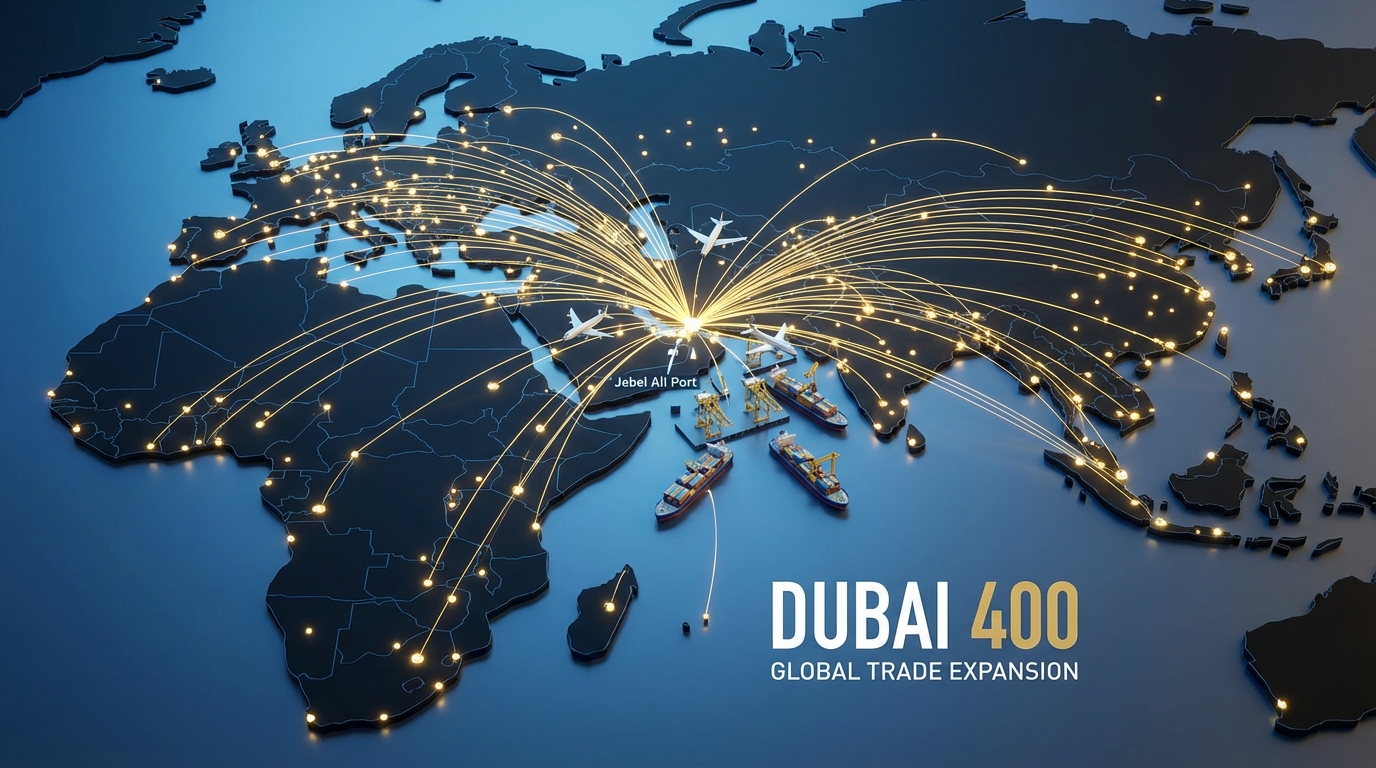
The Dubai D33 Agenda is anchored by three primary objectives: doubling the city’s foreign trade, increasing the contribution of the digital economy, and fostering a sustainable, innovation-led industrial base. By 2033, Dubai aims to increase its foreign trade to AED 25.6 trillion, up from AED 14.2 trillion in the previous decade. This growth is supported by a massive expansion of trade routes, specifically targeting 400 additional cities globally, with a focus on emerging markets in Africa, Latin America, and Southeast Asia.
A central lever of this agenda is the Dubai Universal Blueprint for AI, which is projected to add AED 100 billion annually to the economy through enhanced productivity and the integration of autonomous technologies. This digital-first approach is complemented by the Sandbox Dubai initiative, which allows for the testing and commercialization of new technologies in a controlled regulatory environment. For enterprises, this means Dubai is evolving from a regional logistics hub into a global laboratory for the future economy.
The 2026-2028 Dubai government budget further reinforces this momentum, allocating significant capital toward digital transformation, space research, and future-economy infrastructure. This fiscal commitment ensures that the physical and digital infrastructure required for doubling GDP Dubai 2033 remains ahead of global standards. Furthermore, the 2026 Tier-1 City Index recently ranked Dubai among the top five global cities, validating the city's progress in infrastructure, human capital, and business environment.
Sources:
- UAE Official D33 Overview
- Invest in Dubai D33 Hub
- IndiaAI: Dubai Universal Blueprint for AI
- Sheikh Mohammed Official Portal: 2026–2028 Budget
- ConstructionWorld: Tier-1 City Ranking
2. High-Growth Dubai D33 Business Opportunities by Sector
The D33 Agenda creates a fertile environment for sector-specific growth, particularly for firms capable of leveraging Dubai’s unique position as a gateway between East and West.
Logistics and Trade Facilitation
The primary opportunity lies in the digitization of the global supply chain. With the Dubai Customs 2026–2030 strategic plan aiming to create the world’s most advanced and seamless customs environment, enterprises can significantly reduce dwell times and landed costs.
- 2026 Signals: The expansion of DP World’s multimodal networks and the integration of the India-Middle East logistics links via Mundra port are critical for India-UAE supply chain resilience.
- Entry Modes: Establishing operations in JAFZA or Dubai South allows for seamless access to Jebel Ali Port and Al Maktoum International Airport.
- KPIs: Customs clearance speed, multimodal transit time, and corridor-specific distribution efficiency.
Advanced Manufacturing and Industrials
Dubai is pivoting toward high-value manufacturing, focusing on aerospace MRO, medtech, and EV components. The D33 Agenda provides incentives for firms that localize R&D and production within the emirate.
- 2026 Signals: Increased demand for sustainable industrial materials and the rise of Green Manufacturing zones.
- Entry Modes: Industrial licenses in Dubai Industrial City (DIC) offer proximity to major transport nodes and specialized utility infrastructure.
- KPIs: Capex ROI, export share to D33 target cities, and energy intensity per unit of production.
Digital Economy and Platform Commerce
The goal is to make Dubai a global pioneer in the digital economy. This includes cross-border e-commerce, fintech, and AI-driven consumer experiences.
- 2026 Signals: The WORLDEF Dubai 2026 forum highlighted the convergence of AI, cybersecurity, and cashless payments as the bedrock of future retail.
- Entry Modes: Licensing through the DIFC Innovation Hub or Dubai Internet City provides access to a robust ecosystem of tech talent and venture capital.
- KPIs: Customer Acquisition Cost (CAC) in corridor markets, payment success rates, and platform scalability.
MICE, Tourism, and the Creative Economy
Dubai continues to break records in tourism, with 2025 seeing nearly 10 million visitors. This supports a massive opportunity in hospitality tech, event management, and content IP creation.
- 2026 Signals: The expansion of airport infrastructure and a year-round calendar of mega-events are driving demand for high-tech MICE solutions.
- Entry Modes: Creative licenses in Dubai Media City or strategic partnerships with the Dubai Department of Economy and Tourism (DET).
- KPIs: Event conversion rates, RevPAR uplift, and creative IP monetization.
Sources:
- Dubai Customs Strategic Plan 2026–2030
- WAM: WORLDEF Dubai 2026 Outcomes
- DP World Mundra Throughput Records
- DD News: Dubai Tourism Milestone (2025)
- Dubai DET Initiatives
3. Strategic FDI Incentives UAE: Navigating the Investment Landscape
To attract the capital necessary for doubling GDP Dubai 2033, the UAE has institutionalized a suite of FDI incentives UAE that are among the most competitive globally. These incentives are designed to reduce market-entry friction and maximize capital productivity for foreign enterprises.
100% Foreign Ownership and Regulatory Clarity
The landmark change in the Commercial Companies Law allows for 100% foreign ownership of onshore companies in most sectors, removing the previous requirement for a local Emirati partner. This is coupled with a legal framework based on international best practices, providing high levels of IP protection and contract enforcement.
Specialized Free Zone Regimes
Dubai’s free zones offer tailored environments for specific industries, each providing unique advantages:
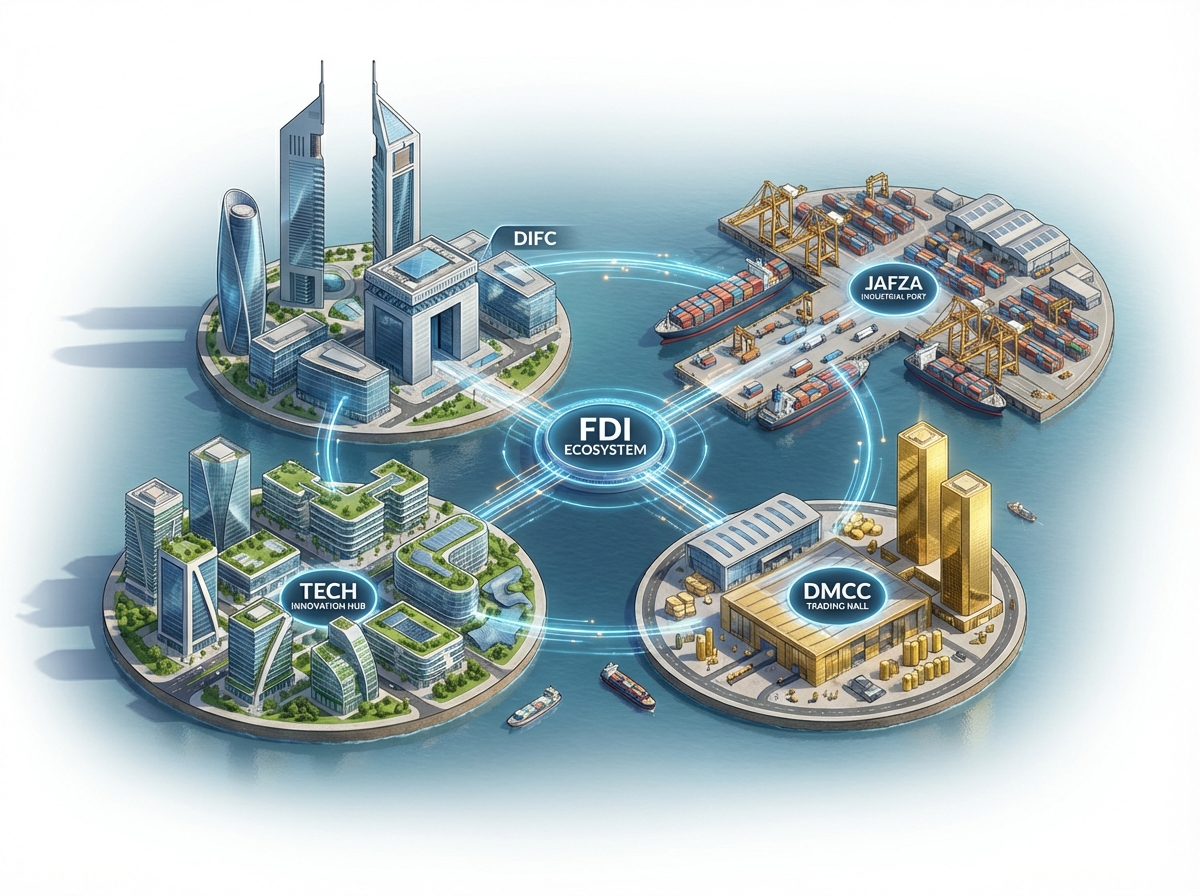
- DIFC (Dubai International Financial Centre): An independent jurisdiction with its own civil and commercial laws, ideal for financial services and fintech.
- DMCC (Dubai Multi Commodities Centre): The world’s leading free zone for commodities trade and digital assets.
- JAFZA (Jebel Ali Free Zone): Optimized for heavy industry and global logistics, integrated directly with the world's largest man-made harbor.
- Dubai South: The master-planned city focused on aviation, logistics, and the aerotropolis concept.
Long-Term Residency and Talent Attraction
The Golden Visa program provides 5-to-10-year residency to investors, entrepreneurs, and specialized talents. This ensures that enterprises can retain key leadership and technical staff within the UAE, fostering long-term organizational stability. Additionally, the establishment of international university campuses, such as the IIM Ahmedabad Dubai branch, ensures a steady pipeline of high-tier management talent.
Favorable Tax and Treaty Networks
The UAE maintains an extensive network of double-taxation treaties (DTTs) with over 130 countries, significantly reducing the tax burden on cross-border transactions. While a federal corporate tax was introduced in 2023, free zone entities that meet qualifying criteria can still benefit from a 0% corporate tax rate on qualifying income, maintaining Dubai's status as a tax-efficient hub.
Sources:
- UAE Government: Foreign Direct Investment Overview
- Grant Thornton: India–UAE Startup Convergence
- IIM Ahmedabad: Dubai Campus Announcement
4. Activating Foreign Trade Expansion Corridors: The +400 Cities Playbook
A cornerstone of the D33 Agenda is the Dubai 400 project, which aims to add 400 cities to Dubai’s foreign trade map. This initiative focuses on building foreign trade expansion corridors that link Dubai to high-growth regions, particularly in the Global South.
The India-West Asia Corridor
The Comprehensive Economic Partnership Agreement (CEPA) between the UAE and India has created a blueprint for corridor activation. This corridor is not just about moving goods; it is about knowledge exchange, digital services, and capital flows. Enterprises can use Dubai as a re-export hub to move Indian manufactured goods into African and European markets with minimal friction.
The Africa and Southeast Asia Expansion
Dubai is aggressively positioning itself as the primary gateway for investment into Africa. By leveraging Dubai’s logistics infrastructure, firms can mitigate the last-mile challenges of African markets. Similarly, Southeast Asian corridors are being strengthened through digital trade agreements and multimodal logistics links that connect Dubai to hubs like Singapore and Ho Chi Minh City.
Operationalizing the Corridor Strategy
To successfully navigate these foreign trade expansion corridors, enterprises should adopt a structured triage model:
- Market Scoring: Evaluate potential corridor cities based on Total Addressable Market (TAM), regulatory ease, and existing logistics SLAs.
- Localization and Creative Adaptation: Success in diverse markets requires more than just logistics; it requires cultural resonance. Messaging must be localized not just in language, but in cultural nuance.
- Payment and Compliance Rails: Establish robust cross-border payment systems and ensure AML/KYC compliance across multiple jurisdictions.
- Omnichannel Go-To-Market: Utilize a mix of digital platforms, local partnerships, and MICE events to build brand presence within the corridor.
Sources:
- TextileValueChain: Dubai as a Gateway to Africa & Europe
- CIEU: West Asia Dialogue Background Note
- Invest UP: Tourism Pavilion Brief
5. Doubling GDP Dubai 2033: A 180-Day Enterprise Execution Roadmap
For enterprises looking to capitalize on the Dubai D33 business opportunities, speed to market is a critical differentiator. The following roadmap outlines the steps required to align with the goal of doubling GDP Dubai 2033.
Days 0–30: Foundation and Strategic Alignment
- Incorporation: Select the optimal jurisdiction (Free Zone vs. Mainland) based on your primary activity and target corridors.
- Banking and Tax: Initiate the opening of corporate accounts and register for VAT/Corporate Tax.
- Corridor Triage: Use data-driven models to identify the first 2–3 cities within the D33 expansion map for your pilot phase.
Days 31–90: Pilot and Infrastructure Setup
- Regulatory Sandboxes: If operating in fintech or AI, apply for Sandbox Dubai to test products under regulatory supervision.
- Logistics Integration: Partner with 3PL providers in JAFZA or Dubai South to establish your distribution backbone.
- Localized Content Strategy: Develop a multilingual content engine. TrueFan AI's 175+ language support and Personalised Celebrity Videos can be integrated into your CRM to deliver hyper-personalized outreach to partners and customers in new markets.
Days 91–180: Scaling and Optimization
- GTM Execution: Launch localized campaigns across your chosen corridors.
- Performance Analytics: Monitor conversion rates and CAC across different cities. Solutions like TrueFan AI demonstrate ROI through significantly higher engagement rates compared to generic, non-localized video content.
- Expansion: Based on pilot results, scale your operations to an additional 5–10 cities within the foreign trade expansion corridors.
By following this roadmap, enterprises can transition from market entry to market leadership, leveraging Dubai’s institutional support to drive sustainable growth.
6. Conclusion: The Future of Global Trade is Dubai
The Dubai D33 Agenda is a clarion call to global enterprises to rethink their international expansion strategies. By providing a stable, innovative, and highly connected environment, Dubai is not just facilitating trade; it is redefining it. The combination of doubling GDP Dubai 2033 targets, lucrative FDI incentives UAE, and the systematic expansion of foreign trade expansion corridors creates a unique window of opportunity for firms that act decisively.
The complexity of managing growth across 400 diverse cities requires advanced technological solutions. Whether it is through AI-driven logistics or hyper-personalized marketing, the tools for success are already available in the Dubai ecosystem. As the city moves toward its 2033 goals, those who integrate early into this vision will be the primary beneficiaries of the next decade of global economic growth.
Final Research Citations & Sources:
- Dubai Economic Agenda D33 Official Portal: UAE Government D33 Overview
- Invest in Dubai - D33 Strategy: Invest in Dubai: D33 Agenda
- Dubai Customs Strategic Plan 2026-2030: Dubai Customs Plan
- IndiaAI - Dubai Universal Blueprint for AI: IndiaAI Coverage
- WAM - WORLDEF Dubai 2026 Outcomes: WAM Report
- Sheikh Mohammed bin Rashid Al Maktoum Official Site (Budget 2026-2028): Budget 2026–2028
- ConstructionWorld - Dubai Tier-1 City Ranking: Tier-1 City Ranking
- Grant Thornton - India-UAE Startup Ecosystem: Startup Ecosystem Report
- TextileValueChain - Dubai Gateway Analysis: Gateway to Africa & Europe
Frequently Asked Questions
What is the Dubai D33 Agenda?
The Dubai D33 Agenda is a comprehensive economic plan launched in 2023 to double the size of Dubai’s economy by 2033. It includes over 100 projects aimed at increasing foreign trade to AED 25.6 trillion, adding 400 cities to the trade map, and positioning Dubai as a top three global economic hub.
Which sectors offer the best Dubai D33 business opportunities?
Key sectors include global logistics and trade facilitation, advanced manufacturing (aerospace, medtech, EV), the digital economy (AI, fintech, e-commerce), and the creative economy (MICE, tourism). 2026 signals highlight AI-integrated supply chains and cashless commerce as growth catalysts.
What are the primary FDI incentives UAE for global enterprises?
The UAE offers 100% foreign ownership, long-term Golden Visas, preferential free zone regimes, and an extensive double-taxation treaty network. Qualifying free zone entities may benefit from a 0% corporate tax rate on qualifying income.
How can businesses access 400 cities via foreign trade expansion corridors?
Leverage Dubai’s multimodal logistics hubs (Jebel Ali and Al Maktoum International) as a re-export base to reach Africa, Latin America, and Southeast Asia with reduced lead times and lower regulatory friction.
How does AI video technology support the D33 expansion goals?
Scaling across 400 cities requires localized, culturally resonant communication. AI-driven, multilingual video content enables hyper-personalized engagement, improving trust, conversion, and market penetration across new corridors.