Sustainable Consumption Rewards 2026: How D2C Brands Retain Gen Z with Personalized Eco-Loyalty Videos
Estimated reading time: ~14 minutes
Key Takeaways
- By 2026, loyalty shifts from discounts to values-based sustainability, rewarding low-impact purchases, refills, and circular actions.
- Carbon footprint personalization and personalized eco-loyalty videos make impact visible, driving repeat purchases and advocacy.
- A Green Loyalty Stack blends SKU-level data, GreenScore recommendations, and gamification to guide better choices.
- Authentic reward mechanics with verifiable impact receipts counter greenwashing and build trust with Gen Z.
- Clear implementation and measurement frameworks ensure compliance, lift in retention, and scalable engagement.
The landscape of digital commerce is undergoing a seismic shift as we approach the mid-decade mark. By 2026, the definition of brand loyalty will have evolved from transactional point-accumulation to a values-based alignment centered on environmental stewardship. Sustainable consumption rewards 2026 represents the next frontier in loyalty mechanics, where enterprise D2C brands award points, status, and tangible benefits for low-impact purchases, circular behaviors like repair and refill, and climate-positive actions. This evolution is driven by a sophisticated integration of carbon footprint tracking personalization and hyper-personalized video content that makes an individual’s environmental impact visible and rewarding. Sustainable Shopping Rewards Automation 2026
For enterprise D2C brands and omnichannel retailers in India, this shift is not merely a trend but a necessity for eco-conscious customer retention. Indian Gen Z and Millennial cohorts now demand transparent environmental impact visualization and expect brands to facilitate their transition toward a low-carbon lifestyle. By utilizing sustainable brand storytelling and conscious consumer engagement strategies, brands can transform abstract sustainability goals into a tangible, gamified journey. The integration of eco-loyalty program videos allows brands to communicate complex carbon data through engaging, personalized narratives that drive repeat purchase rates and long-term advocacy. Eco-loyalty Program Automation
Why Sustainability is a Retention Strategy in 2026, Not Just CSR
In the current market, eco-conscious customer retention has matured into a systematic framework. It uses sustainability-linked experiences and rewards to increase repeat purchase frequency and reduce churn among the most valuable consumer segments. For the Indian market, the stakes are particularly high. Research indicates that Gen Z in India views sustainability as a core pillar of brand accountability, often citing it as a primary driver for fashion and lifestyle choices. This demographic is no longer satisfied with vague "green" claims; they require data-backed evidence of their personal contribution to a better planet.
The 2026 loyalty landscape is characterized by three defining trends: gamification, holistic incentives, and sustainability-linked actions. According to industry forecasts, gamified experiences will drive a 40% increase in participation rates for loyalty programs by 2026. Furthermore, the integration of climate action loyalty rewards into standard mobile apps is becoming a baseline expectation. Brands that fail to provide a sustainable shopping gamification layer risk losing relevance to competitors who offer interactive, rewarding paths to conscious consumption. Loyalty Program Gamification 2026
By aligning loyalty incentives with environmental impact, brands move beyond the "discount trap." Instead of competing solely on price, they compete on shared values and the emotional satisfaction of "doing good." This creates a "green moat" around the customer base, where the cost of switching to a less sustainable competitor includes the loss of accumulated "eco-status" and the cessation of personalized impact tracking.
Sources:
- EY India: How financial services can evolve for Gen Z
- Springer: Sustainable fashion consumption insights for Indian Gen Z
- Talon.One: Loyalty trends defining 2026
- AWS Builder Center: Top loyalty app trends for 2026
The Green Loyalty Stack: Data, Engagement, and Personalization
To operationalize sustainable consumption rewards 2026, enterprises require a robust "Green Loyalty Stack." This architecture begins with a sophisticated data layer that captures SKU-level sustainability attributes, logistics modes, and return behaviors. This data is then processed through a personalization intelligence engine to generate carbon footprint tracking personalization insights. These insights are delivered to the consumer not through static dashboards, but via dynamic eco-loyalty program videos that visualize impact in real-time.
Carbon Footprint Tracking Personalization
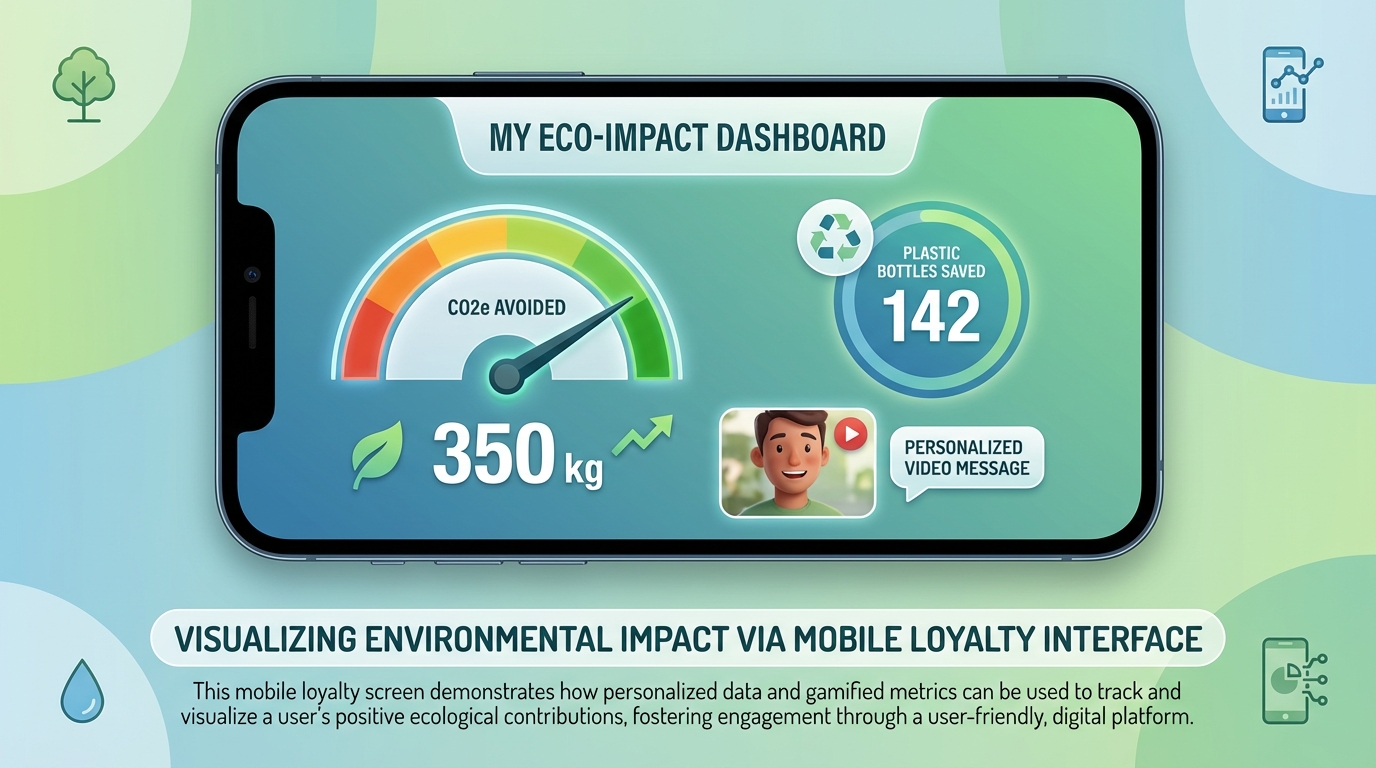
The core of the stack is member-level CO2e estimation. This involves calculating the carbon cost of every interaction—from the materials used in a product to the carbon intensity of the last-mile delivery. By 2026, leading brands will use normalized monthly recaps to show members their "CO2e avoided" compared to a standard baseline. This environmental impact visualization turns invisible gases into a measurable score, making the consumer's effort feel significant.
Platforms like TrueFan AI enable brands to transform this complex data into hyper-personalized video recaps. These videos can dynamically display a user’s specific savings—such as "14kg of CO2 avoided this month"—using animated charts and counters. By delivering these through WhatsApp or email microsites, brands ensure the data is consumed and shared, rather than buried in a profile tab.
Green Product Recommendation Engine
A green product recommendation engine is essential for guiding consumers toward lower-impact choices. Unlike traditional engines that focus solely on affinity and margin, this model incorporates a "GreenScore." This score is a weighted composite of recycled content, plastic-free packaging, and refill availability. When a customer browses, the engine nudges them toward "Refill-ready" or "Low CO2e" alternatives, often using personalized video embeds to explain the "reason-to-believe" behind the recommendation. Sustainable Shopping Rewards Automation 2026
Sustainable Shopping Gamification and Tiers
To maintain high conscious consumer engagement, brands must employ sustainable shopping gamification. This includes "streaks" for consecutive plastic-free orders and "quests" for returning empty packaging. These actions are celebrated through green tier progression videos that unlock new benefits as the user ascends from "Eco-Explorer" to "Climate Champion." Loyalty Program Gamification 2026
TrueFan AI's 175+ language support and Personalised Celebrity Videos can be integrated here to boost engagement. Imagine a celebrity or a brand mascot congratulating a user in their native tongue for completing a "Zero-Waste Challenge." This level of personalization significantly increases the shareability of the achievement, turning a private action into a public badge of honor.
Sources:
- Mastercard: Carbon Calculator for global rollout
- Cogo: Climate action insights for consumers
- Capillary India: Rewarding eco-conscious behaviors
Reward Mechanics That Drive Retention and Avoid Greenwashing
The success of sustainable consumption rewards 2026 hinges on the authenticity of the rewards. Consumers are increasingly wary of "greenwashing"—vague claims that lack substance. To counter this, reward mechanics must be tied to verifiable, tangible actions.
Plastic-Free Purchase Rewards
One of the most effective levers is the implementation of plastic-free purchase rewards. Brands can offer extra tier credits or points multipliers when a customer selects a plastic-free SKU or opts for "naked" packaging. This directly incentivizes a change in purchasing behavior while providing the brand with clear data on consumer preferences for sustainable packaging.
Climate Action Loyalty Rewards
Beyond simple points, climate action loyalty rewards allow users to redeem their earnings for real-world impact. This might include planting a tree with a verified partner in India, sponsoring a community clean-up, or purchasing renewable energy credits. The key is to provide "impact receipts"—personalized digital certificates or videos that prove the action was taken. This transparency builds deep trust and reinforces the brand's commitment to the cause.
Sustainability Score Marketing
Sustainability score marketing is the practice of displaying a transparent, trend-based score on a member's profile. This score represents their progress relative to a category baseline. To avoid the pitfalls of vanity metrics, brands must publish their methodology, explaining how Life Cycle Assessments (LCA) are used and where data gaps exist. This level of honesty is highly valued by Gen Z consumers, who prefer a brand that is "honestly trying" over one that claims perfection.
Sources:
Creative System: Sustainable Brand Storytelling in Motion
In 2026, static images and text-heavy reports are insufficient for communicating environmental impact. A dynamic creative system built on sustainable brand storytelling is required to keep consumers engaged over the long term. This system should follow the principle of "show, don't tell," using environmental impact visualization to make the invisible visible.
Episodic Impact Seasons
Brands should move toward an episodic format for their eco-communications. "Impact Seasons" can align with the fiscal year or seasonal cycles, featuring monthly carbon recaps and quarterly tier ceremonies. This creates a narrative arc that the consumer follows, making them feel like a protagonist in the brand's sustainability journey.
Visual Patterns for Eco-Loyalty Program Videos
Effective eco-loyalty program videos use specific visual patterns to convey progress:
- Animated CO2e Meters: Showing the needle moving toward a "Net Zero" goal.
- Digital Forest Growth: A virtual forest that grows as the user earns climate action loyalty rewards.
- Plastic Bottle Counters: A dynamic tally of plastic units diverted from landfills through the user's purchases.
These visual cues are processed much faster than text and create a more lasting emotional impact. By using API-triggered video generation, enterprises can ensure that every single member receives a unique video that reflects their specific contributions, localized in their preferred language and cultural context.
Enterprise Implementation and Measurement Blueprint
Implementing a sustainable consumption rewards 2026 program at an enterprise scale requires seamless integration across the technology stack. This is not a standalone project but a layer that sits atop existing CRM, CDP, and commerce engines.
The Integration Framework
- CDP/CRM Integration: Capture real-time event streams for purchases, returns, and eco-preferences. Ensure consent flags for carbon tracking are strictly managed. Post-purchase Loyalty Automation India 2024
- Commerce Engine: Tag every SKU with sustainability attributes (LCA data, packaging type, origin).
- Carbon APIs: Integrate with tools like the Mastercard Carbon Calculator or Cogo to provide standardized CO2e estimations.
- Video Personalization: Use a robust API for real-time video rendering. Solutions like TrueFan AI demonstrate ROI through hyper-personalized delivery at scale, ensuring that thousands of unique videos can be generated and sent via WhatsApp or email in under 30 seconds. Post-purchase Loyalty Automation India Guide
Measurement and Lift Targets
To prove the efficacy of the program, brands must track specific KPIs:
- Retention Lift: A target of 10-15% uplift in 90-day repeat purchase rates among eco-tier members compared to a control group.
- Churn Reduction: Measuring the delta in churn between participants in zero-waste challenge videos and non-participants.
- Eco-Action Completion: Tracking the rate of refill returns or recycling drop-offs triggered by circular economy participation videos.
- Video Engagement: Monitoring watch-through rates and CTA clicks on personalized impact recaps.
Data Governance and Compliance
Enterprises must adhere to strict data residency and privacy laws, especially in the Indian context. Personalization should always be "consent-first." Furthermore, all environmental claims must undergo legal review to ensure they comply with evolving regulations regarding green marketing. Using ISO 27001 and SOC 2 compliant platforms ensures that sensitive customer data is handled with the highest security standards.
India-Focused Caselets: Driving Impact Across Verticals
Fashion D2C: Closing the Loop
A leading Indian fashion D2C brand faces high return rates and rapid trend cycles. By launching sustainable consumption rewards 2026, they introduce a "Return-for-Repair" loop.
- The Mechanic: Customers receive green tier progression videos when they choose to repair an item rather than return it.
- The Reward: They earn plastic-free purchase rewards for future orders.
- The Result: A 12% reduction in net returns and a significant increase in LTV among Gen Z shoppers who value the brand's circularity efforts.
Grocery and Q-Commerce: The Low-Carbon Basket
An Indian Q-commerce giant wants to differentiate in a crowded market. They integrate carbon footprint tracking personalization into their weekly summary.
- The Mechanic: A green product recommendation engine suggests locally sourced produce with lower transport emissions.
- The Reward: Users earn climate action loyalty rewards (like tree planting) for opting for "Eco-Delivery" (slower, consolidated shipping).
- The Result: A 20% shift in basket composition toward sustainable SKUs and improved delivery efficiency. Rapid Fulfillment Personalization Strategies
Beauty and Personal Care: The Refill Revolution
A premium beauty brand in India tackles packaging waste by introducing a refill-first loyalty tier.
- The Mechanic: Circular economy participation videos show users the nearest store for packaging take-back and celebrate their "Plastic Avoided" milestone.
- The Reward: High-tier members get early access to new sustainable product drops and exclusive sustainability score marketing badges on their social profiles.
- The Result: A 30% increase in refill SKU sales and a surge in user-generated content (UGC) as members share their personalized impact videos. Sustainable Shopping Rewards Automation 2026
Conclusion: The 2026 Imperative
The transition to sustainable consumption rewards 2026 is an inevitable evolution for brands seeking to remain relevant to the next generation of Indian consumers. By combining data-driven carbon tracking with the emotional power of personalized video, enterprises can build a loyalty model that is both profitable and purposeful. The brands that lead this shift will not only see a lift in retention and LTV but will also play a crucial role in fostering a more sustainable global economy.
Ready to transform your loyalty strategy?
Book an enterprise demo of TrueFan AI to launch personalized eco-loyalty program videos at scale.
Download the Sustainable Consumption Rewards 2026 checklist.
Recommended Internal Links
- Sustainable Shopping Rewards Automation 2026
- Eco-loyalty Program Automation
- Loyalty Program Gamification 2026
- Rapid Fulfillment Personalization for Quick Commerce (green delivery option promotions)
- ESG investment video campaigns (Environmental ROI and impact visualization)
- Post-purchase Loyalty Automation India (video personalization & stack integration)
Frequently Asked Questions
How do sustainable consumption rewards 2026 differ from traditional loyalty programs?
Traditional programs focus on spending volume. Sustainable consumption rewards 2026 focus on the quality of spend, rewarding actions that reduce environmental impact, such as choosing plastic-free options or participating in circular economy loops.
Can small D2C brands implement these personalized video strategies?
While the "Green Loyalty Stack" is designed for enterprise scale, the modular nature of tools like TrueFan AI allows brands of various sizes to start with basic personalized recaps and scale as their data maturity increases.
How do you calculate the carbon footprint for thousands of different SKUs?
Enterprises use LCA (Life Cycle Assessment) databases and carbon APIs to estimate CO2e based on material weight, origin, and manufacturing process. These are often presented as ranges to maintain transparency.
What is the most effective way to deliver eco-loyalty program videos in India?
Given the high penetration of mobile usage in India, WhatsApp Business API and mobile-optimized email microsites are the most effective channels for delivering personalized video content.
How does TrueFan AI help in launching these programs?
TrueFan AI provides the infrastructure to generate hyper-personalized, API-triggered videos at scale. With support for 175+ languages and the ability to include dynamic charts and celebrity messages, it ensures that eco-loyalty communications are engaging, localized, and high-converting.