Board Exam Stress Marketing 2026: A Compassion-to-Conversion Playbook for EdTech and Coaching Networks Using AI Video
Estimated reading time: ~16 minutes
Key Takeaways
- Adopt a compassion-to-conversion strategy that prioritizes student wellbeing before sales.
- Use hyper-personalized AI video to deliver timely anxiety support, study plans, and mindful nudges.
- Shift KPIs from clicks to watch-through rates, counselor bookings, and long-term retention.
- Design results-day triage and family-alignment content to reduce churn and rebuild confidence.
- Scale with secure enterprise automation that maps data triggers to empathetic video journeys.
The Indian education landscape in 2026 stands at a critical juncture. With the full implementation of the National Education Policy (NEP) 2020 and the shift toward biannual board exams, the traditional “high-stakes” pressure has not vanished; it has evolved into a year-round cycle of performance anxiety. For EdTech giants and coaching networks, this shift demands a fundamental pivot in strategy.
Success in this new era requires moving beyond aggressive sales tactics toward a “Compassion-to-Conversion” framework. By addressing the psychological needs of students through board exam stress marketing 2026 strategies, brands can build the trust necessary to drive long-term enrollments and retention. This playbook outlines how to leverage hyper-personalized AI video to transform student anxiety into academic confidence and measurable business growth.
The 2026 Market Moment: Data-Backed Stress Context and Policy Shifts
The 2026 academic year marks the first full cycle where CBSE Class 10 and 12 students have the option to appear for board exams twice a year. While intended to reduce pressure, early data suggests that the “always-on” exam mode has created a continuous state of alertness among the 30 million students appearing for boards annually.
Recent NCERT-linked surveys indicate that approximately 80% of Indian students identify exams and results as their primary source of anxiety. This stress is not localized; it permeates the entire family unit, with parents reporting high levels of uncertainty during the March–April peak and the subsequent results window. The 2026 policy shift means that the traditional “peak season” for EdTech marketing has expanded into a multi-phase engagement calendar.
Platforms like TrueFan AI enable enterprise EdTech brands to navigate this complexity by delivering empathetic, automated video content that aligns with the NEP 2020’s ethos of holistic student wellness. By integrating support-first content into the student journey, brands can mitigate the “crisis of confidence” that often leads to churn or poor performance in entrance exam preparation.
Sources:
- Hindustan Times: NCERT mental health survey on exam-related anxiety
- Indian Express: CBSE to conduct Class 10 board exams twice a year
- Ministry of Education: NEP 2020 policy document
The Compassion-to-Conversion Framework: A Strategic Overview
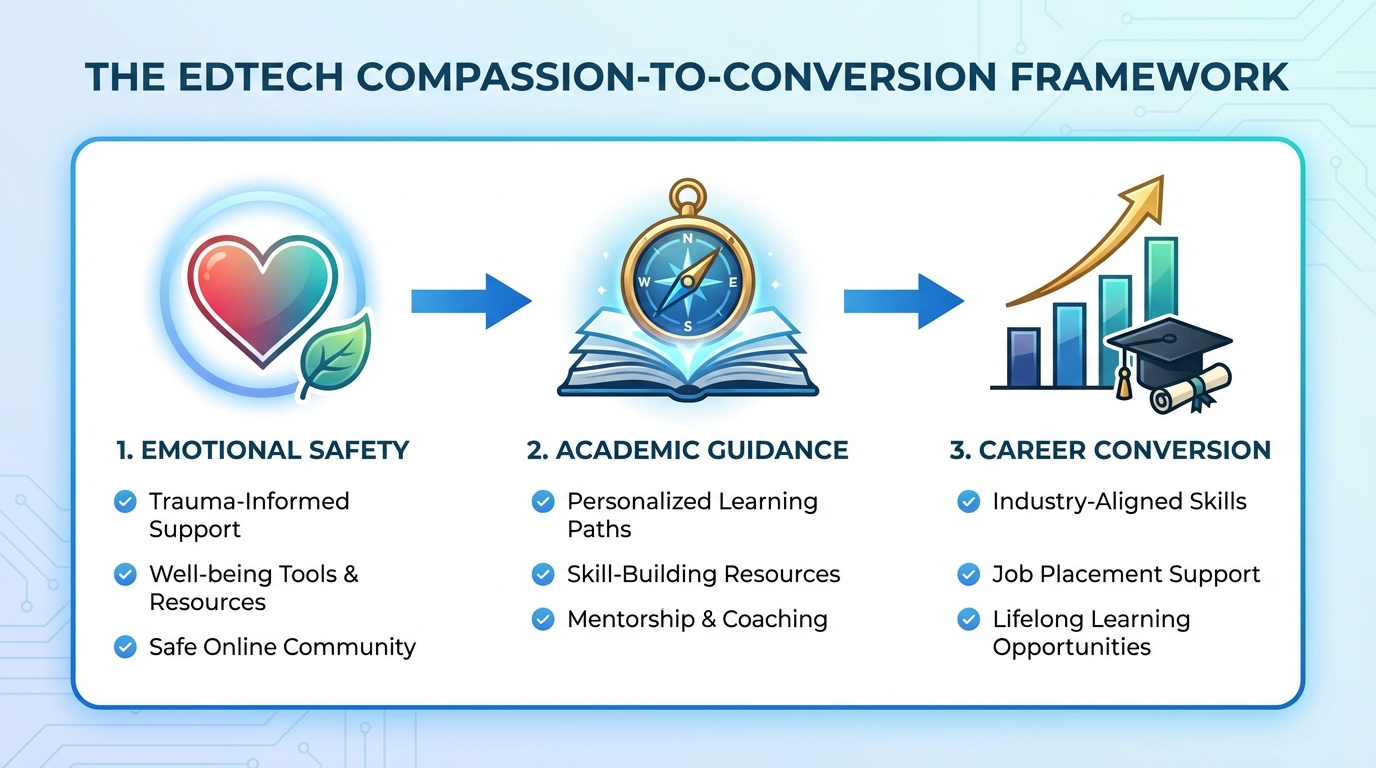
The Compassion-to-Conversion framework is a sequenced marketing journey that prioritizes emotional safety before introducing academic nudges or enrollment pathways. In the 2026 competitive landscape, a “support-first” approach is the only ethical way to maintain mental health student retention.
This framework operates across three distinct lanes. The first lane focuses on student anxiety support videos—short, non-salesy content designed to normalize stress and provide immediate coping mechanisms. The second lane transitions into guidance-to-conversion, where AI-driven career counseling and entrance exam preparation marketing are introduced as logical next steps for a supported student.
The final lane addresses results, recovery, and family alignment. This ensures that even in cases of academic setbacks, the brand remains a partner in the student’s journey rather than a mere service provider. Measurement of this framework moves beyond simple click-through rates (CTR). It focuses on watch-through rates of wellness content, counselor booking deltas, and the long-term conversion of board exam students into high-value entrance prep cohorts.
Playbook Part 1: Emotional Support Streams and Student Anxiety Support Videos
The core of board exam stress marketing 2026 is the delivery of empathetic, human-centric video content at scale. Students in 2026 are fatigued by generic “motivational” posters; they require personalized validation that acknowledges their specific subject fears and timelines.
Implementing Student Anxiety Support Videos
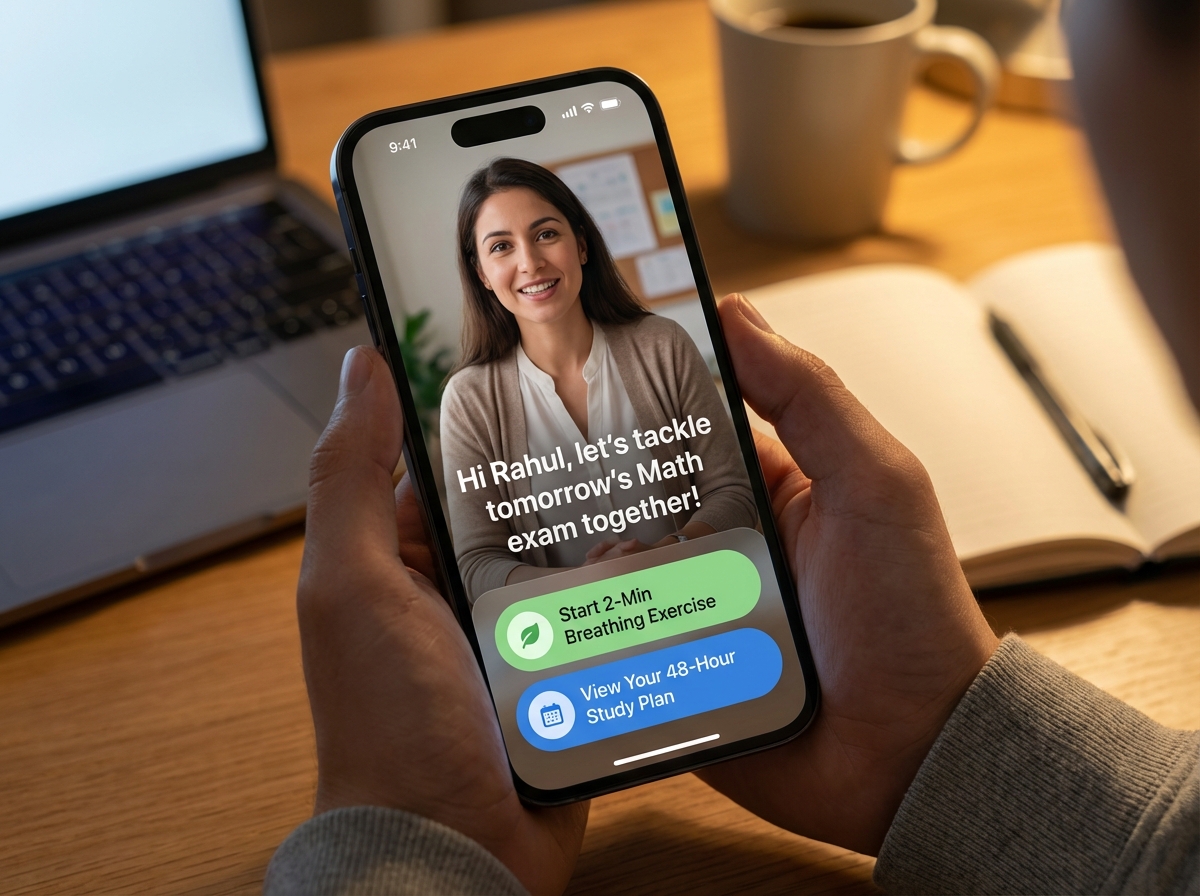
These videos should be 20–45 seconds long, featuring a familiar face—be it a star teacher, a brand ambassador, or the institution's CEO. The script must prioritize validation over instruction. For example, a video triggered the evening before a Mathematics paper should greet the student by name and acknowledge the specific difficulty of that subject.
TrueFan AI's 175+ language support and Personalised Celebrity Videos allow brands to deliver these messages in the student's native dialect, significantly increasing trust and emotional resonance. A student in rural Tamil Nadu receiving a personalized encouragement video in Tamil will feel a much stronger connection to the brand than one receiving a generic English notification.
Personalized Study Plan Videos and Mindfulness Automation
Beyond emotional support, students need actionable clarity. Personalized study plan videos can be auto-generated based on a student’s mock exam performance. If a student consistently scores low in Organic Chemistry, the AI can trigger a video that outlines a 48-hour “recovery sprint,” highlighting exactly which chapters to skim and which previous year questions (PYQs) to solve.
Furthermore, mindfulness study session automation can be integrated into the Learning Management System (LMS). When the system detects a student has been studying for three hours straight without a break, it can trigger a 2-minute guided breathing video. This proactive care demonstrates that the EdTech brand values the student’s health as much as their grades, which is a powerful driver for academic stress relief marketing.
Sources:
Playbook Part 2: Guidance-to-Conversion Journeys via EdTech Automation
Once a foundation of trust is established through emotional support, the brand can transition the student toward future-focused pathways. This is where career counseling automation in EdTech becomes a vital tool for growth.
Student Success Prediction and Pathway Mapping
Using data from mock exams and board performance, AI can generate student success prediction videos. These videos should sensitively present probability ranges for target colleges or scores. Crucially, they must be paired with “Next Best Actions” (NBA). If a student’s current trajectory makes a top-tier IIT seat unlikely, the video can dynamically present alternative high-growth pathways, such as specialized B.Tech programs in AI or Data Science.
This approach reduces the “all-or-nothing” pressure that often leads to student burnout. By showing students multiple viable routes to success, brands position themselves as lifelong career partners. This naturally leads into entrance exam preparation marketing, where the student is invited to join bridge courses or early-bird cohorts for exams like JEE, NEET, or CLAT.
Scholarship Opportunity Personalization
Financial anxiety is a major component of exam stress for Indian families. Scholarship opportunity personalization allows brands to send targeted videos to students who meet specific merit or need-based criteria. These videos can explain eligibility, deadlines, and required documentation in under 60 seconds, with a direct CTA to “pre-qualify” via a simple form. This hyper-targeted approach has been shown to increase scholarship application starts by over 3x compared to generic email blasts.
Sources:
- TrueFan AI Blogs: Multilingual personalized video campaigns
- Ministry of Education: NEP 2020 flexibility for pathways
Playbook Part 3: Results, Recovery, and Family Alignment
Results day is the most volatile moment in the academic calendar. For EdTech brands, it is a moment of either extreme brand loyalty or total churn. Effective exam result crisis management requires a pre-planned, three-tier triage system.
The Results Day Triage
- Green Cohort (High Achievers): Personalized celebratory videos that immediately bridge the student to advanced entrance prep or scholarship rewards.
- Amber Cohort (Average Performers): Encouragement videos that focus on “improvement tracks” and alternative career pathways that still lead to high-value outcomes.
- Red Cohort (At-Risk/Failure): Immediate deployment of failure recovery support campaigns. These videos must be devoid of sales CTAs, focusing instead on morale rebuilding and reattempt planning.
Parent Communication Wellness Content
Parents are the primary decision-makers and often the primary source of pressure. Parent communication wellness content should be sent weekly during the exam season. These videos provide scripts for parents on how to talk to their children about stress, sleep hygiene, and results. By coaching the parent to be a better support system, the brand reduces the overall friction in the student’s home environment, leading to better learning outcomes and higher retention.
Solutions like TrueFan AI demonstrate ROI through these high-empathy touchpoints, as they significantly reduce the churn rate among students who might otherwise feel “abandoned” by their coaching center after a poor result.
Sources:
Enterprise Implementation: Scaling AI Video with TrueFan AI
Implementing a board exam stress marketing 2026 strategy at the enterprise level requires a robust technical architecture. The goal is to move from a “one-to-many” broadcast model to a “one-to-one” personalized experience for millions of students simultaneously.
Data Integration and Trigger Mapping
The system must be fueled by real-time data from the brand's CRM or LMS. Key triggers include:
- mock_score_updated: Trigger a personalized study plan video if the score drops below a certain threshold.
- exam_T-1: Trigger a 30-second exam confidence building video the evening before a major paper.
- attendance_dip: Trigger a wellness check-in video to identify potential burnout.
- results_published: Trigger the appropriate triage video (Green/Amber/Red) within minutes of the result announcement.
Creative Governance and Compliance
For enterprise EdTech, data security and content moderation are non-negotiable. TrueFan AI provides ISO 27001 and SOC 2 certified environments, ensuring that student PII (Personally Identifiable Information) is handled with the highest level of security. Furthermore, all AI-generated content undergoes rigorous content moderation frameworks to ensure that no “grade-shaming” or insensitive language is ever delivered to a minor.
The ability to render these videos in under 30 seconds ensures that the brand can respond to real-time events—like a particularly difficult board paper that has students trending on social media—with a supportive message that reaches their inbox while the stress is still peak.
Sample Scripts for 2026 Student Engagement
To assist content teams, here are three high-impact script templates designed for the 2026 exam cycle.
Script 1: Student Anxiety Support Video (Pre-Exam)
Hook (0–5s): “Hi [Name], I know the [Subject] paper tomorrow feels like a lot. It’s completely normal to feel those jitters.”
Tip (5–20s): “Take 60 seconds right now for 4-7-8 breathing. Then, focus only on the three high-weightage chapters we identified in your dashboard.”
Safety (20–35s): “You’ve put in the work. If you feel overwhelmed tonight, tap the button below to talk to one of our counselors immediately.”
CTA (35–45s): “I’m rooting for you, [Name]. You’ve got this.”
Script 2: Personalized Study Plan Video (Mid-Exam Gap)
Hook (0–5s): “Great job finishing the Physics paper, [Name]. Now, let’s pivot to Chemistry.”
Plan (5–25s): “You have 72 hours. Based on your last mock, we’re going to spend Day 1 on Organic and Day 2 on Physical. I’ve attached your custom 3-day roadmap below.”
CTA (25–35s): “Tap to open your ‘Gap Day’ toolkit. Let’s make every hour count.”
Script 3: Failure Recovery Support Campaign (Post-Results)
Hook (0–5s): “[Name], I wanted to reach out personally. I know today’s result isn't what you hoped for.”
Reframe (5–25s): “One exam does not define your potential. We’ve already helped thousands of students turn a setback into a comeback. We have a dedicated ‘Bridge Module’ ready for you.”
CTA (25–40s): “Let’s jump on a 10-minute call tomorrow to map out your reattempt strategy. We are with you all the way.”
Conclusion: The Future of Empathetic EdTech Marketing
The 2026 board exam season represents a massive opportunity for EdTech brands to redefine their relationship with students. By moving away from high-pressure sales and toward a compassion-led strategy, institutions can achieve what was previously thought impossible: scaling empathy.
Integrating board exam stress marketing 2026 tactics—from student anxiety support videos to failure recovery support campaigns—creates a resilient brand ecosystem. This approach not only improves student well-being but also drives superior business outcomes through enhanced retention and ethical conversion.
As the Indian education system continues to evolve under the NEP 2020, the brands that win will be those that treat students as individuals, not just data points. Utilizing hyper-personalized AI video is the most effective way to deliver that individual care at the scale of millions.
Final Strategic Checklist for CMOs:
- Audit your triggers: Ensure your LMS is talking to your video generation engine in real-time.
- Localize for trust: Deploy content in at least the top 5 regional languages of your student base.
- Prioritize wellness: Dedicate at least 30% of your exam-season content to non-academic support.
- Prepare for the “Red Cohort”: Have your results-day crisis workflows ready by February.
- Measure what matters: Track counselor bookings and “calmness” sentiment alongside traditional ROI.
Recommended Internal Links
- EdTech career counseling videos 2026: boost retention
- Multilingual voice marketing automation: tactics for 2026
- Voice Commerce India 2026: Winning Multilingual Strategies
- AI Video Political Campaigns India 2026: Revolutionizing Election Marketing
- Voice Commerce India 2026: Multilingual Growth Playbook
Frequently Asked Questions
How to ethically use student data for career counseling automation EdTech?
Ethical data usage begins with explicit parental consent and data minimization. Only data points relevant to academic guidance—such as mock scores, subject interests, and stated career goals—should be processed. Brands must ensure that AI-driven recommendations are presented as “options” rather than “destinies,” and always provide a clear path to speak with a human counselor for nuanced advice.
What to say on results day? Exam result crisis management scripts.
On results day, the tone must shift from “performance-driven” to “person-driven.” For students who have underperformed, scripts should focus on emotional de-escalation and the “Growth Mindset.” Avoid any mention of missed enrollments or sales. Instead, provide immediate links to government helplines like Tele-MANAS and offer a “recovery roadmap” that emphasizes that there are multiple paths to a successful career.
How do personalized study plan videos differ by subject and time-to-exam?
Personalization depth increases as the exam approaches. A video sent 30 days before an exam might focus on broad syllabus coverage. However, a video sent 48 hours before (the “T-48” window) must be hyper-specific, focusing on “High-Yield/Low-Effort” topics tailored to the student's known weak points. TrueFan AI allows for these dynamic content swaps, ensuring the advice is always relevant to the remaining time.
What’s the line between academic stress relief marketing and hard selling?
The line is defined by intent. Academic stress relief marketing should provide value without requiring a purchase. If a wellness video ends with a “Buy Now” button for a crash course, it breaks the trust bond. Instead, the CTA should be “Talk to a Counselor,” “Download a Free Guide,” or “Join a Peer Support Group.” The conversion to paid programs happens naturally in the “Guidance” phase once the student feels supported.
How can TrueFan AI help in reducing student churn during the board exam season?
TrueFan AI reduces churn by humanizing the digital learning experience. When a student feels that a brand “sees” their struggle and provides personalized encouragement, they develop an emotional tie to the institution. By automating these touchpoints across 175+ languages, EdTech brands can maintain a high-frequency, high-empathy presence that keeps students engaged with the platform even during the most stressful periods of the year.



