Customer Health Scoring Automation 2026: AI Playbooks, Video Interventions, and Predictive Churn Prevention for SaaS
Estimated reading time: ~14 minutes
Key Takeaways
- Customer health scoring automation in 2026 is AI-first, predicting churn weeks in advance and triggering targeted interventions.
- Modern platforms fuse product usage, commercial data, and sentiment to surface precise, actionable risks.
- Personalized video interventions outperform text-only outreach, especially via WhatsApp in India.
- Enterprises operationalize retention ROI metrics with holdouts, lift analyses, and time-to-intervention tracking.
- A robust AI retention analytics platform plus proactive playbooks drives measurable NRR and save-rate gains.
In the hyper-competitive landscape of 2026, reactive customer success is no longer a viable business strategy. Enterprise SaaS organizations and large-scale subscription brands are moving away from manual spreadsheets and static dashboards toward customer health scoring automation. This shift is driven by the necessity to detect silent disengagement and intervene before a cancellation request ever reaches a human representative.
Modern customer health scoring automation 2026 represents an always-on, AI-driven ecosystem that fuses product usage, commercial data, and sentiment analysis. By 2026, AI has become table stakes in customer success (CS), replacing manual intervention with predictive models that flag risks weeks or even months before a renewal date. Platforms like TrueFan AI enable these organizations to transform raw health data into hyper-personalized video interventions that resonate with users on a human level.
The current economic climate, characterized by CAC inflation and stagnant expansion budgets, makes time-to-intervention a critical KPI. Organizations are now measuring this in minutes rather than weeks. By leveraging predictive churn prevention SaaS tools, teams can shift their focus toward revenue accountability and outcome-led journeys, ensuring that every customer interaction is data-backed and strategically timed. Predictive churn prevention videos
Sources:
1. The Architecture of a Modern AI Retention Analytics Platform
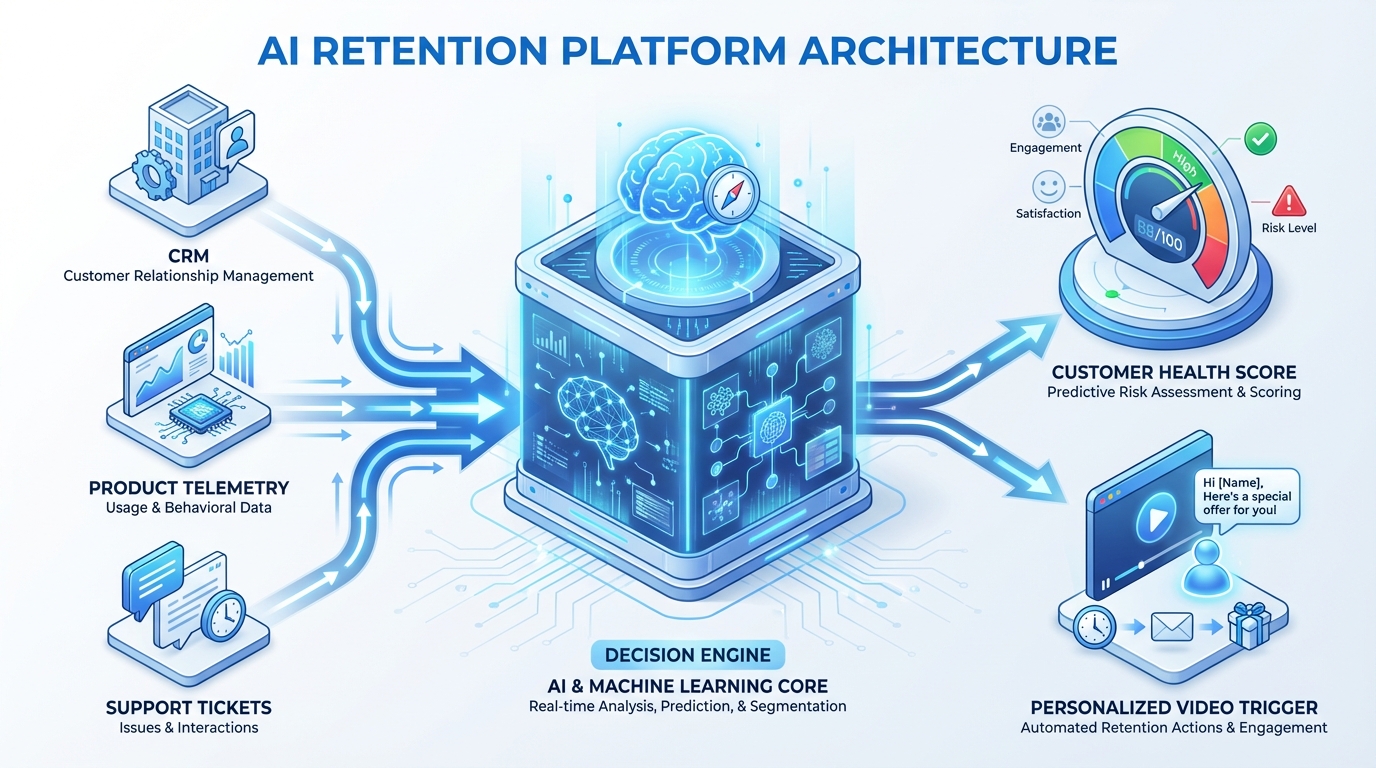
A sophisticated AI retention analytics platform in 2026 is far more than a simple visualization tool. It is a multi-layered system designed to handle real-time data pipelines, execute complex churn risk assessment models, and orchestrate automated outreach. Traditional health scores were often lagging indicators, relying on data that was already weeks old; the modern approach is dynamic and predictive.
The first layer of this architecture involves real-time data ingestion from disparate sources, including product telemetry, CRM records, billing systems, and support tickets. This data feeds into decisioning engines that determine the next best action for every account. Instrumentation for retention ROI optimization metrics allows leadership to see the direct correlation between automated interventions and bottom-line growth.
Furthermore, the 2026 definition of an analytics platform includes a robust content engine. This engine generates customer success automation videos that are triggered by specific health score thresholds. Instead of a generic automated email, customers receive a personalized video addressing their specific usage gaps or technical hurdles. This level of automation ensures sustainable workloads for CS teams while maintaining a high-touch feel for the end user. Predictive churn prevention videos guide
Sources:
2. Behavioral Churn Signals Detection and Risk Assessment Models
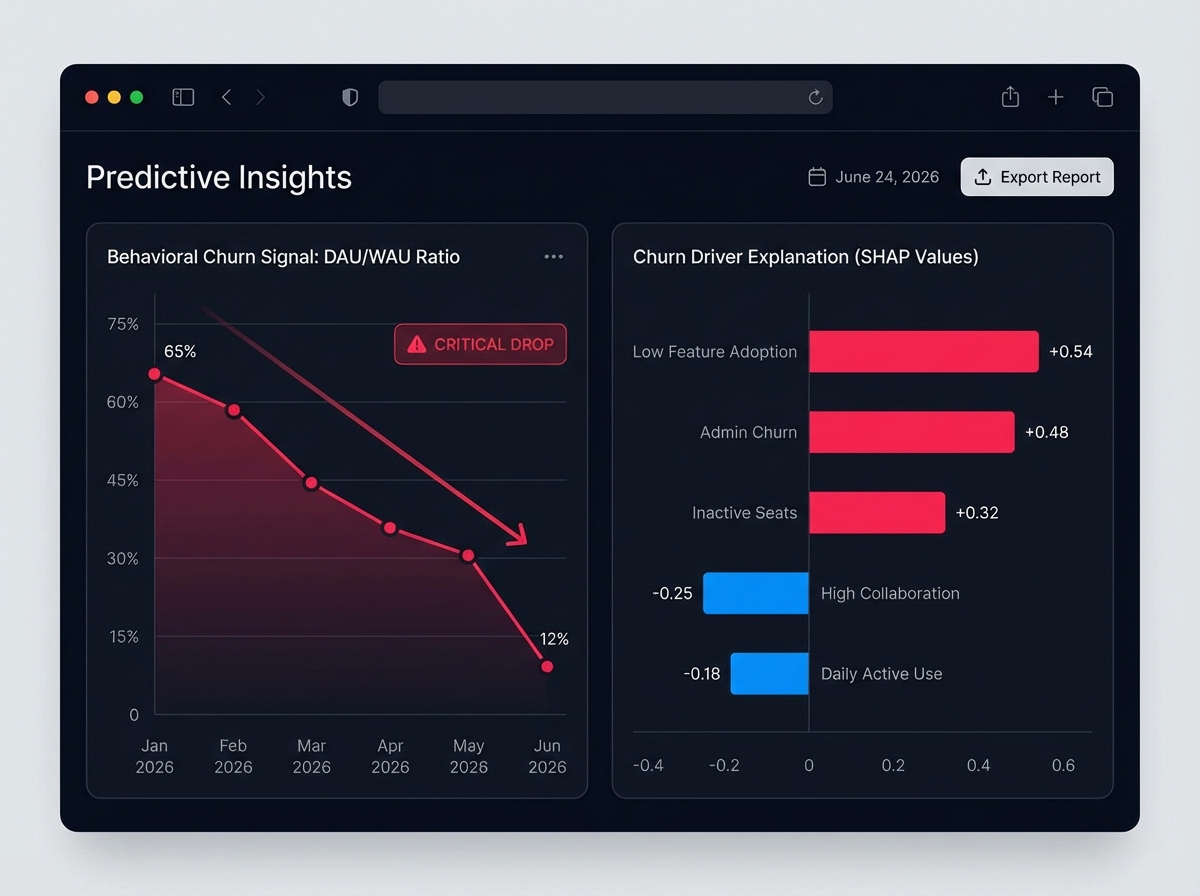
Effective behavioral churn signals detection requires monitoring a wide array of leading indicators that suggest a customer is drifting away. These signals are often subtle, such as a gradual drop in the DAU/WAU (Daily Active User to Weekly Active User) ratio or a decay in the adoption of core features. In 2026, models also track “session depth” and “time-to-first-value” slippage to identify accounts that are struggling to realize the product's full potential.
Beyond product usage, account-level changes serve as critical red flags. Seat reductions, the churn of a key administrative stakeholder, or repeated payment failures are high-weight variables in any churn risk assessment models. License utilization falling below 60% is often a precursor to a downgrade request. By fusing these behavioral metrics with customer satisfaction prediction AI, companies can forecast the trajectory of a customer’s sentiment based on support transcripts and chat interactions.
Building and governing these models involves moving beyond simple logistic regression. In 2026, CS teams utilize gradient boosting (XGBoost or LightGBM) to handle nonlinear interactions between features. Survival models, such as Cox proportional hazards, are employed to predict the specific “time-to-churn,” allowing teams to prioritize accounts with the most imminent risk. Explainability is maintained through SHAP (SHapley Additive exPlanations) values, which surface the top drivers of risk for each individual account, allowing CSMs to understand the “why” behind every score.
Sources:
3. Proactive Customer Rescue Campaigns and the Video Multiplier
Once a risk is identified, the system must trigger proactive customer rescue campaigns that are tailored to the specific persona and lifecycle stage. These campaigns are no longer one-size-fits-all; they utilize retention intervention personalization to address the root cause of the health score drop. For instance, if a user’s risk is driven by a lack of feature adoption, the system might trigger a sequence that includes a personalized explainer video and an invitation to a targeted office-hours session.
The “video multiplier” is a key differentiator in 2026. customer success automation videos are dynamically generated assets that insert variables like the user’s name, company, and specific feature usage data. These videos are delivered automatically via email or in-app banners. TrueFan AI's 175+ language support and Personalised Celebrity Videos allow brands to create high-impact content that feels bespoke, even when delivered at a massive scale.
In addition to rescue videos, early warning system videos are used to acknowledge risk indicators before they escalate. A 60-second clip might be sent to an admin who hasn't activated a critical security feature like SSO, providing a quick setup guide. This proactive support outreach automation ensures that small friction points don't turn into reasons for churn. Measurement of these efforts involves A/B testing video against text-only outreach to determine the lift in click-through rates and adoption metrics. Proactive support video automation
Sources:
4. Predictive Analytics Marketing India: The WhatsApp and Vernacular Advantage
For SaaS companies operating in India, predictive analytics marketing India requires a specialized approach to channel selection and content localization. The WhatsApp Business API has become the primary channel for retention in the region, boasting open rates of approximately 98%. In 2026, enterprise playbooks in India prioritize WhatsApp for delivering health-triggered interventions, as it offers significantly higher engagement than traditional email. WhatsApp Business commerce automation 2026
Leveraging vernacular video is essential for building trust and ensuring comprehension across diverse regional markets. By delivering customer success automation videos in Hindi, Tamil, or Bengali, brands can bridge the gap between technical complexity and user understanding. These videos often include deep links that take the user directly to a specific help-center article or a payment gateway, minimizing the steps required to resolve an issue. WhatsApp catalog video marketing
India-first enterprises are also using AI to predict health scores based on region-specific behaviors, such as device-aware usage patterns and network-specific latency issues. Proactive success management in this context means identifying when a user in a specific tier-2 city is experiencing technical friction and reaching out with a localized solution. Solutions like TrueFan AI demonstrate ROI through their ability to render these personalized, localized videos in sub-30 seconds, ensuring that the intervention is as timely as it is relevant.
Sources:
- AiSensy: WhatsApp statistics for businesses
- The Smarketers: SaaS marketing trends
- 2Factor: WhatsApp marketing strategies for enterprises
5. Enterprise Instrumentation and Retention ROI Optimization Metrics
To manage retention at scale, a subscription health monitoring dashboard is mandatory. This console provides a real-time view of account-level risk tiers, SLA timers, and the status of ongoing interventions. It allows CS leadership to track customer lifecycle health tracking KPIs, such as onboarding activation percentages and time-to-value. Without this level of instrumentation, it is impossible to maintain the data contracts required for complex AI modeling.
Proving the value of these systems requires a rigorous framework for retention ROI optimization metrics. Companies must track gross and net churn deltas, save rates, and the incremental Lifetime Value (LTV) generated by automated interventions. By using holdout groups and multivariate testing, teams can isolate the impact of specific message types, channels, and timings. This data allows for the continuous refinement of the health scoring logic.
A 90-day enterprise rollout plan typically begins with data integration and event taxonomy definition. By week four, a baseline model is established, and by week six, the first proactive customer rescue campaigns are piloted. The final weeks of the quarter are focused on scaling to top risk segments and finalizing the ROI reporting. Throughout this process, compliance with ISO 27001 and SOC 2 standards is paramount, ensuring that PII is handled securely within all video personalization flows. AMC renewal automation (April 2026)
Sources:
Conclusion
The transition to customer health scoring automation is no longer optional for SaaS companies looking to thrive in 2026. By operationalizing predictive churn prevention SaaS through hyper-personalized video interventions and omnichannel orchestration, businesses can protect their revenue base with unprecedented precision. The integration of proactive support outreach automation ensures that customer success teams can focus on strategic growth rather than constant fire-fighting.
As we have seen, the combination of sophisticated churn risk assessment models and dynamic content engines allows for a level of personalization that was previously impossible. Whether it is through early warning system videos that prevent minor issues from escalating or localized WhatsApp campaigns in the Indian market, the goal remains the same: delivering the right message at the right time to the right user.
To stay ahead of the curve, enterprise leaders must invest in an AI retention analytics platform that not only identifies risk but also provides the tools to mitigate it. Book a TrueFan Enterprise demo to connect your data pipelines to our automated video engine and start measuring your retention ROI within 90 days.
Internal Resources for Further Reading:
- TrueFan Enterprise AI Video Platform Buyer’s Guide
- AI Crisis Prevention Marketing Playbooks 2026
- Price Increase Strategy 2026: India Market Insights
Recommended Internal Links
- Predictive churn prevention videos
- Predictive churn prevention videos guide
- Proactive support video automation
- WhatsApp Business commerce automation 2026
- WhatsApp catalog video marketing
- AMC renewal automation (April 2026)
Frequently Asked Questions
How do you build a customer health score in 2026?
Building a modern score involves defining key behavioral and commercial drivers, collecting labeled historical data on churn and retention, and selecting a machine learning model like XGBoost. You then calibrate thresholds to categorize accounts into Red, Amber, or Green tiers and automate playbooks for each tier.
What are the most common early churn signals?
Early signals include a drop in login frequency, a reduction in the number of active seats, negative sentiment in support tickets, and repeated payment failures. Stakeholder churn, specifically when a primary champion leaves the company, is also a high-weight indicator of future risk.
Do customer success automation videos actually improve retention?
Yes, personalized videos significantly outperform text-only communication in terms of engagement and conversion. In markets like India, where WhatsApp is the dominant channel, combining personalized video with mobile-first delivery has shown to drastically increase save rates and feature adoption. TrueFan AI provides the infrastructure to scale this personalization.
What metrics are used to prove the ROI of health scoring automation?
The primary metrics include the “save rate” (the percentage of at-risk customers who remain active after an intervention), net retention rate (NRR), and the reduction in the cost-to-serve. Deflection of escalations to senior management is also a key qualitative ROI metric.
How does behavioral churn signals detection work with AI?
AI systems continuously monitor product telemetry for statistically significant deviations from a user's baseline behavior. For example, if a power user's session depth drops by 30% week-over-week, the AI flags this as a behavioral anomaly and updates the health score accordingly.