AI crisis prevention marketing 2026: Enterprise playbook for predictive, empathy-led churn prevention
Estimated reading time: ~13 minutes
Key Takeaways
- Predictive risk scoring and mood AI let enterprises detect “pre-complaint” churn signals and intervene before escalation.
- Empathy-driven video responses outperform text, improving CSAT/NPS and reducing public complaints.
- Preventive service recovery automates fixes and transparency via event-aware workflows across channels like WhatsApp.
- DPDP compliance requires explicit consent, disclosure, and data minimization for emotion analytics in India.
- Measurable ROI comes from churn reduction, ticket deflection, and higher FCR validated through uplift experiments.
In the rapidly evolving landscape of customer experience, AI crisis prevention marketing 2026 has emerged as the definitive discipline for enterprises seeking to safeguard their market share. By the start of 2026, the shift toward agentic AI operations has rendered traditional, reactive support models obsolete, necessitating a move toward predictive, empathy-led interventions.
This strategic framework integrates at-risk customer identification with customer mood detection AI to trigger empathy-driven video responses before a minor friction point escalates into a brand-threatening crisis. For India-first enterprises, navigating the complexities of the Digital Personal Data Protection (DPDP) Act while maintaining high-velocity engagement requires a sophisticated blend of predictive dissatisfaction management and preventive service recovery.
The thesis of this playbook is clear: by leveraging sentiment-driven customer rescue and proactive support video automation, organizations can achieve measurable satisfaction score improvement and robust brand reputation protection. In an era where 85% of customer interactions are projected to be managed by autonomous agents by late 2026, the human-centric application of AI is the ultimate competitive advantage. Predictive churn prevention videos
What is AI crisis prevention marketing 2026?
AI crisis prevention marketing 2026 represents a proactive CX and Risk operating model that unifies churn propensity modeling with real-time affective computing. Unlike traditional marketing, which focuses on acquisition and upsell, this discipline prioritizes the mitigation of negative sentiment through automated, personalized outreach—primarily via high-impact video—to prevent escalations before they materialize in the public domain. Predictive churn prevention videos guide
The fundamental shift lies in the transition from reactive to preventive service recovery. Reactive models wait for a ticket to be logged or a negative review to be posted; conversely, preventive service recovery utilizes behavioral triggers to detect “pre-complaint” risk. This allows the enterprise to intervene with tailored guidance or goodwill gestures, effectively neutralizing frustration at the source.
Key components of this 2026 model include:
- At-risk customer identification: The use of high-dimensional behavioral, transactional, and sentiment features to score the likelihood of a complaint or churn event at an individual level.
- Predictive dissatisfaction management: A systematic set of playbooks that govern interventions based on predicted risk tiers—low, medium, or high—ensuring resource optimization.
- Emotional intelligence campaigns: Marketing and support efforts that dynamically adapt content, tone, and channel based on the customer’s detected emotional state, such as frustration, confusion, or apathy.
By 2026, the maturity of predictive engines allows for “next-best action” strategies that are not just transactional, but emotional. This ensures that every touchpoint contributes to a positive sentiment delta, reinforcing the customer’s bond with the brand even during service failures.
Sources:
Data signals for at-risk customer identification
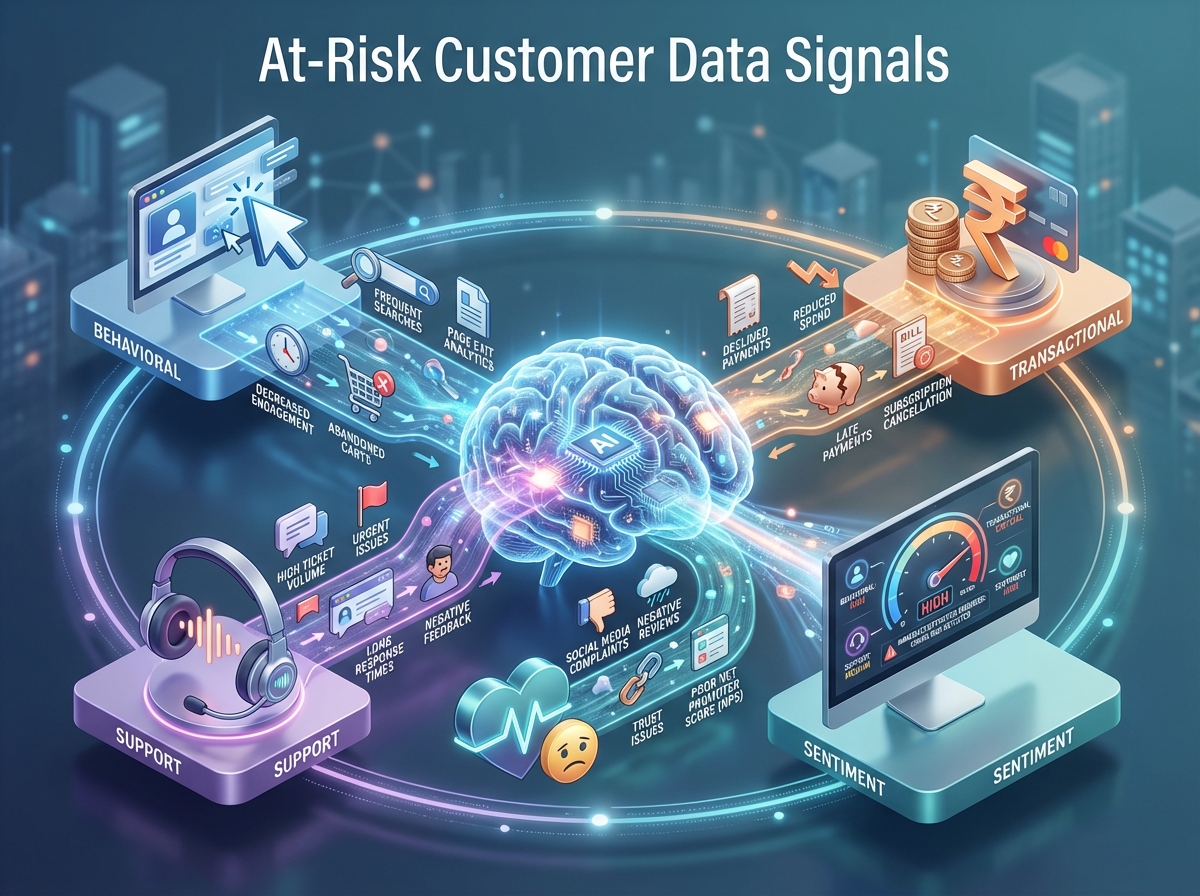
Effective AI crisis prevention marketing 2026 relies on the synthesis of diverse data signals to power at-risk customer identification. In the Indian enterprise context, where omnichannel behavior is the norm, these signals must be captured across the entire customer journey to build an accurate predictive dissatisfaction management engine.
Data signal categories for 2026 include:
- Behavioral & Usage Signals: Sudden drops in login frequency, repeated navigation errors, or the abandonment of high-intent actions like KYC completion or payment setup.
- Transactional Signals: Multiple failed UPI transactions, delivery delays exceeding SLA by 20%, or a high frequency of refund requests within a 30-day window.
- Support Interaction Signals: Rising Average Handle Time (AHT) in chat, unresolved intent across multiple sessions, and negative sentiment markers in call transcripts.
- Sentiment & Mood Signals: Tonal agitation in voice calls (detected via pitch and cadence analysis) and the use of “intent-to-switch” language in text-based communications.
The modeling blueprint for 2026 involves building supervised machine learning models that incorporate Recency-Frequency-Monetary (RFM) data alongside real-time emotional engagement tracking. Enterprises are now calibrating thresholds where a risk score above 0.65 triggers an immediate, automated intervention. For instance, if a user experiences a failed renewal combined with negative sentiment in a support bot, the system initiates a proactive rescue flow.
By utilizing Computed Traits within a Customer Data Platform (CDP), Indian marketers can transform raw behavioral data into actionable risk scores. This allows for dynamic segmentation, where high-risk cohorts receive high-touch, empathy-driven video responses, while lower-risk segments receive automated educational content to resolve potential friction points.
Sources:
Customer mood detection AI and emotional engagement tracking
A cornerstone of AI crisis prevention marketing 2026 is the deployment of customer mood detection AI. This technology utilizes advanced NLP and affective computing to infer a customer’s state—such as frustration, satisfaction, or confusion—from voice prosody, text semantics, and interaction patterns. By 2026, these models have reached a 94% accuracy rate for regional Indian dialects, allowing for nuanced de-escalation.
Emotional engagement tracking involves monitoring the shift in a customer’s affect before and after an intervention. By measuring the “sentiment delta,” CX leaders can quantify the impact of their empathy-driven video responses. If a customer moves from “highly frustrated” to “neutral” or “satisfied” within 72 hours of receiving a personalized video, the intervention is deemed successful.
Practical application of mood detection includes:
- Voice Agitation Flags: Detecting raised pitch or clipped speech patterns in contact center audio to prioritize the call for senior supervisor intervention.
- Textual Negativity Scans: Identifying keywords like “cancel,” “useless,” or “legal” to trigger an immediate sentiment-driven customer rescue flow.
- Visual Affect Analysis: In video-led support, using eye-tracking and facial coding to ensure the customer is following the resolution steps and remains engaged.
In the Indian regulatory environment, the use of such data must strictly adhere to the DPDP Act 2023. This requires explicit consent for analyzing emotional data, clear disclosure of mood detection usage, and the provision for users to opt-out. Data minimization is critical; enterprises must define specific retention periods and ensure that emotional data is pseudonymized to protect user privacy. DPDP-compliant personalization strategies
Sources:
Orchestrating sentiment-driven customer rescue
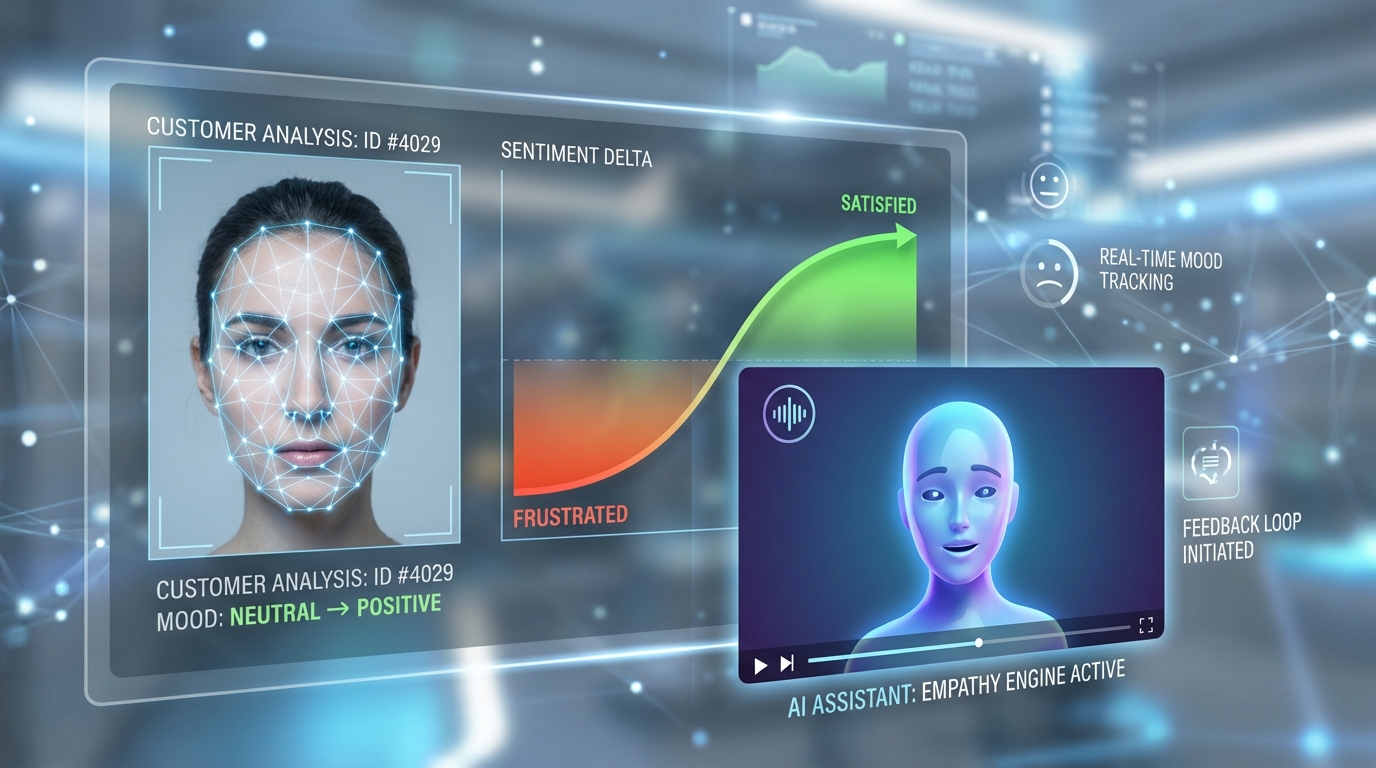
Orchestrating a sentiment-driven customer rescue requires a seamless integration of risk data and automated content generation. When a customer is identified as high-risk, the system must dynamically select the most effective channel and message format to de-escalate the situation. In 2026, video has become the preferred medium due to its ability to convey empathy and clarity far more effectively than text.
Platforms like TrueFan AI enable enterprises to deploy empathy-driven video responses at scale. These videos follow a rigorous script framework:
- Acknowledge Emotion: “We understand you've had a frustrating experience with your recent delivery delay.”
- Validate Experience: “This is not the standard of service we aim to provide.”
- Offer a Clear Fix: “We have expedited your shipment, and it will arrive by 4 PM today.”
- Provide Assurance: “As a gesture of goodwill, we've added a service credit to your account.”
Proactive support video automation ensures that these assets are delivered via WhatsApp or in-app notifications within 30 seconds of a trigger event, such as a KYC failure or a payment error. This rapid response prevents the customer from seeking public outlets for their frustration, thereby ensuring brand reputation protection. WhatsApp catalog video marketing
Furthermore, preemptive retention videos are tailored by risk tier. High-risk customers might receive a video from a virtual brand ambassador offering a deep discount or a direct line to a specialist, while medium-risk customers receive educational “how-to” videos to overcome onboarding friction. By localizing these videos into 175+ languages and dynamically mentioning the customer's name and specific issue, the perceived value of the intervention increases exponentially.
Sources:
Complaint prevention automation and preventive service recovery
The goal of complaint prevention automation is to close the loop before a customer feels the need to escalate. This involves event-aware workflows that fix root causes or provide immediate transparency. Preventive service recovery playbooks are now a standard part of the enterprise CX stack, designed to mitigate negative sentiment through automated, high-context interactions.
Examples of preventive service recovery in 2026 include:
- Logistics Failures: If a delivery is flagged as “delayed” in the ERP, the system automatically triggers a video apology with a real-time tracking link and a discount coupon for the next order.
- Technical Friction: If a user fails a biometric authentication three times, a proactive support video automation flow sends a 30-second walkthrough on correct positioning, delivered instantly via WhatsApp.
- Subscription Churn: When a “silent churner” (low usage + negative sentiment) is detected, the system sends a preemptive retention video highlighting new features relevant to their past behavior.
This cross-functional integration requires alignment between CX, Operations, Risk, and PR teams. By establishing pre-approved messaging templates and clear escalation matrices, brands can respond with agility. The rise of autonomous AI agents, such as those unveiled by Salesforce, further enhances this by making traditional, slow-moving chatbots obsolete and replacing them with agents capable of complex reasoning and empathetic resolution. BNPL default prevention campaigns
In India, where social media can amplify a single complaint into a national trend within hours, negative sentiment mitigation is not just a CX metric—it is a core component of brand reputation protection. Rapid, private de-escalation via WhatsApp Business, supported by localized video content, remains the most effective strategy for containing potential crises.
Sources:
Measuring satisfaction score improvement and ROI
The success of AI crisis prevention marketing 2026 is measured through a combination of traditional CX metrics and advanced emotional analytics. Satisfaction score improvement is the primary KPI, typically measured by the delta in CSAT or NPS scores within high-risk cohorts over a 60-to-90-day period. Enterprises utilizing these strategies target a 5–15% uplift in these scores by successfully preempting dissatisfaction. Predictive analytics for customer retention
Core KPIs for 2026 include:
- Retention/Churn Lift: Measuring the absolute reduction in churn among flagged at-risk customers. A target of 10–30% lift in retained revenue is standard for mature implementations.
- Ticket Deflection Rate: The percentage of potential support tickets avoided through proactive support video automation.
- Emotional Engagement Tracking: Monitoring view-through rates of rescue videos and the subsequent shift in sentiment (negative to positive) within the customer’s next three interactions.
- First Contact Resolution (FCR): An increase in FCR when video guidance is used to replace complex, text-based instructions.
Solutions like TrueFan AI demonstrate ROI through the direct correlation between personalized video interventions and reduced churn costs. The ROI formula for 2026 is calculated as: (Retained Revenue + Cost Avoidance from Deflection) / (Platform + Media + Operations Cost).
To ensure accuracy, CX leaders use uplift experiments, comparing a treatment group (receiving AI-driven rescue) against a matched control group of at-risk customers who receive standard reactive support. This data-driven approach allows for the continuous refinement of empathy-driven video responses and predictive models, ensuring that the enterprise remains both efficient and empathetic.
Sources:
Enterprise implementation blueprint and governance
Implementing AI crisis prevention marketing 2026 requires a structured 90-day rollout plan that prioritizes data integrity and regulatory compliance. TrueFan AI's 175+ language support and Personalised Celebrity Videos provide the necessary scale and cultural resonance for the Indian market, ensuring that every rescue attempt feels authentic and personal.
The 90-Day Rollout Plan:
- Days 0–30 (Foundation): Establish data pipelines between the CRM, CSM, and the AI video platform. Calibrate risk models using historical churn data and implement DPDP-compliant consent notices.
- Days 31–60 (Pilot): Launch the first three rescue playbooks (e.g., payment failure, delivery delay, onboarding friction) for a high-risk pilot cohort. Conduct A/B testing on empathy script variants to determine the most effective tone.
- Days 61–90 (Scaling): Expand the program to 5–7 key customer breakpoints. Integrate two-way AI avatars for complex de-escalations and formalize the reporting dashboard for executive stakeholders.
Governance is paramount. Enterprises must conduct quarterly bias tests to ensure that mood detection models perform equitably across different languages and demographics. Furthermore, a “human-in-the-loop” protocol must be established for extremely high-value or sensitive cases where AI intervention might be insufficient. Interactive video data capture guide
Security standards such as ISO 27001 and SOC 2 are non-negotiable for white-label AI video platforms in 2026. By maintaining a consent-first pipeline and rigorous content moderation filters, brands can leverage the power of AI crisis prevention marketing 2026 without compromising on ethics or legal obligations under the DPDP Act.
Sources:
Case Vignette: Preventive service recovery in action
A leading Indian telecommunications provider observed a significant spike in payment failures following a system migration, leading to a surge in negative sentiment across social media. By deploying an AI crisis prevention marketing 2026 framework, they were able to identify at-risk customers with a 0.72 churn propensity score.
The system automatically triggered proactive support video automation, sending a 45-second video in the customer’s preferred regional language (e.g., Hindi, Tamil, or Bengali). The video acknowledged the technical glitch, provided a simplified three-step UPI retry guide, and automatically granted a 2-day bill extension as a goodwill gesture.
For customers who did not resolve the issue within two hours, the system escalated to an empathy-driven video response featuring a two-way AI avatar that offered live, guided assistance. Within 30 days, the results were transformative:
- 22% satisfaction score improvement in the flagged cohort.
- 18% reduction in the overall complaint rate.
- 30% fewer negative social mentions, directly contributing to brand reputation protection.
- 14% reduction in escalations to human agents, significantly lowering operational costs.
Playbook Checklists for CX Leaders
Data & Modeling Checklist:
- [ ] Define features (behavioral, transactional, sentiment).
- [ ] Set risk thresholds (e.g., >0.65 for high-priority rescue).
- [ ] Implement real-time emotional engagement tracking.
Content & Orchestration Checklist:
- [ ] Script empathy-first templates for top 5 friction points.
- [ ] Localize content into top 8 Indian languages.
- [ ] Ensure <30s render-to-delivery time via WhatsApp/Email.
Governance Checklist:
- [ ] Update privacy notices for DPDP 2023 compliance.
- [ ] Establish a human-override protocol for edge cases.
- [ ] Conduct quarterly bias and fairness audits on AI models.
By integrating these strategies, enterprise leaders can transform their CX from a reactive cost center into a proactive engine for brand loyalty and growth. The future of customer retention is not just about solving problems—it is about predicting them and responding with unprecedented empathy.
Frequently Asked Questions
How is predictive dissatisfaction management different from standard churn prediction?
While churn prediction identifies customers likely to leave, predictive dissatisfaction management focuses on the emotional and experiential triggers that lead to that decision. It allows for interventions before the customer reaches the point of no return, using sentiment-driven customer rescue to fix the relationship in real-time.
Is customer mood detection AI legal under India's DPDP Act?
Yes, provided the enterprise adheres to the principles of lawful basis, explicit consent, and purpose limitation. Organizations must clearly disclose that they are analyzing emotional data to improve service and provide a straightforward opt-out mechanism.
Do empathy-driven video responses actually reduce support tickets?
Data from 2026 implementations shows that personalized video guidance can deflect up to 40% of follow-up tickets. The combination of clear visual instruction and the psychological impact of perceived care significantly reduces the customer’s need to seek further help.
Can these AI crisis prevention marketing 2026 strategies be localized for rural India?
Absolutely. Platforms like TrueFan AI support over 175 languages, enabling brands to reach customers in their native tongue with culturally relevant avatars and scripts, which is essential for building trust in non-urban markets.
What is the typical ROI for a preventive service recovery program?
Most enterprises see a full return on investment within 6 to 9 months. This is driven by the high cost-efficiency of automated video compared to human support, combined with the significant revenue impact of reducing churn by 10–30%.