Predictive life event marketing: using AI and personalized video to win India’s next “moment of need”
Estimated reading time: ~11 minutes
Key Takeaways
- Shift from reactive triggers to anticipatory personalization by predicting life events and engaging before the “moment of need.”
- Build a unified behavioral signal graph combining first-party, CRM, location, and velocity features to score event likelihood.
- Use calibrated probability models (GBMs, sequence, survival) with monthly recalibration to drive precise trigger queues.
- Activate high-intent windows via preemptive automation on channels like WhatsApp with suppression, governance, and dynamic windows.
- Translate predictions into impact using personalized video at scale, leveraging enterprise video APIs and language localization.
Predictive life event marketing is an AI-driven approach to anticipate upcoming customer milestones—such as job changes, marriages, or relocations—from multi-source behavioral signals and execute preemptive, hyper-personalized video campaigns before the moment of need occurs. By shifting from reactive triggers to proactive engagement, brands can secure a competitive advantage in high-intent windows, ensuring better timing, higher relevance, and a measurable lift across life event trigger campaigns and milestone marketing automation.
In the rapidly evolving Indian landscape, this strategy is no longer optional for sectors like BFSI, insurance, telco, retail, travel, and healthcare. As we enter 2026, the promise of anticipatory personalization is being realized through sophisticated life event probability scoring, allowing enterprises to reach customers with the right solution precisely when their life stage transitions demand it.
The 2026 Macro-Trend: India’s Shift to Always-On Intelligence
The Indian marketing ecosystem has undergone a fundamental transformation, moving away from static, batch-and-blast methodologies toward dynamic, outcome-optimized systems. According to industry leaders, by 2026, marketing in India will have transformed into an always-on, intelligent, AI-driven outcome optimization system, where every interaction is powered by real-time predictive insights.
This shift is validated by significant performance data from the region. WebEngage reported a staggering 163% surge in revenue from contextual marketing campaigns in 2024, proving that event-triggered outreach materially outperforms traditional methods. Furthermore, MoEngage’s 2025 benchmarks indicate that advanced personalization can drive over 100% improvement in engagement metrics compared to basic personalization strategies.
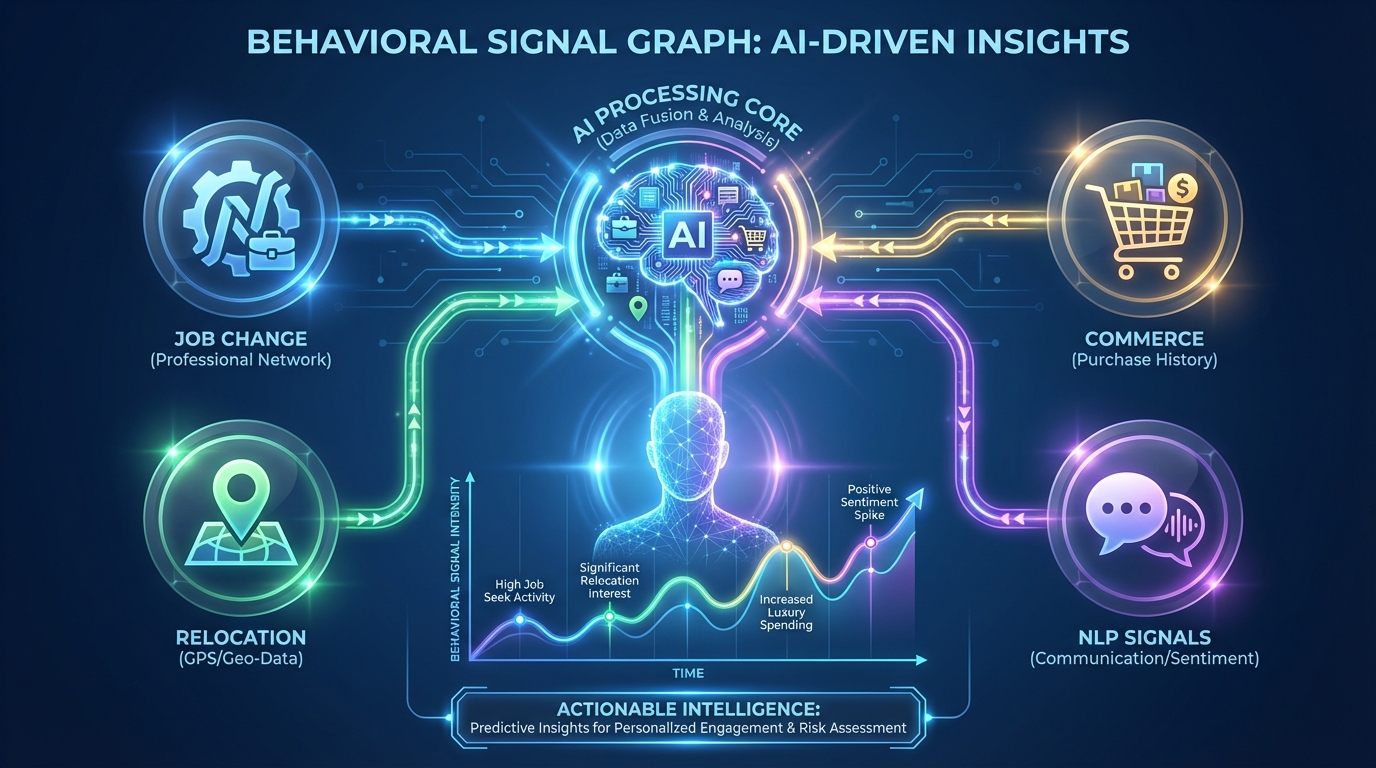
For India’s CXOs and CIOs, the priority has shifted toward unified data and hyper-personalization. The goal is to create a seamless “behavioral signal graph” that allows for proactive lifecycle marketing, ensuring that the brand is present not just when the customer searches, but when the AI predicts they are about to search.
Sources:
- Netcore: Marketing Transforms into Always-On AI Systems (2026)
- WebEngage: 163% Surge in Contextual Marketing Revenue
- MoEngage: Email Benchmarks 2025 and Advanced Personalization
- CIO Economic Times: Unified Data and Hyper-Personalization Priorities
Signals-to-Strategy: Building the Behavioral Signal Graph
At the heart of predictive life event marketing lies the ability to perform behavioral signal detection across disparate data sources. This involves using AI behavioral pattern recognition to identify subtle shifts in a user's digital footprint that correlate with major life transitions.
A robust behavioral signal graph incorporates several key categories of data:
- Profile and Professional Graph Changes: Updates to job titles or companies on professional networks, or geography changes inferred via IP addresses and login locations.
- First-Party Browsing Shifts: Sudden spikes in visits to mortgage calculators, education loan pages, or insurance comparison tools, often indicating a move or a major purchase.
- Commerce and CRM Signals: High-ticket item browsing without immediate purchase, or “category drift” in retail, such as a sudden interest in baby products or home appliances.
- Communications Signals: Natural language processing (NLP) of chat topics or service calls that mention relocation, marriage, or family planning.
- Location and Logistics: Address change requests in utility apps or a consistent drift in app location data toward a new city.
- Velocity Features: Analyzing the recency, frequency, and monetary (RFM) metrics alongside the “velocity of change”—how quickly a user's behavior is deviating from their established baseline.
By mapping these signals, brands can move beyond simple “if-this-then-that” logic. Instead, they employ life event probability scoring to estimate the likelihood of an event occurring within a specific window, such as the next 14 or 30 days.
Sources:
- WebEngage: Event Analytics 2.0 and Pattern Detection
- Netcore: Predictive Segments and Real-Time Data
Modeling Life Event Probability Scoring
To achieve true anticipatory personalization, data science teams must move toward a calibrated probability model: p(event | signals, horizon). This model estimates the probability that a customer will experience a specific life event within a defined prediction window.
The recommended technical stack for this modeling varies by organizational maturity:
- Baseline Rules: For organizations in the “cold-start” phase, interpretable rules based on high-intent signals (e.g., visiting a “new parent” landing page three times in 48 hours) provide a solid foundation.
- Tree-Based Models: XGBoost or LightGBM are highly effective for tabular, sparse data typically found in CRM and transaction logs.
- Sequence Models: For brands with high-frequency interaction data, RNNs or Transformer encoders can capture the temporal context of a user's session trajectory.
- Survival Models: DeepSurv or discrete-time hazard models are used to estimate the “time-to-event,” allowing marketers to adjust their preemptive marketing automation based on how close the predicted event is.
Calibration is critical; models must be re-calibrated monthly using techniques like Platt scaling to ensure that a predicted 70% probability actually results in the event 70% of the time. This precision allows for the creation of high, medium, and low priority trigger queues, optimizing the expected uplift against the cost of contact.
Sources:
- MoEngage: Smart Triggers and Event-Based Targeting
- Zendesk: 59 AI Customer Service Statistics for 2026
Campaign Architecture: Preemptive Marketing Automation
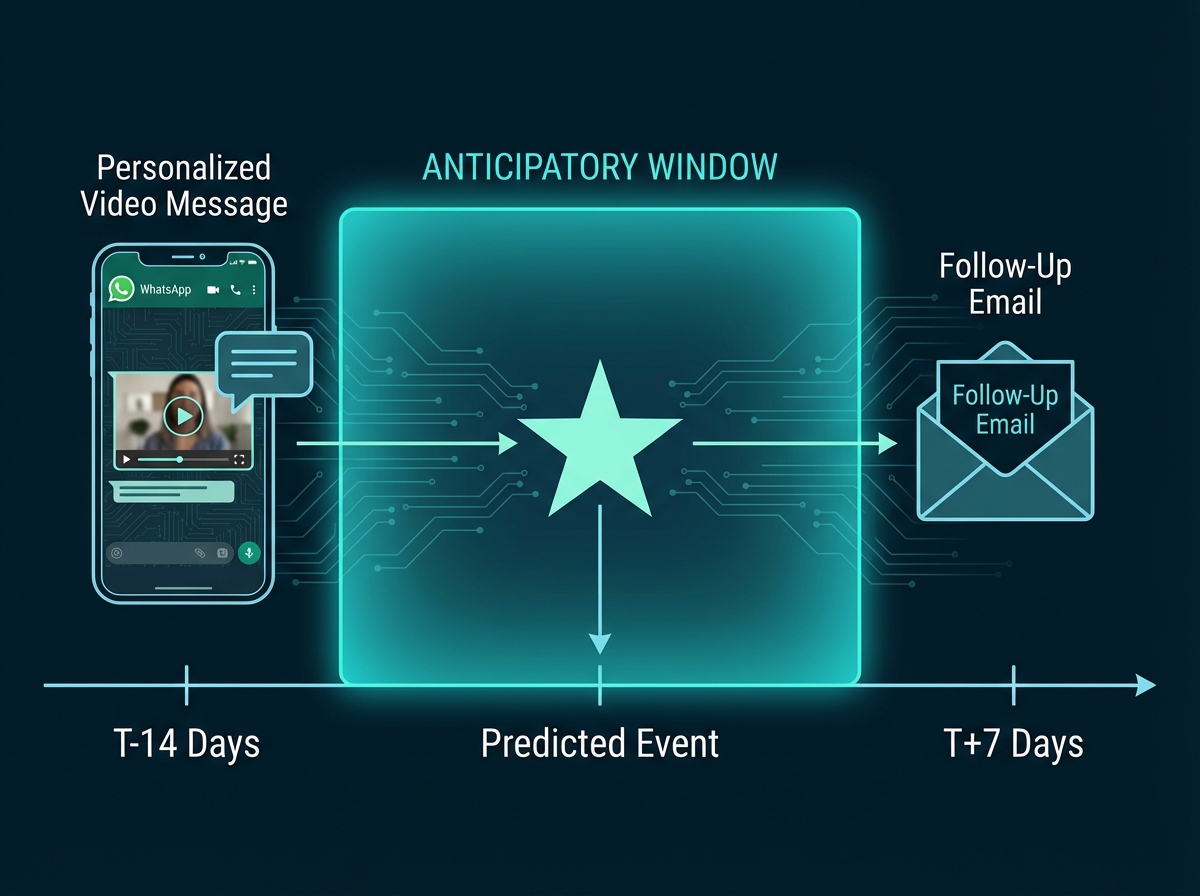
Once a high-probability score is generated, the system must transition into execution through life event trigger campaigns. This requires a sophisticated orchestration flow that respects the “anticipatory window”—the period just before the life event occurs when the customer is most receptive to solutions.
The orchestration involves several layers:
- Priority Queueing: High-score leads are prioritized for high-impact channels like WhatsApp Catalog Video Marketing, while medium-score leads may receive email or in-app nudges.
- Suppression and Governance: Automated rules must prevent over-communication, respecting recent opt-outs and frequency caps to maintain trust.
- Channel Heuristics: In the Indian market, WhatsApp Business Commerce Automation 2026 often serves as the primary channel for time-sensitive nudges, with SMS and email serving as secondary fallbacks.
- Dynamic Windows: Campaigns should hit the “T-14 to T+7” window around a predicted event, recycling users into nurture flows if no immediate engagement is detected.
Milestone marketing automation ensures that discrete events like a new job or a new home are met with finite, highly relevant playbooks. This proactive lifecycle marketing approach ensures that the brand is perceived as a helpful partner rather than an intrusive advertiser.
Sources:
- WebEngage: Transactional Campaign APIs for Real-Time Sends
- Salesforce: India’s Service Leaders Priorities for 2026
Turning Predictions into Impact with Personalized Video
The most effective way to capitalize on a predicted life event is through high-engagement creative assets. Platforms like TrueFan AI enable brands to bridge the gap between predictive insight and creative execution at scale, transforming raw data into emotionally resonant video content.
There are three primary classes of creative assets used in these campaigns:
- Predictive Customer Journey Videos: These explain the “next-best step” tailored to the predicted intent, such as a personalized walkthrough of a home loan pre-approval process.
- Life Milestone Prediction Videos: These celebrate or acknowledge the upcoming milestone, introducing a relevant product bundle—for example, a relocation video that offers a combined broadband and home security package.
- Behavioral Prediction AI Videos: These use micro-variations based on the user's score band, preferred language, and brand ambassador affinity to maximize watch-through rates.
TrueFan AI's 175+ language support and Personalised Celebrity Videos allow for a level of cultural resonance that was previously impossible to automate. By passing a CRM payload—including name, city, and predicted event—to the Enterprise AI Video API, brands can generate unique video variants in under 30 seconds. This capability was demonstrated by Zomato, which generated 354,000 personalized videos in a single day, and Hero MotoCorp, which delivered 2.4 million festive greetings to drive service camp visits.
Sources:
- TrueFan AI: Enterprise Product Offerings and Case Studies
- Wyzowl: 91% of Businesses Use Video as a Marketing Tool in 2026
Life Stage Transition Marketing Playbooks by Industry
To operationalize predictive life event marketing, brands must develop specific playbooks that map signals to offers across various sectors.
BFSI (Banking, Financial Services, and Insurance)
- Predicted Event: New Job or Relocation.
- Signals: LinkedIn title change, salary credit shift, or browsing home loan calculators.
- Offer: A “Salary Account + Premium Credit Card” bundle or a pre-approved relocation personal loan.
- Timing: WhatsApp nudge within 7 days of the predicted job start date.
Insurance
- Predicted Event: Marriage or New Baby (Mother-Child Wellness Marketing 2026).
- Signals: Adding a dependent to an existing policy, searching for pediatricians, or browsing “family floater” plans.
- Offer: A child education plan or a comprehensive family health cover.
- Creative: A life milestone prediction video featuring a celebrity offering congratulations and a “new parent” discount.
Explore the insurance playbook: Insurance CLM Video Automation in India.
Retail and E-commerce
- Predicted Event: Home Purchase or Relocation.
- Signals: Browsing large appliances (refrigerators, washing machines) or furniture velocity.
- Offer: A “Home Setup” bundle with tiered discounts based on total cart value.
- Channel: In-app personalized video showing the products in a simulated home environment.
Telco and Broadband
- Predicted Event: Relocation.
- Signals: Address change requests or searches for ISPs in a new geographic circle.
- Offer: A “Zero-Lag Relocation” pack with instant installation and a complimentary OTT bundle.
Sources:
- WebEngage: 13 Lifecycle Events to Automate in E-commerce
- MoEngage: Data and 360-Degree Views in Financial Services
Measurement, Governance, and the 30-Day Pilot
Success in predictive engagement timing requires rigorous measurement and ethical guardrails. Solutions like TrueFan AI demonstrate ROI through significantly higher watch-through rates and lower cost-per-acquisition compared to generic video assets, but these must be validated through controlled experiments.
Experiment Design and Attribution
Marketers should use geo-level or user-level holdouts to measure the incremental lift of predictive campaigns. Uplift modeling can further refine this by identifying “persuadables”—users who only convert because of the preemptive nudge. Attribution must be multi-touch, accounting for the synergy between WhatsApp, email, and in-app interactions.
Ethics and Compliance
Predictive marketing must be built on a foundation of trust. This includes:
- Consent-First Personalization: Ensuring all data used for prediction is gathered with explicit user consent.
- Bias Audits: Regularly checking models to ensure they do not use protected-class proxies (e.g., using neighborhood as a proxy for ethnicity).
- Security: Implementing ISO 27001 and SOC 2 standards for data handling, especially when passing PII to third-party APIs for video generation.
The 30-Day Pilot Plan
For organizations ready to start, a 30-day pilot is the most effective way to prove value:
- Week 1: Define one event (e.g., job change) and extract historical signals to label outcomes.
- Week 2: Train a baseline GBM model and calibrate the probability scores.
- Week 3: Connect the CRM to the Enterprise AI Video API Platform and build two video variants (value-led vs. incentive-led).
- Week 4: Launch to a 20% holdout group and monitor read rates, watch-through, and conversion lift.
Sources:
- National University: 131 AI Statistics and Trends for 2026
- Creative Garage: 30-40% Higher ROI from AI-Driven Campaigns in 2026
Recommended Internal Links
- Enterprise AI Video API: Scalable, Secure Personalization
- Enterprise AI Video API: Secure, Scalable Personalization (Platform)
- Enterprise AI Video API: Secure, Scalable Personalization (Guide)
- WhatsApp Business Commerce Automation 2026: Growth Playbook
- WhatsApp Catalog Video Marketing: Tactics for 2026
- Insurance CLM Video Automation India: Boost ROI in 2026
- Mother-Child Wellness Marketing 2026: Personalized Videos
Frequently Asked Questions
What is life event probability scoring?
Life event probability scoring is a data science technique that uses AI to calculate the likelihood (from 0 to 1) that a customer will experience a major life milestone—like getting married or moving house—within a specific future timeframe. This allows marketers to time their outreach perfectly.
How does predictive life event marketing differ from traditional trigger marketing?
Traditional trigger marketing is reactive; it responds after an event has occurred (e.g., sending a “Welcome” email after a purchase). Predictive marketing is proactive; it uses behavioral signals to engage the customer before the event happens, capturing the “moment of need” earlier than competitors.
Can personalized videos be generated in real-time?
Yes. Using advanced APIs, brands can generate personalized videos in under 30 seconds. This allows for real-time delivery via WhatsApp or email immediately after a predictive model identifies a high-probability score for a user.
How does TrueFan AI ensure the ethical use of celebrity likenesses?
TrueFan AI operates on a strict consent-first model. Every celebrity featured on the platform has a formal contract allowing their likeness to be used for AI-generated personalization. Additionally, the platform has built-in moderation to prevent the generation of offensive or unapproved content.
What industries see the highest ROI from milestone marketing automation?
While all consumer-facing industries benefit, BFSI, Insurance, and E-commerce typically see the highest ROI. These sectors involve high-value decisions tied to life transitions, where being the first brand to offer a solution can lead to long-term customer loyalty and significantly higher lifetime value (LTV).
How do I integrate predictive video into my existing Martech stack?
Integration is typically handled via API. Your CDP or CRM (like WebEngage or MoEngage) identifies a high-probability user and sends a JSON payload to the Enterprise AI Video API Guide. The API returns a unique video URL, which is then automatically inserted into your automated journey for delivery via your preferred channel.