URL to Video AI Generator: 10x E‑commerce Product Videos in 30 Seconds (No Filming)
Estimated reading time: ~8 minutes
Key Takeaways
- URL-to-video automation converts any product page into a brand-compliant video in ~30 seconds, eliminating manual filming.
- API-driven workflows enable bulk generation, A/B testing at scale, and real-time personalization across markets.
- Shopify and Amazon integrations auto-embed videos on PDPs and listings to boost CTR, CVR, and purchase intent.
- Creative best practices focus on strong hooks, social proof, and channel-specific aspect ratios to fight ad fatigue.
- Enterprise security with RBAC, encryption, and signed webhooks supports compliant, reliable pipelines.
The digital commerce landscape in 2026 has reached a critical inflection point where creative volume is the only remaining lever for sustainable growth. As performance marketers and growth hackers at leading D2C brands grapple with skyrocketing customer acquisition costs (CAC), the traditional video production model has become a structural liability. Utilizing a URL to video AI generator is no longer a luxury; it is a strategic necessity for brands aiming to achieve 10x content velocity without the overhead of manual filming or editing.
By leveraging web content video automation, enterprises can now transform static product detail pages (PDPs) into high-converting e-commerce product videos in under 30 seconds. This shift toward API-driven video creation allows brands to bypass the creative bottleneck, enabling a CI/CD-style approach to performance creative that was previously impossible.
What is a URL to Video AI Generator?
A URL to video AI generator is a sophisticated enterprise-grade system designed to convert a live product page URL or marketplace listing into a fully edited, brand-compliant video asset. Unlike basic text-to-video tools that require extensive prompt engineering and manual asset sourcing, this technology automatically ingests structured data directly from the web. It extracts hero images, video clips, pricing, specifications, and customer reviews to synthesize a cohesive narrative.
Platforms like TrueFan AI enable this seamless transition from data to motion, ensuring that every frame is optimized for conversion. The system functions by “reading” the Document Object Model (DOM) of a product page, identifying the most relevant selling points, and mapping them to high-performance video templates. This automation eliminates the need for expensive studio shoots, allowing brands to refresh their creative assets as frequently as they update their inventory.
In the current 2026 market, where Indian e-commerce is projected to surpass $160 billion, the ability to generate e-commerce product videos at scale is a primary differentiator. Traditional manual editing cycles—often taking days or weeks—cannot keep pace with the rapid SKU updates and flash sales typical of modern retail. A product page video converter solves this by automating the ingestion, templating, and rendering phases, providing a dynamic content generation engine that scales with your catalog.
Sources:
How Web Content Video Automation Works from Any Product URL
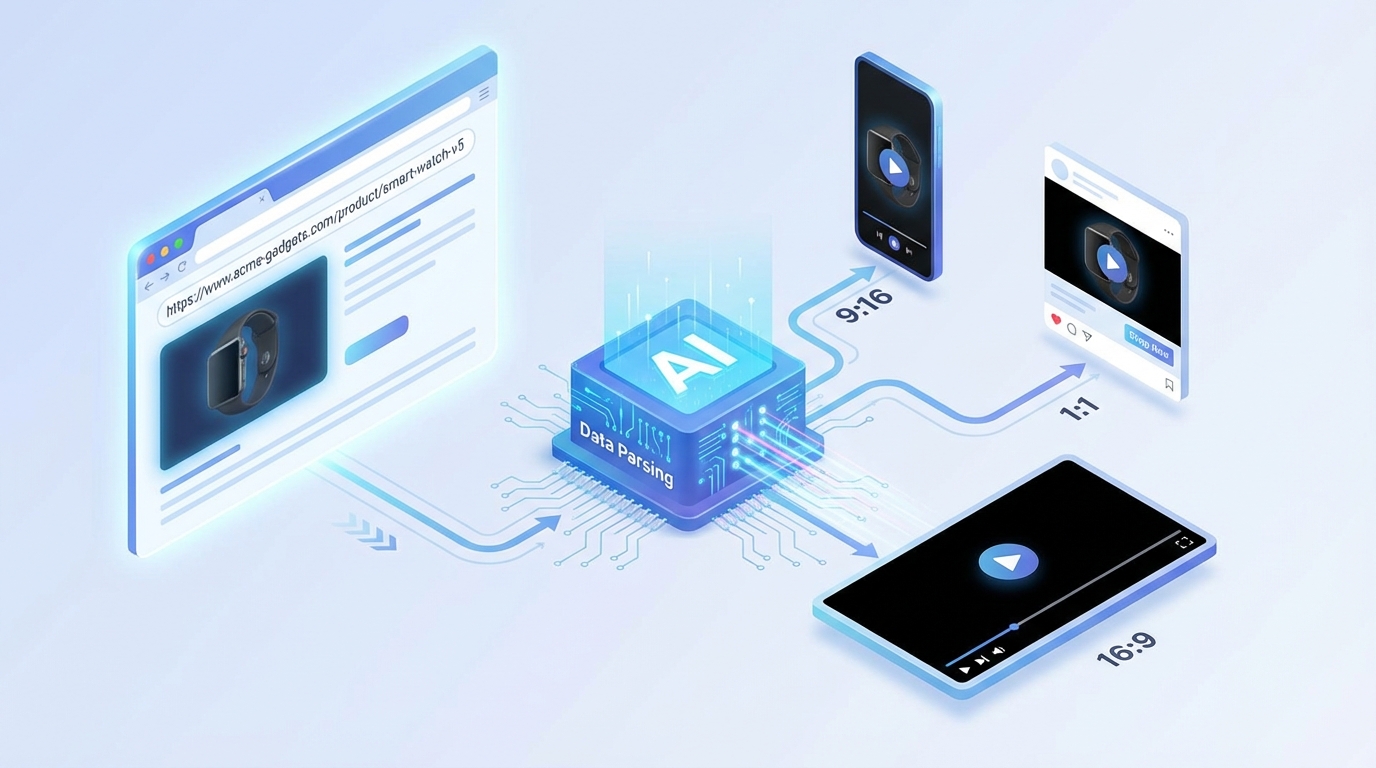
The technical architecture behind web content video automation is designed for speed, precision, and brand governance. The process begins with URL ingestion, where the system fetches the target product page while respecting robots.txt protocols and rate limits. Once the page is accessed, a data parsing engine extracts Schema.org/Product fields, including the product name, brand, SKU, and real-time pricing data.
Following extraction, the system performs asset normalization. This involves upscaling hero imagery and deduplicating assets to ensure only the highest quality visuals are used. The AI then crops these assets into safe-zone aware variants for various aspect ratios, such as 9:16 for Reels or 1:1 for Shopify PDPs. A 30-second rendering time is maintained through a distributed GPU queue, ensuring that even bulk requests for thousands of SKUs are processed with minimal latency.
The final stage involves the template engine, which maps the extracted data to pre-approved brand layers. This includes auto-generating voiceovers (VO) from product benefits and burning in captions for channel compliance. The result is a channel-ready video delivered via a hosted media URL or pushed directly to a marketplace. This level of dynamic content generation ensures that every video is not only high-quality but also contextually relevant to the current state of the product page.
Sources:
API-Driven Video Creation for 10x Content Velocity
For enterprise teams, the true power of this technology lies in API-driven video creation. By utilizing REST endpoints, developers can integrate video generation directly into their existing product management systems (PIM) or marketing automation stacks. This programmatic approach allows for the generation of thousands of unique video variants from a single API call, facilitating massive A/B testing of hooks, intros, and call-to-actions.
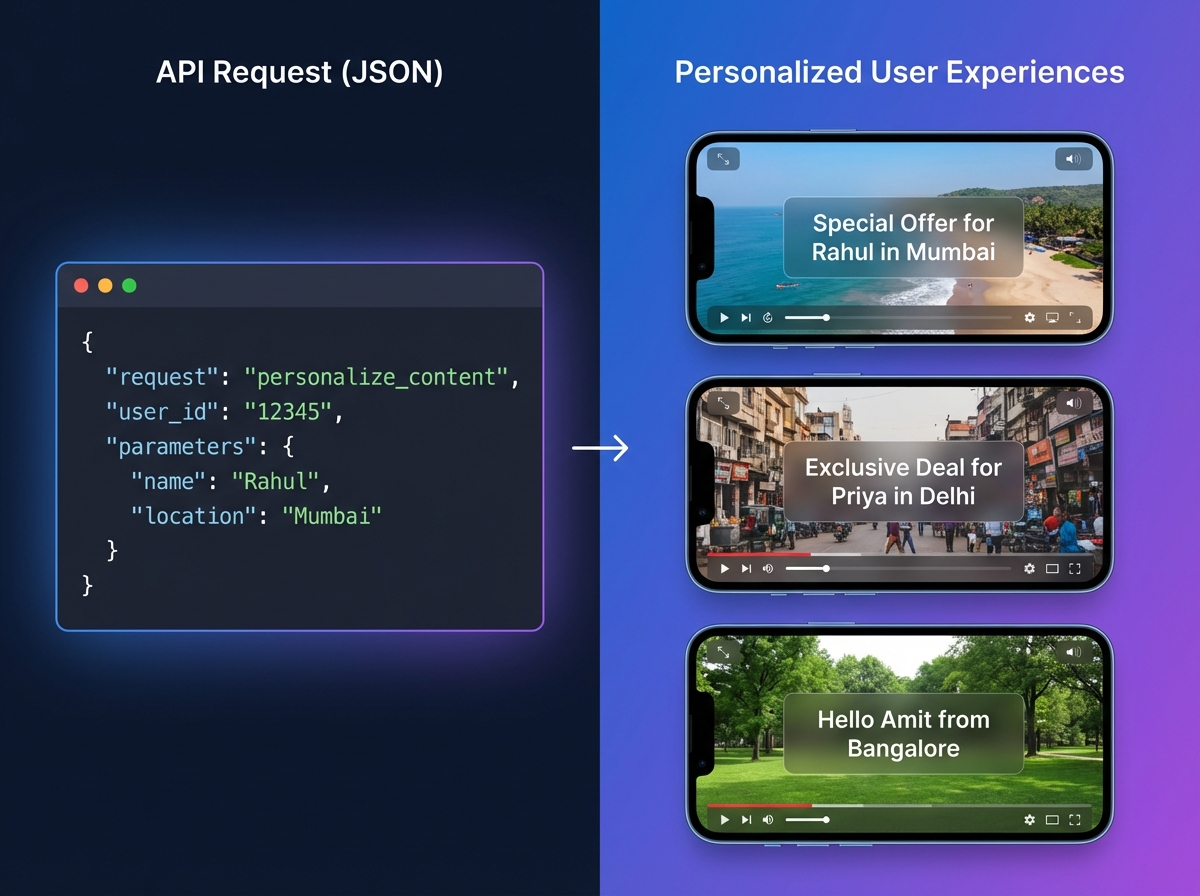
TrueFan AI's 175+ language support and Personalised Celebrity Videos can be integrated into these workflows to create hyper-localized content for diverse markets. REST API video personalization allows brands to pass specific user or product attributes—such as a customer's name, city, or loyalty tier—into the video payload. This results in a tailored viewing experience that significantly boosts engagement and conversion rates compared to generic creative.
The enterprise architecture typically includes an Ingestion API for POSTing product URLs, a Template Engine for selecting brand-locked styles, and a Personalization Service for merging dynamic data. Security is paramount in this workflow; OAuth2/JWT tokens and signed webhooks ensure that data residency and privacy standards are met. This robust framework enables performance teams to treat video creative like software, deploying updates and iterations with the click of a button.
| Feature | Description | Benefit |
|---|---|---|
| Ingestion API | Programmatic URL/ASIN submission | Automated bulk processing |
| Personalization | User/Product attribute merging | Higher CTR and ROAS |
| Render Queue | GPU-accelerated 30s rendering | Real-time creative delivery |
| Webhooks | Status and delivery notifications | Seamless workflow integration |
Sources:
Shopify Video Integration and Amazon Listing Videos
Integrating automated video into major e-commerce ecosystems is a core requirement for modern brands. Shopify video integration allows for trigger-based workflows: when a new product is created or a price is updated, a webhook can automatically trigger the URL to video AI generator. The resulting video is then auto-embedded onto the Shopify PDP and distributed to linked marketing channels like Instagram Reels or WhatsApp.
For marketplace sellers, Amazon listing videos are a critical component of the A+ Content strategy. Using a product page video converter, sellers can generate compliant 15–60 second videos that adhere to Amazon India’s strict guidelines. These videos must respect safe margins and include legible captions to ensure they pass Amazon’s moderation process. Automating this via an ASIN feed allows brands to maintain video coverage across their entire catalog, which is proven to increase purchase intent by up to 80% in some categories.
The technical guidelines for Amazon India emphasize the importance of shoppable video placements. By generating videos in 16:9 or 1:1 formats with clear, high-contrast text overlays, brands can significantly improve their visibility in search results. The ability to batch-generate these assets via CSV or API ensures that even seasonal promotions or flash sales are supported with high-quality video content across all SKUs.
Sources:
Best Practices for High‑Converting E‑commerce Product Videos
To maximize the impact of e-commerce product videos, brands must adhere to specific creative principles optimized for short-form consumption. The first 2–3 seconds, or the “hook,” are the most critical. This segment should feature a clear value proposition or a visually arresting product shot to stop the scroll. High-performing videos often showcase benefits over features, using AI-generated scene variations to keep the content fresh and engaging.
Incorporating social proof, such as star ratings or UGC pull-quotes, directly into the video via dynamic content generation can further build trust. For example, a video can automatically pull the latest 5-star review from the PDP and overlay it as a testimonial. This level of automation ensures that the creative is always aligned with the most current customer sentiment.
Channel-specific optimization is also vital. A “channel pack” approach involves creating 9:16 variants with bold subtitles for Reels and Shorts, 1:1 variants for Shopify PDPs, and 16:9 variants for Amazon listings. By rotating these assets weekly and testing different hooks, brands can effectively fight ad fatigue. Personalizing the copy for specific cities or languages further enhances the relevance of the content, driving higher ROAS across diverse audience segments.
Sources:
Security and Implementation of a Product Page Video Converter
Implementing an enterprise-grade product page video converter requires a focus on security, compliance, and governance. Enterprise teams must ensure that the platform adheres to ISO 27001 and SOC 2 standards, providing role-based access control and PII minimization. Encryption at rest and in transit is mandatory, especially when handling sensitive customer data for REST API video personalization.
The implementation process typically begins with a sandbox environment where developers can test API payloads. A standard POST request to the /videos endpoint includes the product URL, template ID, and personalization attributes. The system then returns a unique ID, which can be used to poll for status or receive a webhook notification once the 30-second rendering time is complete.
// Example Node.js Request for URL-to-Video
const axios = require('axios');

const generateVideo = async () => {
  const response = await axios.post('https://api.truefan.ai/v1/videos', {
    url: 'https://yourstore.com/products/hero-item',
    templateId: 'ecommerce_premium_01',
    aspectRatio: '9:16',
    personalization: {
      firstName: 'Rahul',
      city: 'Mumbai',
      discountPct: '20%'
    },
    webhooks: {
      status: 'https://your-app.com/hooks/video-status'
    }
  }, {
    headers: { 'Authorization': 'Bearer YOUR_API_TOKEN' }
  });
  console.log('Video Queued:', response.data.id);
};
This programmatic control allows for sophisticated error handling, such as automatic retries with jitter and dead-letter queues for failed renders. By integrating these robust protocols, enterprises can ensure a reliable and scalable video production pipeline that supports their global marketing efforts.
Sources:
Results, ROAS Proof, and Frequently Asked Questions
The transition to automated video production yields measurable improvements across the entire marketing funnel. Solutions like TrueFan AI demonstrate ROI through a 10x increase in content velocity and a significant reduction in the cost per video compared to traditional agency models. Brands often see a 20-30% lift in click-through rates (CTR) and conversion rates (CVR) when using personalized, high-frequency creative updates.
A typical 2-week implementation plan involves generating 600+ variants for top SKUs in the first week, followed by performance-based iteration in the second week. By swapping the top-performing hooks across different product categories and utilizing language personalization for Tier-1 and Tier-2 cities, brands can rapidly optimize their ad spend. Tracking metrics such as PDP dwell time and add-to-cart (ATC) rates provides the necessary data to justify the shift toward web content video automation.
Sources:
Frequently Asked Questions
Can I auto-generate Amazon listing videos from a URL?
Yes. By using a product page video converter and API-driven video creation, you can transform any Amazon product link or ASIN into a compliant listing video. Ensure that the output meets Amazon India’s guidelines for captions and safe zones.
How fast is the rendering process?
The system typically achieves a 30-second rendering time for standard e-commerce templates. This is enabled by a scalable GPU-accelerated queue that can handle thousands of concurrent requests.
How does REST API video personalization work?
You pass specific attributes—like a customer's name, their city, or a dynamic discount code—in the API request body. The engine then dynamically swaps text, overlays, and voiceovers during the render process to create a unique video for each recipient.
Is TrueFan AI suitable for large-scale Shopify stores?
Absolutely. TrueFan AI's enterprise infrastructure is designed to handle high-volume Shopify video integration, allowing brands to automate video creation for their entire catalog via webhooks or CSV imports.
What are the benefits of web content video automation for D2C brands?
The primary benefits include 10x faster content production, lower CAC through rapid creative testing, and the ability to maintain a consistent brand voice across thousands of automated video assets.