Board Exam Results Marketing 2026: Transforming Result-Day Anxiety into Strategic Enrollment Growth
Estimated reading time: ~12 minutes
Key Takeaways
- Move beyond simple Pass/Fail segmentation to psychological cohorts that tailor tone, content, and CTAs.
- Lead with empathetic crisis communications in the first 24 hours via WhatsApp-led omnichannel flows.
- Use personalized support and recommendation videos to shift from compassion to action and improve retention.
- Automate career counseling and scholarship guidance to convert peak intent during April–May.
- Scale securely with consent-first data practices and sub-30s video rendering to build trust and speed.
The landscape of board exam results marketing 2026 has shifted from generic congratulatory messages to a sophisticated, empathy-driven “Compassion-to-Conversion” playbook. For Indian EdTech enterprises, the April–May window represents the highest-intent period for student acquisition, yet it is also the period of maximum emotional volatility. Success in 2026 requires moving beyond static ads toward a framework that integrates exam result crisis management with automated, personalized support systems.
In this high-stakes environment, marketing leaders must navigate the intersection of peak motivation and peak anxiety. According to 2026 global marketing benchmarks, strategies that emphasize measurable business outcomes and AI-driven personalization WhatsApp catalog video marketing strategies are outperforming traditional broad-reach campaigns. By leveraging student anxiety support videos and career counseling automation EdTech, platforms can provide immediate value during the “result season” while securing long-term mental wellness student retention.
This guide outlines the technical and psychological architecture required to turn the 2026 board result window into a primary engine for enrollment and student success.
1. Strategic Segmentation: The Foundation of Board Exam Results Marketing 2026
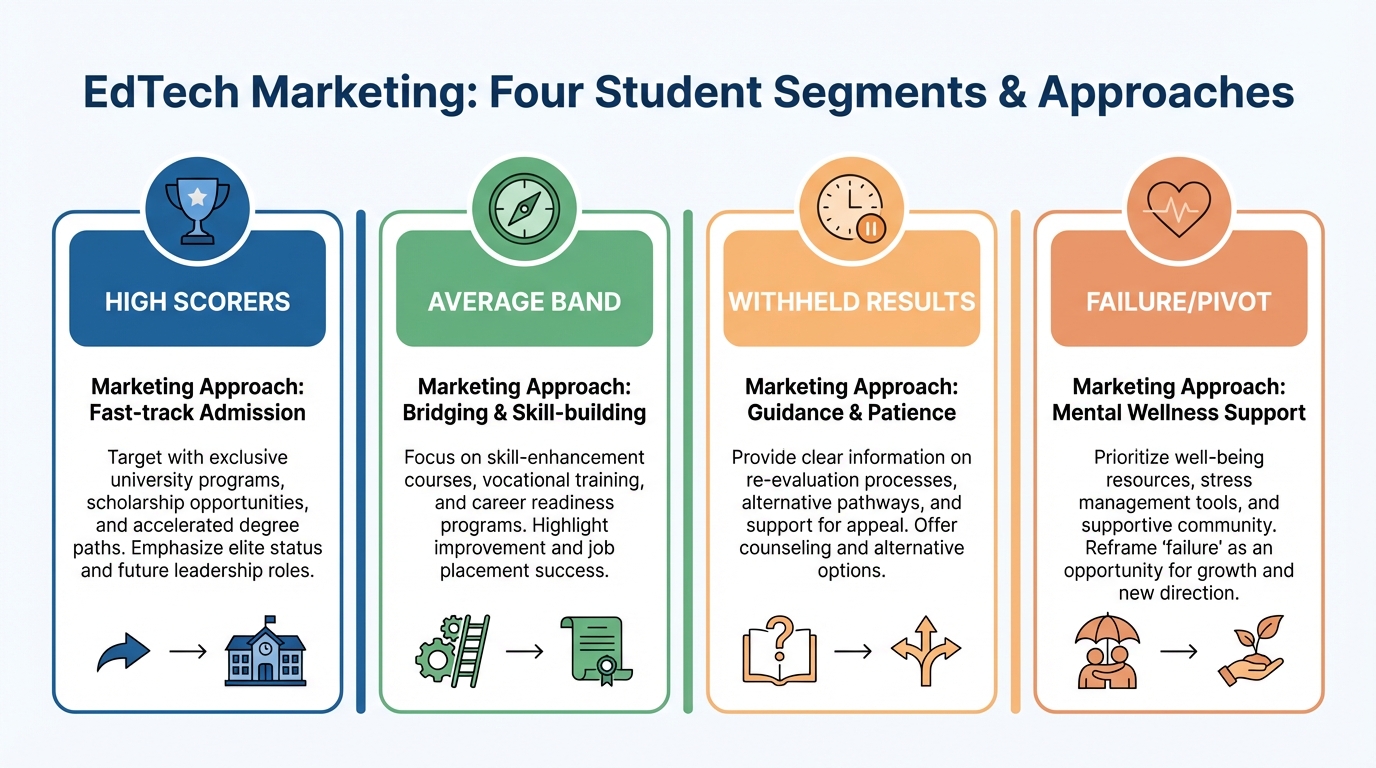
Effective board exam results marketing 2026 begins with a granular data schema that moves beyond simple “Pass/Fail” binaries. To drive conversion, EdTech platforms must ingest result payloads via CRM or CDP webhooks to segment students into four distinct psychological and academic cohorts. These segments dictate the tone, content, and call-to-action (CTA) of every automated communication.
The first cohort consists of “High Scorers” (typically ≥90%), who require immediate validation and fast-tracked admission pathways. The second, and largest, cohort is the “Average Band” (70–89%), who often experience “middle-ground anxiety” and need personalized career path mapping to understand their competitive standing. The third cohort involves students with “Withheld or Incomplete” results—a segment frequently ignored by competitors—who require immediate exam result crisis management to mitigate panic.
Finally, the “Failure or Pivot” cohort requires the highest level of sensitivity. For these students, the marketing objective shifts from immediate enrollment to mental wellness student retention and recovery support. By mapping these segments to specific data points—such as subject-specific strengths, geographic location, and budget bands—EdTech firms can deploy skill gap analysis personalization that feels like a 1:1 counseling session rather than a mass marketing blast.
Sources:
2. Implementing Exam Result Crisis Management and Empathetic Communication
In the immediate aftermath of result declarations, the speed and sensitivity of communication determine brand authority. Exam result crisis management is the practice of using standardized, sensitive communications to provide clarity during moments of high academic stress. Platforms like TrueFan AI enable EdTech giants to deliver these personalized messages at a scale previously thought impossible, ensuring no student is left without a clear next step.
For students in the “Average” or “Withheld” categories, the initial 24 hours are critical. A message map for this period should prioritize psychological safety over hard-selling. For instance, a “Withheld” result script should acknowledge the stress of waiting and provide a clear three-step process for resolution. This reduces the cognitive load on the student and positions the EdTech platform as a trusted partner rather than a mere service provider.
The channel cadence must be omnichannel but prioritized by engagement rates. In the Indian context, WhatsApp WhatsApp Business commerce automation (2026 guide) remains the dominant channel, with open rates frequently reaching 98%. By orchestrating a T0 (Results Day) empathetic video followed by a T+24h parent communication automation sequence, brands can ensure that the support ecosystem around the student is also informed and calm. This multi-stakeholder approach is essential for mental wellness student retention and long-term brand loyalty.
Sources:
3. Deploying Student Anxiety Support Videos for Mental Wellness Student Retention
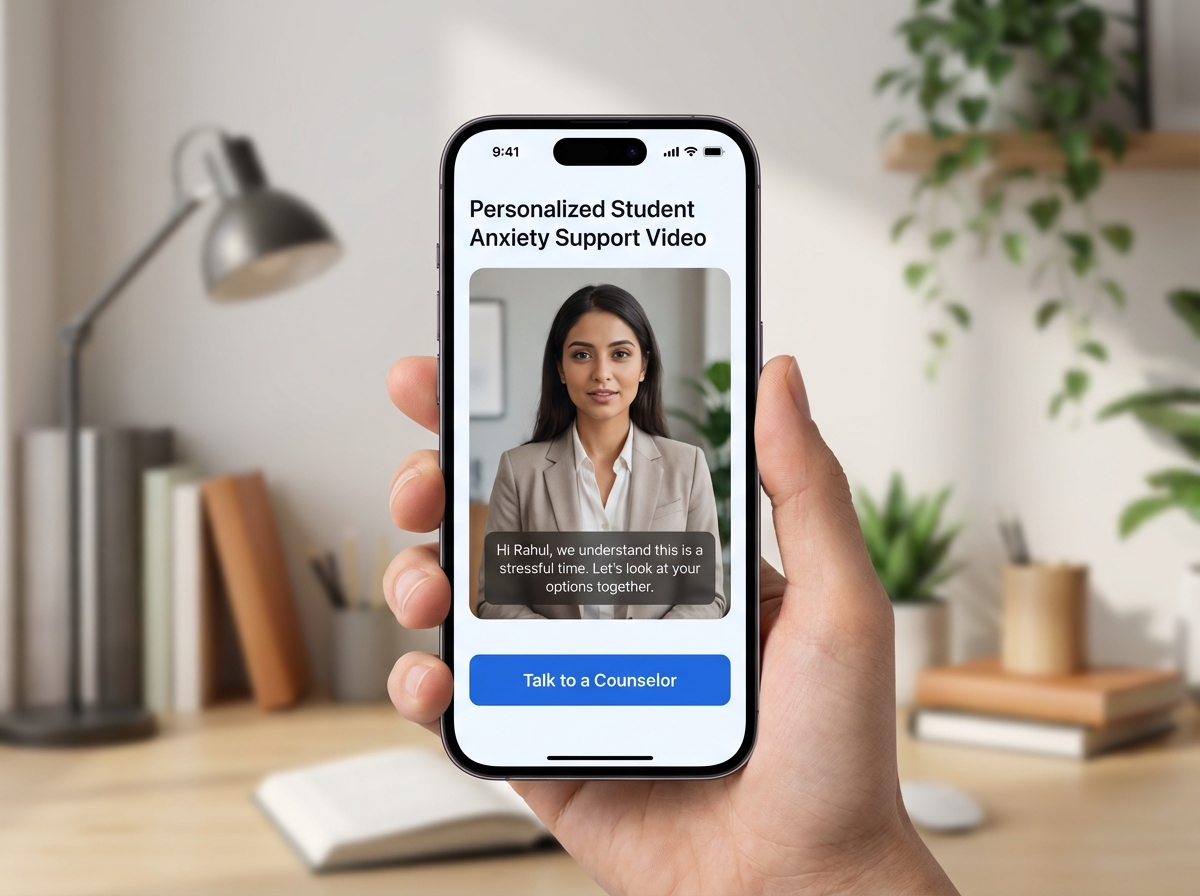
The integration of student anxiety support videos is a critical differentiator in the 2026 enrollment cycle. These are not generic brand films; they are 60–90 second, hyper-personalized clips designed to normalize exam-related stress and provide immediate coping mechanisms. TrueFan AI’s 175+ language support and Personalised Celebrity Videos B2B sales video personalization for 2026 ensure that the message resonates across India’s diverse linguistic landscape, making the support feel local and authentic.
A high-performing support video follows a specific pedagogical structure. The first five seconds must feature a personalized greeting and a validation of the student’s current emotional state. This is followed by a section that normalizes their experience, citing NCERT findings that peer pressure and exams are the primary stressors for Indian youth. By providing a simple “3-step reframe” or breathing technique within the video, the brand delivers immediate utility.
The final 30 seconds of these videos must transition from empathy to action. Whether it is booking a session with a counselor or initiating a skill gap analysis personalization test, the CTA must feel like a natural extension of the support offered. This approach directly impacts mental wellness student retention by reducing the “churn” associated with post-result despair. When a student feels supported during their lowest point, their propensity to enroll in future courses increases by up to 40%, according to 2026 enrollment benchmarks.
Sources:
4. Scaling Career Counseling Automation EdTech and Personalized Path Mapping
Once the initial emotional volatility is managed, the focus shifts to the “Decision Runway.” This is where career counseling automation EdTech becomes the primary driver of conversion. By automating the routing of students to AI-guided or human counselors based on their result payload, EdTech firms can handle the massive surge in volume that occurs during the April–May window without compromising on quality.
The technical flow involves a trigger-based system: the moment a result is ingested, the system fires a course recommendation AI video guide. This video is dynamically rendered to show the student’s “Best-Fit” career paths based on their actual marks and pre-recorded interests. For example, a student with high marks in Biology but average marks in Physics might receive a video highlighting alternative medical sciences or biotechnology pathways, rather than a generic “Join our NEET batch” nudge.
This automation extends to personalized career path mapping, where students are prompted to complete a micro-quiz that updates their profile in real-time. The system then generates a bespoke roadmap, including the top three roles they are suited for and the next two courses they should take. Solutions like TrueFan AI demonstrate ROI through these high-engagement touchpoints, as they transform a static counseling session into an interactive, video-driven journey that can be shared with parents to facilitate faster decision-making.
Sources:
5. Maximizing Conversion with Scholarship Opportunity Videos and Admission Guidance
In the final stage of the “Compassion-to-Conversion” playbook, the marketing focus narrows to financial and logistical barriers. Scholarship opportunity videos are essential for converting high-intent students who may be hesitant due to cost. These videos should dynamically calculate and display the estimated aid a student qualifies for based on their board results, creating a sense of “earned reward” that significantly boosts application rates.
Simultaneously, college admission guidance videos must be deployed to demystify the complex timelines of JEE, NEET, CUET, and university applications. These videos serve as step-by-step explainers, covering document checklists and campus previews. For students who did not achieve their desired scores, the strategy pivots to upskilling pathway marketing and entrance exam preparation marketing. These segments offer “recovery sprints”—short, intensive programs designed to help students pivot to alternative competitive exams or bridge courses.
By providing a clear “start today” checklist within these videos, EdTech platforms can capture the “rebound motivation” that often follows a disappointing result. The use of failure recovery support campaigns ensures that the brand remains a partner in the student’s journey, regardless of their initial score. This holistic approach—covering emotional support, career mapping, and financial aid—is what defines a market leader in the 2026 Indian EdTech ecosystem.
Sources:
6. Enterprise Execution: Parent Communication Automation and Technical Integration
For an enterprise-level rollout, parent communication automation is the most critical yet often overlooked component. In India, parents are the primary decision-makers and financiers of education. Automated sequences must be designed to keep parents informed via WhatsApp and SMS, providing them with calm, data-backed explainers on funding, timelines, and placement outcomes. This reduces household tension and aligns the parent with the student’s chosen path.
The technical execution of this playbook requires a robust integration between the EdTech platform’s CRM and a high-scale video personalization engine. The workflow must support batch rendering of thousands of videos per day with sub-30 second latency quick commerce video personalization in India. This ensures that a student who checks their results at 10:00 AM receives their personalized student anxiety support video by 10:05 AM, capturing the peak moment of intent.
Furthermore, compliance and security are non-negotiable. Handling the data of minors requires ISO 27001-grade practices and a consent-first model. Every automated flow must include clear opt-out mechanisms and adhere to data minimization principles. By combining high-speed execution with rigorous security standards, EdTech firms can build the trust necessary to dominate the board exam results marketing 2026 cycle.
Sources:
Conclusion
Mastering board exam results marketing 2026 requires a fundamental shift from transactional advertising to a relationship-based “Compassion-to-Conversion” model. By integrating exam result crisis management, student anxiety support videos, and career counseling automation EdTech, Indian platforms can provide the support students desperately need while achieving record-breaking enrollment figures. The future of EdTech marketing lies in the ability to deliver personalized, empathetic, and automated value at the exact moment of a student’s greatest need.
Frequently Asked Questions
How do failure recovery support campaigns improve enrollment?
Failure recovery support campaigns improve enrollment by addressing the psychological barriers to re-entry. By providing immediate academic stress relief content and mapping out alternative “bridge” pathways, these campaigns keep students within the platform’s ecosystem. Instead of losing a student to a competitor or total disengagement, the brand offers a structured plan for a “second chance,” which often leads to higher long-term LTV.
What is the role of parent communication automation in result season?
Parent communication automation ensures that the decision-makers in the Indian household receive accurate, calm, and supportive information simultaneously with the student. This prevents misinformation and reduces the emotional friction that often leads to delayed admissions. By automating these touchpoints via high-open-rate channels like WhatsApp, EdTech firms can drive faster consensus and enrollment.
How does TrueFan AI handle data security for student records?
TrueFan AI employs enterprise-grade security protocols, including ISO 27001 and SOC 2-grade practices, to ensure that all student data used for personalization is encrypted and handled with strict consent-first models. The platform is designed for massive scale, having handled campaigns for brands like Zomato and Hero MotoCorp, ensuring that student records are processed with the highest level of integrity and minimal data retention.
Why is personalized career path mapping better than traditional counseling?
Personalized career path mapping uses data-driven insights to provide immediate, 24/7 guidance that is tailored to a student’s specific strengths and weaknesses. Unlike traditional counseling, which can be delayed by human bandwidth, AI-driven mapping provides an instant “next step,” reducing the window of uncertainty where students are most likely to churn or lose motivation.
Can student anxiety support videos be localized for regional boards?
Yes, localization is essential for the effectiveness of student anxiety support videos. In 2026, top-performing EdTech platforms use AI to localize content into at least six major Indian languages, including Hindi, Marathi, Tamil, and Telugu. This ensures that the emotional support feels authentic and accessible to students from diverse linguistic backgrounds across various state boards.
What are the primary KPIs for board exam results marketing 2026?
The primary KPIs include counseling booking rates within the first 72 hours, video completion rates, and the conversion rate from result-day touchpoints to scholarship applications. Secondary metrics include the reduction in churn among the “Average” and “Fail” cohorts and the overall lift in brand sentiment during the high-stress result window.