Regional Festival Marketing Automation 2026: The Enterprise Playbook for Multi-State Orchestration
Estimated reading time: ~11 minutes
Key Takeaways
- Win India’s 2026 festive window with multi-state orchestration that aligns data, dynamic creatives, and distribution.
- Drive conversions through vernacular-first video and ritual-rooted narratives for Ugadi, Gudi Padwa, Ram Navami, and Baisakhi.
- Scale with a CDP, generative AI video, and API-led delivery—render thousands of localized assets in minutes.
- Boost tier-2 growth using Virtual Reshoots, regional payment education, and state-specific offers.
- Ensure governance and consent-first AI with rigorous moderation, compliance, and brand safety controls.
The landscape of Indian commerce is undergoing a seismic shift as we approach the high-stakes festival window of March and April 2026. For national brands, the challenge is no longer just about visibility; it is about achieving regional festival marketing automation 2026 standards that allow for simultaneous, hyper-personalized engagement across diverse linguistic and cultural zones. As Ugadi, Gudi Padwa, Ram Navami, and Baisakhi converge within a four-week period, the ability to orchestrate state-specific narratives at scale has become the ultimate competitive advantage for enterprise leaders.
This period represents the pinnacle of regional New Year commerce, where consumer sentiment is at its highest and the propensity to spend on high-value items—from electronics to mobility—peaks. However, the traditional “one-size-fits-all” creative approach is obsolete in an era where 90% of new internet users in India prefer consuming content in their native tongue. To capture this growth, CMOs must move beyond simple translation and embrace a sophisticated framework of cultural authenticity marketing that respects the unique rituals of each state while maintaining national brand governance.
The 2026 marketing cycle demands a transition toward video-first, vernacular-led strategies that can be deployed across thousands of micro-segments instantly. Whether it is the harvest celebrations of Baisakhi in the North or the New Year festivities of Ugadi and Gudi Padwa in the South and West, the mandate is clear: automate the complexity or risk losing the tier-2 city festival penetration that now drives over 70% of e-retail growth.
1. The Architecture of Multi-State Festival Orchestration in 2026
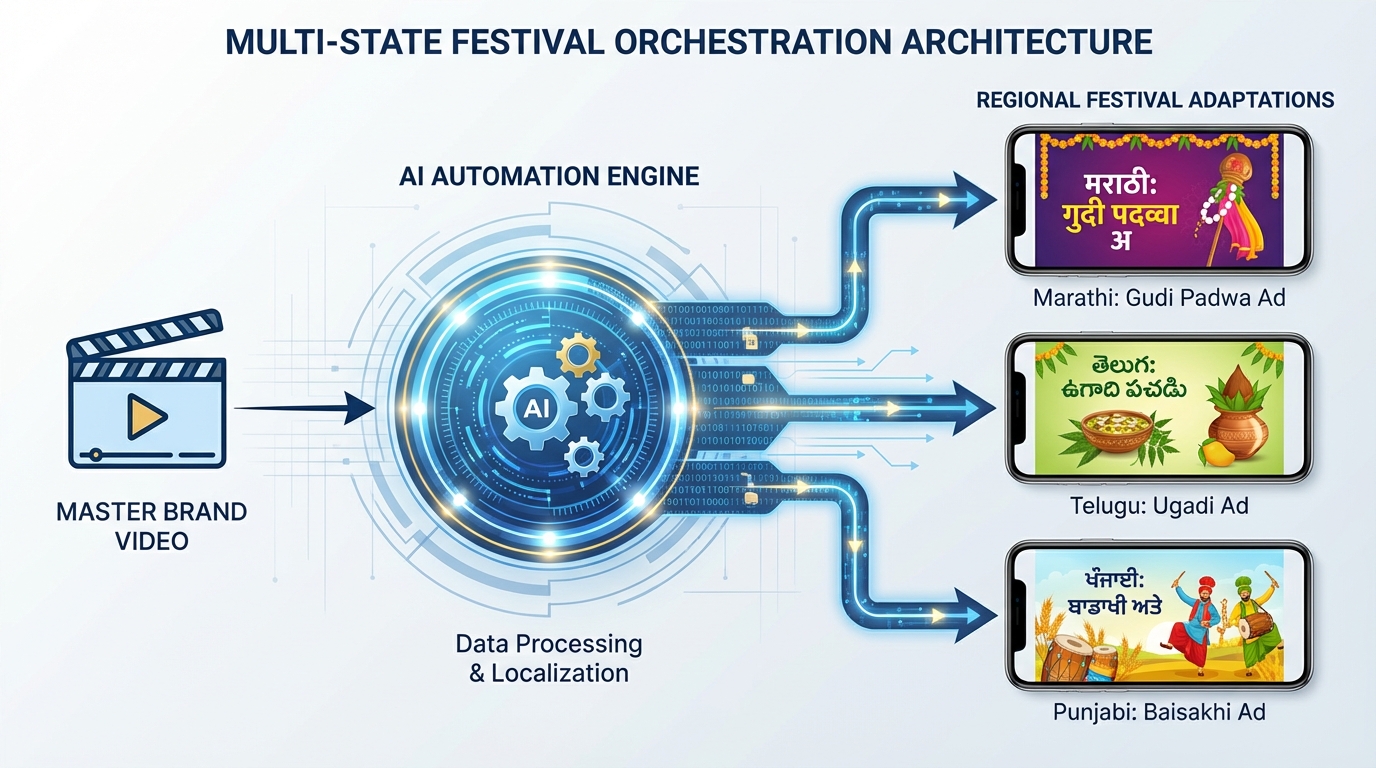
For the modern enterprise, multi-state festival orchestration is defined as an integrated system for planning, producing, and optimizing campaigns that run concurrently across different geographies with distinct cultural triggers. In 2026, this is not merely a logistical feat but a data-driven operation that synchronizes audience segmentation with dynamic creative assets. The goal is to deliver a seamless experience where a customer in Pune sees a Gudi Padwa message while a customer in Hyderabad receives an Ugadi greeting, both perfectly timed and culturally resonant.
The tech stack required for this level of automation relies on three pillars: a robust Customer Data Platform (CDP), a generative AI video engine, and an API-driven distribution network. By 2026, digital advertising in India is projected to exceed $8.15 billion, with a significant portion allocated to regional video content. This necessitates a shift away from manual video editing toward automated rendering pipelines that can produce thousands of unique assets in minutes.
Platforms like TrueFan AI enable enterprises to bridge this gap by transforming a single celebrity or brand ambassador shoot into an infinite stream of personalized videos. This capability is critical when managing the overlapping timelines of March 19 (Ugadi/Gudi Padwa), March 26-27 (Ram Navami), and April 14 (Baisakhi). Without automation, the creative bottleneck alone would prevent brands from reacting to real-time market signals or local inventory changes during these peak shopping days.
Source: India's Digital Advertising Industry 2026 - Campaign Asia
Source: Digital Marketing Trends for 2026 - Reach Skyline
2. Cultural Authenticity Marketing: Personalizing Ugadi, Gudi Padwa, and Baisakhi
Achieving cultural authenticity marketing requires a deep understanding of the specific rituals and linguistic nuances that define each festival. In 2026, superficial localization is easily spotted and dismissed by savvy regional consumers. Brands must instead focus on “ritual-rooting”—the practice of embedding products within the actual traditions of the celebration.
For Ugadi Gudi Padwa personalization, the creative focus must diverge between the Deccan and the Konkan regions. In Andhra Pradesh and Telangana, the narrative should center on the Ugadi Pachadi (the six-taste chutney) and the concept of Subhakankshalu. In Karnataka, the focus shifts to Beavu Bella and the greeting Hosa Varshada Shubhashayagalu. Meanwhile, for Gudi Padwa in Maharashtra, the visual anchor is the Gudi (victory pole) and the community processions known as Shobha Yatras. Automated templates must allow for these visual and auditory swaps to happen dynamically based on the user's geolocation.
The Baisakhi marketing campaigns of 2026, primarily targeting Punjab and Haryana, demand a different energetic profile. These are harvest celebration campaigns that emphasize prosperity, abundance, and the joy of the Rabi crop cycle. The use of Bhangra and Gidda motifs, combined with Punjabi-language scripts that use idiomatic expressions of “Chardi Kala” (eternal optimism), creates an immediate emotional bond. By automating the insertion of these regional cues, brands can ensure their national message feels like a local invitation.
Source: Gudi Padwa 2026 Dates - DrikPanchang
Source: Indian Calendar 2026 - AstroSage
3. Scaling Vernacular Video Customization for Tier-2 City Festival Penetration
The real growth engine for 2026 lies in tier-2 city festival penetration. As e-commerce adoption spreads beyond metros, three in five new shoppers are emerging from smaller urban hubs. These consumers are “video-first” and “vernacular-first,” making vernacular video customization the primary vehicle for conversion. Static banners or English-language ads no longer suffice to drive action in cities like Indore, Vijayawada, or Ludhiana.
TrueFan AI's 175+ language support and Personalised Celebrity Videos allow brands to speak to these audiences with unprecedented intimacy. Imagine a campaign where a top Bollywood star or a regional icon addresses a customer in Nagpur in fluent Marathi, mentioning their local dealership by name and offering a specific Gudi Padwa discount. This level of personalization drives click-through rates (CTR) that are often 3x to 5x higher than generic creative, as it cuts through the digital noise of the festive season.
To execute this at scale, enterprises utilize “Virtual Reshoots.” This technology allows marketing teams to update the celebrity's dialogue or the product offer without ever needing the talent to return to a studio. If a particular SKU is selling out in Bengaluru during Ugadi, the AI can instantly regenerate thousands of videos for that region, swapping the offer to a different product while maintaining perfect lip-sync and voice retention. This agility is what separates market leaders from laggards in the fast-paced 2026 retail environment.
Source: How India Shops Online 2025 - Bain & Company
Source: Digital Marketing Trends India 2026 - Digital Retina
4. Driving Conversion with Regional Payment Adoption Videos and State-Specific Offers
The final mile of any festival campaign is the transaction. In 2026, the friction in this process is being eliminated through regional payment adoption videos. With UPI transactions projected to exceed 1 billion per day by early 2026, the integration of payment education within marketing content is essential. These videos demonstrate how to use specific UPI apps, scan-and-pay flows, or EMI calculators, all narrated in the local dialect to build trust.
State-specific offer videos take this a step further by tailoring the financial incentive to regional economic realities. For instance, during a Ram Navami brand activation, a brand might offer a “Seva-led” discount or a family bundle that resonates with the community-centric nature of the festival. In the North, Baisakhi offers might focus on agricultural equipment or heavy appliances, while in the South, Ugadi offers might prioritize gold, apparel, and home decor.
By automating the generation of these offer-led videos, brands can ensure that the price points and EMI options shown are accurate for the specific city or even the specific retail outlet the customer is likely to visit. This hyper-local approach not only improves conversion but also reduces the burden on local sales teams, as the customer arrives at the store or the checkout page already informed and incentivized by a personalized video message. See also WhatsApp Business orchestration for in-chat commerce.
Source: UPI as a Global Benchmark - BCG-NPCI Report
Source: Banking in India: Growth and Trends - IBEF
5. The T-Minus 60 Day Orchestration Blueprint
Successful regional festival marketing automation 2026 requires a disciplined timeline that begins long before the first lamp is lit. The complexity of managing multiple festivals across different states necessitates a “T-minus” approach to creative production and media buying.
- T-60 to T-45: Insight and Ritual Mapping. This phase involves identifying the specific cultural triggers for each state. For Telugu Kannada Marathi targeting, brands should map out the exact dates and local customs. This is also the time to secure regional influencer partnerships and brief them on the automated creative framework.
- T-45 to T-30: Template Construction. Marketing teams build the dynamic video templates. These templates include “locked” brand elements and “dynamic” regions for the celebrity's face, the vernacular script, and the state-specific offer.
- T-30 to T-14: API Integration and QA. The generative AI engine is connected to the brand's CRM. This allows for the automatic triggering of local language festival greetings based on customer data. Rigorous QA is performed to ensure that the Marathi VO for Gudi Padwa doesn't accidentally play for a Telugu-speaking customer in Hyderabad.
- T-14 to Launch: Distribution and Optimization. The campaign goes live across WhatsApp, Meta, and YouTube. Real-time dashboards track performance, allowing for “Virtual Reshoots” to optimize messaging based on which regional offers are performing best.
Solutions like TrueFan AI demonstrate ROI through this structured approach, allowing enterprises to save thousands of man-hours that would otherwise be spent on manual localization and editing. This efficiency allows the marketing team to focus on strategy and high-level creative direction rather than the minutiae of file management.
6. Implementation, Governance, and FAQ
Implementing regional festival marketing automation 2026 at an enterprise level requires more than just technology; it requires a robust governance framework. As brands use AI to generate millions of videos, ensuring brand safety and cultural sensitivity is paramount. This includes automated moderation filters to prevent the generation of unapproved text and ISO 27001/SOC 2 compliance to protect user data.
Governance also extends to the ethical use of celebrity likenesses. In 2026, “consent-first” AI is the industry standard. Every video generated must be backed by a formal agreement with the talent, ensuring that the brand is protected from legal risks associated with unauthorized synthetic media. By using a platform that bakes these protections into the workflow, CMOs can scale their regional efforts with total confidence.
Finally, the success of these campaigns is measured through a multi-layered ROI model. Beyond traditional metrics like reach and frequency, enterprises in 2026 are looking at “Vernacular Lift”—the incremental conversion achieved by using local language and personalized video over standard assets. This data-driven approach ensures that every rupee spent on festival marketing is optimized for the specific cultural context of the consumer.
Frequently Asked Questions
Q1: How does regional festival marketing automation 2026 handle the overlap between Ugadi and Gudi Padwa?
The system uses geolocation and language preference data from the brand's CRM to determine which creative to serve. While the festivals fall on the same day (March 19, 2026), the automation engine swaps the visual motifs (Gudi vs. Pachadi) and the audio greetings (Marathi vs. Telugu/Kannada) instantly, ensuring each user receives a culturally accurate experience.
Q2: Can we use our existing brand ambassadors for vernacular video customization?
Yes. Modern platforms can take a short 15-minute recording of your existing ambassador and use generative AI to make them speak 175+ languages fluently. This maintains brand consistency while achieving deep regional resonance.
Q3: What is the typical turnaround time for generating a personalized festival video?
With enterprise-grade AI pipelines, the render-to-delivery time is typically under 30 seconds. This allows for real-time triggers, such as sending a personalized WhatsApp video immediately after a user abandons a cart or signs up for a newsletter.
Q4: How do regional influencer partnerships integrate with this automation?
Influencers provide the “authentic voice” for the campaign. Their content can be used as the base for automated templates, allowing the brand to scale the influencer's reach by personalizing their message for thousands of individual followers.
Q5: Is TrueFan AI suitable for large-scale enterprise campaigns with millions of users?
Absolutely. TrueFan AI is designed for enterprise scale, having powered campaigns for brands like Zomato and Hero MotoCorp that generated millions of unique, personalized videos in a single day while maintaining strict governance and security standards.
Conclusion
As we look toward the 2026 festival season, the brands that win will be those that successfully marry national scale with local intimacy. By embracing regional festival marketing automation 2026, enterprises can navigate the complexities of India's linguistic and cultural diversity with ease. The tools are now available to ensure that every customer, whether in a metro or a tier-2 town, feels seen, heard, and valued in their own language. The future of cultural commerce is automated, personalized, and deeply resonant.
Recommended Internal Links
- Deep dive on Ugadi/Gudi Padwa creative guardrails and templates
- Baisakhi harvest playbooks for Punjab & Haryana
- Frameworks for tier-2 festival penetration and hyperlocal orchestration
- WhatsApp catalog video funnels, UPI deep links, and ROI
- Real-time triggers and optimization for festival windows
- Playbook for regional/nano-influencer partnerships at scale
- Vernacular voice and video SEO tactics to lift regional conversions
Frequently Asked Questions
How can brands orchestrate multi-state festival campaigns at scale?
Use a CDP for segmentation, a generative AI video engine for dynamic creative, and API-driven distribution. This stack enables automatic rendering of thousands of vernacular videos aligned to state rituals and local offers.
What makes cultural authenticity different from basic localization?
Cultural authenticity embeds products into real festival rituals and language idioms (e.g., Ugadi Pachadi, Gudi, Chardi Kala) rather than translating generic messages, improving emotional resonance and conversions.
How do Virtual Reshoots improve ROI during festivals?
Virtual Reshoots let teams update dialogue, offers, and VO instantly without re-shoots, keeping messages current with inventory, region, and performance signals—often lifting CTR by 3–5x.
How should brands handle payments and offers in vernacular content?
Combine regional payment education (UPI how-tos, EMI flows) with state-specific incentives. Automate price points and EMI details at city/outlet levels to reduce friction and increase conversion.
What governance is needed for consent-first AI and brand safety?
Implement consent-backed talent usage, moderation filters, and ISO 27001/SOC 2 controls. Maintain audit trails for generated assets and enforce locked brand elements within templates.