Valentine’s Day marketing India 2026: AI-personalized love story videos, WhatsApp journeys, and experience-led offers for retail and D2C growth
Estimated reading time: ~13 minutes
Key Takeaways
- WhatsApp-first conversational journeys deliver 90–98% open rates and seamless, high-ROI Valentine’s flows.
- AI-personalized love story videos boost emotional resonance, CTRs, and watch-through by addressing users contextually.
- Romantic gift recommendation AI blends RFM and real-time intent to curate high-converting shortlists.
- Experience-led offers (dining, travel, QR tickets) and Singles Awareness Day extend the revenue window.
- Rigorous A/B testing and a compliant stack maximize CVR and AOV across city tiers.
As we approach the peak of the 2026 retail calendar, Valentine’s Day marketing India 2026 has evolved into a high-stakes arena of hyper-personalization and AI-driven engagement. For Chief Marketing Officers (CMOs) and D2C founders, the traditional "one-size-fits-all" discount strategy is no longer sufficient to capture the attention of a digitally native, experience-hungry audience.
The landscape of Valentine’s Day marketing India 2026 is defined by a shift toward India-specific, omnichannel campaigns that span the entire Valentine’s Week (February 7–14) and extend into Singles Awareness Day (February 15). This year, the focus is on regional language personalization and the seamless blending of physical gifts with digital experiences to maximize conversion rates.
Data from the 2026 market analysis reveals that influencer spend in India has grown by a staggering 40–45% annually since 2023, signaling a massive shift in budget allocation toward creator-led content. Furthermore, the rise of "self-love" narratives and "opt-out" marketing has created a secondary revenue stream that brands can no longer ignore.
Sources:
- TrueFan AI Blog: Valentine’s Day marketing campaigns in India
- ET BrandEquity: Influencer spend grew 40–45% annually (2023–2026)
- Exchange4Media: Valentine’s Day shifts to singles and self-love
1. India 2026 Market Outlook and the Power of Valentine’s Day WhatsApp Campaigns
The 2026 market outlook for India suggests a definitive move toward conversational commerce. Brands are increasingly moving away from cluttered email inboxes and SMS filters, choosing instead to anchor their strategies in Valentine’s Day WhatsApp campaigns. This shift is driven by the platform's unparalleled reach and engagement metrics in the Indian subcontinent.
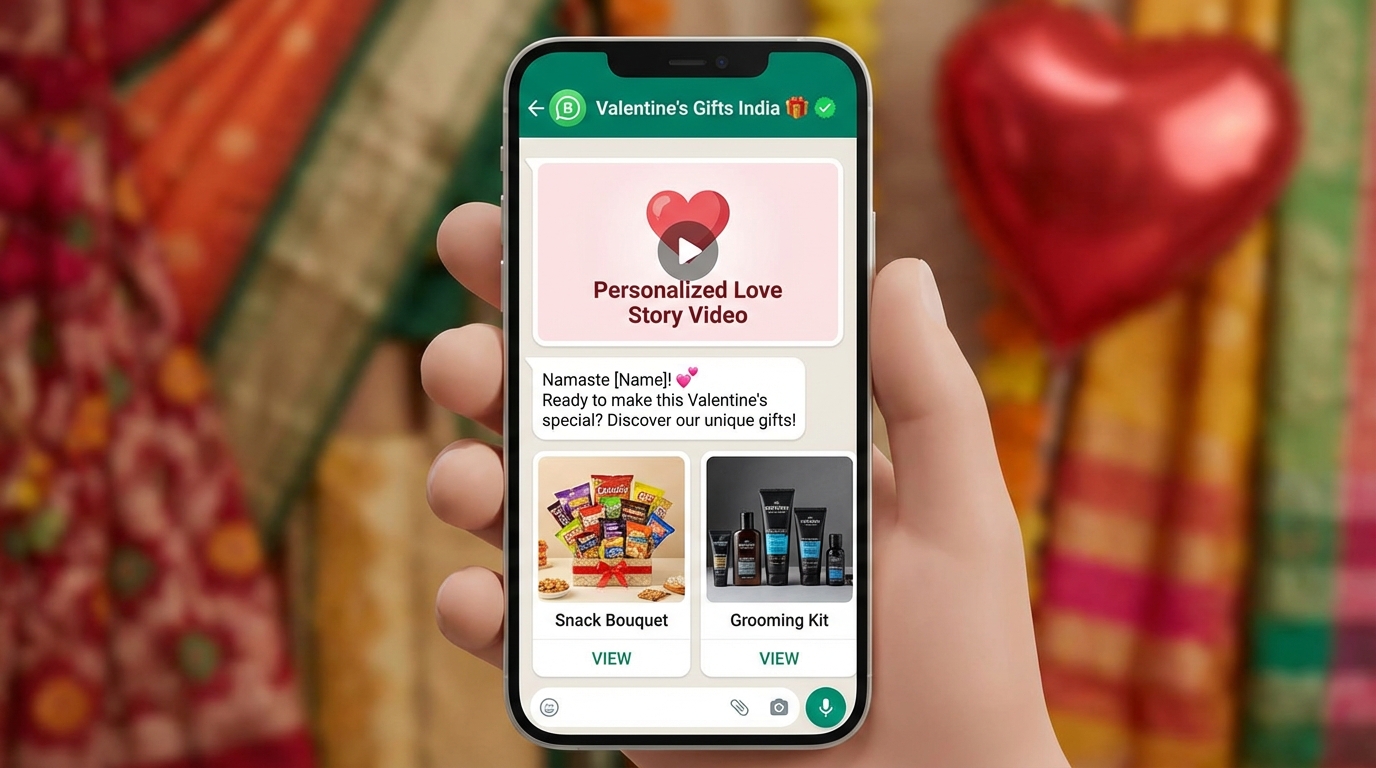
In 2026, Valentine’s Day WhatsApp campaigns are defined as automated, opt-in conversational journeys that deliver high-value content such as personalized love story videos and dynamic gift recommendations. With open rates consistently hovering between 90% and 98%, WhatsApp has become the primary channel for driving immediate action during the high-velocity Valentine’s Week.
The merchandising landscape has also transformed. While roses remain a staple—with quick-commerce giants like Swiggy Instamart recording peaks of 666 roses per minute—there is a surging demand for "practical personalization." This includes snack bouquets, grooming kits, and wellness bundles that cater to the evolving tastes of Indian consumers who value utility alongside sentiment.
Platforms like TrueFan AI enable brands to bridge the gap between high-scale automation and deep personal connection by integrating celebrity-led video content directly into these WhatsApp flows. This integration ensures that the brand message is not just seen, but experienced, leading to significantly higher click-through rates (CTR) compared to static image templates.
Sources:
- Interakt: WhatsApp Business API usage benchmarks (2025)
- Economic Times: Instamart Valentine’s gifting trends
- Haptik: WhatsApp commerce for D2C
2. Scaling Emotional Resonance with Personalized Love Story Videos
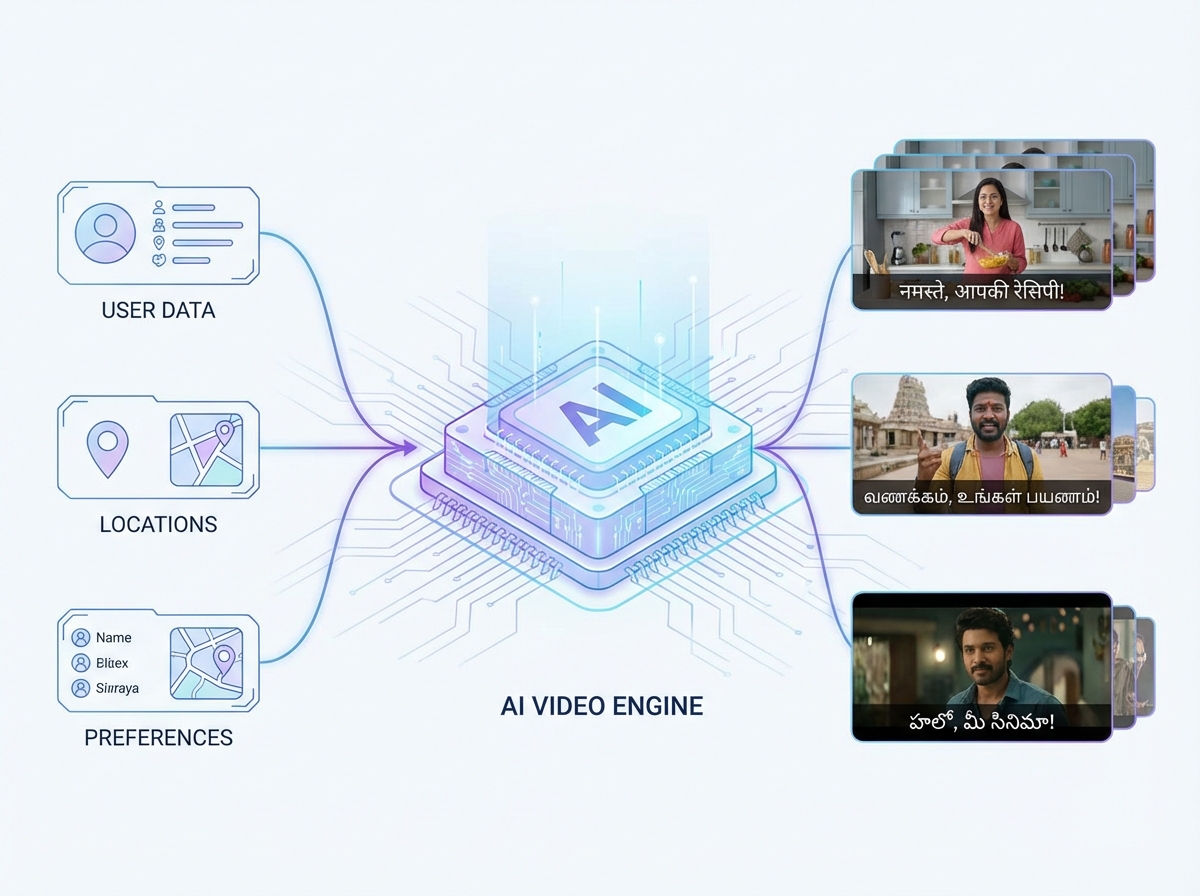
The cornerstone of a successful 2026 campaign is the ability to tell a story that feels unique to every customer. This is achieved through the deployment of personalized love story videos, which leverage generative AI to insert user-specific data into high-quality cinematic templates. These videos go beyond simple name-tagging; they incorporate relationship milestones, city-specific backdrops, and even regional language nuances.
For the Gen Z demographic, authenticity and brevity are paramount. Marketing to this cohort requires seamless integrations with dating apps, where context-aware deep links trigger WhatsApp flows. Within these flows, users receive personalized love story videos that reflect their specific "vibe"—whether it’s a first-date celebration or a long-distance relationship milestone.
Regionalization is no longer optional for brands targeting Tier 2 and Tier 3 cities. A robust strategy must include regional language love messages in Hindi, Tamil, Telugu, Bengali, and Marathi. By code-switching headlines and ensuring that the AI-generated video scripts are linguistically accurate, brands can achieve a level of trust and intimacy that English-only campaigns cannot replicate.
TrueFan AI's 175+ language support and Personalised Celebrity Videos allow enterprises to render these complex, multi-lingual assets in under 30 seconds. This low-latency rendering is critical for real-time engagement, ensuring that the user receives their personalized video while their intent is at its peak.
Sources:
- Storyboard18: Opt-out Valentine’s marketing
- Exchange4Media: Singles/self-love focus
- TrueFan AI: Enterprise intelligence case studies
3. Precision Merchandising via Romantic Gift Recommendation AI
To cut through the noise of generic "For Him" and "For Her" categories, leading retailers are implementing romantic gift recommendation AI. This technology utilizes machine learning rulesets that combine Recency, Frequency, and Monetary (RFM) data with real-time session dwell time and category affinity. The result is a curated shortlist of three products that are most likely to convert for a specific user.
The technical implementation involves a Customer Data Platform (CDP) sending event triggers to a re-ranker engine. This engine then outputs a JSON feed that populates both the personalized video overlays and the WhatsApp product cards. For example, a user who has recently browsed sustainable fashion will see a "planet-friendly pick" badge on their recommendations, significantly increasing the likelihood of a purchase.
In the jewelry sector, personalization has moved into the realm of real-time visualization. Jewelry personalization Valentine’s strategies now include dynamic engraving previews. A customer can see their partner’s initials or a significant date composited onto a ring or pendant within the personalized video itself. This visual proof-of-concept reduces purchase hesitation and drives higher Average Order Values (AOV).
Furthermore, sustainability has become a key decision-making factor for the 2026 consumer. Sustainable gift personalization involves highlighting eco-attributes—such as carbon-neutral delivery or cruelty-free materials—directly in the video and on the Product Detail Page (PDP). Brands that A/B test the presence of these "eco-badges" often see a measurable lift in trust and conversion among younger cohorts.
Sources:
4. Driving Loyalty through Couple Experience Marketing Automation
In 2026, the "gift of an experience" often outweighs the value of a physical product. This has led to the rise of couple experience marketing automation, a system that uses event- and location-triggered workflows to curate date-night packages. By analyzing a user’s city and budget, the automation engine can suggest a bundled package that includes a dining reservation, a ride-hailing credit, and a personalized video invitation.
Dining experience offer videos are a high-performing asset in this category. These videos can be geo-personalized to show the interior of a partner restaurant in the user’s specific neighborhood, complete with a real-time view of available 2-seat windows. By adding a countdown timer for "pre-pay perks"—such as a complimentary dessert or a reserved window seat—brands can drive immediate bookings through WhatsApp.
Travel package romance marketing follows a similar logic. For users showing interest in short-haul getaways, the automation engine surfaces near-city "staycation" deals. These offers are delivered via video nudges that highlight "cancellation-flex" and VIP check-in perks. Case studies from industry leaders like Goibibo have demonstrated that personalized video nudges on WhatsApp lead to a significant uplift in both read rates and booking conversions.
The final stage of this automation is the post-purchase journey. Once a voucher is bought, the system issues a QR-coded ticket on WhatsApp, along with automated reminders as the date approaches. This frictionless experience ensures high satisfaction rates and encourages repeat business for future occasions.
Sources:
5. Capturing the "Self-Love" Economy with Singles Awareness Day Marketing
One of the most significant shifts in Valentine’s Day marketing India 2026 is the mainstreaming of Singles Awareness Day marketing on February 15. Brands are no longer ignoring the large segment of the population that is not in a traditional relationship. Instead, they are creating dedicated "Anti-Valentine’s" or "Self-Love" campaigns that celebrate independence and friendship.
Singles Awareness Day marketing focuses on self-gifting bundles, wellness experiences, and "Galentine’s" or "Palentine’s" friend-to-friend referrals. The tone of these campaigns is empowering and often humorous, providing a refreshing contrast to the sentimental nature of the preceding week. Brands that successfully navigate this shift can extend their peak sales period by an additional 48 to 72 hours.
The Valentine’s week engagement strategy must therefore be a multi-phased calendar:
- Feb 7 (Rose Day): Focus on micro-gifts and early-bird dining offers.
- Feb 9 (Chocolate Day): Push snack bouquets and artisanal confectionery.
- Feb 11 (Promise Day): Highlight sustainable gifts and long-term subscription services.
- Feb 13 (Kiss Day): Deploy last-minute gift urgency videos with local pickup options.
- Feb 14 (Valentine’s Day): Premium deliveries and "surprise and delight" celebrity shout-outs.
- Feb 15 (Singles Awareness Day): Self-care kits, gaming bundles, and wellness retreats.
By utilizing regional language love messages even for the "Singles" segment, brands can ensure that their inclusivity feels genuine rather than performative. This approach builds long-term brand equity across all demographic segments.
Sources:
6. Maximizing ROI with Valentine’s Conversion Optimization
To ensure that high engagement translates into revenue, brands must employ a rigorous Valentine’s conversion optimization playbook. This involves systematic A/B testing across four key pillars: creative hooks, journey mapping, offer framing, and language localization. The goal is to identify the specific combination of elements that drives the highest Conversion Rate (CVR) and Average Order Value (AOV) for each city tier.
One highly effective test is the "Name in first 5 seconds" hook. Data shows that when a celebrity or brand ambassador addresses the viewer by name at the very start of a video, watch-through rates increase by over 25%. Solutions like TrueFan AI demonstrate ROI through these precise engagement metrics, providing dashboards that track everything from video play percentage to direct attribution from WhatsApp quick-replies.
Another critical area for optimization is the "last-minute" window (February 12–14). During this period, brands should deploy last-minute gift urgency videos. These assets feature dynamic countdown timers and highlight "e-gift now, deliver later" options or local "click-and-collect" windows. By reducing the perceived risk of a late delivery, brands can capture the significant volume of procrastinating shoppers.
Finally, the technical stack must be robust enough to handle the surge in traffic. An enterprise-grade implementation requires a seamless pipeline from the product feed to the video rendering engine and finally to the WhatsApp Business API. Ensuring ISO 27001 and SOC 2 compliance for data handling is essential, especially when dealing with personalized user data and celebrity intellectual property. To go deeper on omnichannel metrics and stack architecture, see WhatsApp commerce ROI tracking.
Sources:
Conclusion: The 2026 Execution Roadmap
Success in Valentine’s Day marketing India 2026 requires a blend of technological sophistication and emotional intelligence. CMOs must move beyond the "campaign" mindset and adopt an "orchestration" mindset—where data, AI, and conversational interfaces work in harmony to deliver value at every touchpoint.
By starting the production timeline at least five weeks in advance, brands can ensure their data feeds are clean, their AI models are trained, and their regional language assets are culturally resonant. The integration of personalized love story videos within Valentine’s Day WhatsApp campaigns is no longer a luxury; it is the benchmark for brands that wish to lead the market in 2026.
As the boundaries between physical gifting and digital experiences continue to blur, the winners will be those who use technology not just to sell, but to celebrate the diverse expressions of love—and self-love—across the Indian subcontinent.
Recommended Internal Links
- https://truefan.ai/blogs/whatsapp-catalog-video-marketing
- https://truefan.ai/blogs/whatsapp-catalog-video-marketing-guide
- https://truefan.ai/blogs/whatsapp-business-commerce-automation-2026
- https://truefan.ai/blogs/regional-language-video-seo
- https://truefan.ai/blogs/ai-celebrity-video-marketing-india
- https://truefan.ai/blogs/personalised-video-celebrity-endorsement-saas
Recommended Internal Links
- WhatsApp Catalog Video Marketing: Tactics for 2026 — growth tactics for WhatsApp-first journeys
- WhatsApp Catalog Video Marketing: Automation Strategies — templates and orchestration
- WhatsApp Business Commerce Automation 2026: Growth Playbook — KPIs and ROI tracking
- Regional Language Video SEO: Strategies for 2026 Growth — multilingual scaling
- AI Celebrity Video Marketing India — performance creative at scale
- Personalised Video & Celebrity Endorsement for SaaS — B2B use cases
Frequently Asked Questions
What are the top Valentine’s Day marketing India 2026 trends?
The 2026 landscape is dominated by hyper-personalization via AI, a massive shift toward WhatsApp-first commerce, and the rise of the "self-love" economy. Brands are moving away from generic discounts toward experience-led offers and personalized love story videos that resonate emotionally with consumers.
How do Valentine’s Day WhatsApp campaigns improve conversion?
WhatsApp campaigns boast open rates of 90–98%, far exceeding email or SMS. By using rich media templates and interactive quick-replies, brands can guide users through a personalized funnel—from gift discovery to checkout—without the user ever leaving the chat interface.
How does romantic gift recommendation AI work with existing data?
The AI integrates with your CDP or CRM to analyze past purchase behavior, browsing history, and real-time intent signals. It then uses machine learning to shortlist the most relevant products, which are dynamically inserted into personalized videos or WhatsApp carousels.
Can personalized videos be scaled for millions of users?
Yes. Enterprise solutions like TrueFan AI are designed for high-volume orchestration. Campaigns for leading brands have successfully delivered millions of personalized greetings and video nudges in a single day, proving readiness for India-scale demand.
How can brands effectively target singles on February 15?
Singles Awareness Day marketing should focus on empowerment, self-care, and friendship. By offering "treat yourself" bundles and wellness experiences with an upbeat, inclusive tone, brands can capture a significant secondary market often overlooked during the traditional Valentine’s period.