Regional OTT Content Discovery 2026: The Vernacular Video Playbook for Tier-2/3 Families
Estimated reading time: ~15 minutes
Key Takeaways
- Close the discovery gap in tier-2/3 India with vernacular, video-first recommendations and micro-trailers
- Family viewing plan videos and regional language trailers reliably lift session starts and reduce choice paralysis
- Automate at scale with festival-aware creative and localized VOs to match cultural timing and context
- Build trust through local creators, celebrities, and regional influencer reviews syndicated across Shorts/Reels
- TrueFan AI powers rapid, multilingual personalization with real-time APIs, template automation, and enterprise-grade security
Regional OTT content discovery 2026 represents the next frontier of streaming growth, defined by AI-driven methods that surface hyper-local films and shows through short, vernacular recommendation videos. As the Indian streaming landscape matures, vernacular entertainment personalization has evolved into an algorithmic necessity, tailoring creative assets, voiceovers, and on-screen text to the specific cultural nuances of Bengali, Tamil, and other regional audiences.
This strategic shift is no longer optional for platforms aiming to solve the “discovery gap” in Bharat. By leveraging dynamic trailers and culturally timed campaigns across Over-the-Top (OTT) and Connected TV (CTV) surfaces, growth teams can effectively lift session starts and weekly retention. The following playbook outlines how to utilize AI-generated regional video recommendations to convert casual viewers into loyal subscribers in tier-2 and tier-3 markets.
The Discovery Gap in India’s Tier-2/3 Markets
The primary challenge facing streaming services today is “discovery fatigue,” where low first-play Click-Through Rates (CTR) and brief session starts signal a disconnect between the catalog and the viewer. In tier-2 and tier-3 India, this gap is exacerbated by a lack of cultural fit; static tiles often fail to convey the emotional or linguistic resonance of a show, leading to high churn risks.
Data indicates that 52% of OTT content in FY24 was already in regional languages, a trend that is intensifying as we move through 2026 (Source: MarkNtel Advisors India Media & Entertainment research). Despite this volume, multilingual content curation remains a bottleneck for many platforms. Without vernacular context—such as festival timing or family-appropriateness indicators—even the most expensive regional originals remain buried under layers of generic UI.
Furthermore, device and bandwidth realities in these regions demand a shift in asset strategy. Viewers on mid-range CTVs and mobile devices increasingly value short, data-light video previews over high-resolution static imagery. Research shows that micro-trailers significantly outperform static tiles in initiating sessions, particularly in households where family co-viewing is the norm (Source: Magnite Streaming Research Report India 2024). To achieve sustainable tier-2 OTT user retention, platforms must move beyond “one-size-fits-all” interfaces and embrace a video-first discovery model.
Sources:
Personalization that Feels Local: Bengali Tamil Content Recommendations
Effective vernacular entertainment personalization requires more than just translating a title; it demands the creation of Bengali Tamil content recommendations that resonate with local lifestyles. This involves AI-generated short videos that summarize plot hooks using local idioms and highlighting talent that holds regional sway. For instance, a recommendation for a Bengali thriller might highlight a “Kolkata weekend” vibe, while a Tamil drama could be framed around “Chennai monsoon evenings.”
The inputs for this personalization are multifaceted, drawing from the user’s preferred language, last-watched genres, and household co-viewing signals. In 2026, the India Smart TV and OTT market is projected to reach USD 26.39B, signaling a massive expansion of CTV surfaces where discovery assets must cater to groups rather than individuals (Source: Mordor Intelligence: India Smart TV and OTT Market).
To capitalize on this, platforms are deploying 10–15 second micro-trailers in portrait, square, and 16:9 formats. These assets use localized voiceovers (VO) and geo-tagged cultural references to reduce the cognitive load on the viewer. By matching the creative to the user's city-tier and festival proximity, platforms can ensure that the “watch intent” is established within the first three seconds of the interaction.
Sources:
Formats that Start Sessions: Family Viewing Plan Videos and Regional Language Show Trailers
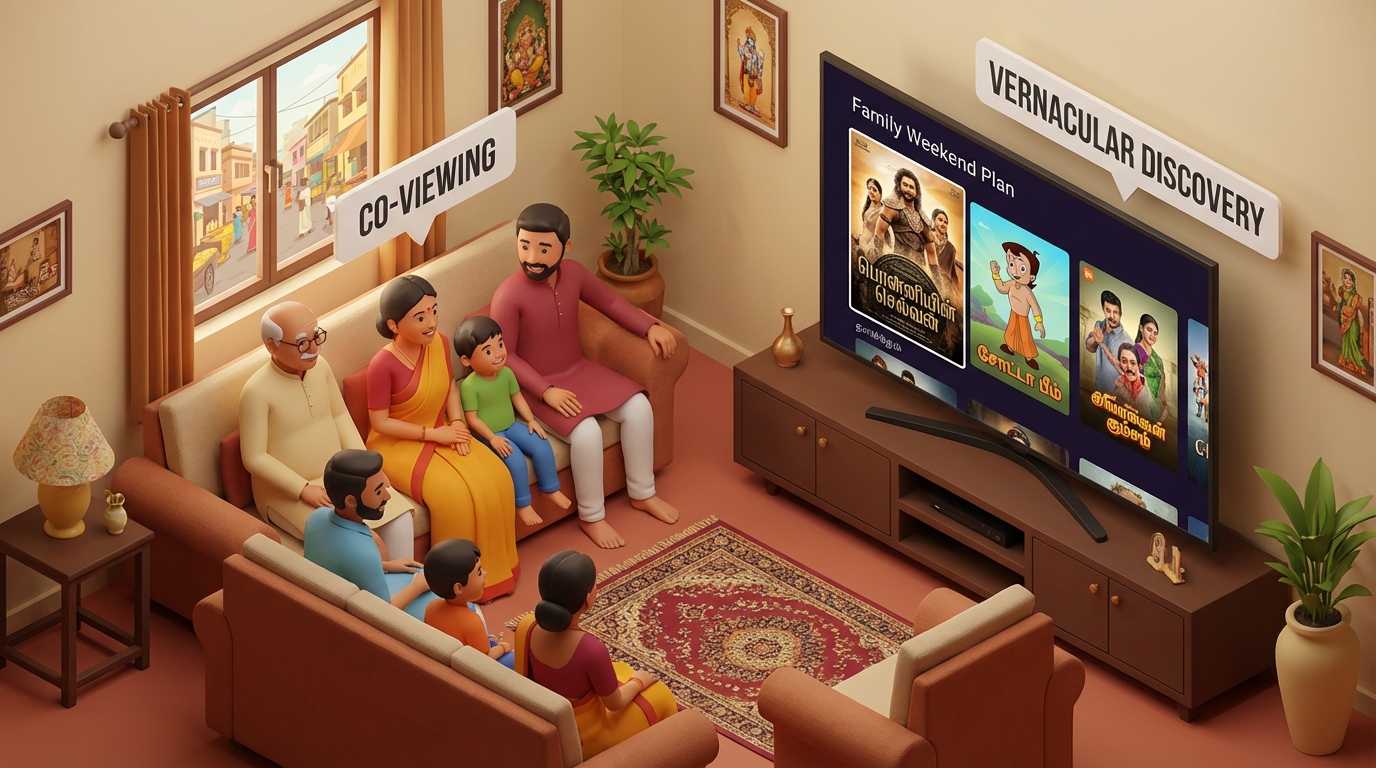
To drive immediate engagement, content teams are prioritizing two specific formats: family viewing plan videos and regional language show trailers. Family viewing plan videos are designed to solve the “what should we all watch?” dilemma by outlining a curated weekend schedule—perhaps one film, two episodes of a trending series, and a kid-friendly cartoon—all presented in the local language with duration badges.
This format aligns with the high CTV co-viewing rate in India, which averages 3.46 persons per screen (Source: Magnite Streaming Research Report India 2024). By providing a clear “plan,” platforms reduce decision paralysis and increase the likelihood of a long-form session start. These videos often include “press play” prompts that encourage the entire family to settle in, effectively turning discovery into a shared event.
Simultaneously, regional language show trailers are being re-engineered for the tier-2 mobile user. These are condensed, 6–15 second versions of official trailers, optimized for low bandwidth with lighter bitrates and adaptive captions in vernacular scripts. They feature localized VO and “Play in Bengali/Tamil” end-cards, ensuring that the user knows exactly what linguistic experience to expect. This granular approach to asset creation is essential for maintaining a high session-start rate across diverse device ecosystems.
Sources:
- Magnite Streaming Research Report India 2024
- Fabric Data: Global Streaming Services Update January 2026
Cultural Content Marketing Automation and Regional Festival Special Content
The scale required for regional OTT content discovery 2026 cannot be met through manual production alone. Cultural content marketing automation has become the backbone of modern growth teams, allowing for rule-based creative generation triggered by local calendars. This ensures that recommendation videos are always timely, reflecting the current cultural mood of the target audience.
A key application of this technology is the creation of regional festival special content. Platforms now pre-bake templates for major events like Durga Puja, Pongal, Onam, Navratri, and Ganesh Chaturthi. These templates include festive intros, specific music cues, and localized offers that are automatically populated with relevant show clips. Platforms like TrueFan AI enable this level of automation by allowing brands to generate thousands of personalized video assets that speak directly to the viewer's cultural context.
By automating these “festival variants,” OTT services can launch massive, state-specific campaigns with minimal lead time. This agility is crucial in 2026, where short-form regional strategies are shaping the competitive landscape of Asian streaming (Source: Fabric Data: Global Streaming Services Update January 2026). See complementary festival execution examples here and a Northeast-specific activation playbook here.
Sources:
- Fabric Data: Global Streaming Services Update January 2026
- EY: Shape the Future - Indian Media and Entertainment
Trust and Reach: Local Content Creator Partnerships, Local Celebrity Show Endorsements, and Regional Influencer Show Reviews
Trust is the currency of discovery in tier-2/3 India. To build this trust, platforms are moving away from corporate-style promotions and toward local content creator partnerships. By identifying micro-creators within specific language clusters, OTT brands can co-create “what to watch this week” reels that feel authentic and peer-led. These creators understand the nuances of their audience better than any centralized marketing team, making their recommendations highly effective.
Furthermore, local celebrity show endorsements are being used to provide a “stamp of approval” for new regional slates. Using consented regional celebrities to record short, personalized endorsements—emphasizing why a show is a “must-watch for families in Tamil Nadu”—creates an immediate emotional hook. This is complemented by regional influencer show reviews, which are curated into snackable reaction cuts with vernacular subtitles and rating badges.
These assets are then syndicated across YouTube Shorts, Instagram Reels, and in-app discovery rows. The success of this approach is evident in how regional hits now travel globally via algorithmic promotion once they perform well locally (Source: Economic Times: Regional stories, global impact). By leveraging the combined power of creators and celebrities, platforms can overcome the initial skepticism often found in new market segments.
Sources:
- Economic Times: How OTT is helping the entertainment industry go global
- Ipsos: The State of Digital Marketing in India 2025
Lifecycle Hooks: Vernacular Binge-Watching Campaigns, Regional Remake Announcements, and Language-Based Subscription Offers
Retention is a marathon, not a sprint. To keep users engaged throughout the month, platforms are deploying vernacular binge-watching campaigns. These are serialized nudges sent after a user completes the first episode of a series, featuring creator-led “what happens next” teasers and cliffhanger recaps in the local language. These nudges reduce the “drop-off” rate between episodes and encourage deeper binge sessions.
Another powerful hook is the use of regional remake announcements. When a platform remakes a Bengali hit into Tamil, they use announcement clips to cross-pollinate catalogs, telling viewers: “If you liked X in Bengali, watch Y in Tamil tonight.” This strategy maximizes the value of existing IP and introduces users to a broader range of content. Additionally, rural and tier-2 internet access is creating new distribution channels, making these localized hooks even more vital for reaching untapped audiences (Source: NASSCOM: Future of OTT in India).
Finally, language-based subscription offers are used to convert fence-sitters. By targeting specific language cohorts with localized “Family Packs” or “Festival Specials,” platforms can drive renewals and new sign-ups. These offers are most effective when paired with free regional festival special content weekends, giving users a taste of the premium experience in their native tongue. This holistic approach to the user lifecycle ensures that every touchpoint reinforces the platform's regional relevance.
Sources:
- NASSCOM: Future of OTT in India
- Inc42: How STAGE is shaking up Netflix & Amazon with regional originals
How TrueFan AI Powers the Pipeline
Executing a high-frequency, multilingual discovery strategy requires a robust technological foundation. TrueFan AI's 175+ language support and Personalised Celebrity Videos provide the necessary infrastructure to localize assets at scale while maintaining perfect lip-sync and voice retention. This ensures that whether a creator is speaking Bengali or Tamil, the output remains authentic and engaging for the local audience.
The platform's real-time APIs allow OTT services to ingest catalog feeds and user segments to render recommendation videos in under 30 seconds. This low-latency capability is essential for “on-the-fly” personalization, such as updating a trailer with a user’s name or a specific city-based greeting. Furthermore, virtual reshoots and template automation allow teams to update offers or lines without the need for expensive new shoots, making it possible to ship weekly micro-trailers and family viewing plan videos efficiently.
Solutions like TrueFan AI demonstrate ROI through increased view rates, higher completion percentages, and improved conversion on subscription offers. By segmenting analytics by personalization elements—such as a name mention in the first five seconds—platforms can continuously optimize their creative strategy. With ISO 27001 and SOC 2 compliance, the platform also ensures that all celebrity and creator assets are handled with the highest standards of security and consent.
Sources:
- TrueFan AI Product Offerings Executive Document (Enterprise)
- Goibibo Case Study: Personalized WhatsApp Nudges (Internal Reference)
Conclusion: AI + Culture + Family-First = Retention Edge
The future of regional OTT content discovery 2026 lies at the intersection of advanced AI and deep cultural empathy. For streaming platforms, the transition from static, translated interfaces to dynamic, video-first vernacular experiences is the only way to capture and hold the attention of the next 100 million users. By prioritizing family viewing plan videos and leveraging the trust of local creators, platforms can transform the discovery process from a chore into a delight.
As the data from EY and NASSCOM suggests, the growth of the Indian media landscape is inextricably linked to regional relevance. Platforms that master the art of vernacular entertainment personalization today will be the ones that define the entertainment habits of tomorrow. The playbook is clear: automate the creative, localize the voice, and always put the family’s viewing experience at the center of the strategy.
Sources:
Recommended Internal Links
- Vernacular Voice SEO Strategies for India’s 2026 Commerce
- Tier-2 Festival Commerce Automation: Local Growth Playbook
- Quick Commerce Festival Marketing 2026: Personalization Wins
- Bihu festival marketing 2026: Northeast activation guide
- Nano-Influencer Tier-3 Marketing 2026: Hyperlocal Playbook
- Micro-Influencer Automation India 2026: Regional Playbook
- Q1 2026 Festival Retention Strategies: A Proven Playbook
Frequently Asked Questions
How do Bengali Tamil content recommendations differ from generic suggestions?
Generic suggestions often rely on global genre tags (e.g., “Action”). In contrast, Bengali Tamil content recommendations use localized voiceovers, regional idioms, and cultural context (like specific festival timings) to make the content feel “made for me.” This level of vernacular entertainment personalization significantly increases the emotional connection and watch intent.
What are family viewing plan videos and when should we use them?
Family viewing plan videos are short clips that suggest a “schedule” of content for a household. Given that India’s CTV co-viewing rate is 3.46, these videos are best used on weekends or during holidays to help families decide what to watch together, reducing the time spent scrolling through menus.
How often should we publish regional language show trailers?
A weekly cadence is recommended. By releasing fresh, 6–15 second regional language show trailers every week, you maintain a “fresh” feel in the discovery row and give users a reason to return to the app frequently, which is a key driver for tier-2 OTT user retention.
How do local content creator partnerships improve trust?
Local creators act as “cultural translators.” When a trusted local voice reviews a show or creates a “top picks” list, it carries more weight than a standard advertisement. These local content creator partnerships help bridge the trust gap in new markets where the platform may not yet be a household name.
What KPIs prove tier-2 OTT user retention is improving?
Key metrics include the impression-to-first-play CTR on recommendation videos, the episode completion rate, and the D28 return rate for specific language cohorts. If users are completing more episodes and returning more frequently after seeing localized videos, your multilingual content curation strategy is working. TrueFan AI provides the analytics tools to track these specific cohort-level improvements.



