
AI marketing ROI justification 2026: A CFO-ready playbook for enterprise AI video investments
Estimated reading time: ~10 minutes
Key Takeaways
- Build a CFO-grade ROI model using ROMI, NPV, IRR, and TCO to win budget approval
- Shift from pilots to scale with a tiered investment roadmap aligned to fiscal cycles and the Union Budget
- Drive revenue via personalized AI video while achieving cost takeout through automated production and localization
- Institutionalize governance and risk controls (consent, SOC 2/ISO 27001, moderation) to de-risk adoption
- Prove value fast with a 90-day pilot that demonstrates 1.5x+ ROMI and clear payback
Securing a robust AI marketing ROI justification 2026 requires more than just creative optimism; it demands a rigorous financial framework that aligns with fiscal year planning martech cycles. As enterprises navigate the complexities of CFO marketing budget approval, the shift from experimental pilots to scalable revenue drivers has become the primary mandate for the upcoming fiscal year.
Executive Summary: The 2026 Mandate for Finance-Led Marketing
In the current fiscal landscape, Boards of Directors and budget committees no longer accept "engagement" as a primary success metric. They now expect a defensible AI marketing ROI justification 2026 built with CFO-grade rigor, utilizing metrics such as Net Present Value (NPV), Internal Rate of Return (IRR), and Total Cost of Ownership (TCO). To greenlight significant AI video investments, marketing leaders must demonstrate how these technologies move the needle on the balance sheet.
This playbook provides a standardized AI video platform ROI calculation that bridges the gap between creative execution and financial performance. By tying personalization ROI measurement to direct revenue lift and mapping marketing automation cost-benefit to tangible cost takeout, enterprises can align their AI strategies with the FY26–FY27 fiscal cycles. This is particularly critical within the context of Union Budget technology planning, where Indian enterprises are under pressure to deliver "real ROI" from their digital transformation initiatives.
Key Takeaways for Finance Leaders:
- Standardized Math: A formulaic approach to calculating ROMI (Return on Marketing Investment) using matched control groups.
- Pilot-to-Scale Roadmap: A phased investment strategy that de-risks the transition from initial testing to enterprise-wide deployment.
- Approval Checklist: A comprehensive set of governance metrics and compliance attestations that finance teams trust.
- Cost Takeout Potential: Benchmarks for reducing production cycle times and localization expenses through AI-driven automation.
Sources:
Macro Trends and the Indian Enterprise Landscape in 2026
The 2026 marketing environment is defined by a shift toward "Agentic AI," where autonomous systems handle complex workflows. However, adoption remains cautious among Indian enterprises due to lingering concerns regarding risk, talent, and immediate ROI. According to NASSCOM and EY, while the GDP value-add potential of AI is immense, finance functions are increasingly pressing for hard evidence of value before authorizing large-scale enterprise AI investment strategies.
Gemini AI marketing trends are currently reshaping how creative and media effectiveness are measured. Google’s Gemini-driven analyses now allow for the identification of actionable video ad patterns that were previously invisible to human analysts. For CFOs, this means that digital transformation metrics are becoming more granular, allowing for a direct correlation between specific creative elements and performance signals.
In the Indian context, regional content and technology investment are the primary drivers of engagement. Localization is no longer an optional feature; it is a fundamental requirement for monetization. As the Union Budget technology planning dialogues emphasize incentives for domestic technology adoption, enterprises must time their pilots and multi-year contracts to align with procurement windows and the national budget calendar. This alignment ensures that technology spend optimization is maximized, leveraging available capital incentives while minimizing tax liabilities.
Furthermore, the focus has shifted from "AI experimentation" to "AI implementation." Finance leaders are looking for integrated workflows that impact core KPIs. Platforms like TrueFan AI enable enterprises to bridge this gap by providing the infrastructure needed for hyper-personalized, regionalized video content that resonates with India's diverse consumer base.
Sources:
- ETCIO: Agentic AI shift amid risk, talent, and ROI concerns
- Think with Google: AI analysis of YouTube ads
- Economic Times: Union Budget 2026 expectations and updates
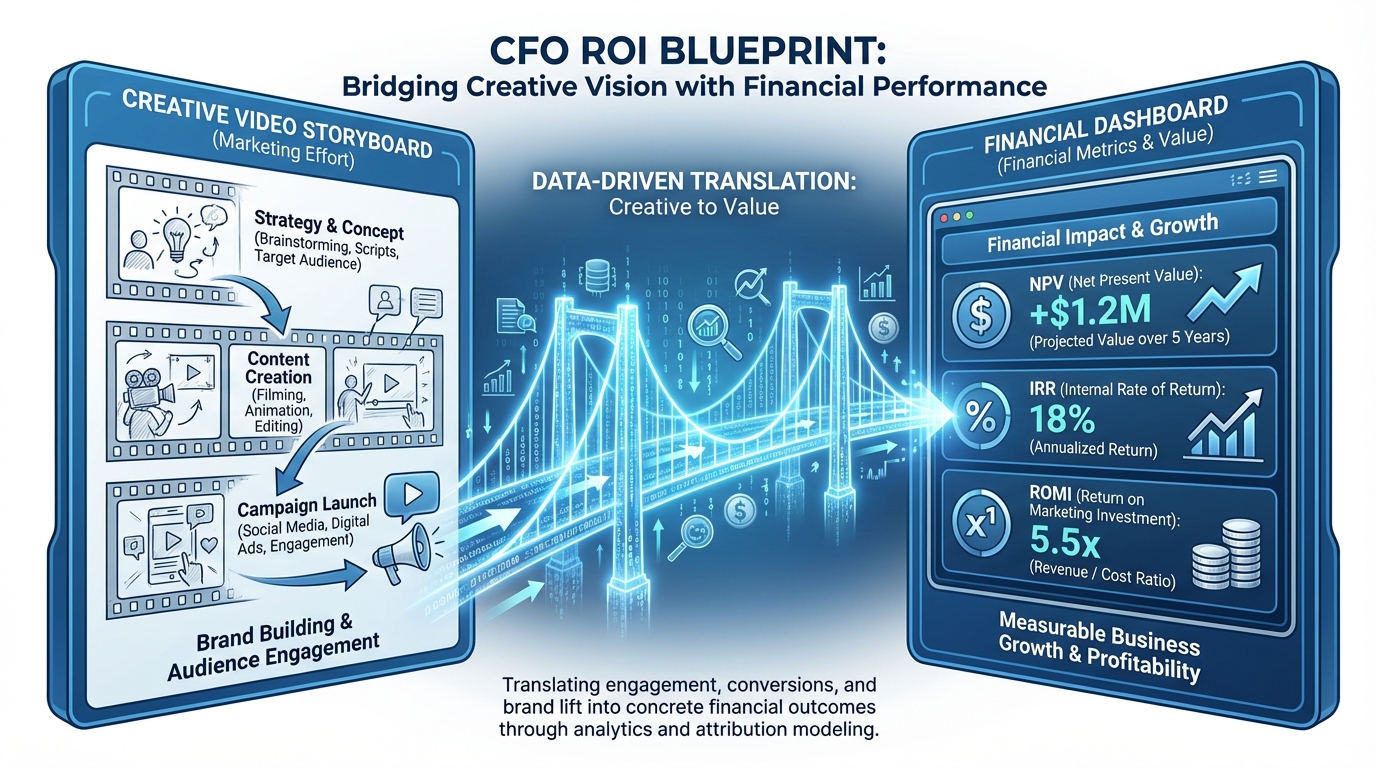
The CFO’s ROI Blueprint: AI Video Platform ROI Calculation
To secure CFO marketing budget approval, the ROI narrative must be translated into the language of finance. This involves defining clear constructs that account for both the upside of revenue growth and the downside of AI adoption enterprise costs.
Defining the Financial Constructs
- ROMI (Return on Marketing Investment): Calculated as (Incremental Gross Profit from Campaign – Investment) / Investment. It is vital to use finance-grade baselines and matched control groups to ensure the "incremental" portion of the profit is accurately attributed to the AI initiative.
- NPV (Net Present Value): This is the sum of the present values of incoming and outgoing cash flows over a period of time. A positive NPV indicates that the projected earnings (in present dollars) exceed the anticipated costs.
- IRR (Internal Rate of Return): The discount rate that makes the NPV of all cash flows from a particular project equal to zero. CFOs typically look for an IRR that exceeds the company's Weighted Average Cost of Capital (WACC).
- TCO (Total Cost of Ownership): This must include platform fees, integration costs, data governance, compliance audits, training, and ongoing operational support.
Revenue Levers: Personalization ROI Measurement
The primary revenue driver for AI video is enterprise video personalization. By moving from generic creatives to 1:1 video messages, brands can see a significant lift in conversion rates. For instance, Indian travel use cases have demonstrated a 17% higher WhatsApp message read rate when personalized celebrity videos were utilized.
Beyond simple conversion, personalization ROI measurement should track:
- Pipeline Velocity: How much faster do leads move through the funnel when personalized explainers are used in Account-Based Marketing (ABM)?
- Customer Lifetime Value (CLV): The impact of win-back videos on churn-risk cohorts.
- Media Efficiency: Higher engagement rates lead to better quality scores on platforms like Google and Meta, which in turn lowers CPM/CPC and improves overall yield.
Cost Levers: Marketing Automation Cost-Benefit
The marketing automation cost-benefit analysis focuses on production efficiency. AI-driven virtual reshoots and automated editing can compress production cycles from weeks to hours. Indian enterprise benchmarks have shown that thousands of creative hours can be saved by using AI to swap lines or variations without the need for physical re-shoots.
Localization is another major cost lever. With the ability to render content in 175+ languages with lip-sync and voice retention, the dependency on expensive agency fees and voice-over artists is drastically reduced. This centralization of the creative pipeline lowers coordination and Quality Assurance (QA) overhead, contributing to significant technology spend optimization.
Sources:
Worked Example: CFO-Grade ROI Math for 2026
Step 1: Establish the Inputs
- Baseline Conversion Rate (CVR): 2.5%
- Test CVR (with AI Personalization): 3.1% (a 24% relative lift)
- Average Order Value (AOV): ₹4,500
- Gross Margin: 40%
- Monthly Audience Size: 1,000,000 users
- Investment: ₹15,00,000 (Platform + Integration + Ops)
Step 2: Calculate Incremental Revenue
- Incremental Conversions: (3.1% - 2.5%) * 1,000,000 = 6,000 additional orders.
- Incremental Gross Profit: 6,000 * ₹4,500 * 40% = ₹1,08,00,000.
Step 3: Calculate Cost Takeout
- Traditional Production Costs: ₹25,00,000 (Multiple shoots, localization, agency fees).
- AI-Enabled Production Costs: ₹5,00,000.
- Cost Takeout: ₹20,00,000.
Step 4: Final ROI Calculation
- Net Cash Flow (Monthly): ₹1,08,00,000 (Profit) + ₹20,00,000 (Savings) - ₹15,00,000 (Investment) = ₹1,13,00,000.
- ROMI: (₹1,13,00,000 / ₹15,00,000) = 7.53x.
In this scenario, the payback period is less than one month, and the NPV over a 12-month period would be exceptionally high. This level of detail provides the AI video platform ROI calculation necessary to satisfy even the most skeptical finance controller. By using a pilot-to-implementation approach, enterprises can validate these numbers on a smaller scale before committing to a full-year contract.
Sources:
Budgeting for Scale: Enterprise AI Investment Strategies
Securing CFO marketing budget approval requires a strategic approach to marketing technology budget allocation. Rather than requesting a massive lump sum, marketing leaders should propose a tiered investment strategy that aligns with the fiscal year planning martech calendar.
Tiered Marketing Technology Budget Allocation
- The Pilot Phase (Q1): Focus on a narrow segment and 1–2 high-impact use cases, such as lifecycle nudges on WhatsApp or ABM outreach. The goal is to hit specific KPI gates, such as a 15% increase in Click-Through Rate (CTR) and a payback period of less than four months.
- The Core-Scale Phase (Q2–Q3): Once the pilot proves successful, expand to 4–6 use cases and integrate with CRM and WhatsApp APIs. This is the time to renegotiate contracts for volume pricing and introduce Marketing Mix Modeling (MMM) to refine attribution.
- The Enterprise-Wide Phase (Q4+): Deploy always-on 1:1 video across all lifecycle, service, and partner channels. This phase includes full regional language expansion and centralized governance.
Aligning with Union Budget Technology Planning
In India, the timing of these phases should coincide with the Union Budget technology planning cycle. By aligning procurement and the capex/opex mix with internal budgeting windows and national tax incentives, companies can optimize their tax positions. Technology spend optimization involves reinvesting 20–30% of savings from low-ROI legacy channels into proven AI programs. This "EBITDA-neutral" design ensures that the platform effectively funds itself through a combination of cost savings and revenue lift.
To facilitate approval, the marketing team should prepare a "Board Pack" consisting of 10–12 slides. This deck must include NPV/IRR tables, sensitivity analysis (showing what happens if conversion lift is lower than expected), and a clear outline of risk controls. Appending a 90-day pilot report with real-world data is the most effective way to de-risk the investment in the eyes of the CFO.
Sources:
Measurement, Governance, and TrueFan AI Integration
For a AI marketing ROI justification 2026 to hold weight, the measurement framework must be beyond reproach. Finance teams trust digital transformation metrics that are instrumented through rigorous control/holdout designs and validated via third-party audits.
Digital Transformation Metrics Finance Trusts
- Incremental CAC (Customer Acquisition Cost): The cost of acquiring a customer specifically through AI-enhanced channels vs. traditional channels.
- LTV/CAC Delta: How much the Lifetime Value to CAC ratio improves as a result of personalized retention efforts.
- Content Throughput: The volume of personalized videos produced per week compared to traditional methods.
- Localization Cost per Unit: The total cost to produce a single video in a regional language, including translation and rendering.
TrueFan AI's 175+ language support and Personalised Celebrity Videos provide a unique advantage in this area. By automating the most labor-intensive parts of the creative process, TrueFan AI allows for hyper-personalization at a scale that was previously impossible. For example, during a Zomato Mother’s Day campaign, the platform delivered 354,000 personalized videos in a single day. Similarly, Hero MotoCorp used the platform to send 2.4 million personalized festive greetings, which directly drove dealership service visits.
Governance and Risk Mitigation
Solutions like TrueFan AI demonstrate ROI through not just revenue and cost, but also risk mitigation. Finance and legal teams require:
- Consent-First Content: Ensuring all celebrity and user data is used with explicit permission.
- Security Attestations: SOC 2 and ISO 27001 certifications to protect enterprise data.
- Content Moderation: Built-in AI filters to prevent brand-damaging content from being generated.
By providing these governance artifacts, marketing leaders can offset the "risk cost" associated with new technology adoption. Regular reporting—including weekly operational updates and monthly finance packs—ensures that the project remains aligned with the broader corporate strategy and the AI adoption enterprise costs remain within the approved budget.
Sources:
Putting it into Practice: A 90-Day Pilot Plan
The most effective way to build a case for CFO marketing budget approval is to start with a high-velocity pilot. This 90-day plan is designed to prove value quickly and provide the data needed for a full-scale rollout.

Phase 1: Use-Case Prioritization (Days 1–30)
Select 2–3 India-ready use cases. High-impact options include:
- WhatsApp Win-Back: Sending personalized video nudges to lapsed customers.
- ABM Outreach: Embedding personalized celebrity or executive videos in SDR emails.
- Regional Onboarding: Using AI to create compliance or educational videos in local languages for BFSI (Banking, Financial Services, and Insurance) clients.
Phase 2: Data Design and Instrumentation (Days 31–60)
Establish a clean data environment. This involves cohort selection, matching, and the implementation of holdout groups. Every interaction must be tagged with UTM parameters or event tags to ensure personalization ROI measurement is accurate. Success thresholds should be defined upfront (e.g., a minimum 10% lift in CVR).
Phase 3: Execution and Evaluation (Days 61–90)
Run the campaigns and collect data. At the end of the 90 days, evaluate the results against the exit criteria. A successful pilot should demonstrate a ROMI of at least 1.5x and a projected payback period of less than six months. If these thresholds are met, the team is ready to present the scale-up decision to the Board.
Budget Stakeholder Videos: To further enhance the approval process, create 60–90 second internal explainer videos for Finance, IT, and Marketing leaders. These budget stakeholder videos should summarize the ROI model, highlight the guardrails in place, and show a demo of the technology in action. This ensures that every decision-maker, regardless of their technical background, understands the value proposition.
Sources:
Conclusion: Securing the Future of Enterprise Marketing
The path to a successful AI marketing ROI justification 2026 is paved with data, financial rigor, and strategic alignment. By moving away from vanity metrics and embracing a CFO-ready playbook, marketing leaders can transform AI from a "discretionary spend" into a "strategic asset."
The combination of technology spend optimization and enterprise video personalization offers a unique opportunity to drive both top-line growth and bottom-line efficiency. As you prepare your FY26 board pack, remember that the most compelling argument is one that demonstrates a clear, de-risked path to value.
Ready to build your ROI model?
Invite your CFO and FP&A teams to a 45-minute ROI workshop and calculator walkthrough. We will help you scope a pilot program pegged to your specific budget windows and business objectives, ensuring you have the evidence needed to secure CFO marketing budget approval for the upcoming fiscal year.
Recommended Internal Links
- AI marketing ROI justification 2026: CFO-ready playbook
- AI Marketing ROI Justification 2026: Win Budget Approval
- Technology Spend Optimization for CFOs: ROI in 2026
- Union Budget 2026 marketing strategies to drive growth
- Union Budget 2026 marketing strategies: high-ROI playbook
- Union Budget 2026 Marketing Opportunities: Campaign Wins
- DPDP Compliant Personalization: Privacy-First Marketing
Frequently Asked Questions
How do we calculate the "Cost Takeout" for AI video production?
Cost takeout is calculated by subtracting the total cost of AI-enabled production (platform fees, internal FTE time, and render costs) from the historical cost of traditional production (agency fees, physical shoots, and manual localization). In many cases, TrueFan AI helps enterprises save thousands of production hours by eliminating the need for reshoots.
What are the most important digital transformation metrics for the CFO?
CFOs typically prioritize ROMI, NPV, and the impact on the LTV/CAC ratio. They also look for "Efficiency Ratios," such as the reduction in localization cost per unit and the increase in content throughput without a corresponding increase in headcount.
How does Union Budget technology planning affect our AI investment?
The Union Budget often includes incentives for digital infrastructure and domestic technology adoption. Aligning your enterprise AI investment strategies with these cycles allows you to take advantage of potential tax breaks or capital subsidies, improving the overall NPV of the project.
Can we measure the ROI of personalization on offline sales?
Yes. By using unique coupon codes or dealership-specific links in personalized videos (as seen in the Hero MotoCorp case study), you can track the journey from a digital video view to an offline transaction, providing a complete picture of the personalization ROI measurement.
What risks should be included in the AI marketing ROI justification 2026?
The justification should address data privacy (GDPR/DPDP compliance), content moderation, and vendor lock-in. Providing SOC 2 or ISO 27001 attestations helps mitigate these concerns and builds trust with the finance and IT departments.



