Answer Engine Optimization Video: The Enterprise Playbook for AI Overviews, Voice, and Zero-Click SEO
Estimated reading time: ~20 minutes
Key Takeaways
- Zero-click search is now the norm—optimize videos to be the direct answer in AI Overviews and voice results.
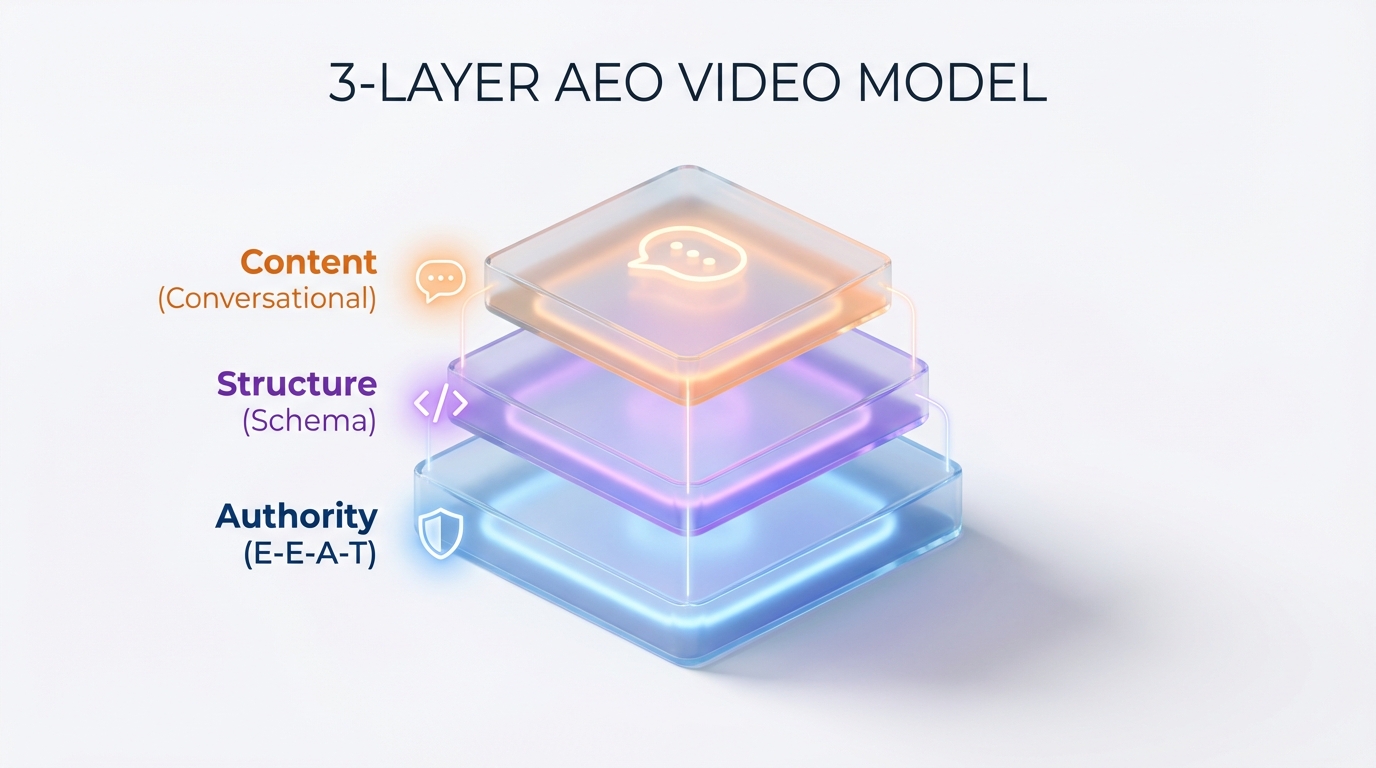
- Use a 3-layer AEO model: conversational content, robust schema, and E-E-A-T authority to win extraction.
- Front-load a 10-second definitive answer, chapter your video, and map data with VideoObject, FAQ, and HowTo.
- Shift measurement to Answer Share, AIO impressions, and timestamp watch-time, not just CTR.
- Scale with AI-driven workflows for rapid localization, iteration, and compliance at enterprise scale.
The search landscape has fundamentally shifted toward a “zero-click” reality where users receive immediate answers without ever leaving the search engine results page (SERP). An answer engine optimization video is a strategically structured, short-form video asset designed specifically for extraction by AI Overviews, voice assistants, and featured snippets to provide instantaneous value. By integrating precise timestamps, comprehensive schema, and natural language scripts, enterprises can capture high-intent visibility in an era where traditional organic clicks are declining.
TL;DR: The AEO Video Strategy
- The 3-Layer Model: Success requires aligning Content (conversational scripts), Structure (technical schema), and Authority (E-E-A-T signals).
- Schema Essentials: Deploy VideoObject, FAQ, and HowTo markup to feed answer engines precise data points.
- Voice-Ready Scripting: Front-load direct answers in the first 8–12 seconds to satisfy conversational AI prompts.
- Measurement: Shift KPIs from traditional CTR to “Answer Share” and AI Overview impressions.
The Zero-Click Landscape in 2026: Why Video Must Be Answer-First
In 2026, the traditional search funnel has been replaced by a conversational loop. Data indicates that nearly 80% of Google searches now end without a click, as AI Overviews and featured snippets satisfy user intent directly on the SERP. For enterprise brands, this means organic listings are often pushed “below the fold,” making on-page visibility the new primary objective for digital growth.
The shift is particularly pronounced in high-growth markets like India, where conversational search is reshaping how users interact with brands. Users no longer type fragmented keywords; they ask complex, multi-turn questions. To remain relevant, brands must move beyond “ranking a page” and focus on “being the answer.” AI summaries now prioritize content that is easily ingestible, factually consistent, and structured for rapid extraction.
Local and “near me” intents have also evolved. AI-first search engines now synthesize local business data with video reviews and how-to guides to provide a comprehensive response. If your video content isn’t optimized for these “no-click” modules, your brand effectively disappears from the most valuable real estate on the web. Adopting zero-click optimization strategies is no longer optional—it is the baseline for enterprise SEO survival.
Sources:
- Ekamoira: 60% of searches get zero clicks—how to win in 2026
- Heroic Rankings: Google AI Overview statistics, 2026 trends
- Digital Shout: Conversational search and AI Overviews in 2026
The 3-Layer AEO Video Model: Content, Structure, and Authority
To dominate the answer engine ecosystem, enterprises must execute across three distinct layers. This holistic approach ensures that videos are not only discoverable but are also cited as the definitive source by AI models.
1. Content Layer: Conversational SEO Videos and Natural Language
The content layer focuses on conversational SEO videos that mirror real-world spoken queries. Unlike traditional marketing videos that rely on long “hook” intros, AEO-optimized videos must be “answer-first.” The most effective format follows a Q→A→Proof→Next structure.
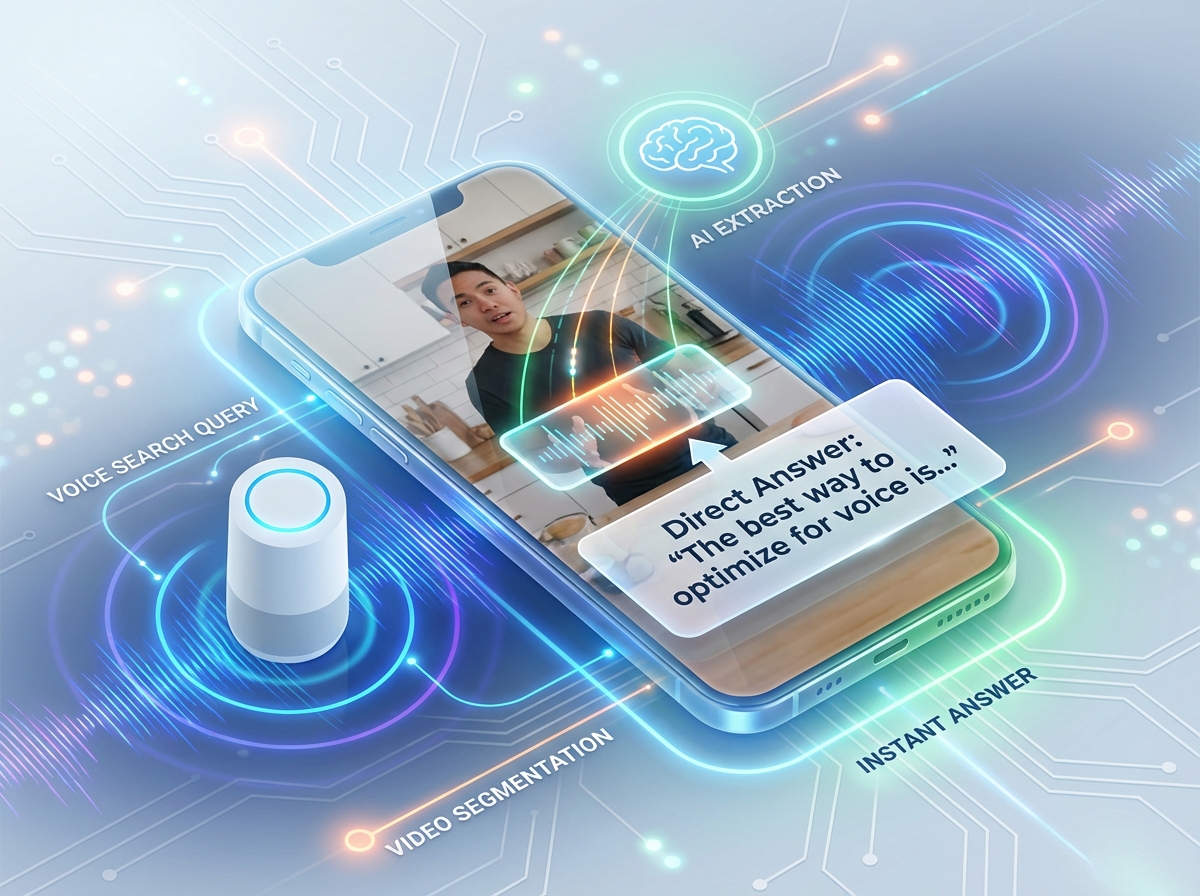
- The 10-Second Rule: Deliver a one-sentence definitive answer within the first 8–12 seconds. This allows AI engines to clip the exact segment needed for a featured snippet or voice response.
- Natural Language Video SEO: Use phrasing that matches how people actually speak. Instead of “Top 10 Benefits of Cloud Computing,” use “Why should my business switch to cloud computing in 2026?”
- Snippet-Friendly Patterns: Structure your script around comparisons (“X vs Y”), lists (“5 steps to...”), and definitions (“What is...” ). These patterns are the “DNA” of featured snippets.
In the Indian market, AI-ready content that aligns with “SERP consensus”—the prevailing factual agreement across top-ranking sites—performs significantly better in AI Overviews.
2. Structure Layer: Schema Markup Video Implementation at Scale
Technical structure is the bridge between your video and the answer engine. Without precise schema markup video implementation, AI models may struggle to understand the context of your content.
- VideoObject Schema: This is the foundation. It must include the name (the question), a detailed description (the answer), and a full transcript.
- FAQ Schema Video Markup: Embed 3–5 Q&A pairs near your video. Each answer should be 1–2 sentences and include a deep link to the exact timestamp in the video where that question is answered.
- HowTo Schema Optimization: For procedural content, break the video into steps. Each step in the schema should correspond to a “Key Moment” or “Clip” in the video metadata.
Treating schema as a “data feed” for AI Overviews is the most effective way to ensure your video is surfaced as a rich result.
3. Authority Layer: E-E-A-T Video Authority and Citation Strategies
As AI Overviews expand, Google’s focus on Experience, Expertise, Authoritativeness, and Trustworthiness (E-E-A-T) has intensified. E-E-A-T video authority is established by clearly identifying the expert on screen and providing verifiable citations.
- On-Screen Credentials: Use lower-third graphics to display the speaker’s name, title, and years of experience.
- AI Answer Citation Strategies: Explicitly cite sources within the voiceover (e.g., “According to the 2026 Gartner report...”) and include outbound links to these sources in the video description and transcript.
- Transparency: Disclose the use of AI in production and provide a clear “About the Author” section on the hosting page to build trust with both users and search algorithms.
Sources:
- JustWords: Best AI tools for SEO in India
- Memento Tech: Shopify SEO strategy 2026 and schema importance
- SEO Analyst: Core update analysis, recovery, and E-E-A-T
Voice Search Video Marketing: Formats, Prompts, and Testing
Voice search is the ultimate “zero-click” environment. When a user asks a smart speaker or mobile assistant a question, the engine looks for the most concise, spoken-word-friendly answer. Voice search video marketing requires a departure from visual-heavy storytelling toward audio-clarity and linguistic precision.
Voice-First Scripting
Scripts should be written for the ear, not the eye. Use short sentences (20–40 words) for the primary answer segments. Front-load numerical facts and definitions, as these are the data points voice assistants prioritize. For example, instead of saying “Our solution provides a significant reduction in costs,” say “Our solution reduces operational costs by 35% for enterprise clients.”
Multilingual and Local Variants
In a diverse market like India, voice search is frequently conducted in regional languages or “Hinglish.” Enterprises must publish locale-specific clips that account for regional dialects and “near me” modifiers. This ensures the brand remains the “top answer” across different geographic and linguistic segments.
Conversational Chaining
Anticipate the “follow-up” question. If a user asks “How much does X cost?”, the next question is likely “What factors influence that cost?” By creating a series of companion clips that address these chained intents, you increase the likelihood of maintaining the “answer position” throughout the user’s entire discovery journey.
Featured Snippet Video Content: Win Formats and Chaptering
To win featured snippet video content placements, your video must be modular. Google increasingly uses “Key Moments” to skip users directly to the part of a video that answers their specific query.
The AEO Pattern Library
- The Definition Snippet: “What is [Topic]?” — Provide a clear definition followed by one proof point.
- The Comparison Snippet: “[Product A] vs [Product B]” — Use a 3-bullet comparison and a final recommendation.
- The List Snippet: “Steps to [Action]” — Clearly label each step on-screen and in the metadata.
- The Pricing Snippet: “Cost of [Service]” — Give a range and explain the primary cost drivers.
Strategic Chaptering
Each chapter name should match a high-volume “People Also Ask” (PAA) question. Use on-screen text overlays that mirror these chapter labels. This visual and textual alignment makes it easier for AI models to “ingest” the content and present it as a standalone answer in the SERP.
Sources:
- Digital Market Academy: AI-Overview compatible content structures
- Hemant.co.in: Future of SEO in India 2026
Semantic Search Video Content and Entity Design
Modern SEO is built on entities (people, places, things, and concepts), not just keywords. Semantic search video content involves defining your brand and products as distinct entities within Google’s Knowledge Graph.
Entity-First Planning
Ensure your video descriptions and transcripts use consistent naming conventions for your brand, products, and key executives. Use sameAs schema properties to link your video entities to authoritative hubs like LinkedIn profiles, Wikipedia pages, or official brand directories.
Knowledge Graph Integration
By tying local entities—such as specific branches or regional partners—to your video content, you provide the context AI Overviews need to trust your information. This is critical for appearing in “near me” conversational results. For instance, a video about “Enterprise banking in Mumbai” should be semantically linked to the Mumbai branch’s LocalBusiness schema.
Production at Enterprise Scale with AI
Scaling an answer engine optimization video strategy across thousands of products and dozens of languages is a massive logistical challenge. Traditional video production is too slow and expensive to keep up with the real-time nature of AI search.
The AI-Driven Workflow
- Script Generation: Use AI to cluster PAA questions and draft 5–7 conversational scripts.
- Master Production: Record a single master cut with a subject matter expert.
- Virtual Reshoots: Use AI to adjust specific lines or offers without needing a new shoot.
- Mass Localization: Automatically translate and lip-sync the video into 175+ languages while maintaining the original speaker’s voice.
Platforms like TrueFan AI enable enterprises to transform a single 15-minute shoot into infinitely scalable, hyper-personalized videos. This allows brands to respond to shifting search trends in hours rather than weeks. TrueFan AI’s 175+ language support and Personalised Celebrity Videos ensure that every answer-first video is culturally and linguistically relevant to the target audience.
Technical Implementation Checklist: Schema-First Publishing
To ensure your videos are “answer-ready,” follow this technical checklist for every upload.
1. VideoObject Essentials
- Name: Phrased as a question (e.g., “How do I optimize for zero-click search?”).
- Description: A 1–2 sentence direct answer.
- Transcript: A full, clean text version of the audio.
- InteractionStatistic: Data on views and likes to signal popularity to the engine.
2. Key Moments (hasPart Clip)
Define each chapter with a startOffset and endOffset. Use the SeekToAction property to allow Google to deep-link users directly to a specific second in the video from the SERP.
3. FAQ and HowTo Integration
- FAQ Schema: Include 3–6 questions that match PAA intent.
- HowTo Schema: Map each step to a visual label in the video.
Sources:
Measurement and Iteration Loop: Zero-Click KPIs
Success in an AEO world cannot be measured by website traffic alone. Enterprises must track how often their content serves as the “source of truth” on the SERP.
KPIs to Track
- AI Overview Impressions: How often your video is cited in an AIO module.
- Featured Snippet Wins: The number of “Position 0” rankings achieved.
- Answer Share: The percentage of brand-related queries where your video provides the top answer.
- Timestamp Watch-Time: Spikes in viewership at specific answer timestamps, indicating the video is satisfying specific intents.
Solutions like TrueFan AI demonstrate ROI through significant reductions in creative production time—often saving thousands of man-hours by using AI-generated revisions instead of traditional editing. This efficiency allows for bi-weekly iteration, where scripts are refined based on which “Key Moments” are winning the most snippet placements.
Governance, Compliance, and E-E-A-T Packaging
For large organizations, maintaining brand safety and legal compliance is paramount when using AI-generated content.
Enterprise Compliance
- Audit Trails: Maintain logs of every script version, source citation, and approval.
- Consent-First Models: Ensure all celebrity or spokesperson likenesses are used under formal contracts.
- Moderation: Use automated filters to prevent the generation of offensive or off-brand content.
E-E-A-T Packaging
Every video page should include an author box with verifiable credentials and a “Last Updated” date. This signals to search engines that the information is current and provided by a legitimate expert.
On-Page Layout Blueprint: Snippet-First Design
Your webpage layout should complement your answer engine optimization video to maximize the chances of a rich result.
- Above-the-Fold: Place the H1 (containing the primary keyword) and a 2–3 sentence direct answer at the very top.
- Video Placement: Embed the primary video immediately below the intro text.
- Chapter List: Display a clickable list of “Key Moments” with timestamps.
- FAQ Block: Place the FAQ schema-mapped questions below the video to reinforce the semantic context.
Conclusion
The rise of AI Overviews and zero-click search has made answer engine optimization video the most critical asset in the enterprise SEO toolkit. By aligning conversational content with rigorous technical schema and high E-E-A-T standards, brands can reclaim visibility in an increasingly fragmented search landscape. To stay ahead, enterprises must move toward a production model that favors speed, localization, and precision. Operationalizing this strategy with an AI video generator for SEO is the fastest path to dominating the “answer position” and securing your brand’s future in the age of conversational discovery.
Recommended Internal Links
- AI Overviews SEO strategy: Video Tactics for 2026 Success
- AI Overviews Optimization 2026: Advanced AEO Strategies
- Featured Snippet Video Content: AEO Strategies for 2026
- Regional Language Video SEO: Strategies for 2026 Growth
- AI Overviews Optimization 2026: Festival SEO Playbook
Frequently Asked Questions
What is answer engine optimization video?
It is the process of structuring video content—through conversational scripting, precise timestamping, and schema markup—so that AI engines (like Google AI Overviews) can extract and present specific segments as direct answers on the SERP.
How do I structure videos for AI Overviews video SEO?
Ensure the first 8–12 seconds contain a concise, one-sentence answer to the primary query. Use clear on-screen headings and “Key Moments” metadata to help AI models identify and clip relevant sections.
What schema markup video implementation is required?
At a minimum, use VideoObject (with name, description, and transcript), hasPart (for Clips/Chapters), and SeekToAction. Complement these with FAQ and HowTo schema for maximum visibility.
How do I optimize for voice search video marketing?
Focus on natural, spoken language. Keep answer segments between 20–40 words and ensure the audio is clear. Create locale-specific variants to capture regional voice search queries.
How do I build E-E-A-T video authority and citations?
Display expert credentials on-screen, provide a detailed author bio on the hosting page, and explicitly cite high-authority sources in both the voiceover and the video description.
How can TrueFan AI help with my AEO video strategy?
TrueFan AI provides an enterprise-grade AI video generator for SEO to produce, localize, and iterate on answer-first videos at scale with strong compliance and E-E-A-T signals across 175+ languages.



