DPDP Act Enforcement Marketing Impact 2026: A Survival Guide to Consent-First Personalized Video and Growth
Estimated reading time: ~12 minutes
Key Takeaways
- DPDP Act 2026 ends implied consent and mandates granular, withdrawable consent for every marketing interaction.
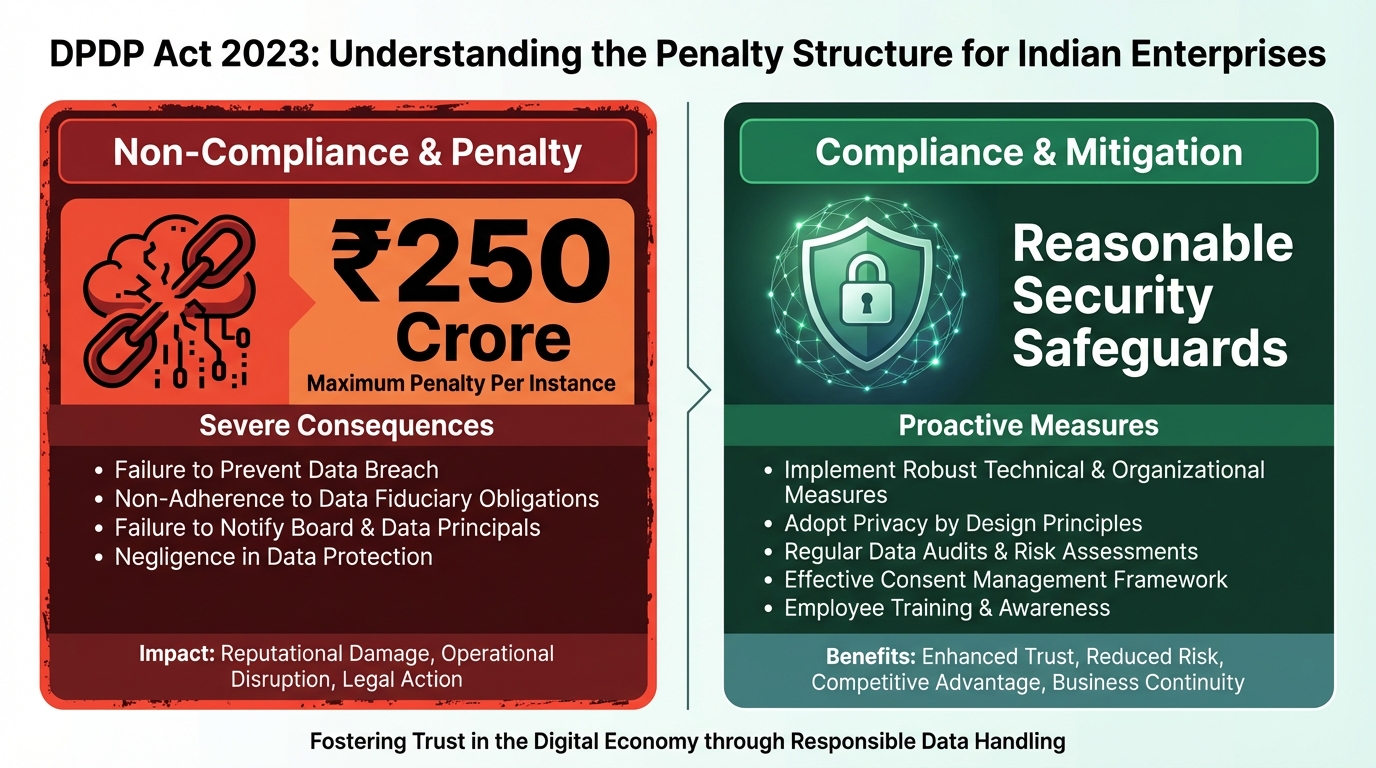
- Non-compliance risks include penalties up to ₹250 crore, reputational damage, and rising CAC.
- First- and zero-party data fuel consent-first personalized video, improving opt-ins and watch-time.
- Scale AI celebrity campaigns with triple-layer consent architecture and enterprise CMP integration.
- Adopt a 120-day implementation plan to operationalize consent capture, cookieless activation, and ISO 27001-grade security.
The DPDP Act enforcement marketing impact 2026 is not just a compliance deadline; it’s a growth lever for Indian enterprises that move from third-party cookies to consent-first personalized video enterprise built on first-party and zero-party data. As the Data Protection Board of India (DPBI) begins its full-scale operationalization, the era of “growth at any cost” has officially ended, replaced by a mandate for privacy-first customer engagement India 2026. For CMOs and CDOs, the stakes are unprecedented: serious violations, such as the failure to implement reasonable security safeguards, now carry financial penalties of up to ₹250 crore. Beyond the legal risk, the reputational damage and the sudden shock to Customer Acquisition Cost (CAC) for non-compliant brands could be terminal.
However, the shift toward a data privacy competitive advantage marketing strategy offers a significant upside for early adopters. Recent industry forecasts suggest that India’s ad market will reach nearly INR 2,000 crore by 2026, with a clear premium placed on brands that respect user autonomy. While 71% of Indian enterprises currently struggle to interpret the granular requirements of the Act, those who master consent-first operations are seeing higher opt-in rates and superior watch-time on personalized content. By integrating ISO 27001-grade security with real-time AI video rendering, enterprises can turn compliance from a procurement hurdle into a distinct market advantage.
The New Reality: DPDP Act Enforcement Marketing Impact 2026 and the Shift to Privacy-First Customer Engagement India 2026
The enforcement of the Digital Personal Data Protection (DPDP) Act in 2026 marks a structural transformation in how Indian brands interact with their audiences. The DPBI is now empowered to enforce granular consent, meaning every marketing interaction must be backed by a clear, informed, and withdrawable opt-in. This shift effectively ends the practice of “implied consent” that has dominated the digital ecosystem for a decade.
For marketing operations, this means moving beyond simple email lists to a sophisticated first-party data video personalization DPDP framework. Enterprises must now maintain immutable consent receipts that log the specific purpose of data processing, the duration of retention, and the exact attributes used in personalization. If a user provides data for a “festive greeting,” that data cannot be repurposed for a “loan offer” without a fresh, explicit consent flow.
The operational depth required is significant, as the 2026 landscape demands a “privacy-by-design” approach to every campaign. This includes implementing data minimization—collecting only the attributes necessary for the specific video template—and ensuring that data is suppressed or erased automatically once the campaign purpose is fulfilled. As third-party cookies continue to deprecate, the transition to cookieless video personalization India becomes the only sustainable path for maintaining high-performance customer engagement.
Sources:
- Government Starts Appointments Process for DPBI - Tsaaro
- DPDP Act: What Digital Marketers in India Must Know in 2026 - First Launch
- Nearly 71% of Indian Enterprises Struggle to Interpret DPDP Act - EY India
Navigating the Penalty Landscape: DPDP Penalties Marketing Non-Compliance and the Marketer’s Risk Surface
The financial implications of DPDP penalties marketing non-compliance are designed to be deterrents at an enterprise scale. The Act specifies a tiered penalty structure, with the most severe fine of ₹250 crore reserved for failures in implementing reasonable security safeguards to prevent data breaches. For a marketing department, a “breach” isn't just a hack; it includes the unauthorized processing of personal data or the failure to notify the DPBI and affected users of a data leak.
Marketers face a heightened risk surface in three specific areas: invalid consent flows, over-collection of data, and disconnected revocation UX. Many legacy lead-generation forms and interactive content pieces still use pre-ticked boxes or vague “terms and conditions” links that do not meet the 2026 standard for “clear and affirmative” consent. Furthermore, if a user withdraws consent via WhatsApp but continues to receive personalized videos via email, the brand is in direct violation of the user's right to erasure and withdrawal.
To survive this enforcement era, brands must adopt a DPDP Act marketer survival guide that prioritizes auditability. This involves mapping every data attribute to a specific marketing purpose and ensuring that the Data Protection Officer (DPO) has a real-time view of all processing activities. The cost of non-compliance is not just the fine; experts estimate that the industry could face an overall impact of ₹8,000–12,000 crore due to market shrinkage and the costs of emergency remediation.
Sources:
- Enforcement and Penalties Under the DPDPA 2023 - Tsaaro
- DPDP Enforcement Begins: Penalties up to ₹250 cr - Storyboard18
- DPDP Doldrums? Industry Staring at Rs 12000-cr Impact - Exchange4media
The Strategic Pivot: First-Party Data Video Personalization DPDP and Zero-Party Data AI Video Collection
In a post-DPDP world, the most valuable asset a brand owns is its first-party data. This is data collected directly from your owned channels—apps, websites, and CRMs—where the user has a direct relationship with the brand. First-party data video personalization DPDP allows enterprises to create hyper-relevant content, such as a celebrity addressing a customer by name regarding their recent purchase, while remaining fully compliant with purpose-limitation rules.
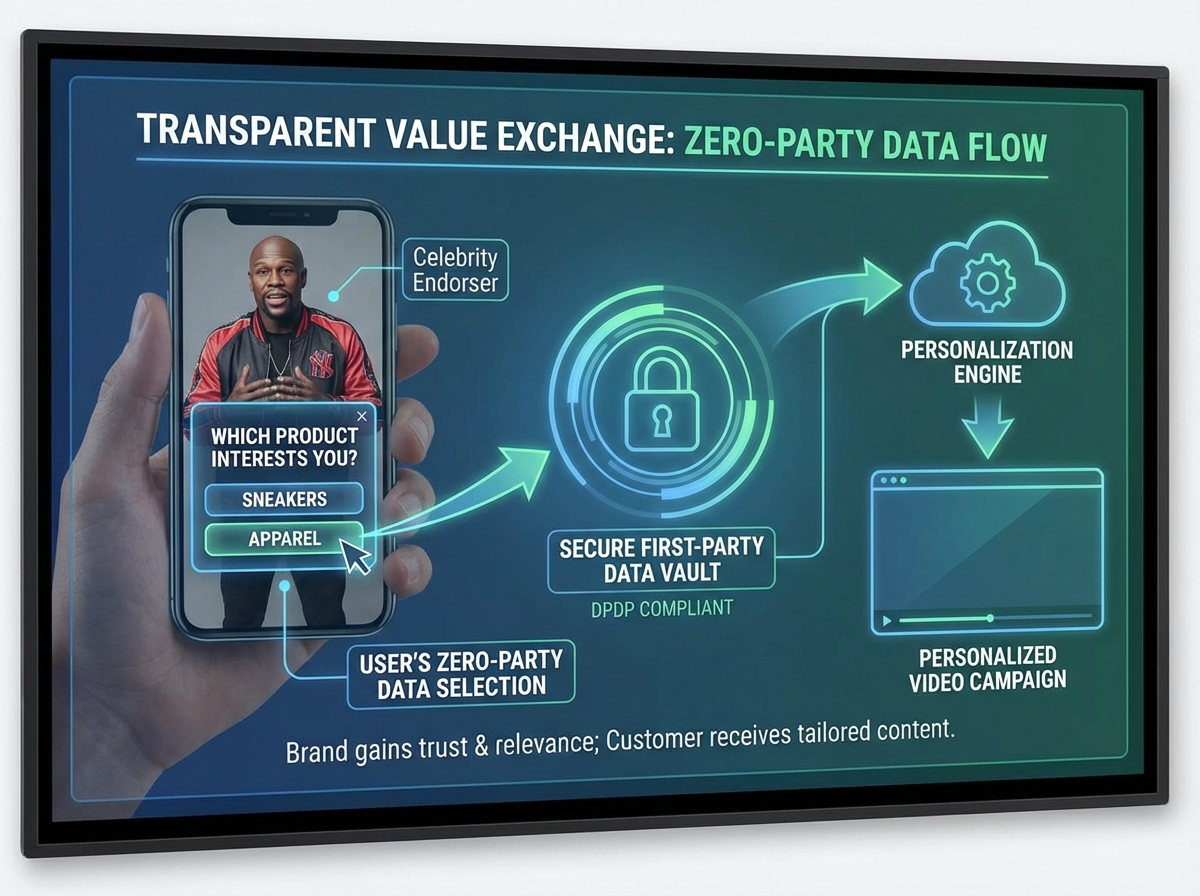
Even more powerful is the rise of zero-party data AI video collection. Zero-party data is information that a customer proactively and explicitly shares, such as their preferred language, product interests, or communication frequency. By embedding interactive prompts within a video player, brands can ask users: “Which language would you like to hear this in?” or “Which product should we show you next?” This creates a transparent value exchange where the user provides data in return for a better, more personalized experience.
This shift creates a data privacy competitive advantage marketing framework. When users feel in control of their data, they are more likely to engage. For example, brands using zero-party data for video personalization have seen a 3.2x higher participation rate in reader activations compared to traditional email campaigns. This approach also naturally enforces data minimization personalized video practices, as you only collect what the user chooses to share for that specific interaction.
Sources:
- DPDP for Marketing Teams: Can You Still Run Personalised Ads? - Blutic
- 2026 Digital Marketing Trends: AI, Privacy, & CRO - LiveHelpIndia
Engineering Trust: Consent Architecture AI Celebrity Videos India and the Role of an Enterprise Consent Management Video Platform
Creating AI-generated celebrity videos at scale requires a robust technical foundation known as consent architecture AI celebrity videos India. This architecture must manage three distinct layers of consent: the celebrity’s consent for their likeness, the user’s consent for data processing, and the platform’s internal moderation rails. Without this triple-layered approach, enterprises risk massive legal exposure under both the DPDP Act and personality rights laws.
Platforms like TrueFan AI enable enterprises to navigate this complexity by providing a secure, API-first environment for video generation. A true enterprise consent management video platform must integrate directly with the brand's Consent Management Platform (CMP). This ensures that a video render request is only triggered if a valid, unexpired consent receipt exists for that specific user and purpose. If a user withdraws consent, the system must immediately invalidate all active video links and suppress the user from future rendering queues.
The technical requirements for this are stringent. The platform must support signed URLs and tokenized delivery to prevent unauthorized sharing of personalized content. Furthermore, it must offer a “moderation-by-design” filter that prevents the generation of any content that violates brand safety or legal guidelines. By centralizing these controls, enterprises can achieve “one-to-one” marketing at a scale of millions of videos while maintaining a perfect audit trail for the DPBI.
Sources:
- DPDP Rules 2025 Explained: Full Overview - Tsaaro
- India's Privacy Trajectory Post-DPDP Act - DRN Legal
Protecting the Future: Children's Data DPDP Act EdTech Marketing and Data Minimization Personalized Video
The DPDP Act is particularly stringent regarding children’s data DPDP Act EdTech marketing, defining anyone under the age of 18 as a child. For EdTech and gaming companies, this necessitates verifiable parental consent before any personal data can be processed. The Act also explicitly prohibits behavioral monitoring or targeted advertising directed at children, which fundamentally changes how personalized learning videos can be marketed and delivered.
To comply, brands must implement age-gating at the point of data capture. If a user is identified as a child, the workflow must trigger an OTP-based consent process for the parent. The resulting personalized video must adhere to strict data minimization personalized video principles—avoiding any tracking pixels or behavioral triggers that could be construed as monitoring. Instead, the focus should be on “Family Mode” templates that deliver educational value without invasive data collection.
This “privacy-first” approach for the youth segment is not just a legal requirement but a significant trust builder. Parents in 2026 are increasingly aware of digital safety, and brands that demonstrate ISO 27001-grade protection for their children’s data will win long-term loyalty. Failure to do so, however, carries the highest penalty bracket, as the DPBI views children’s data violations as a serious breach of public trust.
Sources:
- Children's Data Protection Under India's DPDP Rules - K&S Partners
- Digital Personal Data Protection Rules 2025 - Treelife
Performance in a Cookieless World: Cookieless Video Personalization India and ISO 27001 Video Personalization Compliance
As we move into late 2026, the reliance on third-party cookies has vanished, making cookieless video personalization India the standard for high-performance marketing. Brands are now using server-side identity stitching and hashed identifiers (like email or phone numbers) to trigger personalized experiences. This method is inherently more secure and aligns perfectly with the DPDP Act’s requirement for clear data lineage.
TrueFan AI's 175+ language support and Personalised Celebrity Videos allow brands to activate these cookieless identifiers into emotionally resonant content. By using server-side events, a brand can trigger a personalized video on WhatsApp the moment a user completes a high-value action on their site. This real-time activation, combined with ISO 27001 video personalization compliance, ensures that the data remains encrypted and the processing is fully auditable.
The performance lift from this approach is measurable. Enterprises have reported up to a 17% higher read rate on WhatsApp messages when they include a personalized celebrity video compared to standard text. Furthermore, by moving to a “consent-first” model, brands see a reduction in churn and an increase in “brand love,” as customers no longer feel “stalked” by ads but rather “served” by personalized content they actually opted into.
Sources:
- Cookieless Marketing Strategies for Digital Marketers - Brand Equity
- The State of Digital Marketing in India 2025 - Ipsos
The 120-Day DPDP Act Marketer Survival Guide: Implementing a DPDP Compliance Marketing Technology Stack
Transitioning to a fully compliant marketing operation requires a structured 120-day plan. The first 30 days should focus on a comprehensive data flow audit, identifying every point where personal data enters the system and ensuring it is tagged with a specific “purpose.” This is also the time to evaluate your DPDP compliance marketing technology stack, ensuring your CMP and CRM can talk to each other via real-time APIs.
In the second phase (Days 31–60), enterprises must build their consent architecture. This involves designing the UI/UX for consent capture—ensuring it is granular and language-localized—and setting up the storage schema for consent receipts. This is the ideal window to pilot zero-party data collection moments, such as preference centers, that will feed your personalized video engine.
Solutions like TrueFan AI demonstrate ROI through the final 60 days of implementation, where the focus shifts to cookieless activation and security hardening. By Day 120, the brand should have an automated workflow where consent is captured, a personalized video is rendered in under 30 seconds, and the data is erased according to the retention schedule. This end-to-end automation de-risks the marketing department and provides a scalable foundation for growth in the privacy-first era.
Sources:
- India's New Data Privacy Rules: 8 Steps for Businesses - Fisher Phillips
- Digital Personal Data Protection Act India: Compliance Guide 2026 - Atlas Systems
Frequently Asked Questions
What is the maximum penalty for a marketing data breach under the DPDP Act?
The maximum penalty for failing to implement reasonable security safeguards to prevent a data breach is ₹250 crore. Other violations, such as failing to notify the Board of a breach or violating children's data rules, can attract fines up to ₹200 crore.
How does the DPDP Act affect personalized celebrity video campaigns?
The Act requires explicit, granular consent from the user before their data (like name or location) can be used to personalize a video. Brands must also ensure they have a valid contract with the celebrity and use an enterprise consent management video platform like TrueFan AI to manage the technical and legal requirements of the campaign.
Can I still use my existing customer database for personalized marketing in 2026?
You can only use existing data if the original consent obtained meets the new DPDP standards (clear, specific, and informed) or if you send a fresh notice to users seeking their consent under the new Rules. “Legacy” data without clear consent trails poses a high risk of non-compliance.
What is “Data Minimization” in the context of AI video?
Data minimization means only collecting and processing the specific attributes needed for the video. For example, if a video only needs a user's first name to be personalized, the system should not have access to their full address or purchase history.
Is ISO 27001 certification mandatory for marketing vendors?
While not strictly mandatory by law, the DPDP Act requires “reasonable security safeguards.” ISO 27001 and SOC 2 certifications are the industry gold standards that demonstrate an enterprise has met these safeguards, significantly de-risking the brand during a DPBI audit.
Recommended Internal Links
- AI Celebrity Video Marketing India: Scalable, Personalized Endorsements at a Fraction of the Cost
- B2B Sales Video Personalization 2026: Accelerate Deals
- WhatsApp Business Commerce Automation 2026: Growth Playbook
- Result Day Crisis Management: EdTech Playbook for 2026
- Student Anxiety Support Videos: Proven EdTech Strategies