Maha Shivaratri marketing campaigns 2026: Enterprise playbook for spiritual commerce personalization in India
Estimated reading time: ~12 minutes
Key Takeaways
- Sunday, Feb 15, 2026 creates a weekend advantage for extended temple travel, late-night rituals, and 48-hour retail activation windows.
- Shiva devotee targeting should be privacy-safe and behavior-led, with vernacular-first content for Tier-2/3 markets.
- Offer-led personalization via hyper-personalized, vernacular videos drives higher conversions across wellness, retail, and travel.
- A 6-week implementation timeline covers strategy, awareness, conversion sprint, and retention programs.
- Cultural sensitivity guardrails (puja-hour respect, vrat compliance, ASCI disclosures) are essential for trust and brand safety.
Vernacular video automation, Shiva devotee targeting, and offer-led growth for wellness, retail, and temple tourism brands
The cultural landscape of India is undergoing a seismic shift as digital infrastructure meets ancient tradition, making Maha Shivaratri marketing campaigns 2026 a critical priority for enterprise leaders. Explore the in-depth Maha Shivaratri campaign guide. On Sunday, February 15, 2026, hundreds of millions of devotees will observe the “Great Night of Shiva,” creating a high-velocity commerce window that demands sophisticated, localized, and data-driven execution.
For CMOs in the wellness, retail, and travel sectors, this festival represents more than a religious milestone; it is a catalyst for spiritual commerce personalization in India. As the nation moves toward a $5 trillion economy, the intersection of faith and technology—often termed “Spiritual Tech”—is projected to reach unprecedented heights by 2026.
Maha Shivaratri, observed on the Chaturdashi of Phalguna Krishna Paksha, is characterized by overnight vigils (jaagaran), rigorous fasting (vrat), and ritualistic offerings (abhishek). With major national celebrations led by organizations like Isha Foundation and massive contribution drives in Mumbai and East India, the cultural momentum is undeniable. Brands that fail to operationalize these insights risk missing the most significant spiritual engagement window of the first quarter.
Sources:
Why February 15, 2026, is a commerce catalyst: Timing, demand, and vernacular acceleration
The alignment of Maha Shivaratri on a Sunday in 2026 provides a unique “weekend advantage” for brands. This timing facilitates extended family travel, late-night temple visits, and a concentrated 48-hour window for retail activations that can span from Saturday evening through Monday morning.
The tailwinds for spiritual tourism are stronger than ever. According to the KPMG India x PHDCCI “Sacred Journeys” report, spiritual tourism has evolved into a primary growth engine for the Indian economy, driven by digital discovery and experiential upgrades. India Tourism data highlights a staggering 2,509.63 million domestic tourist visits in 2023, a 45% year-on-year increase that serves as a robust foundation for temple travel in 2026.
Furthermore, the EY India M&E 2025 report underscores a deepening of regional-language consumption across video and social platforms. For enterprise marketers, this necessitates a move away from “one-size-fits-all” English or Hindi creative. Success in 2026 requires vernacular devotional content that speaks to the heart of Tier-2 and Tier-3 markets, where the majority of spiritual commerce originates. See vernacular voice SEO strategies.
Sources:
Defining the spiritual customer journey: Awareness to retention
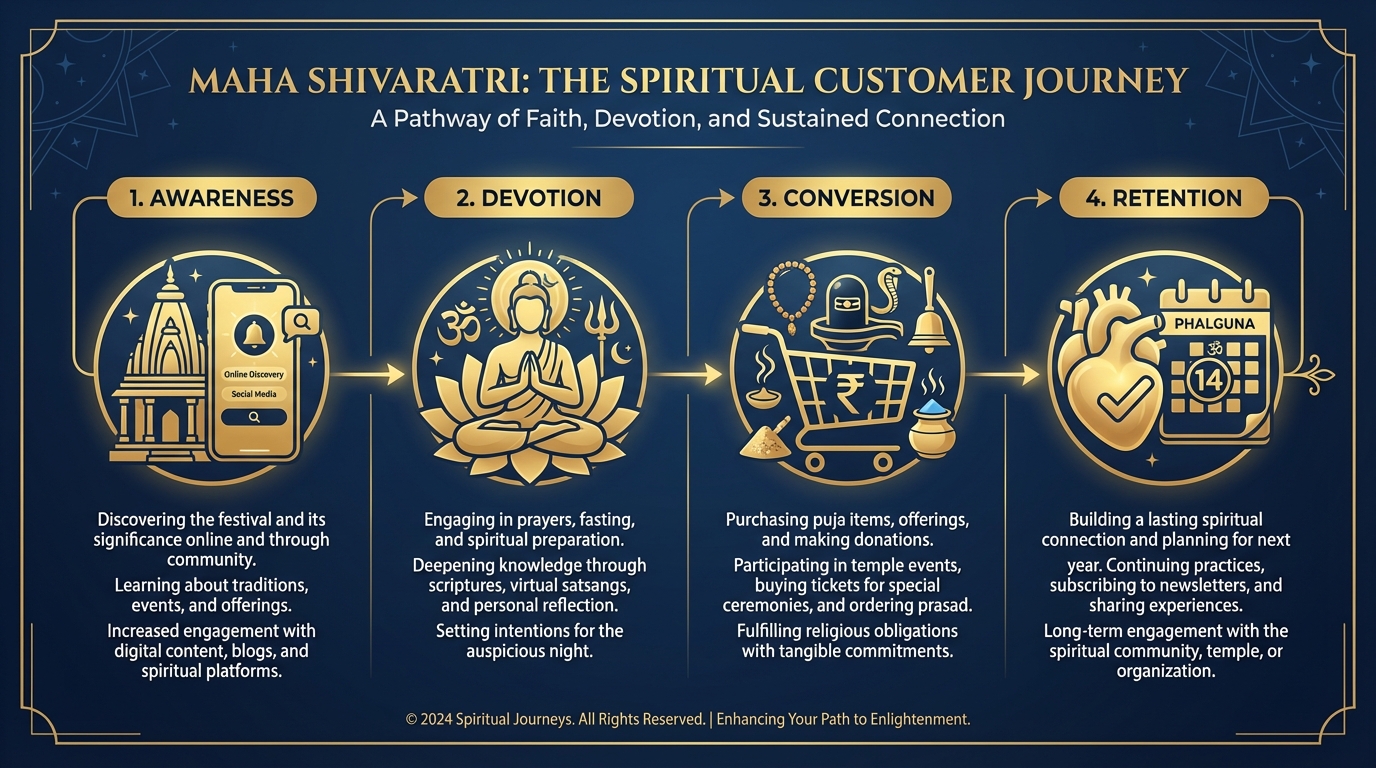
To effectively capture value during Maha Shivaratri, brands must map their strategies to a specialized spiritual customer journey. This framework tracks the devotee’s path from initial intention-setting to post-festival practice, ensuring that marketing interventions are timely and respectful.
Awareness (T-4 to T-3 weeks)
During this phase, the focus is on festival primers and ritual education. Brands should deploy vernacular video shorts that explain the significance of the 2026 date, local temple guides, and ritual checklists. The goal is to establish the brand as a helpful companion in the devotee’s preparation.
Devotion and Consideration (T-3 to T-2 weeks)
As the festival nears, the journey shifts toward specific planning. Influencer-led explainers on fasting (vrat) protocols, abhishek timings, and darshan flows become vital. This is the optimal time for travel brands to push pilgrimage package marketing and for wellness brands to build WhatsApp lists via aarti reminders or “save my puja slot” tools.
Conversion (T-10 days to T-day)
The conversion phase is characterized by high-intent actions. Retailers should focus on time-bound fasting product offers, while travel companies deploy temple tourism offer videos. Meditation app acquisition campaigns should highlight specific festival-night benefits, such as guided meditations for the Maha Nishita Kaal (the most auspicious time for Shiva worship).
Retention (T+1 to T+7 days)
Post-festival engagement is often overlooked but critical for LTV. Spiritual wellness brand engagement can be sustained through 7-day or 21-day sadhana (practice) sequences, follow-up ritual reminders, and personalized gratitude videos. This transforms a one-time festival interaction into a long-term relationship.
Shiva devotee targeting and high-intent segments
Effective Shiva devotee targeting requires a move beyond basic demographics toward privacy-safe, behavior-based segmentation. By leveraging first-party data and consented activity signals, enterprise brands can identify segments with the highest propensity to convert.
High-Intent Audience Segments
- Stotra and Bhajan Listeners: Users frequently engaging with Shiv Tandav Stotram or regional devotional playlists on OTT and streaming platforms.
- Ritual Practitioners: Individuals who have previously purchased Rudraksha, puja samagri (ritual kits), or registered for online abhishek services.
- Pilgrimage Seekers: Users searching for Jyotirlinga circuits (Kashi, Somnath, Mahakaleshwar) or transit nodes near major Shiva temples.
- Vrat Followers: Consumers purchasing fasting-compliant ingredients like sabudana, rock salt, or phalahari snacks.
Geo-Intent and Channel Strategy
Targeting should be intensified in corridors near key temples and transit hubs. For tier-2 religious market penetration, brands must utilize hyper-local surfaces including WhatsApp Business, YouTube Shorts, and regional news apps. Integrating QR codes at local mandirs (temples) can bridge the gap between physical devotion and digital commerce.
Offer-led content and personalization for spiritual commerce personalization India
In the 2026 landscape, generic advertising is obsolete. Spiritual commerce personalization India demands that every offer be tailored to the devotee’s language, city, and specific ritual preferences. This level of granularity ensures cultural authenticity and drives significantly higher conversion rates.
Platforms like TrueFan AI enable enterprises to achieve this scale by transforming a single celebrity shoot into millions of hyper-personalized video messages. These videos can dynamically insert the user’s name, their city, and even their preferred temple, creating a “VIP” experience that resonates deeply with the devotee’s personal faith.
Personalization Logic and Automation
- Language Localization: Defaulting to the user’s regional vernacular (Tamil, Telugu, Marathi, etc.) if the device locale is not English.
- Contextual SKU Swaps: Displaying ritual kits based on regional norms (e.g., specific bel patra counts or regional incense preferences).
- Time-Sensitive Creative: Suppressing price-heavy overlays during core puja windows to maintain cultural sensitivity, while shifting to high-urgency offers during the pre-festival shopping peak.
By utilizing devotional video marketing automation, brands can auto-generate thousands of vernacular variants that include dynamic inserts for darshan slots or specific fasting products, ensuring the right message reaches the right devotee at the right time.
Sources:
Vertical playbooks: Wellness, retail, and travel strategies
Wellness Brands: Meditation app acquisition campaigns
For meditation and mental health apps, Maha Shivaratri is the premier acquisition event of the year. The focus should be on the “transformative” power of the night.
- Pre-festival: Launch a “Shiva Dhyana” teaser series in vernacular languages to build a waitlist.
- Festival Night: Offer a live, guru-led meditation during the Maha Nishita Kaal. Use spiritual wellness brand engagement tactics like “streak badges” that begin on Feb 15 to encourage long-term retention.
- Post-festival: Transition users into a 21-day habit-building program, using personalized gratitude videos to encourage family referrals.
Spiritual Product Retailers: Fasting product offers
Retailers must solve the “compliance” pain point for devotees.
- Vrat-Compliant Carts: Create pre-bundled carts based on regional fasting norms (e.g., singhada atta, ghee, rock salt) with clear “compliance” certifications.
- Shoppable Video: Use religious product personalization to show unboxing videos of puja kits tailored to the user’s specific tradition. Learn about quick-commerce video personalization in India.
- Dynamic Discounts: Implement sunset-to-sunrise discount windows that align with the traditional fasting cycle, driving urgency without compromising the sacred nature of the day.
Travel and Tourism: Temple tourism offer videos
With the domestic tourism surge, travel brands must focus on “frictionless pilgrimage.”
- Weekend Itineraries: Promote 2-day packages for Feb 15 that include night darshan access, abhishek add-ons, and elderly assistance.
- Pilgrimage Package Marketing: Deploy geo-fenced last-minute deals near transit hubs (airports, railway stations) for devotees traveling to major Jyotirlingas.
- UGC and Expert Guides: Use videos from local priests or guides to explain route changes or queue management, building trust through expertise.
TrueFan AI’s 175+ language support and Personalised Celebrity Videos can be integrated into these playbooks to deliver these offers via a celebrity or spiritual influencer, significantly increasing the “open rate” and “trust factor” of the communication.
Sources:
Spiritual influencer partnerships 2026: Authenticity at scale
In 2026, spiritual influencer partnerships 2026 will move beyond simple endorsements toward “cultural co-creation.” Brands should partner with faith-native creators—bhajan singers, temple vloggers, and yoga teachers—who possess inherent legitimacy within their communities. See nano-influencer strategies for Tier-3 markets.
Selection and Briefing
The selection process must prioritize ritual accuracy over follower count. Influencers should be briefed on regional nuances to avoid “cultural flattening.” For instance, a campaign in Varanasi should look and feel different from one in Chidambaram.
Execution Tactics
- Vernacular Reels: Co-create “How-to-Vrat” guides or “Temple Etiquette” shorts that naturally integrate the brand’s products or services.
- Live Streams: Sponsor live aarti streams or Q&A sessions where influencers address common devotee queries about the 2026 festival.
- Affiliate Nudges: Use influencer-specific codes for fasting product offers or app installs, allowing for precise measurement of conversion lift.
Devotional video marketing automation at enterprise scale
For large-scale organizations, the manual creation of thousands of localized assets is impossible. This is where devotional video marketing automation becomes a strategic necessity. TrueFan AI’s enterprise solutions provide the infrastructure to operationalize cultural commerce at a national level.
Key Enterprise Capabilities
- Hyper-Personalization: API-driven insertion of names, cities, and specific SKUs in under 30 seconds.
- Virtual Reshoots: The ability to swap lines or offers in existing celebrity footage to A/B test different festival hooks without new production costs.
- Multilingual Localization: Perfect lip-sync and voice retention across 175+ languages, ensuring the celebrity’s “aura” remains intact in every regional dialect.
- Real-Time Delivery: Integration with WhatsApp Business API and CRM systems to trigger videos based on user actions, such as cart abandonment or itinerary searches.
Solutions like TrueFan AI demonstrate ROI through significant uplifts in engagement—such as the 17% higher WhatsApp read rate seen by Goibibo or the 3.2x higher participation rate achieved by Dainik Bhaskar. By automating the creative process, enterprises can save thousands of man-hours while delivering a more resonant message.
Sources:
Implementation timeline for Maha Shivaratri marketing campaigns 2026
A successful campaign requires a 6-week operational runway. This timeline ensures that tech integrations, creative assets, and influencer contracts are finalized well before the peak demand.
T-6 to T-4 Weeks: Strategy and Setup
- Finalize the keyword clusters and audience segments for Shiva devotee targeting.
- Ingest TrueFan enterprise templates and script the master devotional video assets.
- Confirm influencer contracts and brief them on the 2026 cultural nuances.
T-4 to T-2 Weeks: Awareness and List Building
- Launch vernacular devotional content across YouTube Shorts and Meta Reels.
- Start WhatsApp list growth through “ritual reminder” opt-ins.
- Warm up audiences with storytelling about the significance of the Sunday, Feb 15 date.
T-10 Days to T-Day: The Conversion Sprint
- Intensify fasting product offers and last-mile pilgrimage package marketing. See the quick-commerce festival marketing guide.
- Deploy temple tourism offer videos in geo-fenced zones near major temples.
- Use scarcity-based automation for darshan slots or limited-edition ritual kits.
Festival Day (Feb 15, 2026)
- Execute night-long creative rotations aligned with the four prahars (watches) of the night.
- Sponsor live darshan streams and encourage devotee UGC (User Generated Content).
T+1 to T+7 Days: Retention and Attribution
- Send personalized gratitude videos to all participants.
- Onboard users into post-festival wellness programs.
- Conduct a full attribution readout, analyzing performance by language, city, and creative hook.
Channels, budgets, and cultural sensitivity guardrails
Channel Mix
The 2026 media mix should be “video-first.” YouTube Shorts and Meta Reels serve as the primary awareness drivers, while WhatsApp Business API acts as the high-conversion “closing” channel. Explore WhatsApp catalog video marketing. For enterprise brands, regional OTT and CTV (Connected TV) provide the necessary reach for tier-2 religious market penetration.
Measurement Framework
- Awareness: Hook retention at 3s/8s and CTR on vernacular assets.
- Mid-Funnel: WhatsApp opt-in rates and product detail page (PDP) views.
- Conversion: ROAS on fasting products and CPA for meditation app acquisition campaigns.
- Retention: 21-day sadhana completion rates and LTV delta.
Cultural Sensitivity Guardrails
- Avoid aggressive price overlays during the core puja hours (Nishita Kaal).
- Adhere to regional vrat (fasting) norms to avoid offering non-compliant products.
- Ensure all influencer content includes transparent disclosures and follows ASCI guidelines.
- Secure explicit permissions for any temple imagery or religious symbols used in creative.
Enterprise checklist and next steps
To operationalize this playbook for February 15, 2026, enterprise teams should begin the following steps immediately:
- Tech & Data: Audit CRM segments for devotee-type signals and ensure WhatsApp BSP (Business Solution Provider) setup is ready for high-volume delivery.
- Creative Assets: Develop video templates that allow for name, city, and temple inserts. Create SKU bundles that align with regional fasting traditions.
- Compliance: Review all creative against regional ritual norms and ensure data processing flows are consent-first.
- Integration: Book a demo with the TrueFan AI Enterprise team to explore how to automate your vernacular, personalized devotional video campaigns.
By combining the power of generative AI with a deep respect for cultural tradition, brands can transform Maha Shivaratri 2026 into a landmark event for both devotee engagement and commercial growth.
Sources:
- KPMG India: Sacred Journeys - Evolution of Spiritual Tourism
- Ministry of Tourism: India Tourism Data Compendium 2024
- EY India: Shape the Future - Media & Entertainment Report 2025
- Drik Panchang: Maha Shivaratri 2026 Calendar
- TrueFan AI: Enterprise Case Studies and ROI
Frequently Asked Questions
What is the exact date for Maha Shivaratri marketing campaigns 2026?
Maha Shivaratri falls on Sunday, February 15, 2026. Brands should begin their awareness campaigns at least 4–6 weeks prior to this date to capture the full planning cycle of devotees.
How can brands ensure cultural authenticity in vernacular content?
Authenticity is achieved by using native speakers for scripts, respecting regional ritual variations, and partnering with local spiritual influencers. Leveraging devotional video marketing automation from platforms like TrueFan AI ensures that regional nuances are maintained at scale.
Which sectors see the highest ROI during Maha Shivaratri?
Spiritual tourism (travel), wellness (meditation/yoga apps), and retail (fasting foods and ritual kits) typically see the highest conversion rates. Any brand that provides genuine value to the devotee’s journey—such as banking or insurance for pilgrims—can also see significant lift.
Is it possible to personalize video content for millions of devotees?
Yes. Platforms like TrueFan AI allow enterprises to generate millions of unique, celebrity-led videos where each user is addressed by name and provided with a personalized offer based on location and preferences.
What are the key targeting signals for Shiva devotees?
Key signals include engagement with devotional music, searches for Jyotirlinga temples, previous purchases of spiritual products, and geo-location data near pilgrimage sites or transit hubs.