
Financial wellness video campaigns 2026: Enterprise playbook for BFSI and corporate partnerships in India
Estimated reading time: ~11 minutes
Key Takeaways
- Leverage the fiscal year transition to time high-intent employee education on tax, insurance, and retirement.
- Build a modular, multilingual video-first content ecosystem with tracks for tax, insurance, retirement, and investments.
- Use salary-based personalization and life-stage logic to deliver relevant, compliant financial education at scale.
- Drive action via payroll deduction campaigns and ESS deep links for one-click enrollments.
- Ensure security and compliance with robust QA, risk disclaimers, and data governance across journeys.
The Indian corporate landscape in 2026 is defined by a critical intersection of digital acceleration and employee-centricity. As the fiscal year transition (April–March) approaches, BFSI marketers and HR leaders face a high-intent window where salaried professionals must make pivotal decisions regarding investment declarations, proof of investments (POI), and insurance renewals. Launching strategic financial wellness video campaigns 2026 allows enterprises to transform these administrative hurdles into high-value engagement opportunities that drive payroll deduction campaigns and long-term loyalty.
Recent industry insights from People Matters highlight that financial wellbeing has ascended to a top-tier leadership priority for 2026, as Indian employees’ future-readiness becomes a central pillar of organizational resilience. With India’s internet user base nearing 1 billion and short-form video consumption dominating digital behavior, the shift toward personalized, video-first financial education is no longer optional. These campaigns are defined as enterprise-grade, personalized video programs orchestrated around the fiscal year transition to educate professionals on investments, insurance, and retirement in their preferred language and channel.
By integrating data-driven insights with automated video delivery, BFSI institutions can reduce financial stress for employees while improving benefit uptake at an enterprise scale. This playbook outlines the strategic architecture for executing these campaigns, ensuring that every video serves as a catalyst for better financial outcomes and reduced workplace anxiety.
Sources:
Why fiscal year transitions are the moment for corporate employee financial education
The fiscal year transition in India is the most significant period for corporate employee financial education due to the convergence of tax compliance and personal financial planning. During this window, employees are required to navigate complex choices between the Old and New Tax Regimes, finalize Section 80C and 80D planning, and submit POI documents to avoid heavy tax leakage. According to greytHR, the release of IT declarations and the subsequent POI submission windows represent the peak moments of employee engagement with payroll and benefit systems.
Beyond compliance, this period aligns with salary revisions, bonus cycles, and the adjustment of National Pension System (NPS) or Employee Provident Fund (EPF) contributions. Employers who provide clear, video-based guidance during these moments see a direct correlation with reduced financial stress and increased productivity. Research from People Matters suggests that 2026 employer wellbeing priorities are shifting toward holistic programs that address the financial fragility of the workforce, particularly as trends like advance payout (earned wage access) gain traction.
Strategic employee benefit communication during the transition ensures that professionals understand the value of employer-sponsored insurance and retirement contributions. By deploying payroll deduction campaigns that are timed with these transitions, BFSI partners can facilitate seamless enrollment into mutual funds or insurance products. This proactive approach mitigates the last-minute tax rush and positions the employer as a partner in the employee's long-term wealth creation journey.
Sources:
Campaign architecture and the modular content ecosystem
A successful 12–16 week financial wellness program requires a modular content ecosystem that addresses different stages of the employee's financial journey. The foundation of this architecture is a corporate financial literacy playlist—a series of short, high-impact explainer videos in multiple Indian languages. These videos should cover the basics of the Indian financial system, from understanding a CTC structure to the fundamentals of compounding in a volatile market.
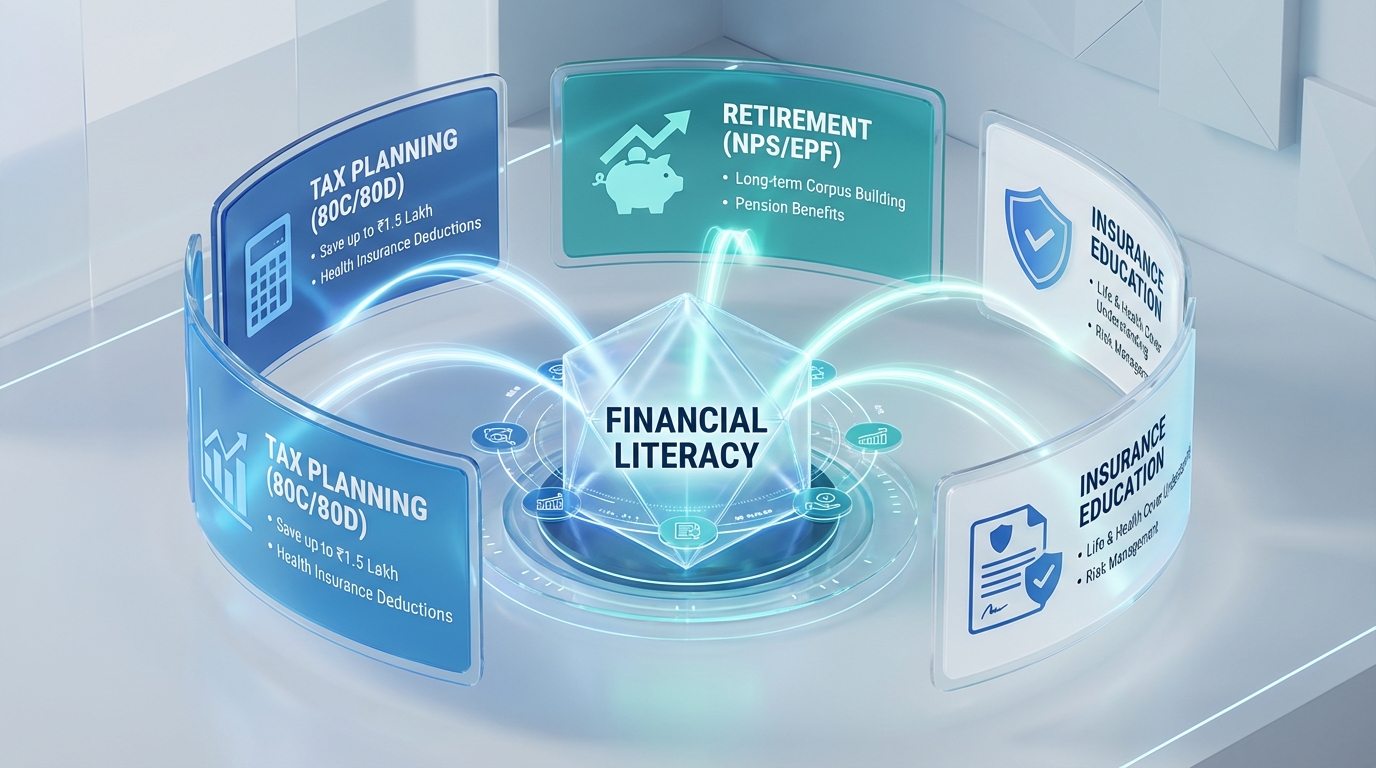
The program should be segmented into specific product and behavior tracks to ensure relevance. Tax planning educational videos 80C investment personalized videos focus on regime comparisons and document checklists, while retirement planning videos should demystify the long-term benefits of NPS NPS enrollment deadline videos and EPF. Furthermore, insurance education automation can be used to trigger personalized explainers for health and term insurance renewals, ensuring that employees do not lose coverage due to administrative oversight.
For the conversion phase, mutual fund investment guides and financial goal setting videos should be deployed via internal channels like WhatsApp, SMS, and Employee Self-Service (ESS) portals. These videos should be short (30–60 seconds for awareness and 90–120 seconds for deep-dives) and include interactive elements like SIP calculators. By using financial stress management content as a top-of-funnel hook, enterprises can engage employees who might otherwise ignore traditional investment marketing.
Sources:
Investment planning personalization and salary-based financial advice
The core of a high-performing campaign lies in investment planning personalization. In 2026, generic advice is often ignored; employees expect content that reflects their specific salary band, age, and risk profile. For instance, an entry-level professional earning ₹8 LPA requires different guidance than a senior executive in the ₹50 LPA+ bracket. Salary-based financial advice should be delivered through segmented video scripts that explain how SIP step-ups can be aligned with annual increments.
Personalization logic should also account for the employee's tenure and life stage. Early-career professionals should receive nudges regarding ELSS and the power of starting early, while mid-career employees might benefit from videos explaining NPS Tier I upsizing or child education planning. For those nearing retirement, content should shift toward annuity awareness and succession planning. This level of granularity ensures that the corporate employee financial education provided is actionable and highly relevant to the individual's current needs.
Compliance is paramount when delivering personalized content. All videos must be framed as educational and illustrative, rather than individualized financial advice. Clear risk disclaimers must be visible, and the content should focus on eligibility, tax benefits, and historical scenarios. Platforms like TrueFan AI enable enterprises to bridge the gap between generic financial advice and hyper-personalized employee engagement, ensuring that every video feels bespoke while maintaining strict adherence to SEBI and IRDAI guidelines.
Retirement planning videos and insurance education automation at scale
Retirement planning in India is often perceived as complex due to the variety of instruments available, such as EPF, VPF, NPS, and private superannuation schemes. Retirement planning videos must simplify these options by using age-based glide-path education. For example, a micro-script could highlight: “At age 28, a 1% increase in your PF contribution can compound to an additional ₹15 lakhs by retirement.” Visualizing these numbers through dynamic video overlays significantly increases the likelihood of employees opting for higher contributions.
Insurance education automation plays a vital role in protecting the workforce from financial shocks. Automated explainers can be triggered by specific life events—such as marriage or the birth of a child—or by upcoming renewal dates. These videos should walk employees through the nuances of term insurance, health top-ups, and riders like OPD or day-care coverage. By automating the delivery of document checklists and claims walkthroughs, enterprises can ensure that employees are well-prepared for emergencies.
The integration of these videos into the employee benefit communication strategy ensures a seamless user experience. When an employee receives a personalized video explaining their group term life cover and the benefits of a voluntary top-up, the friction of decision-making is reduced. This is particularly effective when the video includes a direct CTA to the ESS portal, allowing the employee to “Opt-in” or “Increase Cover” with a single click, thereby driving the success of payroll deduction campaigns.
Tax planning educational videos and mutual fund investment guides
As the POI submission deadline nears, tax planning educational videos become the most consumed content within an enterprise. See the ultimate FY-end marketing guide. These videos should provide a clear comparison between the Old and New Tax Regimes, helping employees identify which path minimizes their tax liability based on their specific deductions. Detailed segments on Section 80C (ELSS, PPF, EPF), Section 80D (Health Insurance), and Section 80CCD(1B) (NPS) are essential for comprehensive coverage.
In tandem with tax planning, mutual fund investment guides should focus on the dual benefits of wealth creation and tax saving. ELSS-focused content should explain the three-year lock-in period and the potential for higher returns compared to traditional instruments. For broader wealth management, videos should introduce the concept of SIPs in index or large-cap funds, emphasizing the importance of consistency over market timing. Including SIP calculators within the video interface allows employees to visualize their future corpus in real-time.
To maximize impact, these campaigns must be timed perfectly with the HR/Payroll calendar. The first wave of videos should launch during the IT declaration phase in April, followed by a mid-year review in October, and a final push during the POI window in January/February. Referencing greytHR’s guides on IT declaration processes ensures that the content is technically accurate and aligned with the latest government mandates for the 2025–26 and 2026–27 assessment years.
Sources:
Financial goal setting videos and financial stress management content
Behavioral science is a critical component of financial wellness video campaigns 2026. Financial goal setting videos should encourage employees to define SMART goals: short-term (emergency funds), mid-term (home down payments), and long-term (retirement). By using visual goal dashboards and progress milestones, these videos act as commitment devices that nudge employees toward better financial habits. Quarterly nudges can remind employees to “top up” their emergency funds or celebrate reaching a savings milestone.
Equally important is financial stress management content. Financial anxiety is a leading cause of decreased productivity and absenteeism in the Indian workplace. Content should focus on practical budgeting frameworks, such as the 50/30/20 rule adapted for Indian urban living costs. Explaining concepts like the “debt snowball” or “debt avalanche” methods can provide a lifeline to employees struggling with high-interest credit card debt or personal loans.
Furthermore, education on earned wage access and advance payout policies can prevent employees from falling into debt traps. By positioning these tools as part of a broader wellness strategy, employers can foster a culture of transparency and support. TrueFan AI's 175+ language support and Personalised Celebrity Videos allow BFSI marketers to communicate complex tax and insurance concepts in a way that resonates with diverse workforces, making even the most stressful financial topics feel approachable and manageable.
Employee benefit communication and payroll deduction campaigns
Effective employee benefit communication requires translating complex policy documents into simple, visual narratives. Videos should explain group term life, health policy terms, and parental covers using relatable scenarios. For instance, a video could demonstrate how a “Room Rent Limit” in a health policy affects out-of-pocket expenses during hospitalization. This clarity drives trust and encourages employees to utilize the benefits provided by their organization.
The ultimate goal of these communications is often to drive payroll deduction campaigns. These campaigns are designed to make saving and investing as frictionless as possible. By mapping CTAs directly to the HRIS or ESS portal, employees can “Increase NPS contribution by 10%” or “Start an ELSS SIP” without leaving the video environment. This “one-click” investment model, backed by explicit consent and a secure audit trail, significantly increases participation rates compared to traditional email-based reminders.
For corporate tie-up marketing, co-branded content between the BFSI provider and the employer is essential. These videos should adhere to strict brand safety and data privacy protocols. Activation can be further enhanced through on-site kiosks with QR-to-video journeys or manager-led huddles where personalized videos are shared. Solutions like TrueFan AI demonstrate ROI through significantly higher watch-through rates and direct conversion into payroll deduction enrollments, proving the value of hyper-personalization in the enterprise sector.
Execution with TrueFan AI Enterprise: Delivering at scale
Executing financial wellness video campaigns 2026 for a workforce of thousands requires a robust technical infrastructure. TrueFan AI Enterprise provides the capability to generate hyper-personalized videos at scale via APIs. By injecting data points such as name, city, salary band, and language preference, the platform can render real-time, triggered journeys that reach employees on their preferred channels—whether it is WhatsApp, email, or the company intranet.
The platform’s multilingual localization is a game-changer for pan-India campaigns. With support for over 175 languages, including voice retention and lip-syncing technology, a single campaign can be seamlessly adapted for employees in Mumbai, Chennai, Kolkata, and beyond. This ensures that the message is not just heard but understood in the cultural context of the viewer. Additionally, virtual reshoot capabilities allow BFSI partners to update policy details or interest rates without the need for expensive and time-consuming talent re-shoots.
Security and compliance are built into the core of the enterprise offering. With ISO 27001 and SOC 2 certifications, the platform ensures that employee data is handled with the highest level of encryption and access control. Detailed analytics dashboards provide insights into view-through rates, CTRs, and enrollment starts, allowing marketers to optimize their campaigns in real-time. Whether it is a high-volume festive greeting or a critical tax-saving nudge, the ability to deliver personalized content at scale is what defines the next generation of corporate financial wellness.
Data, integrations, and the technical blueprint for 2026
To launch a successful campaign, a clear technical blueprint is required. The primary data sources include the HRIS (for employee demographics and tenure), Payroll (for salary bands and pay cycles), and Benefits Administration (for current policy enrollments). Identity resolution is managed using the Employee ID as a primary key, ensuring that the right video reaches the right person while maintaining data integrity.
The template architecture should be modular, with swappable scenes for different tax regimes, insurance products, and language variants. CTA scenes must be mapped to employer-specific deep links, ensuring that the transition from “watching” to “acting” is seamless. Versioning and change control protocols are essential to handle mid-year policy updates or changes in government regulations, ensuring that the content remains compliant at all times.
Distribution in 2026 will rely on a mix of owned and professional channels. While ESS portals and WhatsApp remain the primary drivers, LinkedIn video and office signage (via QR codes) provide additional touchpoints. Measurement must go beyond surface-level metrics like impressions; it must track funnel metrics such as prefilled form completions, SIP starts, and payroll deduction opt-ins. By analyzing the lift in engagement from early-name callouts and personalized data points, enterprises can continuously refine their strategy for maximum ROI.
Compliance and Launch Checklist for BFSI Marketers
Before going live, every campaign must pass a rigorous compliance and quality assurance check. The following checklist ensures that the program meets both legal and organizational standards:
- Educational Framing: Verify that all content is labeled as “educational” and does not constitute individualized financial advice.
- Risk Disclaimers: Ensure that SEBI/IRDAI-mandated disclaimers are prominently displayed and legible across all devices.
- Data Privacy: Confirm that data processing agreements are in place and that employee consent is captured and stored securely.
- Multilingual Accuracy: Conduct QA on all 175+ language variants to ensure that the translation and lip-syncing are natural and accurate.
- Integration Testing: Test deep links to the ESS/HRIS portal across different salary bands and regimes to ensure a frictionless user journey.
- Accessibility: Ensure that videos include subtitles and are accessible to employees with different needs.
Once these steps are completed, a soft launch to a pilot cohort is recommended. This allows for a two-week optimization sprint where engagement data can be used to tweak script variants or CTA placement before scaling to the entire organization during the peak IT declaration or POI windows.
Conclusion: The future of corporate financial wellness
The transition to financial wellness video campaigns 2026 represents a fundamental shift in how BFSI institutions and employers interact with the Indian workforce. By moving away from static emails and generic brochures toward hyper-personalized, video-first education, enterprises can significantly reduce financial stress and improve the financial health of their employees. This playbook provides the framework to execute these campaigns with precision, scale, and compliance.
As we look toward the 2026–27 fiscal year, the organizations that prioritize clear, accessible, and personalized financial guidance will be the ones that win the war for talent and drive the highest levels of employee engagement. The tools are available, the data is ready, and the window of opportunity is open. It is time to transform the way India saves, invests, and secures its future.
Recommended Internal Links
- Financial Year-End Marketing 2026: High-ROI Campaign Ideas
- Financial Year-End Marketing 2026: Proven Campaign Tactics
- 80C investment personalized videos for March 31 tax rush
- NPS Enrollment Deadline Videos: Drive Urgency in 2026
- January 2026 insurance renewal automation strategies
- WhatsApp Catalog Video Marketing: Automation Strategies
Frequently Asked Questions
How is “salary-based financial advice” framed to stay compliant?
All content is framed as education-only. The videos use salary bands to show eligibility and illustrative scenarios (for example, “For those in the 30% bracket, NPS can save up to ₹X”). No individualized recommendations are made, and risk disclaimers are always present.
What data is minimally required to start a personalized campaign?
At a minimum, Employee ID, Name, Language preference, and Department. For deeper personalization, salary bands, age, and current benefit enrollment data can be integrated via secure APIs.
How fast can content be updated after a policy change?
With virtual reshoots and AI-driven editing, script lines can be swapped and videos re-rendered within the same day. This eliminates the need for talent re-shoots and ensures your campaign remains current with the latest FY regulations.
How does TrueFan AI ensure data security during these campaigns?
TrueFan AI employs enterprise-grade security, including ISO 27001 and SOC 2 compliance. All data is encrypted at rest and in transit, and role-based access controls ensure that only authorized personnel can manage employee information.
Can these videos be delivered via WhatsApp Business API?
Yes, the platform is designed for omnichannel delivery. We can integrate with your existing WhatsApp Business API or provide a managed solution to deliver personalized video links directly to employees' mobile devices.



