AI video personalization ROI India enterprise: FY26–27 business case, benchmarks, and ROI calculator for CMOs, COOs, and CFOs
Estimated reading time: ~12 minutes
Key Takeaways
- Indian enterprises can unlock 10x+ ROI with AI-personalized video by combining vernacular scale, WhatsApp distribution, and real-time triggers.
- A rigorous ROI calculator—tracking incremental conversions, revenue, and TCO—enables defensible FY26–27 budget allocations.
- Costs fall dramatically versus traditional production via virtual reshoots, algorithmic localization, and usage-based pricing.
- Enterprise-grade adoption requires CRM/CDP integration, sub-30s rendering latency, and ISO/SOC security with India data residency.
- Evaluation criteria should prioritize scale, vernacular support, consent-first celebrity models, and certified security.
AI video personalization ROI India enterprise is the definitive business case guide for Indian conglomerates and large enterprises entering FY26–27 budget cycles. This comprehensive analysis provides verified enterprise video personalization benchmark data, a personalized video marketing ROI calculator, cost comparisons versus traditional production, and CRM/CDP integration roadmaps tailored specifically for the Indian market.
As we approach the FY27 fiscal year, the Indian martech landscape is undergoing a seismic shift toward hyper-individualization at scale. Indian enterprises are no longer satisfied with static segmentation; they require dynamic, real-time engagement that resonates across diverse linguistic and cultural demographics. Platforms like TrueFan AI enable these organizations to bridge the gap between mass reach and personal connection, leveraging agentic AI to deliver millions of unique video messages with sub-30-second rendering latency.
For the modern CMO, COO, and CFO, evaluating an AI video platform business case India requires a rigorous focus on quantifiable outcomes. This guide addresses the strategic necessity of enterprise AI video adoption India 2026, focusing on vernacular scale, WhatsApp-first distribution, and consent-first celebrity-led creative. By the end of this document, leadership teams will have the necessary framework to justify FY27 martech budget AI video allocations based on defensible ROI models and proven industrial-scale performance.
1. The Strategic Business Case for AI Video Platform Business Case India
The fundamental definition of AI video personalization for Indian enterprises involves the automated generation of one-to-one video content where a celebrity, brand ambassador, or executive addresses each recipient by name and specific context. This context includes geographic location, last purchase behavior, loyalty tenure, or specific life events, localized across 10+ Indian languages and dialects Hindi AI Video Marketing.
In the Indian context, ROI is not merely a measure of efficiency but a driver of incremental profit. The formula for ROI in this domain is defined as: ROI = (Incremental Profit from Personalized Video – Total Cost of Ownership) / Total Cost of Ownership. Incremental profit is derived from the delta between personalized campaign revenue and baseline performance, adjusted for variable costs.
Indian business value levers for FY26–27 are concentrated in four primary areas:
- Hyper-Local Acquisition: Utilizing language-fit offers and retargeting videos that reference specific SKUs or travel destinations to drive top-of-funnel conversion. Voice Commerce India 2026
- Frictionless Onboarding: Implementing KYC nudges and app feature tours with named callouts to reduce drop-off rates in complex financial or service-oriented journeys.
- Retention and Renewals: Using usage statistics and personal milestones in renewal videos to increase Life Time Value (LTV) and reduce churn.
- Collections and Compliance: Softening debt collection reminders through trusted faces, which has shown to improve repayment intent and maintain brand affinity even during difficult touchpoints.
According to 2026 industry projections, 72% of Indian Tier-1 enterprises plan to automate at least 40% of their video production by FY27. This shift is driven by the need to manage the "content explosion" required for effective 1:1 marketing without a linear increase in headcount or agency fees. A scalable personalized video SaaS ROI model allows for a decrease in Cost Per Video (CPV) as volume increases, creating a powerful economy of scale that traditional production cannot match.
Sources:
2. Enterprise Video Personalization Benchmark Data and Performance Proofs
To build a defensible AI video platform business case India, leadership must look at verified performance data from the previous fiscal cycles. The Indian market presents unique challenges—specifically high volume and low-bandwidth distribution—that require specialized AI architectures.
Recent enterprise-scale campaigns in India have established new benchmarks for what is possible:
- Zomato (Scale Benchmark): During a Mother’s Day campaign, Zomato successfully generated and delivered over 354,000 personalized videos in a single 24-hour window. This demonstrated the platform's ability to handle massive concurrency and real-time rendering demands.
- Hero MotoCorp (Engagement Benchmark): For festive greetings, Hero MotoCorp deployed 2.4 million personalized videos at a national scale. The campaign focused on driving offline impact, specifically increasing footfalls at service camps through personalized invitations.
- Goibibo (Channel Benchmark): Internal data from 2025–2026 campaigns indicates that Goibibo achieved a 17% higher WhatsApp read rate when using personalized video mentions compared to standard text-based reminders.
These benchmarks highlight the importance of AI video marketing conversion rates India. When analyzing channel performance, enterprises must measure more than just "views." On WhatsApp, the critical metrics are message read rates, video play rates, and CTR to the final offer. In-app and web-based delivery should focus on watch-through rates and assisted conversions within the user journey.
TrueFan AI's 175+ language support Vernacular Video Automation India: Scale Multilingual Ads and Personalised Celebrity Videos have become a cornerstone for these results, as celebrity-led content provides an immediate trust-anchor. In the Indian market, the familiarity of a celebrity face can lead to a 25-40% uplift in CTR compared to generic AI avatars, particularly in trust-critical sectors like BFSI and EdTech.
Sources:
3. The Definitive Personalized Video Marketing ROI Calculator for FY27
The transition from pilot to permanent martech fixture requires a rigorous ROI modeling framework. For FY27, Indian CFOs are demanding "payback months" metrics and Total Cost of Ownership (TCO) comparisons. The following framework serves as the basis for a personalized video marketing ROI calculator. GenAI ROI Calculator for Marketing
Core ROI Variables
- Audience Size (N): The total number of eligible recipients in the segment.
- Baseline Conversion Rate (CVR_b): The current conversion rate without video personalization.
- Personalization Uplift (ΔCVR): The expected percentage increase in conversion (typically 15% to 50% based on industry benchmarks).
- Average Order Value (AOV) or LTV: The monetary value of a successful conversion.
- Total Cost of Ownership (TCO): Includes platform subscription, usage credits, integration costs, and celebrity licensing.
The Formulas
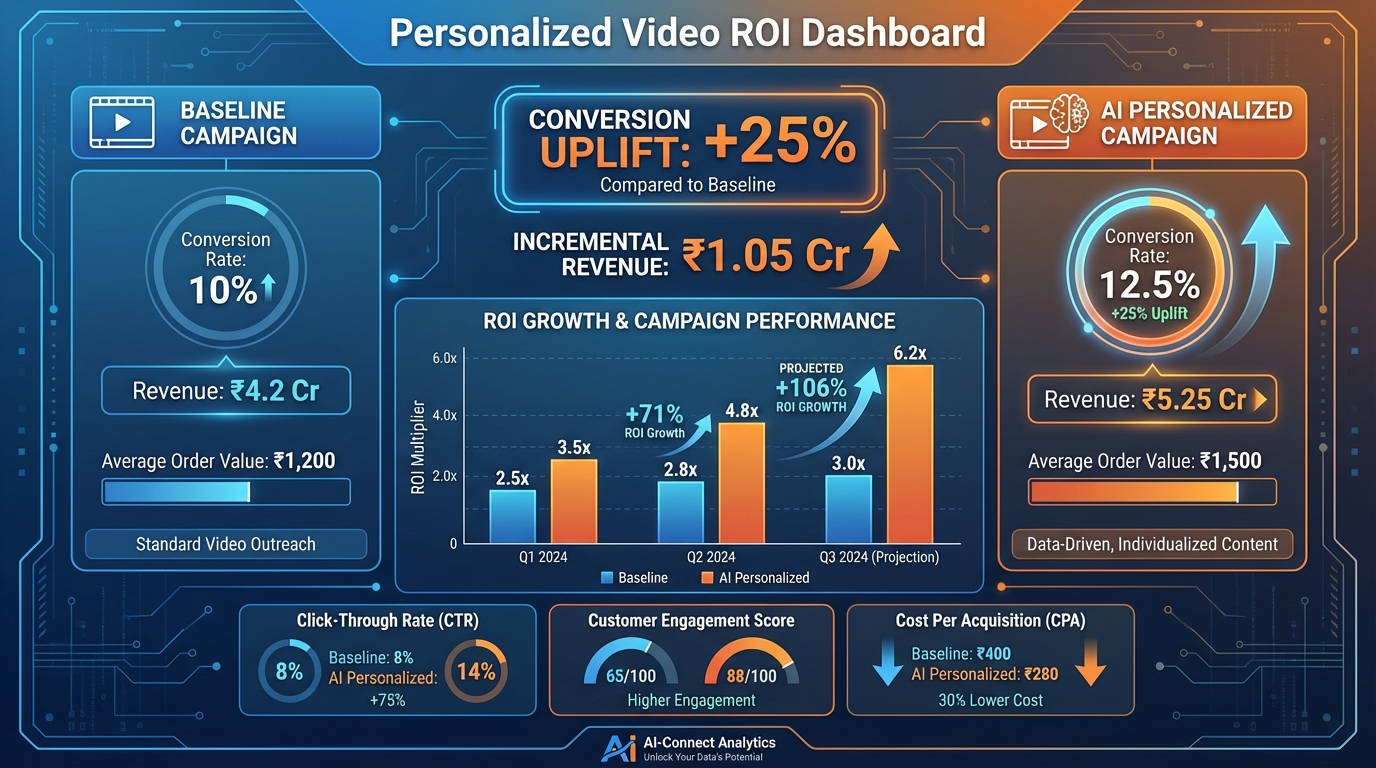
- Incremental Conversions = N × CTR_b × (1 + ΔCTR) × CVR_b × (1 + ΔCVR) – (N × CTR_b × CVR_b)
- Incremental Revenue = Incremental Conversions × AOV
- ROI = (Incremental Revenue – TCO) / TCO
FY27 Scenario Analysis (Illustrative)
| Metric | Mid-Market Campaign | Enterprise Scale | Mega-Conglomerate |
|---|---|---|---|
| Audience Size | 100,000 | 1,000,000 | 5,000,000 |
| Baseline CVR | 2.0% | 1.5% | 1.2% |
| Expected Uplift | 25% | 20% | 18% |
| Incremental Conversions | 500 | 3,000 | 10,800 |
| AOV (INR) | 5,000 | 3,500 | 2,500 |
| Incremental Revenue | ₹25,00,000 | ₹1,05,00,000 | ₹2,70,00,000 |
A CRM integrated video personalization ROI model also accounts for the impact of real-time triggers. For example, a video triggered within 5 minutes of an abandoned cart has a 3x higher conversion rate than a batch-processed video sent 24 hours later. This necessitates a platform with low-latency rendering (under 30 seconds) to ensure the video is ready the moment the user is most likely to convert.
Sources:
4. Personalized Video Cost vs Traditional Production: The Efficiency Delta
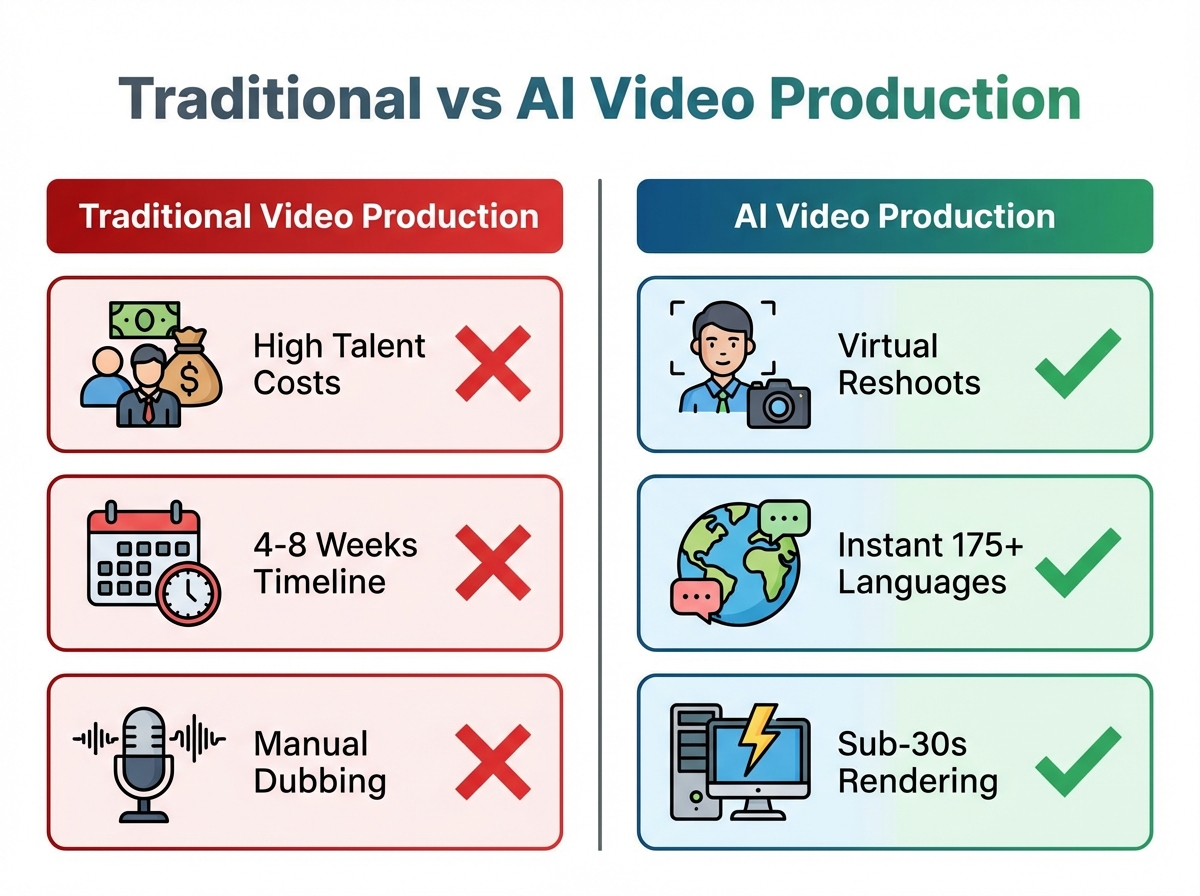
One of the most compelling arguments for AI video personalization ROI India enterprise is the radical reduction in production costs. Traditional video production is linear and unscalable; every new variant requires additional editing, voice-over, or even reshoots.
Traditional Production Constraints
- Talent Costs: High daily rates for celebrities or professional actors.
- Logistics: Studio rentals, crew, and equipment for every shoot.
- Localization: Manual dubbing and subtitling for each of India's 22 official languages.
- Time-to-Market: Typically 4–8 weeks from concept to delivery.
AI-Led Production Advantages
- Virtual Reshoots: The ability to update scripts and offers without re-hiring talent or booking studios.
- Algorithmic Localization: Instant translation and lip-syncing across 175+ languages.
- Usage-Based Pricing: Costs scale with success rather than upfront investment.
- Instant Delivery: From script to millions of videos in hours, not weeks.
Solutions like TrueFan AI demonstrate ROI through the elimination of "media waste." In traditional campaigns, a significant portion of the budget is spent on broad-reach media with low relevance. AI video allows for "message relevance" to match "media reach," ensuring that every rupee spent on distribution (like WhatsApp API costs) is backed by a creative that is 100% relevant to the recipient.
By 2026, the Cost Per Personalized Video (CPV) at the million-scale is projected to drop below ₹0.50 for many Indian enterprises, making it more cost-effective than even static direct mail or high-end SMS campaigns. This efficiency allows CMOs to reallocate budget from production overhead to working media, further amplifying the overall campaign ROI.
Sources:
5. CRM Integrated Video Personalization ROI: Integration and Security
For an AI video platform business case India to be viable at the enterprise level, it must pass the rigorous scrutiny of the CTO and CISO. Integration is the "last mile" of ROI; if the video cannot be delivered seamlessly through existing CRM and CDP pipelines, the value is lost.
Reference Architecture for Indian Enterprises
- Ingest Layer: Integration with Salesforce, Adobe Experience Cloud, Braze, MoEngage, or CleverTap via robust APIs and webhooks.
- Logic Layer: Dynamic mapping of personalization fields (e.g., {{first_name}}, {{city}}, {{last_purchase_date}}) into the AI video template.
- Rendering Layer: A high-availability pipeline capable of handling the "India scale" (millions of requests per hour) with SOC 2 and ISO 27001 compliance.
- Delivery Layer: Automated hand-off to WhatsApp Business Solution Providers (BSPs), ESPs, or in-app notification engines.
Security and Governance Essentials
In the FY26–27 landscape, data residency and PII encryption are non-negotiable. Indian enterprises, particularly in the BFSI sector, require that all customer data remains within Indian borders. Furthermore, "consent-first" celebrity licensing is critical to mitigate legal risks. This ensures that the AI model of a celebrity is used only within the agreed-upon parameters, protecting both the brand and the talent.
Key security features for 2026 include:
- SSO/SAML/SCIM: For secure access management across large marketing teams.
- Role-Based Access Control (RBAC): Ensuring only authorized personnel can trigger high-volume campaigns.
- Audit Trails: Comprehensive logging of every video generated and every data access request.
- Content Moderation: AI-driven filters to prevent the generation of disallowed or brand-unsafe content.
Enterprises should prioritize platforms that offer "Privacy-by-Design," where PII is minimized and encryption is applied both at rest and in transit. This level of governance is what separates a "toy" AI tool from a true enterprise-grade solution.
Sources:
6. Personalized Video Platform Comparison India 2026: Evaluation Criteria
As the market matures, the number of vendors claiming to offer AI video personalization is increasing. For the FY27 budget cycle, procurement teams must use a standardized matrix to evaluate these platforms. The following criteria are essential for Indian enterprise-grade performance.
Evaluation Matrix
| Feature | Requirement for India Enterprise | Red Flag |
|---|---|---|
| Scale & Latency | Millions of videos/day; <30s render | Batch processing only; >1 hour latency |
| Vernacular Support | 10+ Indian languages with lip-sync | English only or poor translation |
| Celebrity Licensing | Consent-first, legally vetted models | Unlicensed or "deepfake" style models |
| CRM Connectors | Native MoEngage/CleverTap/Salesforce | Manual CSV uploads only |
| Security | ISO 27001, SOC 2, SSO/RBAC | No certifications; no audit logs |
| Data Residency | India-based servers available | Global-only data hosting |
TrueFan Enterprise stands out in this landscape due to its proven track record with India's largest consumer brands. While international alternatives exist, they often lack the deep understanding of Indian dialects and the specific technical requirements of the WhatsApp-heavy Indian ecosystem.
When planning the 90-180-365 day roadmap for adoption, enterprises should start with a focused POC in a single lifecycle use case, such as "Renewal Nudges." By day 180, the goal should be to expand to 3+ channels and 5+ languages, integrating AI celebrity variants to test against generic avatars. By the end of the first year, the platform should be fully integrated into the CDP, driving real-time triggers across all major customer touchpoints.
Sources:
7. FAQ and Conclusion: Maximizing AI Video Marketing Conversion Rates India
Conclusion
The business case for AI video personalization ROI India enterprise is no longer theoretical. As we move into FY26–27, the combination of agentic AI, vernacular scale, and deep CRM integration has created a new standard for customer engagement. For CMOs, the choice is clear: continue with the diminishing returns of static, mass-market creative, or embrace the high-ROI potential of hyper-personalized video.
By leveraging the ROI modeling framework, benchmark data, and security protocols outlined in this guide, Indian enterprises can confidently allocate martech budgets toward AI video. The path to a 10x ROI lies in the strategic application of technology to humanize digital interactions at a scale previously thought impossible.
Final Sources & Citations:
- Zomato 354K/day: Mother’s Day Case Study
- Hero 2.4M festive: Bakrid Marketing Campaigns India 2026
- India AI Strategy ROI: Designing Your AI Strategy for Measurable ROI
- Enterprise Security Comparison: AI Video Platform Security Comparison
- Personalized Video Scaling: Scaling to 10,000+ Personalized Videos
- TrueFan Enterprise Dataset (Internal): Goibibo +17% read rates on WhatsApp with personalized video mention.
Recommended Internal Links
- Enterprise AI Video Platform India: Drive Video ROI
- Vernacular Video Automation India: Scale Multilingual Reach
- Vernacular Video Automation India: Scale Multilingual Ads
- Hindi AI Video Marketing: Vernacular Growth Strategies
- Voice Commerce India 2026: Vernacular Video AI Strategies
- GenAI ROI Calculator Marketing: Prove Value Fast in 2025
Frequently Asked Questions
What is the typical uplift in AI video marketing conversion rates in India compared to static images?
Based on 2025–2026 data, Indian enterprises typically see a 20% to 45% increase in CTR and a 15% to 30% increase in final conversion rates when switching from static creative to personalized AI video, especially on WhatsApp.
How does TrueFan AI handle data privacy for Indian BFSI clients?
TrueFan AI employs enterprise-grade security protocols, including PII encryption, ISO 27001 certification, and options for local data residency to comply with Indian financial regulations.
Can we use our own brand ambassadors in the AI video platform?
Yes. The platform allows for the creation of custom AI models based on your existing brand ambassadors, provided there is a consent-first legal agreement in place. This enables virtual reshoots and rapid creative iteration.
What are the primary drivers of ROI in an AI video platform business case in India?
Key drivers include reduced traditional production costs, higher conversion rates via personalization, and scalable vernacular content without additional headcount.
How long does it take to integrate AI video with a CRM like Salesforce or MoEngage?
Standard API integration typically takes 2–4 weeks, including data mapping and security vetting. Once integrated, campaigns can be triggered in real time.