Vernacular Video Automation India: How Enterprise Marketers Win Bharat with Multilingual AI Video
Estimated reading time: ~10 minutes
Key Takeaways
- Vernacular video automation turns a single master shoot into culturally accurate, multilingual variants at enterprise scale.
- AI voice cloning and high-fidelity lip-sync deliver authentic Indian accents and dialects that boost trust and engagement.
- Enterprise-grade architecture integrates with CRMs/CDPs, supports sub-30s renders, and meets ISO/SOC 2 and MeitY compliance.
- Language playbooks for Hindi, Tamil, Bengali, and Hinglish drive performance on YouTube Shorts, ShareChat, and WhatsApp.
- Automation reduces time-to-market and CAC while lifting conversions, VTR, and retention across tier-2/3 Bharat markets.
The rapid evolution of the Indian digital landscape has reached a critical inflection point where generic, English-first communication no longer suffices for national scale. Vernacular video automation India has emerged as the definitive strategic lever for enterprise CMOs and growth heads aiming to penetrate the high-growth “Bharat” markets of tier-2 and tier-3 cities. By leveraging a sophisticated multilingual AI video generator, brands can now transcend traditional production bottlenecks to deliver hyper-localized content that resonates with the cultural and linguistic nuances of diverse regional cohorts.
The shift toward regional language personalization is not merely a trend but a fundamental structural change in how the next billion users consume media. Platforms like TrueFan AI enable enterprises to convert a single master video shoot into thousands of personalized, culturally accurate assets across Hindi, Tamil, Bengali, and Hinglish. This capability ensures that marketing messages are not just translated, but transcreated to maintain emotional resonance and drive measurable uplift in tier-2 city video marketing campaigns. Explore voice commerce and vernacular India 2026 insights
The Bharat Opportunity and Why Vernacular Video Automation Matters
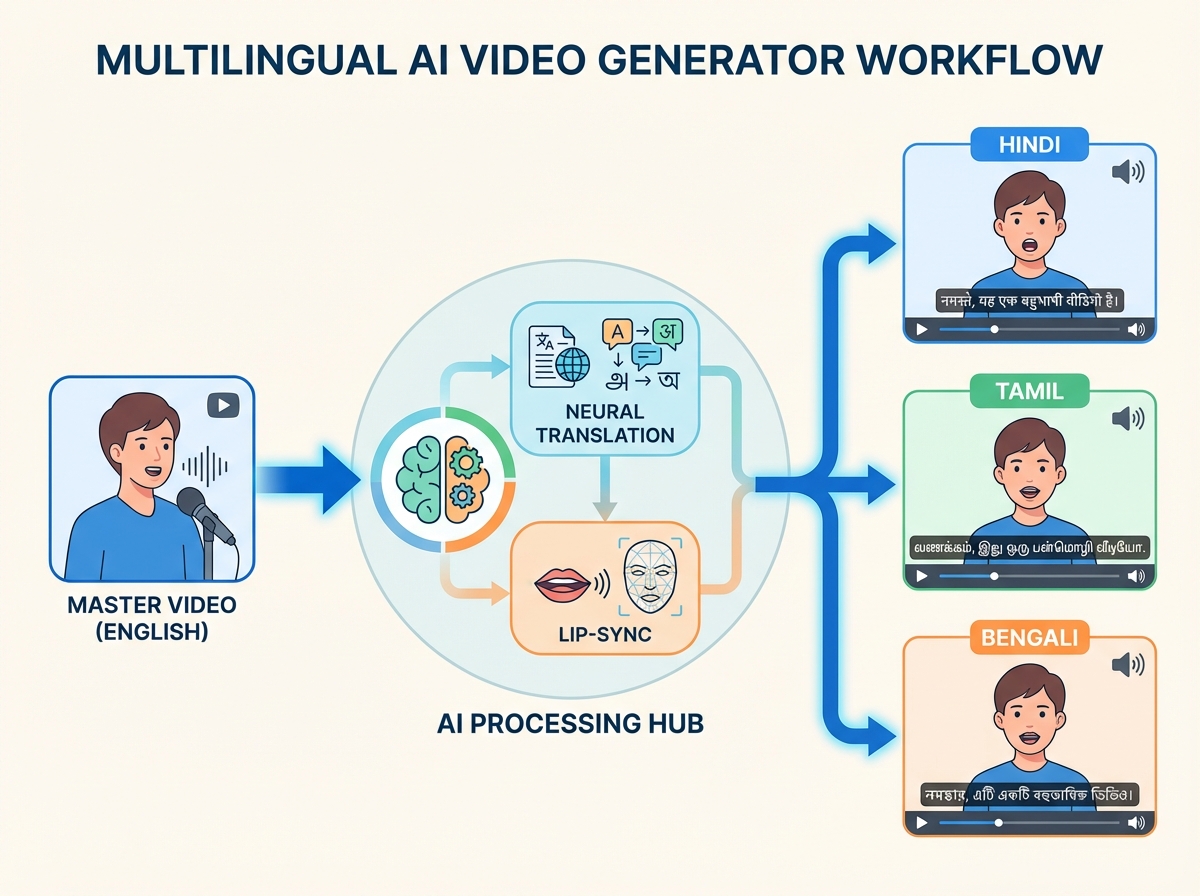
India’s digital advertising expenditure is projected to undergo a massive transformation by 2026, with a primary focus on vernacular dominance and tier-2/3 market expansion. Current market intelligence suggests that brands prioritizing localized formats and cultural alignment are outperforming their English-centric competitors by significant margins in terms of engagement and trust. The 2026 marketing shift necessitates a move away from ad-hoc translations toward a persistent, automated vernacular video system that integrates seamlessly with existing martech stacks.
Channel realities in 2026 reflect a mobile-first, short-form dominance where platforms like YouTube Shorts, ShareChat, Moj, and Dailyhunt (Josh) command the majority of regional attention. Vernacular creators have become the primary growth engine on YouTube India, with regional content seeing stronger per-view returns due to high audience loyalty and lower competitive saturation in specific dialects. For an enterprise to remain relevant, it must deploy a vernacular video automation strategy that can match the velocity and volume of these high-engagement channels.
The strategic implication for regional marketing directors is clear: the ability to scale authentic video content is the new competitive moat. By 2026, the creator economy in India is expected to reach a $2.5 billion valuation, driven largely by regional language influencers who bridge the gap between brands and local consumers. Enterprises that fail to automate their vernacular output risk being sidelined by more agile, AI-powered competitors who can speak to a customer in their mother tongue within seconds of a lead trigger.
Sources:
- India Digital Advertising 2026 trends
- Exchange4media on vernacular growth in India
- StartupMandi: YouTube India 2026 and creator boom
- Royalways: Digital marketing trends 2026
What Vernacular Video Automation India Entails: Definition and Components
Vernacular video automation India is defined as an end-to-end enterprise AI pipeline that transforms a single “master” video shoot into a massive library of localized variants. This process utilizes a multilingual AI video generator to handle complex tasks such as neural translation, voice cloning, and high-fidelity lip-syncing. The goal is to produce videos that appear as if they were originally filmed in the target language, complete with local idioms, accents, and cultural references.
Multilingual AI Video Generator Workflow
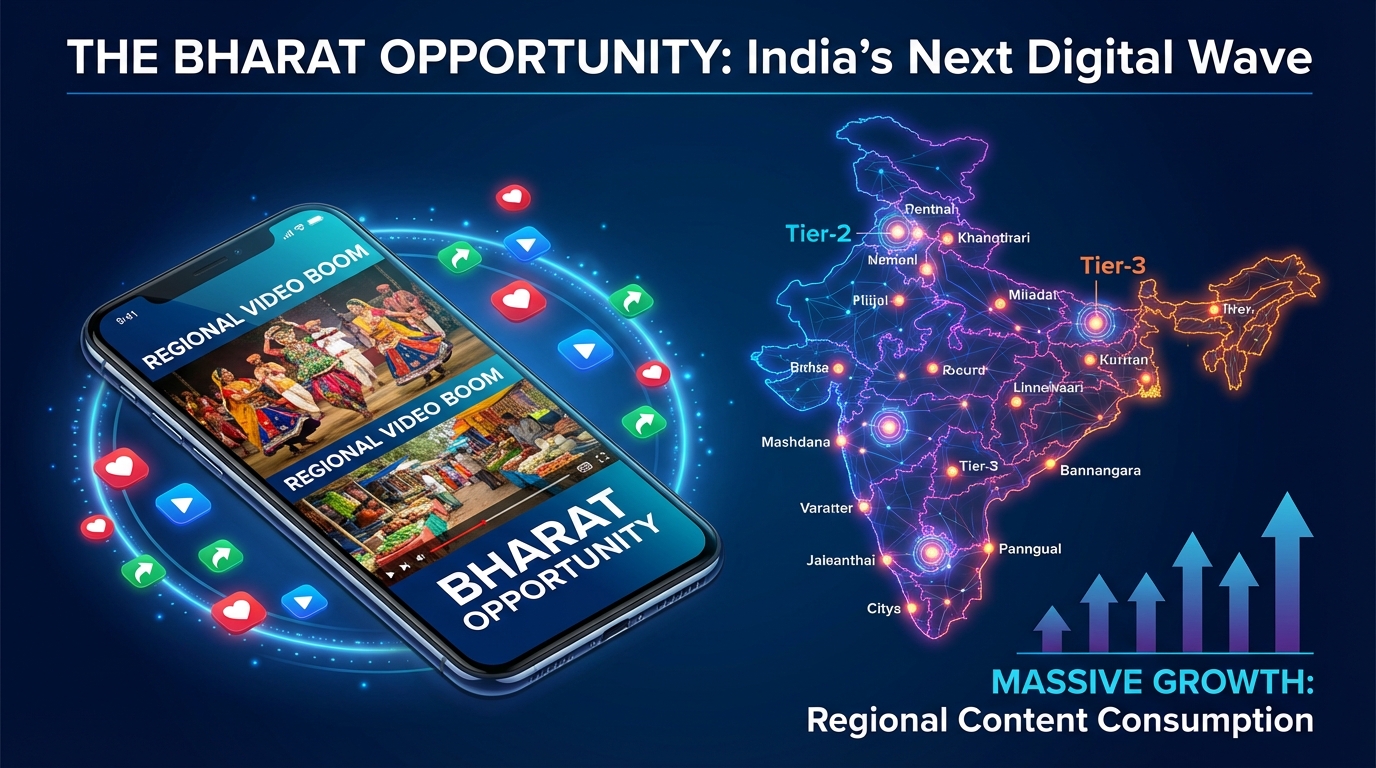
The technical workflow begins with a single master shoot, typically lasting 5 to 15 minutes, featuring a brand ambassador or an Indian AI avatar. This master footage serves as the foundation for all subsequent iterations, ensuring brand consistency while allowing for infinite linguistic flexibility. Once the master is captured, the system processes scripts through intent-preserving Neural Machine Translation (NMT) that adheres to specific regional style guides.
The automation engine then performs face reanimation and lip-syncing to match the timing of the new localized audio perfectly. This ensures that the visual articulation of the spokesperson is indistinguishable from a native speaker of Tamil, Bengali, or Marathi. Finally, the system injects personalization variables—such as the customer's name, city, or a specific offer code—via API or CSV, rendering the final video in sub-30 seconds to meet real-time marketing demands. See the multilingual voice marketing automation guide
AI Voice Cloning Indian Accents for Authenticity
A critical component of this automation is AI voice cloning Indian accents, which moves beyond robotic text-to-speech to capture the soul of regional communication. Neural TTS models now replicate the specific phonetics, prosody, and code-switching patterns unique to different Indian states. For instance, a Hindi voice clone can be tuned to a “Neutral Hindi” for national reach or a “Bhojpuri-inflected” tone for hyper-local relevance in Bihar and Eastern UP.
Authenticity is maintained through rigorous QA checklists that include name dictionaries for correct regional pronunciation and emphasis markers for natural intonation. This prevents the “uncanny valley” effect, where the audio sounds slightly off to a native ear, thereby preserving the brand's credibility. By retaining the original spokesperson's vocal texture while changing the language, enterprises maintain a consistent brand identity across a fragmented linguistic landscape.
Indian AI Avatar and Bengali AI Spokesperson Options
For brands that require high-volume content without the logistical overhead of celebrity shoots, an Indian AI avatar library offers a photorealistic alternative. These avatars are designed with culturally aligned wardrobe choices, gesture sets, and greeting norms that reflect the diversity of the Indian subcontinent. A Bengali AI spokesperson, for example, would be styled and programmed to use empathetic tones and local idioms that resonate specifically with audiences in Kolkata, Asansol, and Siliguri. Learn more about multilingual voice marketing automation
These avatars are particularly effective for educational explainers, PSU/FSI onboarding, and regional festive greetings where a human touch is required at scale. By aligning the spokesperson's appearance and behavior with local cultural expectations, enterprises can significantly improve trust and comprehension. This level of detail is essential for driving conversions in markets where consumers are increasingly wary of generic, “one-size-fits-all” advertising.
Hinglish AI Video Creation for Relatable Storytelling
In urban and semi-urban clusters, the most effective communication often happens in Hinglish—a fluid blend of Hindi and English. Hinglish AI video creation mirrors this natural speech pattern, ensuring that the content feels colloquial and relatable rather than overly formal. This approach is vital for YouTube Shorts and WhatsApp marketing, where the tone must be conversational to capture the viewer's attention within the first three seconds. Read vernacular voice SEO strategies
Effective Hinglish automation follows specific copy rules, such as maintaining a “do-not-translate” glossary for brand names and SKUs while localizing the call-to-action (CTA). Phrases like “Deal live hai” or “Abhi book karo” are used to drive urgency in a way that feels native to the platform. This hybrid linguistic strategy bridges the gap between traditional regionalism and modern aspirational lifestyles, making it a powerhouse for tier-2 city video marketing.
Sources:
Enterprise-Grade Execution: Architecture, Security, and Governance
For large-scale organizations, vernacular video automation India must be supported by a robust, enterprise-grade architecture that prioritizes security and compliance. TrueFan AI's 175+ language support and Personalised Celebrity Videos are built on a cloud-agnostic GPU pipeline capable of sub-30s renders, allowing for real-time personalization at the point of customer interaction. This infrastructure is designed to handle millions of requests, integrating directly with CRMs and CDPs to trigger videos based on first-party data like cart abandonment or policy renewals. Deep-dive: vernacular OTT retention marketing
Security is a non-negotiable pillar of this technology, with certifications such as ISO 27001 and SOC 2 ensuring that data integrity and privacy are maintained. The platform employs a consent-first model for all celebrity and spokesperson likenesses, backed by comprehensive audit logs and moderation filters. These filters prevent the generation of unapproved or harmful content, providing brand safety in an automated environment. PII minimization and tokenization further protect sensitive customer information during the personalization process.
Compliance with the Ministry of Electronics and Information Technology (MeitY) mandates is another critical factor for 2026. Indian regulations now require the clear labeling and watermarking of AI-generated or synthetically altered media to combat misinformation. Enterprise solutions must embed provenance metadata and visible watermarks on all public-facing content. By maintaining a transparent audit trail of licensed likenesses and consent documentation, brands can navigate the regulatory landscape with confidence while scaling their vernacular efforts.
Sources:
Language-Specific Playbooks: Strategies for Regional Dominance
To succeed in Bharat, enterprises must move beyond simple translation and adopt language-specific playbooks that account for regional consumer behavior and channel preferences. Each major linguistic cluster in India requires a tailored approach to scripting, visual presentation, and distribution.
Hindi AI Video Marketing (North and Central India)
Hindi AI video marketing targets the massive urbanizing clusters across Uttar Pradesh, Madhya Pradesh, Rajasthan, and Bihar. Given the diverse device landscape in these regions, videos must be optimized for low-bandwidth environments, often favoring 6–15 second “snackable” cuts. The scripts should lead with a personalized greeting that mentions the user's name and city, followed by a localized price point or offer that appeals to the value-conscious consumer. Hindi AI video marketing playbook
Channels like ShareChat and WhatsApp are dominant here, especially during peak festival seasons like Holi and Diwali. A successful Hindi playbook often incorporates Hinglish variants for younger audiences while maintaining pure Hindi for older demographics. By automating these variations, brands can achieve a level of granular targeting that was previously impossible with traditional production methods.
Tamil Video Automation (South India)
The South Indian market, particularly Tamil Nadu, demands a high degree of precision and cultural respect. Tamil video automation focuses on tier-2 hubs like Coimbatore and Madurai, where consumers prefer direct, value-driven communication. Scripts should utilize respectful address markers (equivalents of sir/madam) and align with the local festival calendar, such as Pongal, to build a deeper emotional connection. Voice commerce in vernacular India 2026
Distribution in this region often extends to local OTT platforms and CTV experimentation in metro-adjacent areas. The emphasis is on high-quality production values and crisp value propositions. Personalization in Tamil videos has been shown to significantly reduce churn in subscription-based models, as it demonstrates a brand's commitment to the local culture and language.
Bengali AI Spokesperson (East India)
In West Bengal and the Northeast, trust is built through empathetic storytelling and culturally aligned representation. Using a Bengali AI spokesperson allows brands to deliver longer, educational explainers that are well-received in markets like Kolkata and Siliguri. These videos often perform best on YouTube and within dedicated WhatsApp communities where peer-to-peer sharing is high. Multilingual voice marketing automation overview
The Bengali playbook should incorporate local idioms and festive tie-ins, particularly around Durga Puja, which is the largest consumer spending period in the region. For sectors like banking and government services (PSU/FSI), a localized AI spokesperson can simplify complex information, making it more accessible to the average citizen. This approach not only drives engagement but also fosters long-term brand loyalty in a traditionally underserved market.
Sources:
Tier-2 City Video Marketing Playbook: Targeting and Measurement
Winning in tier-2 cities requires a sophisticated blend of data-driven targeting and creative automation. Marketers must segment their audience not just by geography, but by dialect clusters, price sensitivity, and device capabilities. By aligning automated video scripts with local retail cycles and harvest calendars, brands can ensure their message is timely and relevant to the consumer's current reality.
Distribution strategy is equally important, utilizing a mix of YouTube Shorts for broad reach and ShareChat or Moj for deep vernacular engagement. WhatsApp remains the primary conversion channel, where personalized videos can be sent as direct messages to drive high-intent actions. See voice commerce tactics for vernacular India. Frequency capping and creative iteration loops—typically every 7 to 14 days—are essential to prevent ad fatigue and maintain high view-through rates (VTR).
Measurement of these campaigns must go beyond surface-level metrics. Enterprise leaders should track CTR, add-to-cart rates, and conversion lift segmented by specific personalization elements. For example, comparing the performance of a video that mentions a user's city versus one that does not can provide invaluable insights for future optimization. This data-driven approach allows for the continuous refinement of the vernacular video automation India strategy, ensuring maximum ROI.
Sources:
ROI and Operating Impact: Modeling the Business Value
The transition to automated vernacular video production fundamentally alters the economics of content creation. Solutions like TrueFan AI demonstrate ROI through a dramatic reduction in time-to-market and cost-per-variant. Traditional video production often requires weeks of planning, shooting, and editing for each language; AI-driven automation reduces this to days or even hours. By moving from “per-shoot” to “per-render” economics, enterprises can scale their video output to millions of personalized assets without a linear increase in budget.
Operating impact is also felt in the velocity of creative testing. With the ability to generate multiple versions of a hook or CTA in seconds, marketing teams can conduct multivariate testing across different regions simultaneously. This leads to a rapid improvement in campaign performance, as the most effective linguistic and visual combinations are identified and scaled in real-time. Internal benchmarks have shown that personalized vernacular videos can lead to a 3x increase in WhatsApp read rates and a significant reduction in customer acquisition costs (CAC).
Furthermore, the use of vernacular video automation India supports long-term customer retention. In the OTT and e-commerce sectors, personalized retention videos—delivered in the user's native tongue—have proven effective in reducing churn. Read the vernacular OTT retention marketing 2026 guide. By providing a more human and localized experience, brands can build a stronger rapport with the “Bharat” consumer, leading to increased lifetime value (LTV) and a more resilient market position in 2026 and beyond.
Conclusion: Mastering the Future of Regional Marketing
The era of English-only digital dominance in India has passed. To win in the “Bharat” of 2026, enterprise leaders must embrace vernacular video automation India as a core component of their growth strategy. By integrating a multilingual AI video generator into their marketing stack, brands can deliver the level of regional language personalization that modern consumers demand. This is not just about translation; it is about building a scalable, authentic, and compliant bridge to the next billion users.
Whether through Hindi AI video marketing, Tamil video automation, or the use of a Bengali AI spokesperson, the path to tier-2 city video marketing success lies in the intelligent application of AI. As the regulatory environment matures and consumer expectations rise, the ability to produce high-quality, localized video at the speed of culture will be the ultimate differentiator. Now is the time for enterprises to move beyond experimentation and build the automated foundations for a truly multilingual future.
Final Strategic Checklist for CMOs:
- Audit your current video production pipeline for linguistic bottlenecks.
- Evaluate vendors based on accent fidelity, security certifications (ISO/SOC 2), and MeitY compliance.
- Pilot a Hinglish or regional language campaign on high-engagement channels like WhatsApp and YouTube Shorts.
- Measure the conversion lift of personalized vs. generic content to build a business case for full-scale automation.
Recommended Internal Links
- Hindi AI video marketing
- Voice commerce in vernacular India 2026
- Multilingual voice marketing automation
- Vernacular voice SEO strategies
- Vernacular OTT retention marketing 2026
Frequently Asked Questions
What is vernacular video automation India?
Vernacular video automation India refers to the use of an enterprise-grade 175 language video platform to automatically generate localized video content for the Indian market. This technology allows brands to take a single video shoot and use AI to translate, lip-sync, and voice-clone the content into multiple Indian languages like Hindi, Tamil, and Bengali, enabling massive scale in regional marketing.
How does a multilingual AI video generator localize for tier-2/3 cities?
A multilingual AI video generator uses advanced neural networks to ensure that regional language personalization goes beyond simple translation. It adapts the spokesperson's lip movements and voice to match local dialects and accents, making the content feel authentic to viewers in tier-2 and tier-3 cities who prioritize cultural relevance.
Can AI voice cloning capture Indian accents accurately?
Yes, modern AI voice cloning Indian accents is highly sophisticated. It can replicate the specific intonations, prosody, and even the code-switching patterns (like Hinglish) found across different Indian states. When combined with an Indian AI avatar, it creates a seamless and trustworthy viewing experience for regional audiences.
What is the best way to do Hinglish AI video creation at scale?
The most effective way to manage Hinglish AI video creation at scale is through an automated pipeline that uses a “do-not-translate” glossary for technical terms and brand names while keeping the conversational flow in a mix of Hindi and English. This ensures the content remains relatable to urban and semi-urban youth across India. Explore vernacular voice SEO strategies
How does TrueFan AI ensure enterprise security and compliance?
TrueFan AI's 175+ language support and Personalised Celebrity Videos are backed by ISO 27001 and SOC 2 certifications. The platform ensures compliance with MeitY guidelines through mandatory AI labeling, watermarking, and a consent-first model for all likenesses used in the vernacular video automation India process.



