Regional New Year Marketing 2026: Enterprise Playbook for Ugadi, Baisakhi, Poila Boishakh with Cultural Authenticity
Estimated reading time: ~9 minutes
Key Takeaways
- Treat Ugadi, Baisakhi, and Poila Boishakh as a single festival cluster to pool production, unify QA, and synchronize media bursts.
- Win with cultural authenticity: precise greetings, state-specific symbols, and temple-neutral festive backdrops.
- Scale with vernacular-first video, sensitivity automation, and always-on subtitles for accessibility.
- Activate regional influencers and align local payment preferences (UPI, COD, BNPL) for frictionless commerce.
- Use TrueFan AI for API-driven personalization, virtual reshoots, and brand-safe scale across states.
Regional New Year Marketing 2026 represents a pivotal shift for national brands seeking to capture the immense purchasing power of India’s diverse states. As the mid-April window approaches, enterprises must master festival cluster marketing—the strategic orchestration of creative, media, and commerce across Ugadi, Baisakhi, and Poila Boishakh within a 48–72 hour window. This approach allows brands to maximize shared demand while minimizing production duplication through intelligent, vernacular-first frameworks.
The 2026 landscape is defined by a move toward hyper-personalization, where generic festive greetings are replaced by cultural authenticity marketing videos. With vernacular-led video consumption projected to dominate 75% of all mobile traffic, the ability to deliver state-specific offer videos is no longer a luxury but a core requirement for multi-state celebration commerce. Platforms like TrueFan AI enable enterprises to bridge the gap between national scale and local relevance, ensuring that every digital touchpoint feels deeply personal and culturally resonant.
Success in this high-stakes environment requires more than just translation; it demands a sophisticated understanding of regional nuances, from local payment preferences to specific harvest festival engagement triggers. By leveraging AI-powered personalization and regional influencer activation, brands can drive significant ROI while maintaining the highest standards of brand safety and cultural sensitivity.
Sources:
Why Treat Ugadi, Baisakhi, and Poila Boishakh as One Festival Cluster
The mid-April period (April 13–14, 2026) creates a unique “festival cluster marketing” opportunity where multiple regional new years coincide. This includes Ugadi in Andhra Pradesh, Telangana, and Karnataka; Baisakhi/Vaisakhi in Punjab and Haryana; and Poila Boishakh in West Bengal. Satellite overlaps like Gudi Padwa, Vishu, and Bohag Bihu further extend the reach, creating a pan-India surge in consumer sentiment and spending.
From an operational perspective, treating these as a cluster allows for pooled production and shared creative templates with regional variables. Instead of running isolated campaigns, enterprises can deploy unified QA workflows and consolidated media bursts. This synchronization improves efficiency and allows for faster iteration cycles via virtual reshoots, where offer details or greetings can be updated across all regions simultaneously without starting from scratch.
The activation cadence must be precise to capture multi-state celebration commerce. A pre-warm phase (T-10 to T-5) should focus on teaser greetings and brand-building. The peak phase (T-2 to T+1) is dedicated to high-conversion state-specific offer videos. Finally, a post-peak phase (T+2 to T+7) utilizes retargeting and store-visit nudges to capture residual demand and build long-term regional trust.
Sources:
Cultural Authenticity by State: Creative Guardrails and Execution
Ugadi (Andhra Pradesh, Telangana, Karnataka)
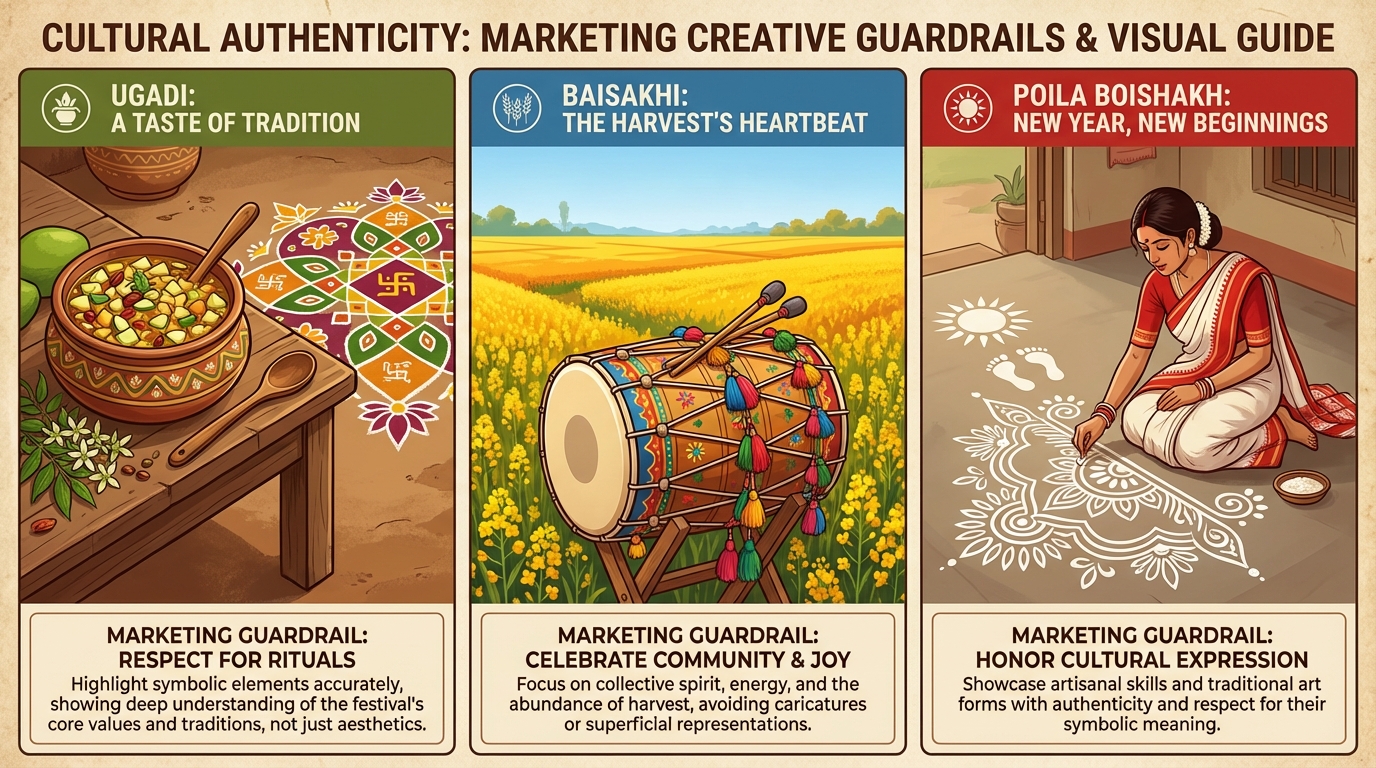
Ugadi marks the beginning of the Hindu lunar calendar and is celebrated with profound ritualistic significance. In AP and Telangana, the “Ugadi Pachadi” (a dish with six tastes) symbolizes the varied experiences of life, while in Karnataka, “Bevu-Bella” serves a similar purpose. For cultural authenticity marketing videos, visual cues must include mango leaf torans, neem sprigs, and intricate muggulu (rangoli) designs.
Greetings must be precise: “Ugadi Subhakankshalu” for Telugu audiences and “Hosa Varshada Shubhashayagalu” for Kannada speakers. Brands should depict family preparation and temple-neutral festive backdrops to ensure broad appeal. Avoid mixing Marathi Gudi Padwa symbols, such as the gudi pole, which is not part of the Ugadi tradition. A sample 6-shot template for this region includes a celebrity greeting in the local tongue, followed by a product offer card and a UPI QR reveal for seamless commerce.
Baisakhi/Vaisakhi (Punjab, Haryana)
Baisakhi is both a harvest festival and a commemoration of the Khalsa’s formation in 1699. Creative assets should emphasize prosperity, the spirit of community langar, and the vibrant energy of the harvest. Visual cues like sarson (mustard) fields, dhol drums, and bhangra/gidda dancers are essential. The standard greeting is “Vaisakhi di lakh-lakh vadhaiyan.”
Enterprises must avoid stereotyping through caricatured accents or props. Instead, focus on the “harvest festival engagement” angle by offering agri-finance EMI holidays or kitchen staple bundles. Yellow-themed merchandise tie-ins resonate well with the seasonal aesthetic. Authenticity here is built by depicting both rural and urban contexts, acknowledging the festival's deep roots in Punjab’s agrarian economy and its modern celebratory forms.
Poila/Pohela Boishakh (West Bengal)
The Bengali New Year, Poila Boishakh, is characterized by “haalkhata” (opening new ledgers), alpana floor art, and community “adda.” Creative content should feature red-and-white attire, traditional sweets (mishti), and subtle Rabindra Sangeet-inspired music beds. The greeting “Shubho Nobo Borsho” is the cornerstone of any Poila Boishakh brand activation.
For retail brands, depicting the haalkhata ritual in shopfronts builds immediate local rapport. Avoid generic North Indian festive imagery or “Bollywood-style” cues that feel alien to the Bengali cultural fabric. Offer angles should focus on electronics exchange programs, jewelry combos, or bank account opening incentives with special festival rates, reflecting the tradition of starting new financial ventures on this day.
Sources:
- TrueFan AI Blog: Regional New Year commerce strategy
- India Digital Advertising: Digital marketing trends for 2026
- Social Beat: Digital marketing trends 2026 in India
Vernacular Festival Campaigns: Language, Tone, and Sensitivity Automation
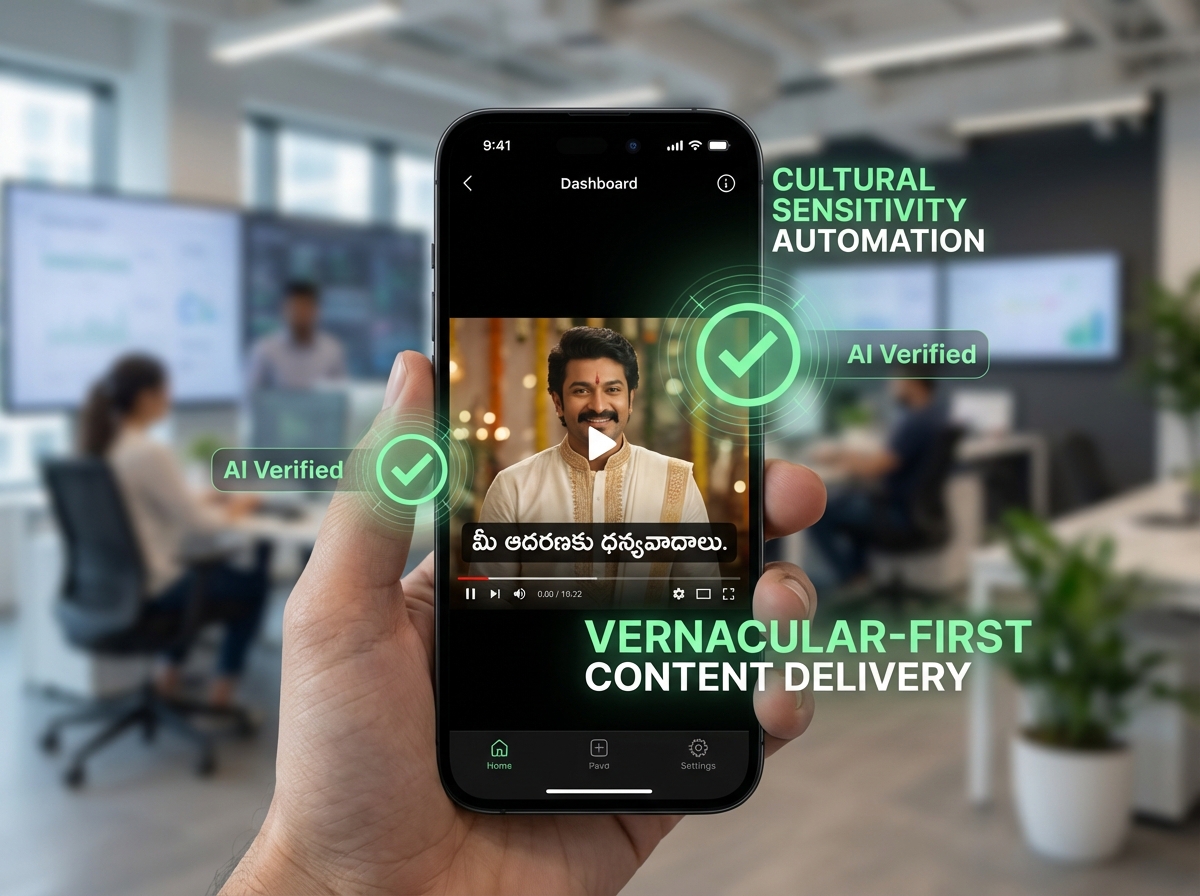
Regional language festival content is the primary driver of engagement in 2026. Scripts, captions, and voiceovers must be delivered in the audience’s primary language—Telugu, Kannada, Punjabi, or Bengali—with Hindi and English serving only as supportive elements. Localization must extend to dialectal nuances and the correct use of honorifics to ensure the brand is perceived as a “local insider” rather than a distant national entity.
To manage this at scale, enterprises are adopting cultural sensitivity automation. This involves pre-publish AI checks and human-in-the-loop QA to flag taboo symbols, attire mismatches, or inaccurate transliterations. For instance, an AI agent can verify that a greeting’s pronunciation is phonetically perfect or that a specific color palette doesn't inadvertently trigger religious sensitivities. This governance framework ensures that vernacular festival campaigns in India remain brand-safe while achieving high resonance.
Accessibility is equally critical. Every video asset should include always-on subtitles in the regional script plus English. On-screen text should be limited to 14 words per frame to ensure readability on mobile devices, which are the primary consumption screens for regional audiences. By integrating these guardrails, brands can automate the production of thousands of personalized videos without risking cultural faux pas.
Sources:
- Social Beat: Digital marketing trends 2026 in India
- India Digital Advertising: Digital marketing trends for 2026
- TrueFan AI Blog: Regional New Year commerce strategy
Regional Influencer Activation and Local Payment Preferences
The Indian influencer marketing industry is estimated to reach INR 3,375 crore by 2026, with nano and micro-creators taking a larger share of regional budgets. These creators offer higher trust and efficiency within specific districts. A successful regional influencer activation strategy involves selecting creators based on their vernacular fluency, festival relevance, and historic coupon ROAS.
Influencers should be provided with a comprehensive briefing pack that includes approved greetings, ASCI-compliant disclosure templates, and specific “dos and don'ts” for each festival. For example, a Punjabi creator might focus on the energy of Baisakhi, while a Bengali creator emphasizes the cultural “adda” of Poila Boishakh. Measuring success through unique codes and store-visit lift allows brands to quantify the impact of these regional trust-building campaigns.
Commerce flows must be adapted to local payment preferences. While UPI dominates digital payments nationally, with a 2026 baseline showing it as the primary choice for over 80% of digital transactions, brands must remain flexible. In certain districts, Cash on Delivery (COD) remains a vital backup, while Buy Now Pay Later (BNPL) options are gaining traction for higher-ticket categories like electronics or jewelry. Integrating UPI “smart intent” flows directly into WhatsApp Business journeys ensures that the transition from a personalized greeting video to a completed purchase is frictionless.
Sources:
- EY Insights: How influencer marketing is impacting brands in India
- ET BrandEquity: Influencer marketing industry to reach INR 3375 crore by 2026
- ICRIER: State of India’s Digital Economy Report 2025
- BCG: UPI—The global benchmark for digital payments
Enterprise Execution with TrueFan AI: Shipping at Scale
Executing a multi-state campaign of this magnitude requires a technology stack that can handle hyper-personalization without creative debt. TrueFan AI's 175+ language support and Personalised Celebrity Videos allow brands to render thousands of unique assets—featuring different names, cities, and offers—via API in minutes. This level of scale is essential for capturing the diverse needs of the Ugadi, Baisakhi, and Poila Boishakh clusters.
One of the most powerful features for 2026 is the ability to perform virtual reshoots. If a specific offer in Andhra Pradesh is outperforming one in Karnataka, brands can swap lines and update creative assets in real-time without needing the celebrity to return to a studio. This agility ensures that the campaign remains optimized throughout the 48-hour peak window. Furthermore, built-in moderation tools ensure that all content adheres to cultural sensitivity automation standards, protecting the brand from potential backlash.
Solutions like TrueFan AI demonstrate ROI through significantly higher view-through rates and conversion lifts compared to generic creative. By delivering a video where a beloved celebrity greets a customer by name in their mother tongue and offers a localized deal, brands move beyond mere advertising into the realm of personalized experience. This approach not only drives immediate sales but also fosters long-term brand loyalty in high-growth regional markets.
Sources:
Measurement, Optimization, and Project Timeline
To ensure the success of a Regional New Year Marketing 2026 campaign, enterprises must track a specific set of KPIs. These include the subtitle-on rate (indicating engagement with vernacular content), UPI intent success, and influencer-assisted ROAS. Creative Multivariate Testing (MVT) should be used to compare different opener greetings or soundtrack localizations. For instance, testing a dhol-heavy track against a folk string melody in Punjab can reveal subtle preference shifts that impact conversion.
A 30-day project timeline is recommended for enterprise-grade execution:
- T-30 to T-21: Validate cultural research with regional leads and secure influencer/celebrity talent.
- T-20 to T-10: Draft scripts in four core languages and configure automation guardrails.
- T-9 to T-5: Conduct pilot renders and internal QA for regional sensitivity.
- T-4 to T-1: Launch pre-warm greetings and deploy retail QR codes.
- T0 to T+2: Execute peak launch with live MVT and virtual reshoot updates.
- T+3 to T+14: Measure store visit uplift and document case studies.
By following this structured approach, brands can navigate the complexities of multi-state celebration commerce with confidence, ensuring that every rupee spent contributes to a cohesive and culturally authentic narrative.
Sources:
Conclusion
The Regional New Year Marketing 2026 window offers a high-velocity opportunity for enterprises to dominate regional markets through cultural authenticity and technological precision. By treating Ugadi, Baisakhi, and Poila Boishakh as a strategic cluster, brands can deploy vernacular-first, celebrity-led personalized videos that resonate deeply with local audiences. Success in this landscape requires a blend of cultural sensitivity, influencer-driven trust, and frictionless commerce flows optimized for local payment preferences.
As the digital economy continues to localize, the ability to ship high-quality, state-specific content at scale will be the ultimate competitive advantage. Book an enterprise demo today to stand up your Ugadi, Baisakhi, and Poila Boishakh cluster campaigns within days using TrueFan AI.
Frequently Asked Questions
What is festival cluster marketing for regional new year campaigns?
Festival cluster marketing is the strategic coordination of creative, QA, media, and commerce across multiple regional festivals that occur within the same timeframe—such as Ugadi, Baisakhi, and Poila Boishakh—so brands can share production resources, unify processes, and drive a synchronized impact across states.
How can brands ensure cultural authenticity in marketing videos?
Use state-specific symbols and rituals, precise local greetings, and appropriate attire and backdrops. Implement cultural sensitivity automation with human-in-the-loop QA to flag taboo symbols, language errors, or mismatched iconography before publishing.
Which languages should be prioritized for these April festivals?
Prioritize Telugu, Kannada, Punjabi, and Bengali for primary scripts and voiceovers. Use Hindi and English as supportive elements and subtitles, while maintaining dialectal nuance and correct honorifics for local credibility.
What payment methods work best for regional commerce?
UPI is the dominant method in 2026. Retain COD as a backup in select districts and offer BNPL for higher-value categories. Embedding UPI QR or smart-intent flows into WhatsApp journeys helps convert interest to purchase seamlessly.
How do I scale regional influencer activation responsibly?
Blend macro-influencers for reach with nano/micro-creators for hyperlocal trust. Provide standardized brief packs, ASCI-compliant disclosures, and track via unique codes and store-visit lift to ensure positive ROAS.