Maha Shivratri marketing campaigns 2026: The CMO’s cultural commerce playbook for India
Estimated reading time: ~12 minutes
Key Takeaways
- Shift from discount-led promos to spiritual commerce personalization that respects rituals and regional nuances.
- Leverage vernacular devotional content and hyper-personalized video to win Tier-2/3 audiences.
- Activate vertical playbooks across FMCG, travel, wellness, and D2C religious with clear KPIs.
- Orchestrate a full-funnel plan from T-30 to T+15 using real-time scarcity and gratitude loops.
- Ensure brand safety, compliance, and DPDP-consented data use with measurable outcomes.
The landscape of Indian retail and service sectors is undergoing a seismic shift toward “spiritual commerce,” a trend that will reach its zenith during the Maha Shivratri marketing campaigns 2026. As the nation prepares for the Great Night of Shiva on Sunday, February 15, 2026, Chief Marketing Officers (CMOs) must transcend traditional advertising to embrace a model of spiritual commerce personalization India that respects ritualistic nuances while leveraging hyper-automation. This is no longer merely about festive discounts; it is about orchestrating a data-driven, culturally resonant journey that captures the devotion of millions across the FMCG, travel, and wellness sectors. Voice commerce in vernacular India 2026
The urgency for this transition is underscored by the massive surge in religious tourism and the digital maturity of Tier-2 and Tier-3 markets. With Varanasi alone drawing a record 7.26 crore tourists in 2025 and the Union Budget 2026 providing unprecedented infrastructure tailwinds for spiritual circuits, the opportunity for brand integration is unparalleled. To succeed, brands must deploy vernacular devotional content and temple tourism offer videos that speak directly to the devotee’s specific intent, language, and location. Vernacular Voice SEO strategies
Sources:
- Economic Times: Maha Shivratri 2026 Date and Panchang Details
- Samarth Gurudhara: The Ultimate Guide to Maha Shivratri
- Economic Times: Varanasi Tourism Records 2025
1. The 2026 Opportunity: Why Spiritual Commerce Personalization India is Pivotal
The concept of spiritual commerce personalization India represents the convergence of deep-rooted cultural traditions with cutting-edge marketing technology. In 2026, personalization is not a luxury but a baseline expectation for the Indian consumer. A generic “Happy Maha Shivratri” banner is no longer sufficient to drive engagement. Instead, marketers must utilize data-driven insights to deliver content that adapts to a devotee’s specific fasting status, temple affinity, and regional customs. This level of granularity ensures that a brand becomes a facilitator of the spiritual experience rather than an intruder. Vernacular Voice SEO strategies
The momentum behind this shift is fueled by significant policy and infrastructure developments. The Budget 2026 has prioritized tourism infrastructure, including seaplane manufacturing and the expansion of Buddhist and Shiva circuits, signaling a long-term government commitment to religious travel. Furthermore, the EY India M&E report highlights a consistent rise in vernacular content consumption, suggesting that the most effective Maha Shivratri marketing campaigns 2026 will be those that communicate in the heartland's native tongues. Platforms like TrueFan AI enable brands to bridge the gap between mass reach and individual devotion through automated video generation, allowing for the creation of thousands of personalized messages that resonate on a deeply human level. Voice commerce in vernacular India 2026
To capitalize on this, brands must align their offers with the specific “pre-spring” planning cadence of the Indian eCommerce calendar. This involves locking in Maha Shivratri slots early and ensuring that logistics partners are prepared for the surge in demand for puja essentials and fasting products. The goal is to create a seamless transition from digital discovery to physical fulfillment, leveraging the rising trust in digital payments and quick-commerce delivery models in Tier-2 and Tier-3 cities. Quick commerce festival marketing 2026
Sources:
- Economic Times: Budget 2026 Tourism Boost
- EY India: Shape the Future of Indian M&E
- Refresh Ideas: India eCommerce Marketing Calendar
2. Audience Mapping: Strategic Shiva Devotee Targeting Archetypes
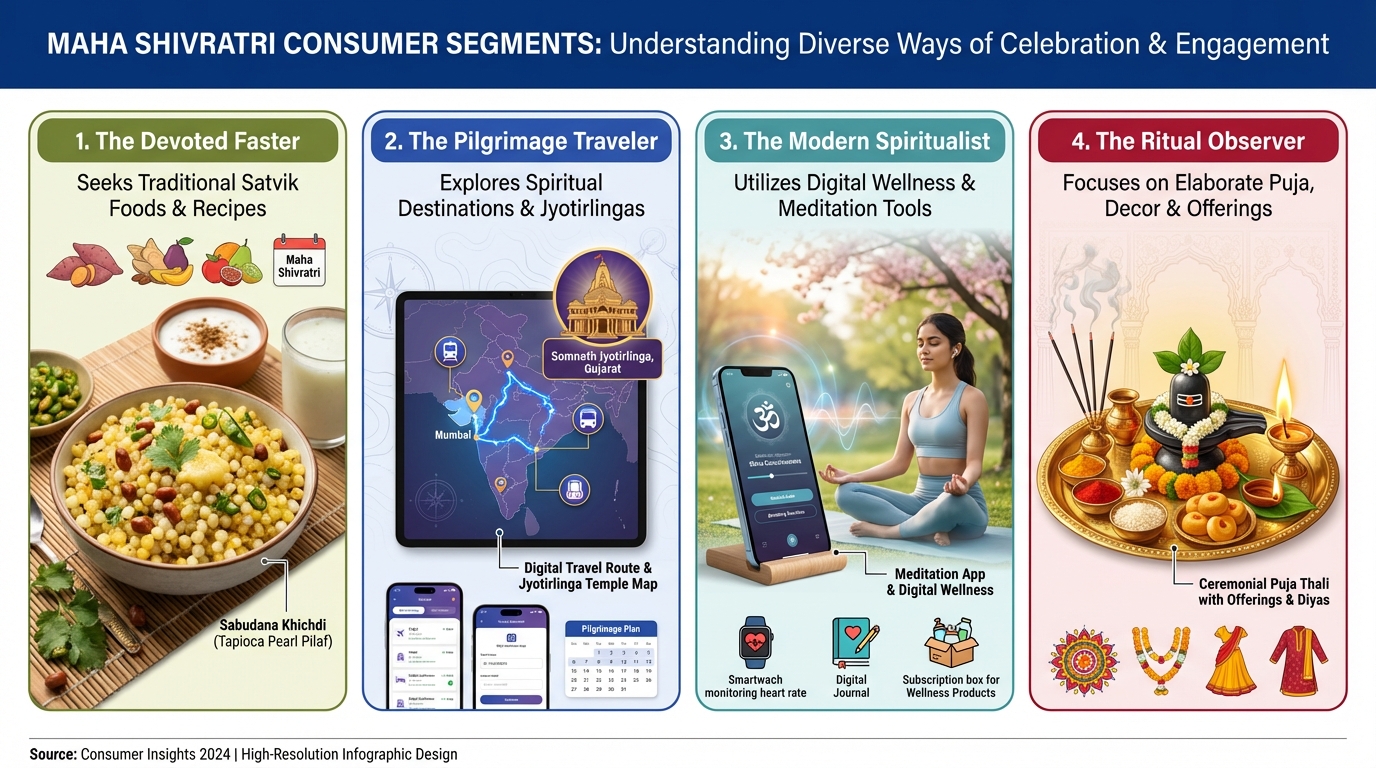
Effective Shiva devotee targeting requires a sophisticated understanding of the diverse motivations that drive engagement during Maha Shivratri. By segmenting the audience into distinct archetypes, brands can tailor their creative assets and offer hooks to maximize relevance and conversion. This segmentation goes beyond basic demographics, utilizing declared and inferred signals such as engagement with devotional music, past pilgrimage searches, and specific dietary preferences during the festival.
The Vrat Followers (Vratis)
This segment is characterized by their adherence to strict fasting rituals. Their primary needs include vrat-friendly foods such as sabudana, kuttu, singhara, and rock salt. To engage this group, brands should focus on fasting product offers Shivratri that emphasize purity, convenience, and nutrition. High-ROI tactics include shoppable reels and WhatsApp-based carts that offer dawn-to-dusk delivery SLAs. Devotional product video marketing can be used here to provide recipe explainers or nutrition tips, personalized with the user’s name and city to build trust. WhatsApp catalog video marketing
The Pilgrimage Seekers
With the massive influx of tourists to Jyotirlingas and other sacred sites, this segment seeks clarity on darshan timings, crowd intelligence, and travel logistics. Pilgrimage package personalization is key here, offering “origin city” price bundles and senior-friendly add-ons. Temple tourism offer videos should be localized by city, providing dynamic itinerary teasers that highlight queue-skip options or midnight darshan slots. This group values efficiency and reliability, making them ideal targets for premium travel services.
The Wellness and Meditation Seekers
For many, Maha Shivratri is a time for intense meditation, yoga, and the “Jagran” (night vigil). These users are prime candidates for meditation app customer acquisition and yoga wellness promotions. Offers should focus on guided japa sessions, pranayama classes, and Shiva stotra playlists. TrueFan AI's 175+ language support and Personalised Celebrity Videos allow wellness brands to deliver guided meditations that feel intimate and locally relevant, significantly increasing the likelihood of trial-to-paid conversion.
The Household Puja Planners
This segment is responsible for organizing the rituals at home, requiring puja kits, incense, diyas, and prasad. The prasad delivery marketing strategy for 2026 should leverage the ONDC network, which has shown immense potential in delivering temple-certified prasad at scale. Brands can offer 2-hour express delivery slots in the lead-up to the midnight puja, ensuring that the sanctity of the ritual is maintained through timely fulfillment. ONDC hyperlocal commerce marketing 2026
Sources:
3. Content Strategy: Vernacular Devotional Content for Tier-2 Religious Market Penetration
To achieve deep tier-2 religious market penetration, brands must adopt a “vernacular-first” content strategy. The diversity of India’s linguistic landscape means that a one-size-fits-all English or Hindi campaign will miss significant pockets of the population. Vernacular devotional content must be ritual-accurate and region-specific, respecting the local panchang and customs of states like Maharashtra, Gujarat, Tamil Nadu, and West Bengal. Vernacular Voice SEO strategies
The content formats should be designed for high engagement and shareability. Short-form “How-to” explainers (30–45 seconds) covering vrat rules or samagri lists are highly effective for educating the younger demographic while maintaining cultural legitimacy. For travel and FMCG brands, 6–15 second price/promo snippets can be used for retargeting, while 30-second itinerary teasers can build aspiration for Jyotirlinga routes. The EY India report confirms that marketers see a much higher CTR and CVR in vernacular content compared to English, particularly in the spiritual and wellness categories. Voice commerce in vernacular India 2026
Furthermore, the integration of spiritual influencer partnerships adds a layer of trust and authenticity. Micro and nano-influencers, such as regional temple vloggers or yoga teachers, can act as cultural bridge-builders. By whitelisting creator-handle dark ads in local languages, brands can achieve a “trust lift” that is difficult to replicate through corporate handles. This approach is particularly effective for devotional product video marketing, where the messenger is often as important as the message itself. Nano-influencer Tier-3 marketing 2026
Sources:
4. Vertical Mini-Playbooks: Executing Maha Shivratri Marketing Campaigns 2026
To provide actionable value, we have developed vertical-specific playbooks that CMOs can immediately integrate into their Maha Shivratri marketing campaigns 2026. Each playbook focuses on a unique set of KPIs and customer journeys.
FMCG: Fasting Product Offers Shivratri
- The Offer: A “Shivratri Vrati Combo” featuring sabudana, rock salt, and fruit kits, with a 20% discount code (OM2026).
- The Creative: 15-second personalized reels in Hindi, Marathi, or Gujarati, featuring the user’s name and a countdown to the midnight puja.
- The Journey: A T-7 quiz to “Build Your Vrat Basket” followed by a T-1 personalized WhatsApp video reminder to complete the purchase.
- Key Metric: Average Basket Value (ABV) and COD success rate in Tier-2 cities. WhatsApp catalog video marketing
Travel: Temple Tourism Offer Videos
- The Offer: “Somnath Midnight Darshan” bundles including origin-city flights, queue-assist, and senior-friendly accommodation.
- The Creative: 30-second itinerary teasers localized by the user’s departure city (e.g., “Fly from Bengaluru to Ahmedabad for Somnath”).
- The Journey: T-10 travel planner tool → T-5 price drop alert video → T-1 “Last 5 Darshan Slots” urgency video via SMS.
- Key Metric: Search-to-booking conversion rate and ancillary attach rate (insurance/guide).
Wellness & Apps: Meditation App Customer Acquisition
- The Offer: A 7-day “Shiva Mantra Pack” with a free trial that unlocks premium content if the user completes 3 sessions during the festival.
- The Creative: 10-second YouTube Shorts featuring deity-free, respectful visuals and a personalized audio greeting.
- The Journey: Pre-festival lead generation ads → T-0 live meditation counter → T+3 “Post-Festival Recovery” upsell video.
- Key Metric: Trial-to-paid conversion rate and Day-30 retention.
D2C Religious: Prasad Delivery Marketing
- The Offer: Temple-certified prasad delivered within 6 hours in major metros or 48 hours nationwide via ONDC.
- The Creative: A “Blessing En Route” tracker video that shows the prasad's journey from the temple to the user’s doorstep.
- The Journey: T-3 signup for delivery slots → T-0 dispatch notification video → T+2 thank-you video with a UGC prompt.
- Key Metric: Slot fill rate and User-Generated Content (UGC) volume. ONDC hyperlocal commerce marketing 2026
5. Orchestration: The Full-Funnel Spiritual Customer Journey Automation
The success of Maha Shivratri marketing campaigns 2026 depends on the seamless orchestration of the customer journey from 30 days before the festival to 15 days after. This spiritual customer journey automation ensures that the brand remains top-of-mind during the entire period of devotion.
T-30 to T-10: Awareness and Education
The focus here is on seeding the brand within the cultural context. Brands should push vernacular devotional content that educates users on vrat rules or temple history. This is the time to capture data—language preferences, fasting intent, and preferred temples. This data becomes the foundation for the hyper-personalization that follows.
T-10 to T-1: Consideration and Intent Harvesting
As the festival approaches, the strategy shifts to conversion. Dynamic product quizzes and itinerary planners help users finalize their plans. Solutions like TrueFan AI demonstrate ROI through significantly higher click-through rates (CTR) compared to static, non-personalized creative. By sending hyper-personalized videos via WhatsApp with regional offers, brands can harvest the intent generated in the awareness phase. WhatsApp catalog video marketing guide
T0: The Day of Maha Shivratri
On February 15, the focus is on real-time scarcity and last-mile fulfillment. Scarcity-driven videos—such as “Last 10 prasad packs left” or “Final darshan slots for tonight”—should be deployed across WhatsApp and social commerce storefronts. This is the peak moment for devotional product video marketing to drive immediate action. Quick commerce festival marketing 2026
T+1 to T+15: Gratitude and Retention
Most brands stop their campaigns on the day of the festival, creating a massive coverage gap. The post-festival period is ideal for yoga wellness promotions and “thank you” videos. Converting trial users into long-term subscribers for meditation apps or encouraging repeat purchases for FMCG brands ensures a higher Lifetime Value (LTV).
6. Tech Stack and Implementation: Scaling with TrueFan AI
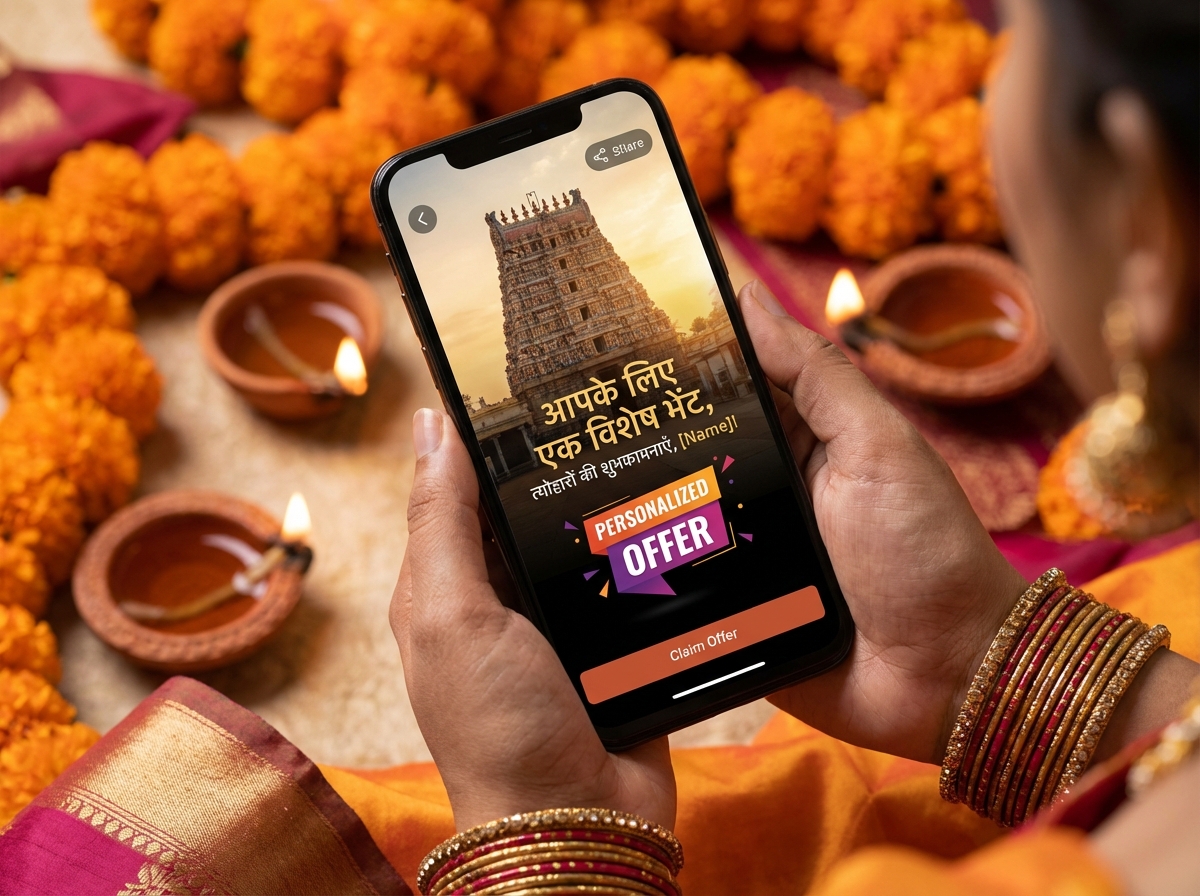
Operationalizing Maha Shivratri marketing campaigns 2026 at an enterprise scale requires a robust martech stack. The core of this stack must be the ability to generate and distribute personalized video content in real-time. TrueFan AI provides the infrastructure to render thousands of per-user videos in under 30 seconds, supporting over 175 languages. This capability is essential for brands looking to penetrate the diverse Indian market without the prohibitive costs of traditional video production.
The integration of this tech stack with existing CRM and CDP systems allows for event-triggered journeys. For example, a cart abandonment of a vrat kit can automatically trigger a personalized video message on WhatsApp, offering a limited-time discount. Similarly, a search for “Ujjain Mahakal darshan” can initiate a temple tourism offer video tailored to the user's origin city. This level of automation ensures that the marketing remains relevant and timely, even during the high-volume peak of the festival.
Furthermore, the use of AI-driven “virtual reshoots” allows brands to A/B test different offer variants or script lines without needing new production shoots. This agility is crucial for optimizing campaigns in real-time based on performance data. Combined with ISO 27001 and SOC 2 compliance, and a focus on DPDP-consented data use, this technology provides an enterprise-grade solution for the modern CMO. Interactive video data capture
Martech Checklist:
- CRM/CDP Integration: Ensure fields for language, fasting intent, and temple preference are active.
- Personalization Engine: Deploy TrueFan AI for automated, multilingual video generation.
- Delivery Channels: Secure WhatsApp Business API and ONDC partner connectors.
- Analytics Dashboard: Set up real-time tracking for CTR, CVR, and CAC by region and language.
7. Measurement, Compliance, and Frequently Asked Questions
To ensure the long-term success of Maha Shivratri marketing campaigns 2026, brands must adhere to strict measurement frameworks and brand-safety guardrails. The “spiritual” nature of the festival requires a high degree of sensitivity. Every creative asset must be vetted for ritual accuracy, and sacred imagery must be used respectfully.
KPI Framework for 2026
- FMCG: Focus on add-to-cart rates, coupon redemption, and COD success.
- Travel: Measure search-to-booking conversion and the attachment rate of travel insurance.
- Wellness/Apps: Track trial-to-paid conversion and Day-30 retention cohorts.
- Brand Sentiment: Monitor social media for positive engagement and UGC volume.
Brand Safety and Compliance
Marketers must ensure that all spiritual influencer partnerships include ASCI-compliant disclosures. Data privacy is paramount; all data collection must be DPDP-compliant, with granular opt-ins for religious preferences. Avoiding pricing practices that could be perceived as exploitative during a religious festival is also critical for maintaining brand trust. Micro-influencer automation in India 2026
Frequently Asked Questions (FAQs)
Explore consolidated answers in the FAQ section at the end of this article.
Sources:
Recommended Internal Links
- Voice commerce in vernacular India 2026
- Vernacular Voice SEO strategies
- WhatsApp catalog video marketing
- WhatsApp catalog video marketing guide
- Quick commerce festival marketing 2026
- ONDC hyperlocal commerce marketing 2026
- Nano-influencer Tier-3 marketing 2026
- Micro-influencer automation in India 2026
- Interactive video data capture
- Quick commerce festival marketing 2026 guide
Frequently Asked Questions
When is Maha Shivratri 2026 in India?
Maha Shivratri 2026 will be celebrated on Sunday, February 15, 2026. This date is confirmed by the Hindu Panchang and major news outlets like the Economic Times.
How can brands ensure ritual accuracy in their campaigns?
Collaborate with cultural consultants or Subject Matter Experts (SMEs) to review scripts and visuals. Validate regional variations (e.g., vrat foods, puja timings) and maintain respectful, deity-appropriate creative guidelines across languages.
What is the best channel for reaching Shiva devotees in Tier-2 cities?
WhatsApp and YouTube Shorts perform best for Tier-2/3 outreach, supporting high-engagement short video and rapid sharing of devotional updates. See the WhatsApp catalog video marketing guide.
How does TrueFan AI handle high-volume video requests during festival peaks?
TrueFan AI uses scalable cloud rendering and APIs to generate thousands of personalized videos in under 30 seconds across 175+ languages, maintaining low latency during peak hours.
Can ONDC be used for prasad delivery during Maha Shivratri?
Yes. ONDC increasingly enables temple-certified prasad and puja essentials delivery nationwide, giving D2C religious brands reliable last-mile capabilities. Learn more about ONDC hyperlocal commerce marketing 2026.