Women’s Day marketing campaigns 2026: Enterprise playbook for personalized employee recognition and gender equality storytelling
Estimated reading time: ~11 minutes
Key Takeaways
- Shift from performative gestures to proof-based DEI with transparent pay equity and promotion data.
- Use personalized recognition videos at scale to celebrate women’s achievements and boost belonging.
- Design March 8 programs with pre-, during-, and post-IWD sequencing to sustain impact.
- Bridge employer and consumer brands with women-centric storytelling and action-oriented campaigns.
- Track ROI via eNPS, participation, pipeline metrics, and brand sentiment to secure future budgets.
International Women’s Day (IWD) has evolved from a symbolic date on the corporate calendar into a critical benchmark for employer branding and organizational integrity. As we approach Women’s Day marketing campaigns 2026, the shift from “pinkwashing” to “proof-based” advocacy is no longer optional; it is a mandate for enterprises seeking to retain top-tier female talent.
In the current landscape, generic social media posts and standardized “thank you” emails are viewed with increasing skepticism by a workforce that demands authenticity. For HR Directors and DEI Leaders, March 8 represents a high-attention window to demonstrate that gender equality is not just a policy but a lived experience within the company culture.
The 2026 theme—“Rights. Justice. Action. For ALL”—underscores a global movement toward measurable systemic change. For large-scale enterprises, this means moving beyond token gestures and leveraging advanced technology to deliver hyper-personalized recognition that resonates on an individual level across diverse, global teams.
From performative to proof — design corporate DEI video initiatives that resonate
The era of performative allyship is ending, replaced by a demand for corporate DEI video initiatives that provide transparent evidence of progress. Modern employees and external stakeholders are quick to identify “tokenism,” where brands use women’s stories for optics without addressing underlying structural disparities.
To design initiatives that truly resonate, enterprises must pivot toward “proof-based” storytelling. This involves showcasing real-world commitments, such as pay equity audit results, the number of mentorship seats created for women of color, and clear promotion pipelines for female leaders.
Authenticity guardrails are essential in this process. Campaigns should avoid the “superwoman” trope—the idea that women must be extraordinary to be worthy of recognition—and instead center on the diverse, everyday contributions of women across all levels of the hierarchy.
Research from Campaign India suggests that the most effective IWD campaigns are those where brands “let women do the talking,” ensuring that narratives are led by the subjects themselves rather than being filtered through a corporate lens. By co-creating content with Employee Resource Groups (ERGs), organizations can ensure that the tone is inclusive and representative of intersectional identities.
Furthermore, People Matters highlights that leading Indian organizations are now transforming DEI from a “nice-to-have” into a systemic change with measurable goals. Your 2026 video initiatives should reflect this by including data-backed progress reports alongside personal narratives, bridging the gap between corporate messaging and employee reality.
Sources:
The centerpiece — women employee recognition videos at scale
The most powerful tool in an HR leader's arsenal for 2026 is the deployment of women employee recognition videos at scale. Unlike a mass-distributed newsletter, a personalized video addresses the employee by name, acknowledges her specific achievements, and validates her unique role within the organization.
International Women’s Day personalization — variables and data design
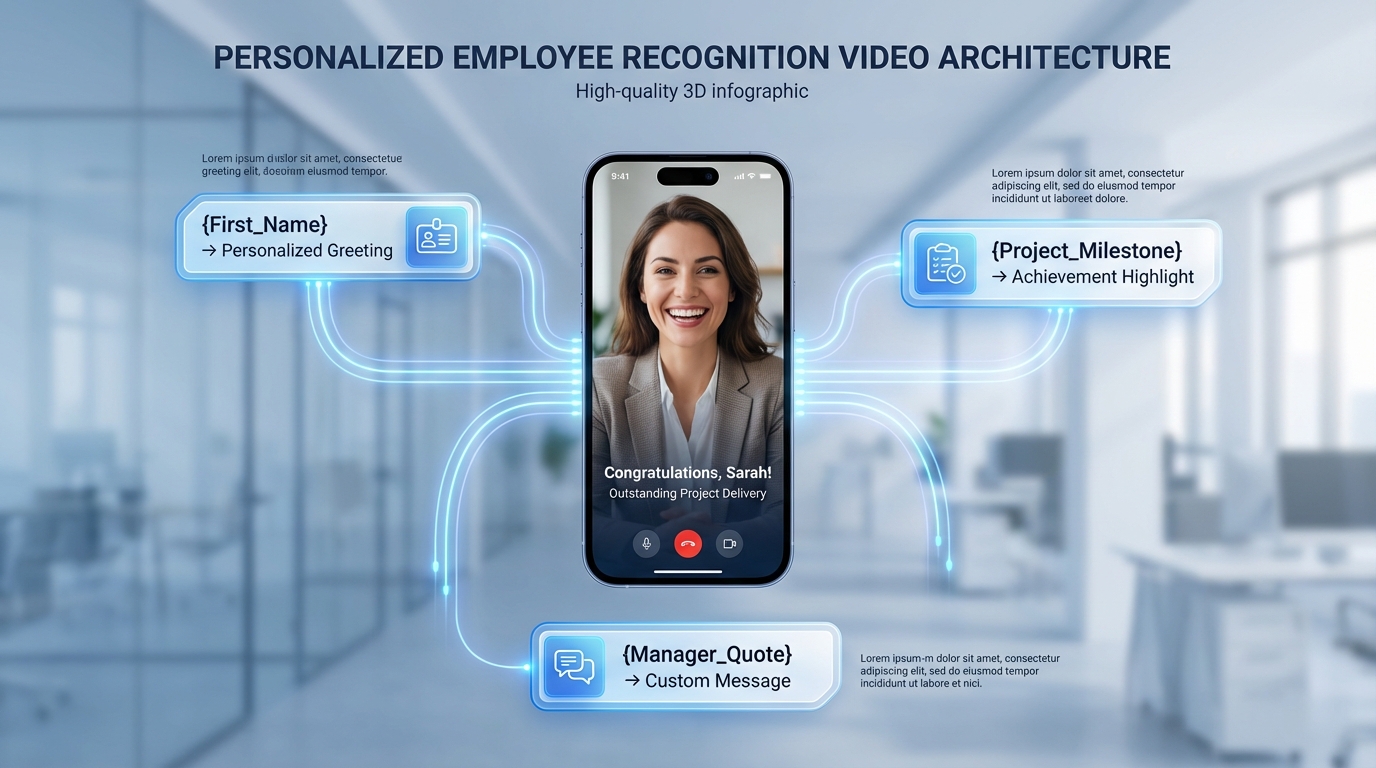
Achieving International Women’s Day personalization at an enterprise level requires a sophisticated data architecture. Personalization is not merely about inserting a name; it involves the dynamic integration of multiple data fields such as tenure, specific project milestones, and even regional language preferences.
Enterprises should leverage their Human Resource Information Systems (HRIS) like Workday or SAP SuccessFactors to pull relevant variables. These might include:
- {first_name}: For immediate personal connection.
- {role_and_function}: To ground the recognition in her professional identity.
- {recent_achievement}: Referencing a specific KPI or project success.
- {manager_quote}: Adding a layer of localized, interpersonal validation.
Data sensitivity is paramount. Organizations must ensure explicit consent is collected before using employee data for video generation. Providing “fallback” lines—such as “Your dedication to our mission”—is crucial for instances where specific data points might be missing or incomplete, ensuring no employee is left out of the celebration.
Women’s achievements showcase videos — formats and scripts
To maintain engagement, varied video formats should be utilized. An “Impact Spotlight” (30–45 seconds) might focus on a singular, quantifiable outcome led by a female employee. A “Journey Reel” (45–60 seconds) could celebrate a long-tenured leader’s progression, highlighting her growth from an entry-level associate to a senior executive.
Scripting must be precise. A sample scaffold might read: “Hi [FirstName], as a [Role] in our [Location] office, your leadership on the [ProjectName] was instrumental in our [OutcomeMetric] success this year. We see your impact, and we value your voice.” This level of detail transforms a generic greeting into a meaningful artifact of professional recognition.
Women leadership celebration videos — spotlighting the path forward
Beyond individual contributors, women leadership celebration videos serve to inspire the next generation of talent. By featuring female executives sharing vulnerable moments of their career journey or their specific sponsorship practices, enterprises can humanize the “C-suite” and demonstrate a clear path for advancement.
These videos should be accessible, incorporating burned-in captions and sign language where appropriate. By tying these stories to broader leadership KPIs, organizations signal that female leadership is not just a diversity metric, but a core driver of business performance.
Campaign architecture for March 8 employee engagement
A successful March 8 employee engagement strategy requires a multi-phased approach that extends far beyond a single day. The architecture of the campaign should be designed to build momentum, peak on IWD, and sustain impact throughout the remainder of the month.
Sequencing pre-, during-, and post-March 8
The “Pre-IWD” phase (February 15 – March 7) should focus on anticipation. This includes teaser montages, calls for peer-to-peer nominations, and calendar invites for upcoming ERG events. Providing preview GIFs in internal emails can significantly increase click-through rates to nomination portals.
On March 8, the “Main Event” occurs. This might involve an all-hands livestream featuring a “live recognition reel” that showcases the personalized videos being delivered to employees in real-time. An on-demand video microsite can serve as a hub where employees can view their own recognition and explore the stories of their colleagues.
The “Post-IWD” phase (March 9 – March 31) is often where enterprises fail. To sustain impact, organizations should release a “Highlights Reel” of the month’s activities and, more importantly, provide updates on how the company is acting on feedback received during the campaign. This is the ideal time to launch new mentorship sign-ups or leadership development cohorts.
Channel mix and accessibility
Distribution must be omnichannel to reach a fragmented, hybrid workforce. While email remains a staple, integration with Slack, Microsoft Teams, and WhatsApp is essential for reaching deskless or mobile-first employees. Digital signage in physical office locations can further amplify the message.
Accessibility is a non-negotiable component of inclusive workplace marketing. Every video must include high-quality captions, and flagship films should offer audio descriptions. In the Indian context, considering regional languages and Indian Sign Language (ISL) ensures that the message of inclusion is truly universal.
Sources:
Extend impact beyond HR — women-centric brand positioning and female customer targeting campaigns
While internal recognition is the foundation, the most impactful Women’s Day marketing campaigns 2026 will bridge the gap between employer brand and consumer brand. Women-centric brand positioning involves aligning the company’s external identity with its internal DEI values.
For enterprises, this means highlighting the women behind the products or services. If a major technological breakthrough was led by a female engineering team, that story should be the centerpiece of female customer targeting campaigns. This creates a virtuous cycle where customers feel good about supporting a brand that empowers women, and employees feel proud to see their work recognized publicly.
In 2026, consumers are looking for “Action-Oriented” marketing. This could manifest as limited-run product offers where a portion of proceeds supports women-led social enterprises, or “Creator Spotlights” that feature female influencers who are authentically aligned with the brand’s mission.
Platforms like TrueFan AI enable enterprises to bridge the gap between intent and execution by delivering hyper-personalized content at scale. By using AI to create personalized messages from brand ambassadors or internal leaders, companies can speak directly to their female customer base in a way that feels intimate rather than industrial.
Female talent retention strategies powered by recognition
The ultimate goal of any internal IWD initiative is the long-term retention of talent. Female talent retention strategies must be more than just “perks”; they must address the fundamental need for visibility and career velocity.
Data from People Matters indicates that the gender pay gap in Indian tech and GCCs remains a significant hurdle, with women often earning 15–20% less than their male counterparts. While a video cannot fix a pay gap, it can be the catalyst for the structural changes that do. Recognition videos should be tied to tangible outcomes, such as:
- Automatic enrollment in a high-potential leadership program.
- Guaranteed mentorship pairings with senior executives.
- Public “shout-outs” that increase visibility for promotion cycles.
By 2026, it is projected that AI-driven personalization will drive a 40% increase in employee engagement scores for organizations that implement it correctly. When a woman receives a video that accurately reflects her contributions, it fosters a sense of belonging that is a primary driver of retention.
Sources:
Enterprise execution with TrueFan AI — from a single 15‑minute shoot to infinite personalized variants
Executing a campaign of this magnitude traditionally required months of production and millions in budget. However, generative AI has democratized high-end video production. TrueFan AI’s 175+ language support and Personalised Celebrity Videos ensure that every woman in a global workforce feels seen in her native tongue.
The production model is revolutionary: an enterprise records a single 15-minute shoot with a CEO, a celebrity ambassador, or a DEI leader. TrueFan AI then generates thousands—or even millions—of hyper-personalized variants with perfect lip-sync and voice retention.
This technology allows for “Virtual Reshoots,” where a brand can update a specific line of dialogue or A/B test different recognition messages without ever returning to the studio. For a global enterprise, this means a message recorded in English can be seamlessly localized into Hindi, Marathi, Tamil, or Bengali, maintaining the original speaker's voice and emotional resonance.
The scale is already proven. In previous high-impact campaigns:
- Zomato delivered 354,000 personalized Mother’s Day videos in a single day.
- Hero MotoCorp generated 2.4 million personalized greetings for its customers.
- Cipla used personalized videos to thank over 6,000 doctors individually.
These benchmarks demonstrate that the technology is ready for the rigors of enterprise-scale corporate DEI video initiatives. With ISO 27001 and SOC 2 certification, the platform ensures that employee data is handled with the highest standards of security and privacy.
Measurement and ROI for HR/DEI video programs
To secure budget for future initiatives, DEI leaders must demonstrate clear ROI. Solutions like TrueFan AI demonstrate ROI through increased employee Net Promoter Scores (eNPS) and reduced regrettable attrition among female leadership cohorts.
Key Performance Indicators (KPIs) for 2026 should include:
- Engagement Metrics: Video completion rates, internal share rates, and sentiment analysis of comments.
- Participation Metrics: Number of peer nominations submitted and ERG sign-up rates post-campaign.
- Talent Pipeline Metrics: Number of women from the “recognized” cohort who are nominated for promotions or leadership programs within six months.
- Brand Sentiment: Tracking mentions on Glassdoor and LinkedIn that specifically reference the company’s IWD efforts.
By segmenting these analytics by personalization element—such as whether a video featured a peer vs. a leader—organizations can refine their gender equality brand campaigns for maximum impact in subsequent years. Incrementality testing and predictive retention frameworks can further sharpen budget efficiency.
Conclusion
As we look toward Women’s Day marketing campaigns 2026, the path to success lies in the intersection of authentic storytelling and cutting-edge technology. By moving from generic “celebrations” to hyper-personalized recognition, enterprises can build a culture where every woman feels valued, seen, and empowered to lead.
The transition from performative to proof-based DEI is not just a trend; it is the future of work. Organizations that embrace this shift will not only win the battle for talent but will also set the standard for what a truly inclusive workplace looks like in the AI era.
Are you ready to transform your 2026 Women's Day strategy? Book an enterprise demo today to see how personalized video can scale your impact.
Frequently Asked Questions
How do we ensure employee privacy when creating personalized recognition videos?
Privacy is handled through a “consent-first” model. Employees must opt-in to the campaign, and only non-sensitive HRIS data (like name and role) is used. TrueFan AI ensures all data is encrypted and processed in compliance with global standards like SOC 2.
Can these videos be localized for a global workforce?
Yes. Modern AI platforms can translate and lip-sync content into over 175 languages, allowing a global CEO to address employees in their local dialect while maintaining their natural voice.
What is the typical lead time for an enterprise-scale IWD campaign?
While the AI rendering is fast (often under 30 seconds per video), a 4–6 week lead time for data mapping, script approval, and spokesperson recording is recommended to ensure a seamless rollout.
How do we avoid the “tokenism” trap in our 2026 campaign?
Avoid tokenism by centering real employee stories and backing up the celebration with concrete policy updates. Ensure your video content reflects the actual diversity of your workforce across all levels.
What is the ROI of personalized video vs. traditional internal comms?
Personalized videos typically see 3x higher engagement rates and significantly higher “emotional recall” compared to text-based communications, directly impacting employee belonging and retention.