AI Impact Summit TrueFan: India’s Enterprise AI Video Platform Powering Generative AI Transformation by 2026
Estimated reading time: ~10 minutes
Key Takeaways
- India’s AI focus has shifted from pilots to production-grade, governed deployments with measurable ROI by 2026.
- Enterprise AI video platforms are essential for DPDP-ready, multilingual, hyper-personalized customer communication at scale.
- Agentic, multi-agent workflows with human-in-the-loop governance operationalize speed, safety, and brand consistency.
- LLM-agnostic architectures reduce vendor lock-in, optimize costs, and support data residency requirements.
- A structured 90-day roadmap enables quick wins, compliance readiness, and scalable rollout across channels and languages.
At the AI Impact Summit TrueFan in New Delhi (Feb 19–20, 2026), India’s shift from experimental AI pilots to governed, production-scale deployments took center stage, particularly within the realm of enterprise AI video. Platforms like TrueFan AI enable organizations to navigate this transition by providing the infrastructure necessary for hyper-personalized, secure, and multilingual communication at a population scale. For CTOs and CMOs, the summit underscored that the focus has moved beyond mere generation toward production-readiness, interoperability, and measurable ROI.
The generative AI transformation currently sweeping through India’s corporate landscape demands a sophisticated approach to digital engagement. As enterprises face the dual challenge of the Digital Personal Data Protection (DPDP) Act compliance and the need for hyper-local vernacular content, the role of an enterprise AI video platform India has become a strategic necessity. This blog explores the architectural shifts, agentic workflows, and roadmap requirements discussed at the summit to help leaders achieve enterprise AI adoption India 2026 goals.
1. Why an enterprise AI video platform in India is a 2026 priority
An enterprise AI video platform India is no longer a luxury but a foundational requirement for brands operating in a market characterized by extreme linguistic diversity and mobile-first consumption. By 2026, the IndiaAI Impact Summit agenda has prioritized responsible adoption and sectoral deployments, launching “casebooks” that signal a maturity shift from speculative pilots to hardened production environments. These platforms provide a secure, interoperable system to create, personalize, render, and deliver video content that integrates seamlessly with existing CRM, CDP, and Marketing Automation Platforms (MAP).
Macro signals from the 2026 summit indicate that Indian enterprises are seeking vernacular-first, low-latency, and omni-channel video solutions for customer acquisition, retention, and internal communications. With India's AI spend projected to reach $5.1 billion by late 2026, the emphasis is on reducing media waste through 1:1 relevance. For decision-makers, the outcomes lens focuses on faster experimentation cycles via virtual reshoots and improved Lifetime Value (LTV) through data-safe personalization.
Furthermore, the AI marketing thought leadership emerging from the summit highlights the necessity of “Bharat-first” strategies. This involves moving beyond simple translation to deep cultural and linguistic localization that resonates with Tier 2 and Tier 3 audiences. As the regulatory environment tightens, having a platform that is DPDP-ready by design ensures that personalization does not come at the cost of data privacy or institutional trust.
Sources:
- IndiaAI Impact Summit: About the Summit
- Business Standard: How IndiaAI Impact Summit differs from global meets
- Inc42: Impact over hype at the center of India’s AI strategy
- IndiaAI: Released Compendium and Casebooks
2. Scalable personalized video SaaS: Technical architecture and capabilities
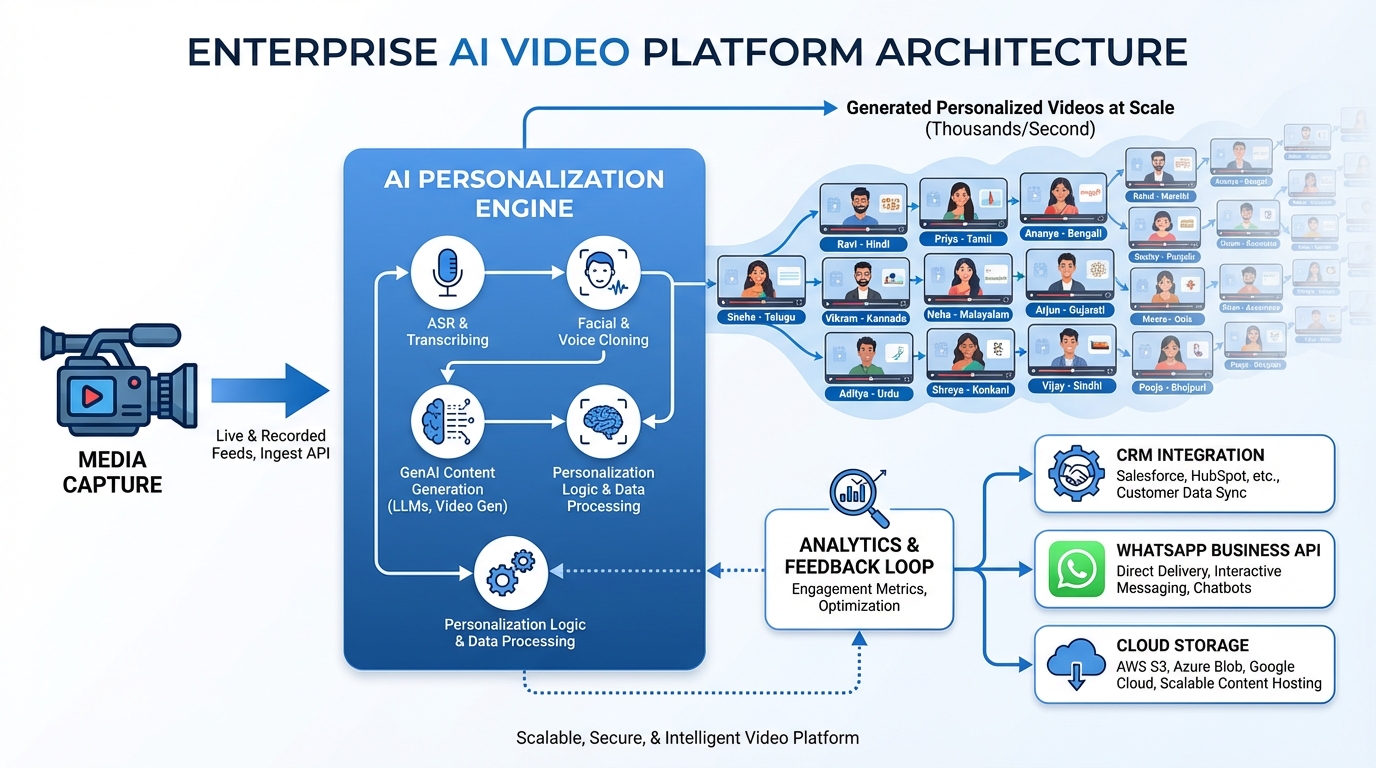
A scalable personalized video SaaS represents a cloud-native or hybrid-deployable engine that transforms a single 15-minute media capture into millions of compliant, hyper-personalized videos. TrueFan AI's 175+ language support and Personalised Celebrity Videos demonstrate the technical depth required to handle sub-30s render Service Level Agreements (SLAs) at an enterprise scale (vernacular video automation in India). This capability is powered by an API-first distribution model that allows for programmatic insertion of first names, cities, product SKUs, and dynamic visual assets.
The core capabilities of such a platform must align with the rigorous demands of the Indian enterprise. This includes voice retention and precise lip-syncing for vernacular journeys, ensuring that the AI-generated spokesperson maintains brand consistency across dialects. Virtual reshoots and AI editing allow marketing teams to swap lines, offers, or Calls to Action (CTAs) without the need for expensive and time-consuming fresh shoots, facilitating rapid A/B/n testing at the scene level.
Integration is the linchpin of successful generative AI transformation in 2026. A robust SaaS platform must connect natively with Salesforce, WebEngage, and the WhatsApp Business API to trigger real-time, event-driven rendering. Security remains paramount, with ISO 27001 and SOC 2 certifications serving as the baseline for protecting PII (Personally Identifiable Information). By utilizing cloud-agnostic GPU farms and sophisticated queue management, these platforms ensure that high-volume campaigns, such as festive greetings or flash sales, are delivered with minimal latency.
Sources:
- TrueFan AI: AI Impact Summit Guide
- IndiaAI Summit: Sessions
- YourStory: India AI Summit innovation coverage
3. Agentic AI marketing: Orchestrating multi-agent AI workflows
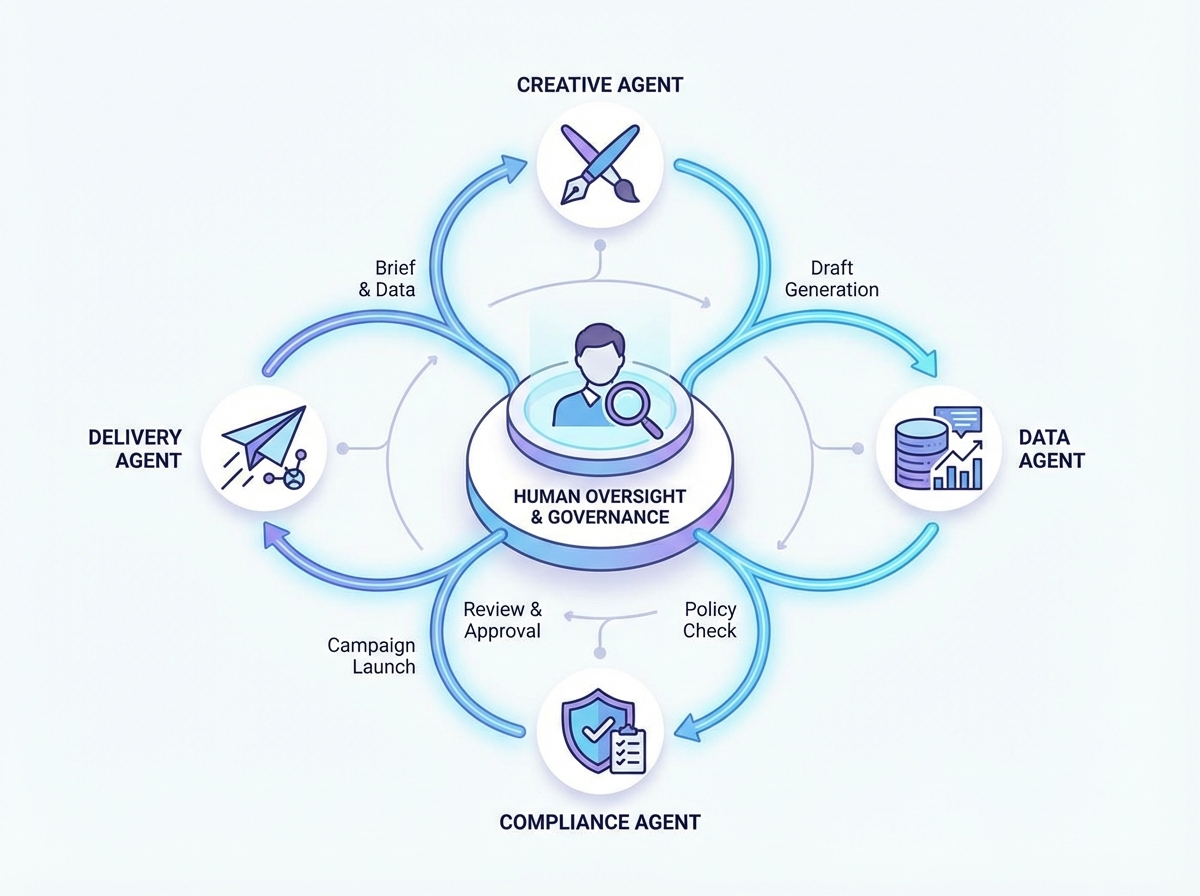
The concept of agentic AI marketing represents a paradigm shift where autonomous and supervised AI agents collaborate with human operators to plan and distribute content. In this model, multi-agent AI workflows are orchestrated by a central controller that enforces brand policies and performance SLAs. Each agent within the ecosystem is specialized, possessing clear inputs, outputs, and guardrails to ensure that the final video output is both creative and compliant.
A reference architecture for enterprise video personalization typically involves several specialized agents. The Creative Agent synthesizes scripts from brand-approved libraries, while the Data Agent securely retrieves customer information from the CRM, ensuring PII tokenization and consent verification. The Personalization Agent then handles the lip-sync and voice model selection, routing the task to the most efficient rendering node based on current latency and cost targets.
Governance is maintained through a dedicated Compliance Agent that performs real-time content moderation, regulatory rule checks, and watermarking for traceability. Finally, the Delivery and Analytics Agents manage channel routing across WhatsApp or SMS and stitch together attribution data to measure incremental lift. This “human-in-the-loop” approach allows for pre-flight approvals and emergency stops, ensuring that the AI marketing thought leadership translated into action remains within the bounds of corporate safety and ethical standards (AI Impact Summit TrueFan 2024 recap).
Sources:
- TrueFan AI: AI Impact Summit TrueFan post
- IndiaAI: Outcome resources
- CSIS: India’s AI Impact Summit projects
4. LLM agnostic solutions: Navigating performance, cost, and DPDP
In the 2026 landscape, LLM agnostic solutions have emerged as a critical requirement for enterprises seeking to avoid vendor lock-in and optimize operational costs. An agnostic architecture utilizes a routing layer to select the best-fit model for specific tasks—such as script generation, sentiment analysis, or summarization—balancing quality against inference-time costs. This flexibility is vital for maintaining a sustainable generative AI transformation strategy as model capabilities and pricing structures continue to fluctuate.
For Indian enterprises, model agnosticism is also a key component of a robust DPDP compliance posture. Sensitive workloads can be routed to on-premise or hybrid nodes to ensure data residency, while less sensitive tasks utilize public cloud APIs for scale. This approach allows for inference-time redaction and ensures that customer data never leaves the authorized boundary. Furthermore, dynamic routing provides resilience against outages, automatically switching to fallback models if a primary provider experiences downtime.
The infrastructure supporting these LLM agnostic solutions in India often involves NVIDIA-backed deployments designed for locality-first processing. By reducing the physical distance between data and inference, enterprises can achieve the sub-30s render times necessary for real-time customer engagement. This technical neutrality ensures that the enterprise AI video platform India remains future-proof, capable of integrating the next generation of models without requiring a complete architectural overhaul.
Sources:
- Business Standard: AI democratization and sustainability at IndiaAI
- IndiaAI: Summit home
- YourStory: Ecosystem depth at India AI Impact Summit
5. Benchmarking best AI tech companies India for enterprise video
When evaluating the best AI tech companies India for video personalization, procurement teams must look beyond simple demo quality to assess enterprise-grade reliability. Key criteria include the ability to demonstrate million-scale renders, p95/p99 latency data, and a proven track record of DPDP-ready consent pipelines. Interoperability is equally critical; the platform must offer open APIs, SDKs, and native connectors for the existing enterprise stack, including SSO (Single Sign-On) and SCIM for identity management (enterprise AI video platform guide).
Solutions like TrueFan AI demonstrate ROI through their ability to handle the unique complexities of the Indian market, such as accurate pronunciation of diverse Indian names and high-fidelity voice cloning. Governance features, including automated moderation and immutable audit logs, are non-negotiable for regulated sectors like BFSI and Healthcare. Additionally, the Total Cost of Ownership (TCO) must be evaluated through the lens of unit economics at scale, considering burst pricing and data egress costs.
TrueFan’s leadership in this space is evidenced by its performance in large-scale campaigns, such as delivering 354,000 personalized videos in a single day for Zomato and 2.4 million greetings for Hero MotoCorp. These benchmarks provide the necessary social proof for enterprise AI adoption India 2026 initiatives. By focusing on incrementality frameworks and multi-touch attribution, the leading platforms allow CMOs to see the direct correlation between personalized video and bottom-line growth.
Sources:
- Business Standard: Day 3 sessions and speakers
- IndiaAI: Key attendees
- TrueFan AI: Enterprise case studies
6. Enterprise AI adoption India 2026: The 90-day roadmap to transformation
Achieving a successful generative AI transformation requires a pragmatic, phased approach that prioritizes quick wins while building long-term governance. A standard 90-day roadmap (AI Impact Summit TrueFan guide) begins with a two-week strategy phase focused on defining KPIs—such as Click-Through Rate (CTR) lift and churn reduction—and conducting a DPDP impact assessment. This initial period is crucial for establishing the legal and compliance framework, including the creation of Data Processing Agreements (DPAs) and consent templates.
Weeks three through six focus on data readiness and pilot construction. This involves mapping CRM schemas, tokenizing PII, and developing script packs that are aligned with specific audience segments. During this phase, the multi-agent AI workflows are configured, and the initial API integrations with WhatsApp and other delivery channels are established. A “control vs. treatment” design is implemented to ensure that the pilot generates statistically significant data for ROI analysis.
The final six weeks are dedicated to go-live, optimization, and hardening. After launching in one or two primary channels, teams monitor p99 latency and error budgets, iterating on script variants based on real-time analytics. By day 90, the enterprise should be ready to scale the scalable personalized video SaaS across additional segments and languages. This structured path ensures that enterprise AI adoption India 2026 is not just a technological upgrade, but a fundamental improvement in how the organization engages with its customers.
Sources:
Conclusion
India’s 2026 AI inflection point requires a move toward governed, LLM-agnostic, and agentic workflows. Video has emerged as the highest-ROI surface for scaled personalization, offering a unique way to bridge the gap between digital automation and human connection. With proven India-scale campaigns, sub-30s renders, and a commitment to consent-first operations, the path to generative AI transformation is now clearly defined. Leaders are encouraged to book an enterprise demo at the AI Impact Summit TrueFan or download the comprehensive buyer’s checklist to begin their 90-day pilot journey.
Sources:
Frequently Asked Questions
The AI Impact Summit TrueFan highlighted several recurring questions from executive leaders regarding the implementation of advanced video AI. Below are the most critical queries addressed during the 2026 sessions.
What makes an enterprise AI video platform India-ready in 2026?
An India-ready platform must offer deep vernacular breadth (175+ languages), seamless WhatsApp integration, and strict DPDP compliance. It requires sub-30s rendering capabilities to handle population-scale demand and must operate on a consent-first basis to protect both the brand and the consumer. Furthermore, it should utilize LLM agnostic solutions to ensure cost-efficiency and technical flexibility, as outlined in the enterprise AI video platform India best practices.
How do multi-agent AI workflows operationalize agentic AI marketing?
These workflows function by assigning specific tasks—such as script creation, compliance checking, and delivery—to specialized AI agents. A central controller orchestrates these agents, ensuring they follow predefined policy rules and human-in-the-loop approval chains. This reduces operational overhead while maintaining high output quality and brand safety. Learn more about multi-agent AI workflows for Indian enterprises.
Why are LLM agnostic solutions critical for enterprises?
Agnosticism prevents vendor lock-in, allowing enterprises to switch between models as the market evolves. It also enables better cost governance by routing tasks to the most economical model that meets the quality threshold. Most importantly, it supports data privacy by allowing sensitive processing to occur on-premise while leveraging the cloud for scale. See the LLM-agnostic reference guide for details.
How fast is ROI from scalable personalized video SaaS?
Most enterprises see measurable ROI within a 4-to-8 week pilot window. Typical outcomes include a 3-to-5x engagement lift compared to static assets and a significant reduction in creative production hours. For example, gains reported in the enterprise AI video platform 2024 guide include improved WhatsApp read rates via hyper-personalized celebrity nudges.
How does TrueFan AI handle data security for large-scale campaigns?
TrueFan AI utilizes ISO 27001 and SOC 2 certified infrastructure, ensuring that all data processing meets international security standards. The platform incorporates PII minimization, encrypted data boundaries, and automated moderation filters to ensure that every video generated is compliant with Indian regulations and brand safety guidelines.



