
URL-to-Video AI Generator India: Turn Amazon, Flipkart, and Shopify Links into 15-Second Ads for the 2026 E-commerce Boom
Estimated reading time: ~9 minutes
Key Takeaways
- URL-to-video AI turns Amazon, Flipkart, and Shopify product links into 15-second ads in minutes, slashing production friction.
- Short-form video delivers higher ROI than static images, making zero-production workflows essential for India’s 2026 e-commerce boom.
- Built-in compliance and multi-aspect exports ensure marketplace-ready videos for Amazon, Flipkart, and Shopify.
- Brands cut costs by 70–90% and localize to 175+ languages using platforms like Studio by TrueFan AI.
- Automated scripts, motion design, and avatars enable fast creative velocity and region-specific A/B testing.
The digital landscape in India is undergoing a seismic shift, and by 2026, the e-commerce sector is projected to hit a staggering $200 billion valuation. For D2C founders and marketplace sellers, the challenge is no longer just about having a product; it’s about how fast you can turn a product link into a high-converting visual story. A URL-to-video AI generator is now the essential tool for Indian brands looking to dominate Amazon, Flipkart, and Shopify without the friction of traditional production.
In an era where attention spans are measured in milliseconds, static images are no longer enough to stop the scroll. Indian SMBs are facing a critical bottleneck: the high cost and slow turnaround of professional videography. With freelancer costs often exceeding ₹5,000 per video and production cycles stretching into weeks, staying competitive feels like an uphill battle. However, the emergence of a URL-to-video AI generator India–focused workflow allows you to paste a product link and receive a marketplace-ready 15-second ad in minutes.
1. Why India’s 2026 E-commerce Moment Demands Zero-Production Videos
India’s e-commerce trajectory through 2026 is defined by massive SKU expansion and a shift toward video-first discovery. According to the India Brand Equity Foundation (IBEF), the rapid penetration of 5G and the rise of social commerce have made video listings a non-negotiable requirement for visibility. Sellers who rely solely on static photos are seeing a significant drop in “thumb-stop” rates as consumers increasingly demand dynamic, informative content before making a purchase.
The traditional model of product photography—hiring a studio, shipping samples, and waiting for edits—is fundamentally broken for the 2026 market. Brands now need to refresh their creative assets every 7 to 10 days to combat ad fatigue and stay relevant in the fast-paced Reels and Shorts ecosystem. This is where e-commerce video automation India 2026 trends come into play. By removing the physical production barrier, brands can achieve a creative velocity that was previously reserved for enterprise-level budgets.
Data from 2026 marketing reports indicates that short-form video ads now deliver 1.6 times higher ROI compared to static ads. Furthermore, 85% of marketers identify short-form video as the highest-ROI content format currently available. For a D2C brand in India, this means that the ability to generate AI video from a product link is not just a luxury—it is a survival mechanism.
2. What is a URL-to-Video AI Generator? (Definition + India Focus)
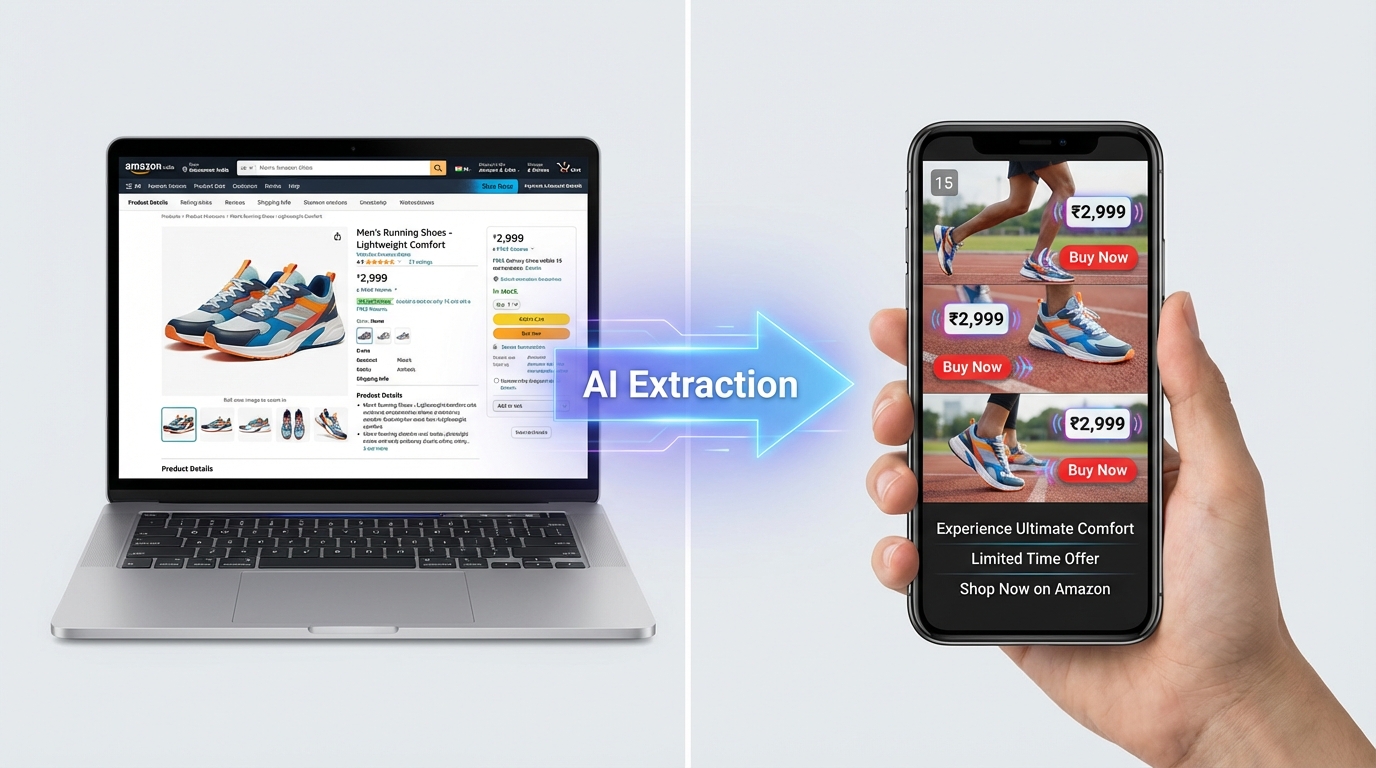
A URL-to-video AI generator is a sophisticated software solution that automates the entire video creation process by ingesting a product page URL from platforms like Amazon, Flipkart, or Shopify. The AI parses the page to extract critical metadata, including the product title, high-resolution images, pricing highlights, key features, and even customer review snippets. It then synthesizes these elements into a structured 15-second video ad, complete with on-screen captions, background music, and a professional voiceover.
For the Indian market, this technology is particularly transformative. Platforms like Studio by TrueFan AI enable brands to bridge the gap between a simple product listing and a high-production-value video ad without needing a single camera. This is especially vital for “vernacular SEO,” where brands need to communicate in Hindi, Tamil, Telugu, or Bengali to reach the next 200 million shoppers in Tier 2 and Tier 3 cities.
The core advantage of using an AI video generator from URL is the elimination of “asset gaps.” Even if you only have three basic photos on your Amazon listing, the AI can use motion design techniques—such as the Ken Burns effect, 3D parallax, and automated background removal—to make those images feel like part of a cinematic production. This allows SMBs to cover their entire long-tail catalog with video, rather than just their top three best-sellers. See the overview: TrueFan AI: AI Video Generator from URL 2026.
3. How it Works Under the Hood: The Technical Journey from Link to Lead
Understanding the mechanics of a URL-to-video AI generator helps sellers appreciate the precision involved in automated creative. The process is generally divided into four distinct phases:
Step 1: Intelligent Metadata Ingestion
When you input a Shopify or Amazon URL, the AI uses web scraping and API hooks to “read” the page. It looks for Schema.org tags and Open Graph metadata to identify the most important visual assets. It prioritizes the “Hero” image and then looks for lifestyle shots that show the product in use. This ensures that the AI video from product link generation always starts with the most compelling visual evidence.
Step 2: Automated Storyboarding and Scripting
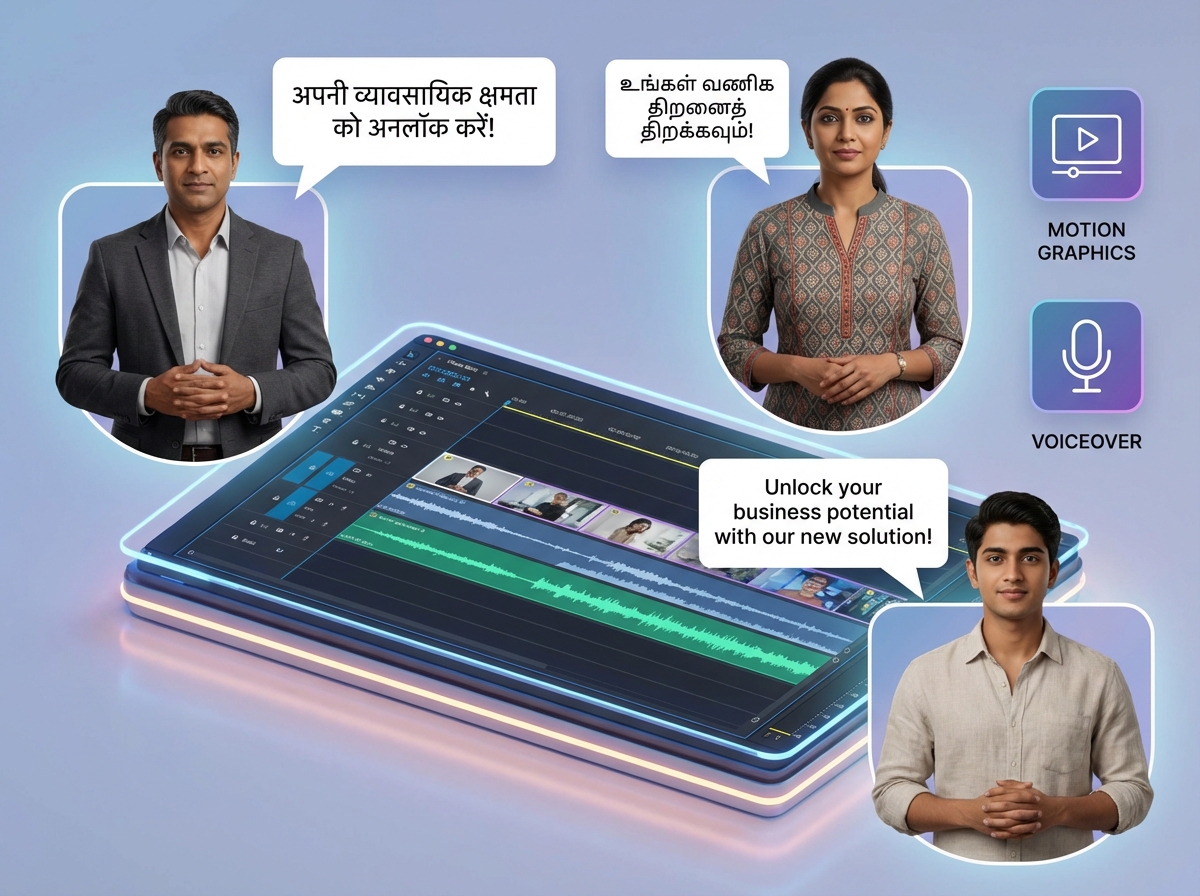
The AI doesn’t just slap images together; it follows a proven marketing framework: Hook → Problem/Solution → Social Proof → Call to Action. It generates a concise script optimized for mobile viewing. In the Indian context, this often involves “Hinglish” (a mix of Hindi and English) to maximize relatability. Studio by TrueFan AI’s 175+ language support and AI avatars for India allow this script to be delivered by a photorealistic presenter, adding a human touch that significantly boosts trust and conversion rates.
Step 3: Motion Design and Branding
Once the script and assets are ready, the system applies motion graphics. This includes animated price badges, “Limited Time Offer” stickers, and brand-specific color palettes. The AI ensures that all text remains within the “safe zones” of various platforms, so your CTA isn’t cut off by the Instagram UI or the Amazon “Buy Now” button.
Step 4: Multi-Aspect Ratio Exporting
The final step is rendering the video in multiple formats. A single product URL can generate a 16:9 version for Amazon Sponsored Brands, a 1:1 version for the main product gallery, and a 9:16 version for YouTube Shorts and Instagram Reels. This text-to-video AI for sellers approach ensures that your brand is omnipresent across all digital touchpoints.
4. Marketplace Compliance in India: Amazon, Flipkart, and Shopify
Creating a video is only half the battle; ensuring it meets the rigorous standards of Indian marketplaces is the other. A high-quality URL-to-video AI generator India tool must be built with these compliance rules in mind.
Amazon Sponsored Brands Video Essentials
Amazon has strict guidelines for video ads. They must be between 6 and 45 seconds, though 15–20 seconds is the “sweet spot” for conversion. The video must not have any black frames at the start or end, and the product must be visible within the first 2 seconds. Furthermore, Amazon requires high-contrast captions because many users watch videos with the sound off. Using an Amazon Flipkart listing video creator ensures that your output automatically adheres to these technical specs, reducing the risk of ad rejection. See the Amazon Advertising Specs.
Flipkart Product Contextual Ads (PCA)
Flipkart’s advertising ecosystem is increasingly favoring “Rich Creatives.” Video ads on Flipkart have been shown to improve CTR significantly compared to static banners. The key on Flipkart is accuracy; the video must reflect the exact claims made on the PDP (Product Detail Page). Automated tools help maintain this consistency by pulling data directly from the live link, ensuring that the price and features in the video always match the listing. Learn more from Flipkart PCA insights.
Shopify and D2C Storefronts
For Shopify sellers, the focus is on page speed and mobile optimization. Shopify product video AI tools generate lightweight MP4 files that don’t bog down your site’s loading time. In 2026, Shopify’s Online Store 2.0 themes are fully optimized for video backgrounds and galleries, making it easier than ever to embed AI-generated content that keeps users on the page longer, thereby increasing the “dwell time” which is a positive signal for SEO.
5. ROI Analysis: The Math of AI Video vs. Traditional Production
For most Indian SMBs, the decision to switch to a URL-to-video AI generator comes down to the bottom line. Let’s look at the “Creative Velocity” math for a typical D2C brand with 100 SKUs.
Traditional Production Model:
- Cost: 100 SKUs × ₹5,000 per video = ₹5,00,000.
- Time: 4–6 weeks for shooting, editing, and revisions.
- Flexibility: Zero. If the price changes or a new feature is added, you need a re-shoot.
- Localization: Additional ₹1,000–₹2,000 per language for dubbing.
AI-Driven Model (e.g., Studio by TrueFan AI):
- Cost: Included in a monthly subscription (starting as low as ₹2,999).
- Time: 100 videos generated in under 2 hours.
- Flexibility: Infinite. Update a URL, and a new video is ready in minutes.
- Localization: One-click conversion into 175+ languages.
Solutions like Studio by TrueFan AI demonstrate ROI through a 70–90% reduction in production costs while simultaneously increasing ad performance. In 2026, data shows that AI-generated video can boost ROI by 82% over old methods. This is because brands can afford to A/B test different hooks, voices, and languages for every single product, rather than just their “hero” items. By identifying which 15-second variant performs best in a specific region (e.g., a Tamil VO for Chennai vs. a Hindi VO for Delhi), brands can optimize their ad spend with surgical precision. Use the AI Video ROI Calculator for India to model your uplift and the AI Video Payback Period Calculator to estimate payback.
6. Step-by-Step Guide: Generate Your First 15-Second Video from a URL
If you are ready to implement D2C video marketing automation, follow this simple workflow to go from a product link to a live ad.
- Select Your Source: Copy the URL of your best-selling product from Amazon, Flipkart, or your Shopify store. Ensure the listing has at least 3–4 clear images.
- Input into the Generator: Paste the link into the AI video generator from URL dashboard. The system will take a few seconds to “scrape” the data.
- Choose Your Template: Select a “Marketplace Ad” template. For 2026, we recommend a 15-second duration with a “Problem-Solution” narrative arc.
- Localize and Personalize: Choose your target language. For the Indian market, a “Hinglish” or regional language voiceover often outperforms pure English. Add an AI avatar to act as a virtual influencer presenting your product.
- Review and Brand: Check the automated captions for accuracy. Apply your brand’s hex colors and upload your logo. Ensure the “Price Drop” or “Discount” badges are prominent.
- Export and Deploy: Download the video in 16:9 (for Amazon), 1:1 (for Feed), and 9:16 (for Reels). Upload them directly to your seller central or social media management tool.
By following this product video without photography AI workflow, you can transform your entire catalog into a library of high-performing video assets in a single afternoon.
7. Frequently Asked Questions & The Future of D2C Advertising
As the e-commerce landscape evolves, sellers often have questions about the transition to automated video. Explore the answers in the FAQ section below, then see what’s next for high-velocity D2C advertising.
Conclusion: The Future is Automated
The era of manual video production for e-commerce is coming to an end. As we move through 2026, the brands that win will be those that can produce the most relevant, localized, and engaging content at the highest frequency. A URL-to-video AI generator is the key to unlocking this scale. Whether you are a small Shopify boutique or a large-scale Amazon seller, the ability to turn a link into a lead in under 60 seconds is the ultimate competitive advantage in India’s booming digital economy.
Sources:
- IBEF: E-commerce Industry Report
- HubSpot: State of Marketing 2026
- TrueFan AI: AI Video Generator from URL (2026)
- Amazon Advertising: Sponsored Brands Video Specs
- Flipkart PCA: Contextual Ads Insights
- AtlasCloud: AI Video ROI Data 2026
- Vmaker: URL to Video Generator Tools
- Adobe Firefly: AI Video Trends
Recommended Internal Links
- Shopify product video AI: Create ads from any URL instantly
- Shopify product video AI 2026: Create videos from any product URL
- Shopify product video generator AI: Sell more in India 2026
- Social commerce shoppable videos 2026: ROI guide for India
- Real-time Interactive AI Avatars India: Live Video Chat
- AI Product Showcase Generator for E-commerce in 2026
- AI Video ROI Calculator India: Boost E-commerce Conversion
- AI Video Payback Period Calculator: ROI for India 2026
- Enterprise Video Analytics Platform: ROI and Attribution
Frequently Asked Questions
Can I create a product video without photography?
Yes. Modern AI uses your existing listing photos and enhances them with motion graphics, AI-generated backgrounds, and stock lifestyle footage to create a professional-looking video. You do not need to ship products to a studio.
Is AI-generated video allowed on Amazon and Flipkart?
Absolutely. As long as the video meets technical specifications (resolution, bit rate, length) and accurately represents the product without false claims, it is compliant. Studio by TrueFan AI is designed to output marketplace-safe videos with real-time content moderation.
How many languages should I localize my videos into for India?
A pragmatic “Power Five” strategy covers most high-intent shoppers: English, Hindi, Tamil, Telugu, and Kannada. With text-to-video AI, localization takes seconds rather than days.
What is the ideal length for social media ads in 2026?
Fifteen seconds is the sweet spot: long enough to deliver value and short enough to maintain strong completion rates on Instagram and YouTube.
How do automated product ads impact Customer Acquisition Cost (CAC)?
Automated product ads can reduce CAC by up to 60% by boosting CTR and enabling rapid creative iteration without new production costs, improving efficiency across campaigns.



