ONDC hyperlocal commerce marketing 2026: Democratizing retail with vernacular videos and WhatsApp journeys
Estimated reading time: ~12 minutes
Key Takeaways
- ONDC enables democratic marketplace positioning that improves fair discovery and ownership for MSMEs.
- Vernacular, video-led onboarding removes friction for sellers and boosts activation and first-order rates.
- WhatsApp journeys drive end-to-end discovery, education, and retention in a familiar chat interface.
- Winning tier-2 markets requires vernacular-first GTM, community partnerships, and hyperlocal personalization.
- An ONDC ROI framework should track TTF1O, repeat rates, CAC vs LTV, and unit economics across the unbundled stack.
The landscape of Indian digital trade is undergoing a seismic shift as ONDC hyperlocal commerce marketing 2026 becomes the cornerstone of the nation’s Digital Public Infrastructure (DPI). By 2026, India’s e-commerce market is projected to reach US$163 billion, with a significant portion of this growth driven by the Open Network for Digital Commerce (ONDC). This decentralized protocol is dismantling the walled gardens of traditional marketplaces, offering a democratic marketplace positioning that empowers 63 million MSMEs. For digital commerce leaders, the challenge lies in navigating this interoperable ecosystem where discovery, logistics, and payments are unbundled. Success in 2026 requires a sophisticated blend of vernacular ONDC education and automated engagement to bridge the digital divide.
As the network completes its fourth year of expansion, the focus has shifted from mere technical integration to neighborhood commerce activation. The goal is to enable a kirana store in Indore or a cloud kitchen in Coimbatore to compete on equal footing with national giants. This playbook outlines how to leverage digital retail democratization videos and WhatsApp ONDC integration marketing to drive mass adoption. By focusing on hyperlocal delivery personalization and robust ONDC ROI measurement, brands can unlock the true potential of India’s tier-2 and tier-3 markets. The following sections provide a data-driven blueprint for mastering the ONDC ecosystem in 2026.
Democratic marketplace positioning: Why ONDC is the MSME growth engine
Democratic marketplace positioning represents a fundamental shift in how small businesses interact with the digital economy. Unlike traditional aggregator models that prioritize high-margin sellers through opaque algorithms, ONDC operates on an open protocol that ensures "equal listing parity." This means a local merchant's visibility is determined by proximity, price, and service quality rather than platform-specific advertising spend. For MSMEs, this government marketplace adoption signals a move toward a more equitable landscape where small merchant enablement is a structural feature, not an afterthought.
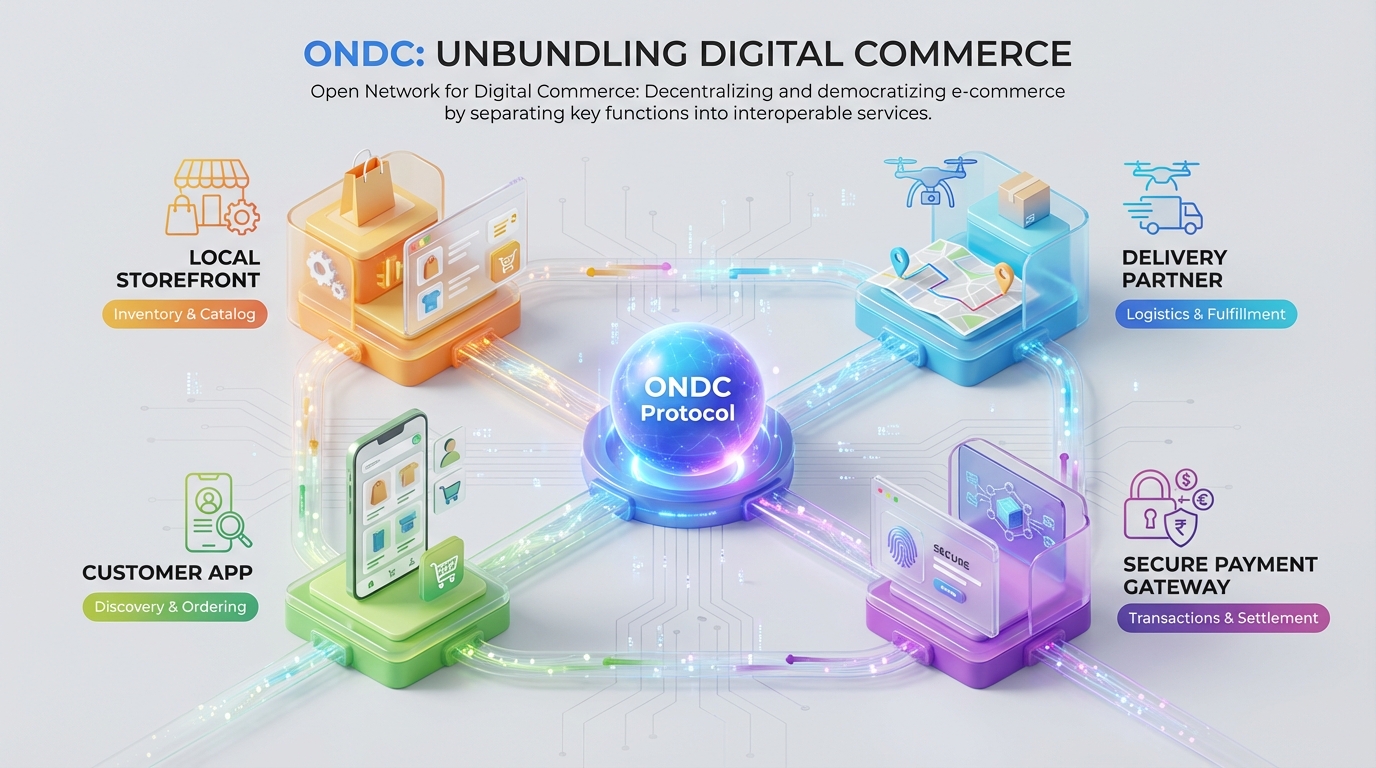
The DPI framing of ONDC allows for the unbundling of the e-commerce value chain. A seller can choose one provider for their storefront, another for logistics, and a third for payment reconciliation. This interoperability reduces the "platform lock-in" that has historically stifled the growth of small traders. In 2026, the network's ability to facilitate fair discovery across multiple buyer apps is the primary driver for kiranas, F&B outlets, and local D2C brands. By breaking these silos, ONDC enables a truly competitive environment where the merchant owns their data and customer relationships.
Furthermore, the trust signaling provided by a government-backed network cannot be overstated. For many MSMEs, the transition to digital retail is fraught with concerns over hidden fees and arbitrary delisting. ONDC’s standardized policies and transparent grievance redressal mechanisms provide the security necessary for mass onboarding. This structural trust, combined with the rise of regional logistics providers, creates a fertile ground for hyperlocal commerce to thrive. The focus is no longer just on national reach but on dominating the 5-kilometer radius through superior local service.
Sources:
Digital retail democratization videos: The lever for mass awareness and action
In a country where regional languages and visual storytelling dominate internet consumption, digital retail democratization videos are essential for ONDC's success. By 2026, video-first behavior has become the standard for India’s next 500 million internet users. These AI-personalized, vernacular videos serve as a bridge, translating complex technical concepts into simple, actionable narratives. Whether it is explaining the nuances of catalog digitization or the mechanics of UPI-based refunds, video content ensures higher recall and lower friction for both sellers and buyers.
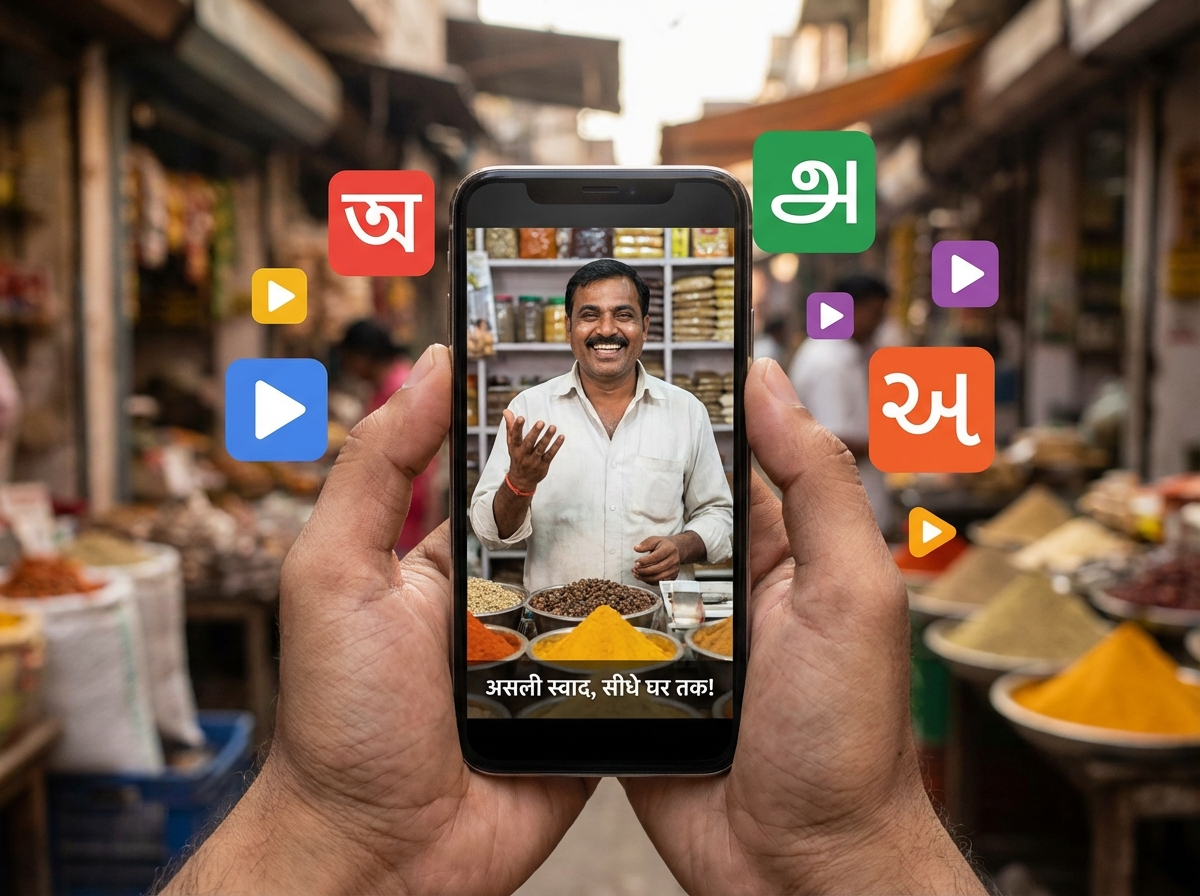
Platforms like TrueFan AI enable the creation of these high-impact assets at a scale previously unimaginable. For MSMEs, the onboarding process is often the biggest hurdle. Traditional text-based manuals are being replaced by short, 2-minute vernacular ONDC education clips that guide merchants through KYC, tax configuration, and logistics setup. These videos are not just instructional; they are motivational, featuring local success stories that build confidence in the network. By addressing the merchant in their native tongue—be it Marathi, Tamil, or Bengali—brands can significantly reduce the "drop-off" rate during the registration phase.
On the buyer side, trust-building campaigns via video are critical for converting skeptical first-time users. Short explainers embedded in buyer apps can clarify delivery SLAs, return policies, and the authenticity of local products. For instance, a video showing a local farmer’s produce being packed and delivered within the hour creates a level of transparency that static images cannot match. These videos serve as "digital handshakes," fostering a sense of community and reliability in the hyperlocal ecosystem. As we move through 2026, the integration of these visual assets into every touchpoint of the buyer journey will be the differentiator for successful ONDC participants.
Sources:
MSME seller onboarding automation: From sign-up to first sale with video-led flows
The complexity of digital onboarding remains a significant barrier for the average Indian merchant. MSME seller onboarding automation is the solution, utilizing a guided, multilingual workflow to move a seller from "interested" to "active" in record time. In 2026, this process is no longer a series of static forms but a dynamic, video-led journey. By breaking down the onboarding process into bite-sized, manageable steps, platforms can ensure that even the least tech-savvy merchant can successfully digitize their inventory.
A typical automated flow begins with a KYC checklist video, followed by a module on catalog digitization. This is where many sellers struggle—mapping categories and ensuring high-quality product imagery. Automated tools now use AI to assist in attribute completeness, suggesting the best keywords for local merchant discovery campaigns. The third phase involves pricing and tax logic, where videos explain MoQ (Minimum Order Quantity) and shipping fee structures in simple terms. Finally, logistics setup and a "go-live" checklist ensure the merchant is ready to receive their first order.
The success of this automation is measured through specific metrics: completion rate per step, Time-to-First-Batch (TTFB) of SKUs, and Time-to-First-Order (TTF1O). By tracking these KPIs, network participants can identify where merchants are getting stuck and deploy targeted video interventions. For example, if a cohort of sellers in Lucknow is struggling with GST mapping, a localized video nudge can be triggered automatically. This level of precision in small merchant enablement ensures that the ONDC network grows not just in quantity of sellers, but in the quality and readiness of its participants.
Sources:
WhatsApp ONDC integration marketing: Meet users where they are
WhatsApp has evolved into the "operating system" for many Indians, making WhatsApp ONDC integration marketing the most effective channel for both discovery and support. With the launch of the ONDC Sahayak WhatsApp bot—now supporting over 22 languages—the network has a direct line to millions of users. This conversational commerce approach allows for seamless local merchant discovery campaigns, where a user can simply send their PIN code to see a curated list of nearby shops and products.
The power of WhatsApp lies in its ability to handle the entire customer lifecycle within a single chat interface. For discovery, users can browse carousels of local SKUs and deep-link directly to a buyer app's cart. For education, the bot can play 30-second trust videos explaining return policies or payment security. Post-purchase, WhatsApp becomes the primary tool for retention; cart abandonment nudges, personalized with the user's name and locality, can significantly improve conversion rates. This "phygital" approach—combining digital ease with physical proximity—is the hallmark of ONDC in 2026.
Beyond simple transactions, WhatsApp serves as a critical tool for buyer trust-building campaigns. Real-time updates on delivery status, coupled with the ability to chat directly with the seller or a support agent, reduces the anxiety associated with online shopping. For the MSME, it provides a low-cost way to manage customer relationships without needing a dedicated CRM team. By integrating these conversational flows with the ONDC protocol, brands can create a frictionless experience that encourages repeat purchases and builds long-term loyalty in the hyperlocal market.
Sources:
Tier-2 city ONDC expansion: Vernacular-first go-to-market
The next frontier for digital commerce is not the metros, but the burgeoning tier-2 and tier-3 cities. Tier-2 city ONDC expansion requires a specialized playbook that prioritizes vernacular-first strategies and localized partnerships. Cities like Indore, Coimbatore, and Nagpur are seeing a surge in digital readiness, but they require a different engagement model than Mumbai or Delhi. This involves aligning marketing efforts with local festival calendars—such as Pongal, Ganeshotsav, or Navratri—and launching themed offers in regional languages.
Neighborhood commerce activation in these cities is often driven by community trust. Working with Resident Welfare Associations (RWAs) and local trader bodies is essential for building a ground-up presence. QR-code-based drives in local markets, supported by vernacular video screens, can bridge the gap between offline and online shopping. Furthermore, leveraging local micro-influencers who speak the regional dialect and understand the neighborhood's nuances can lend authenticity to ONDC campaigns. These influencers can showcase "near-me" deals, making the abstract concept of an open network feel tangible and relevant.
To support this expansion, hyperlocal delivery personalization is key. In dense urban pockets of tier-2 cities, the promise of 30-minute delivery can be a major draw. This requires AI-driven logistics and the strategic use of dark stores or micro-fulfillment centers. By tailoring delivery slots and fees based on precise location and real-time inventory, ONDC participants can offer a level of service that rivals global giants. The goal is to create a self-sustaining local ecosystem where the convenience of digital retail meets the trust of the neighborhood store.
Sources:
Measuring what matters: ONDC ROI measurement framework
As the ecosystem matures, the ability to quantify impact becomes paramount. An ONDC ROI measurement framework must go beyond vanity metrics like "app installs" and focus on the economic health of the merchant and the lifetime value of the buyer. This requires a funnel-based approach that tracks every stage of the journey, from onboarding and activation to conversion and retention. For MSMEs, the primary KPI is the Time-to-First-Order (TTF1O), which serves as the ultimate validation of the onboarding process.
On the buyer side, the focus is on discovery CTR, PDP-to-cart rates, and overall conversion. However, in the hyperlocal context, repeat purchase rates at 30, 60, and 90 days are the true indicators of success. Solutions like TrueFan AI demonstrate ROI through higher engagement rates on personalized video content, which directly correlates with lower Customer Acquisition Costs (CAC). By using media-mix modeling and geo-split experiments, brands can attribute growth to specific video or WhatsApp interventions, ensuring that marketing spend is optimized for the highest impact.
Unit economics also play a critical role in the 2026 ROI framework. This includes calculating the CAC by channel (video vs. search), the LTV (Lifetime Value) by cohort, and the payback period in months. For the ONDC network to be sustainable, it must prove that it can deliver orders at a lower cost than traditional platforms. This is achieved through the efficiencies of an open protocol—lower commissions, shared logistics, and decentralized discovery. By maintaining a rigorous focus on these metrics, network participants can build a data-driven case for continued investment and scaling.
Sources:
How TrueFan AI powers the ONDC 2026 playbook
Executing a large-scale ONDC strategy requires advanced technological capabilities that can handle the diversity and scale of the Indian market. TrueFan AI's 175+ language support and Personalised Celebrity Videos provide the necessary infrastructure for hyper-personalization at scale. By creating 1:1 video variants that address sellers and buyers by their name, locality, and specific needs, the platform ensures that every communication feels personal and relevant. This level of detail is crucial for building trust in the decentralized ONDC environment.
The platform's "virtual reshoot" technology allows brands to update lines, offers, or festival greetings without the need for expensive new productions. This agility is vital for A/B testing and pivoting strategies based on real-time performance data. Furthermore, TrueFan AI’s real-time API integration allows for triggered videos—such as a personalized nudge when a merchant completes a KYC step or a buyer abandons a cart. With sub-30-second render targets, these videos can be delivered instantly over WhatsApp, ensuring that the momentum of the user journey is never lost.
Security and governance are also at the forefront of TrueFan AI’s enterprise offerings. With ISO 27001 and SOC 2 compliance, the platform ensures that all data is handled with the highest standards of privacy. The consent-first celebrity and program host workflows provide a safe and ethical way to leverage star power for MSME education and buyer engagement. As Indian enterprises look to scale their ONDC initiatives in 2026, the combination of hyper-personalization, rapid iteration, and robust analytics makes TrueFan AI an indispensable partner in the journey toward a truly democratic digital marketplace.
Sources:
90-Day pilot blueprint: Scaling ONDC success
To begin your journey with ONDC hyperlocal commerce marketing 2026, we recommend a structured 90-day pilot. Start by selecting one tier-2 city (e.g., Indore) and one priority category like F&B or Kirana. Aim for a seller cohort of 500 prospects and a reachable buyer cohort of 50,000 via WhatsApp opt-ins.
- Weeks 1–2: Focus on content and infrastructure. Script and produce your vernacular video templates and set up the automated WhatsApp flows. Define your KPI tracking and UTM taxonomy.
- Weeks 3–6: Launch the onboarding phase. Use video-led automation to bring sellers onto the network. Simultaneously, roll out local merchant discovery campaigns to the buyer cohort.
- Weeks 7–10: Optimization is key. Use your ROI dashboard to identify bottlenecks. Run A/B tests on different video variants and expand your neighborhood commerce activation through RWA and micro-influencer partnerships.
- Weeks 11–12: Consolidate your findings. Publish your ONDC seller success stories to build further momentum and prepare for a full-scale rollout across other cities.
CTA: Ready to revolutionize your ONDC strategy? Book a TrueFan AI Enterprise demo today to see how vernacular video-led onboarding and WhatsApp journeys can transform your MSME engagement. Download our ONDC ROI measurement workbook and seller onboarding checklist to kickstart your 2026 growth plan.
Frequently Asked Questions
What is the primary benefit of ONDC for a small neighborhood kirana store?
The primary benefit is democratic marketplace positioning. ONDC allows a small store to be discovered by any customer using any ONDC-compatible buyer app (like Pincode or Paytm) within their delivery radius. It removes the need for the store to be "exclusive" to one platform and ensures they aren't buried by the algorithms of large aggregators.
How does vernacular ONDC education help in reducing seller churn?
Many sellers drop out because the technical jargon of e-commerce is intimidating. By using regional-language videos that explain tasks like "cataloging" or "GST reconciliation" in simple terms, you reduce the cognitive load on the merchant. This clarity builds confidence, leading to higher completion rates in the onboarding funnel.
Can WhatsApp ONDC integration marketing really drive sales for local merchants?
Yes, because it leverages the existing habits of Indian consumers. Features like "Send PIN for nearby shops" make discovery effortless. When combined with personalized video nudges for cart recovery, WhatsApp becomes a high-conversion channel that feels like a natural extension of a neighborhood conversation.
What role does TrueFan AI play in the ONDC ecosystem?
TrueFan AI provides the technology to create personalized, vernacular video content at scale. Whether it's a celebrity-led onboarding guide for sellers or a localized trust-building video for buyers, TrueFan AI helps brands communicate more effectively across India’s diverse linguistic landscape, ultimately driving better ROI on ONDC initiatives.
How is ONDC ROI measurement different from traditional e-commerce ROI?
Traditional ROI often focuses on platform-specific metrics. ONDC ROI measurement is more holistic, looking at the efficiency of the entire unbundled chain. It tracks the cost-effectiveness of using third-party logistics versus in-house, the impact of open discovery on CAC, and the long-term value of owning customer data rather than "renting" it from a platform.