Quick Commerce Personalization in India: Enterprise Playbooks for Hyperlocal, Instant-Gratification Growth
Estimated reading time: ~17 minutes
Key Takeaways
- Winning quick commerce requires hyperlocal personalization that adapts creatives and offers by pincode, weather, and live inventory.
- Inventory-aware videos with real-time ETAs and stock badges drive above-the-fold conversion and reduce cancellations.
- Pair ONDC reach with Blinkit/Zepto retail media to secure premium placements and execute neighborhood flash sales.
- WhatsApp commerce enables instant, low-friction reorders using localized video flows and CTWA automation.
- An AI-native stack powers 10-minute commerce optimization via rapid variant rendering, A/B testing, and consent-first data practices.
The landscape of Indian retail is undergoing a seismic shift as quick commerce personalization becomes the primary differentiator for enterprise brands aiming to capture the "instant gratification" segment. In 2026, the ability to dynamically tailor offers, creatives, and shoppable video experiences by specific pincodes using real-time dark store inventory and delivery ETAs is no longer a luxury—it is a survival mandate. Platforms like TrueFan AI enable enterprises to bridge the gap between digital intent and physical delivery by automating hyper-contextual communication that resonates with the local nuances of the Indian consumer.
As quick commerce enters its most competitive phase in 2026, platforms are pushing beyond grocery into high-margin non-grocery sectors like electronics and beauty to drive profitability. This evolution requires a sophisticated approach to quick commerce personalization, where every digital touchpoint—from a Blinkit banner to a WhatsApp notification—is optimized for a 10-minute conversion window. By leveraging AI-native stacks, brands can now elevate operational precision, ensuring that a user in Koramangala sees a different, more relevant video than a user in Powai, based on local weather, inventory, and cultural signals.
1. The 2026 State of Quick Commerce Video Personalization India
The Indian quick commerce market, valued at approximately $7 billion in 2025, has transitioned into a phase characterized by category diversification and profit momentum. Industry leaders like Blinkit, Zepto, and Swiggy Instamart are no longer just delivery services; they are sophisticated advertising ecosystems. For growth marketing leaders, the challenge lies in the "one-page constraint." Data indicates that 89% of consumers visit only one product page before purchase and rarely scroll beyond the first fold. This necessitates quick commerce video personalization India strategies that convert users instantly above the fold.
In 2026, the growth vector has shifted toward non-grocery acceleration, with Gen Z powering a $40 billion beauty market that relies heavily on 10-minute delivery. To capture this, enterprises must move away from static assets toward dynamic, AI-driven video content. The logistics backbone—comprising dark store proximity and real-time inventory sync—now feeds directly into marketing automation. This ensures that the "on-time promise" is not just a logistical goal but a personalized marketing claim, where the delivery ETA is embedded directly into the video creative the user sees.
Furthermore, the expansion into Tier-2 and Tier-3 cities has made language-first personalization a critical requirement. The "Bharat" consumer demands content in their native tongue, requiring brands to automate video localization at scale. With AI-native architectures becoming the standard for Indian e-commerce, the integration of real-time data with creative production allows for a level of operational excellence that was previously impossible. This shift is driving dark-store productivity and ensuring that repeat orders are secured through localized, high-relevance engagement.
Sources:
- Inc42: Quick commerce 2026 trends outlook
- Redseer: Quick commerce scale, mix and momentum
- Medianews4u: 89% of consumers view only one PDP fold
- BestMediaInfo: India’s quick commerce hits $7B
- ET Retail: Gen Z to power India’s $40B beauty market
- Fortune India: Why 2026 will make e-commerce smarter
2. Hyperlocal Delivery Marketing Automation: From Pincode to Purchase
To achieve true scale in 2026, enterprises must implement hyperlocal delivery marketing automation. This involves automating campaign triggers and creative selection based on granular location data, such as pincodes or geo-fences. The goal is to move a user from intent to purchase in under 60 seconds by aligning the marketing message with the immediate reality of their neighborhood. This requires a robust data mapping exercise where dark store inventory, SKU-level availability, and dynamic ETA slots are synchronized with the creative engine.
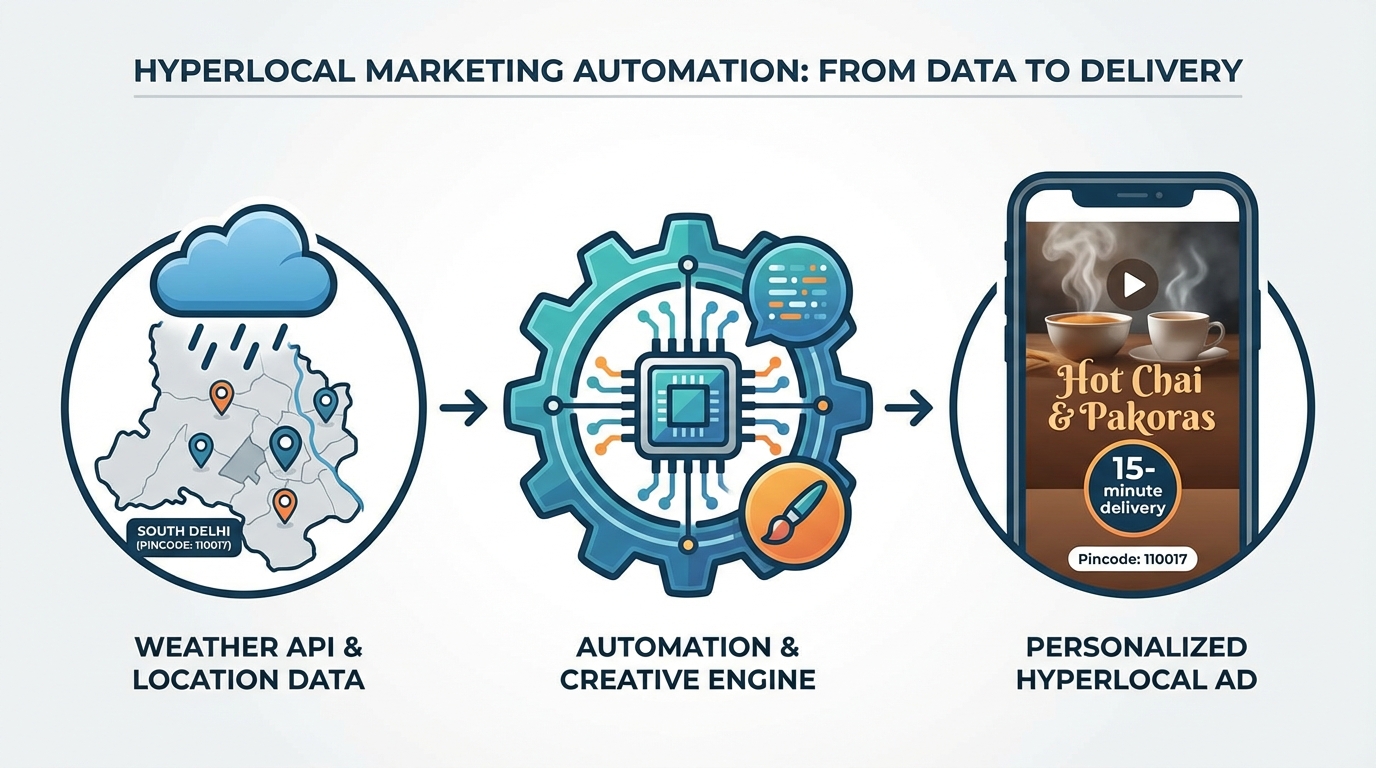
The automation logic follows a "context-first" approach. For instance, if a weather API signals heavy rain in a specific South Delhi pincode, the system automatically triggers a "chai and pakora" video creative. This creative isn't just a generic ad; it features a "15-minute delivery" overlay and confirms that the specific SKU is in stock at the nearest dark store. If the item goes out of stock, the automation engine instantly swaps the creative for the closest available variant, preventing the friction of a "cancelled order" experience and maintaining the 10-minute commerce optimization loop.
Beyond weather, local signals such as sports wins, power outages, or regional festivals (like Chhath Puja or Onam) serve as high-intent triggers. By mapping these events to pincode clusters, brands can deploy location-based urgency triggers that feel personal and timely. This level of automation ensures that the marketing spend is directed only where the product is serviceable and the delivery promise can be kept, significantly improving Return on Ad Spend (ROAS) and reducing the operational burden on marketing teams.
Sources:
- Eshipz: Quick commerce India 2026 trends & logistics
- TrueFan AI Blog: Ramadan quick commerce marketing 2026
3. Dark Store Inventory Videos: Real-Time Stock as a Creative Asset
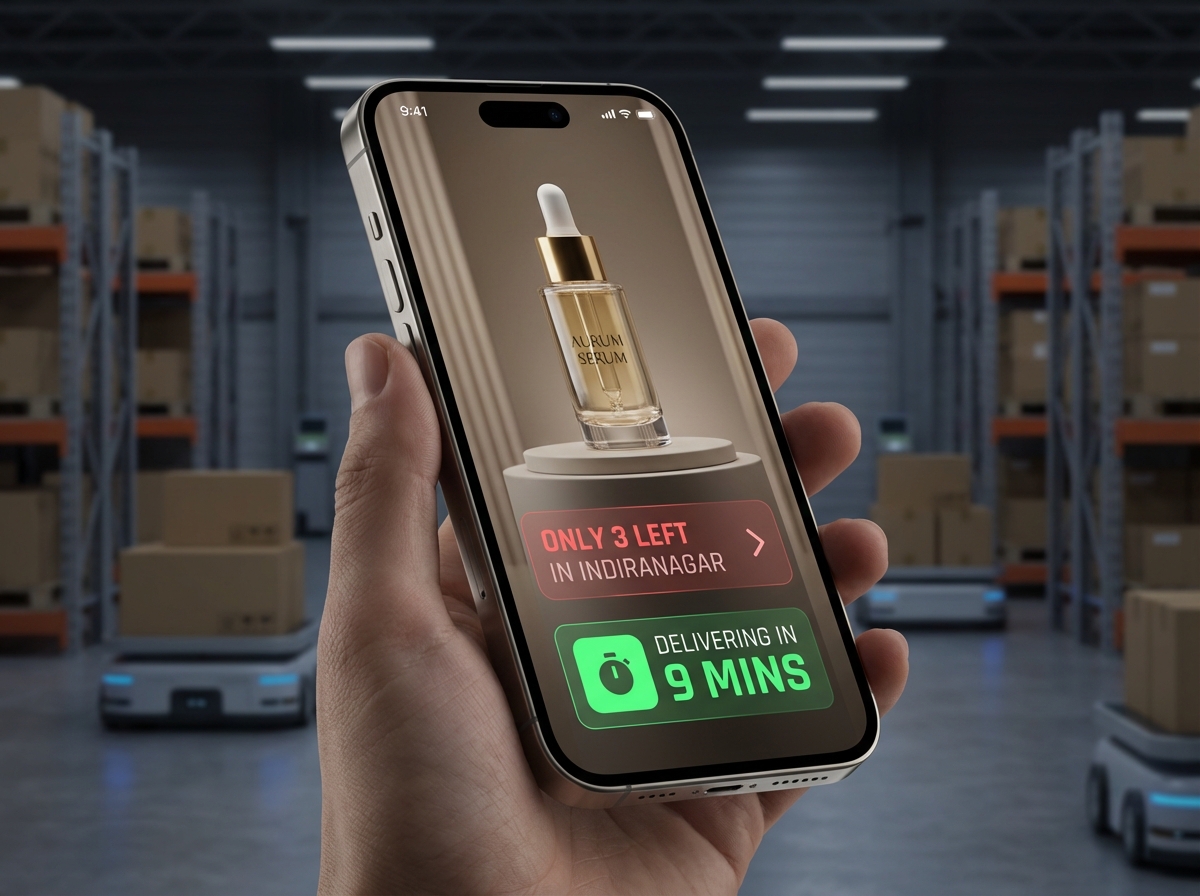
The most advanced enterprises in 2026 are utilizing dark store inventory videos to turn live stock data into shoppable content. These are auto-rendered video variants where dynamic overlays—such as price, discount, stock levels, and store-specific ETAs—are bound to live inventory feeds. When a user clicks on a product, they aren't just seeing a static image; they are viewing a 6-second high-impact video that confirms the item is "Only 4 left in Indiranagar" and can be delivered in "12 minutes."
The technical pipeline for these videos involves a feed schema that includes SKU IDs, promo prices, and serviceable pincodes. TrueFan AI's 175+ language support and Personalised Celebrity Videos allow brands to add a layer of human connection to these data-driven assets. A celebrity can "virtually" announce a neighborhood-specific flash sale, with the AI engine handling the lip-sync and voice-over for different regional languages. This creates a powerful "instant shopping conversion video" that addresses the consumer's need for both trust and speed.
Performance data suggests that these inventory-aware videos significantly lift Product Detail Page (PDP) Click-Through Rates (CTR). Because most quick commerce users do not scroll, placing a dynamic video in the first fold is essential for capturing attention. These videos also serve a dual purpose: they act as real-time inventory mirrors that reduce order cancellations. By only showing "In-Stock" videos with accurate ETAs, brands can manage consumer expectations and build long-term loyalty in a market where 10-minute commerce optimization is the standard.
Sources:
- TrueFan AI: Platform overview
- Eshipz: Quick commerce India 2026 trends & logistics
- Medianews4u: PDP first-fold behavior insights
4. ONDC Marketplace Video Integration and Platform Partnerships
The rise of the Open Network for Digital Commerce (ONDC) has introduced a new dimension to ONDC marketplace video integration. As a government-backed initiative, ONDC enables interoperable commerce across various buyer and seller apps. For enterprises, this means their personalized video assets must be compliant and functional across a fragmented network. Integrating 6-12 second inventory-aware clips into ONDC listings allows brands to maintain a consistent, high-quality brand presence regardless of which buyer app the consumer is using.
Simultaneously, Blinkit Zepto partnerships remain a cornerstone of the quick commerce strategy. These platforms offer "platform-exclusive festival deals" that are ripe for co-branded video personalization. During major events like Diwali or Rakhi, brands can co-create category spotlights where celebrity-led videos greet users in their local language and offer exclusive bundles available only on that platform. This collaborative approach helps in securing premium real estate like home tiles and search banners, driving massive spikes in new-to-category penetration.
The execution of these partnerships requires a sophisticated framework. Brands must reserve home tiles well in advance and prepare a library of "instant shopping conversion videos" that can be tweaked in real-time based on hourly sales data. Success metrics for these campaigns go beyond simple conversion; they include basket size growth and the ability to clear specific "dark store" inventory through neighborhood flash sales automation. By combining the reach of ONDC with the deep integration of Blinkit and Zepto, enterprises can cover the entire spectrum of the Indian quick commerce market.
Sources:
- ONDC: Official website
- Inc42: Quick commerce 2026 trends
- TrueFan AI Blog: Quick commerce festival offers
5. WhatsApp Commerce Integration for Reorders and Retention
In the Indian context, WhatsApp commerce integration is the ultimate tool for driving repeat purchases and instant conversions. By using Click-to-WhatsApp (CTWA) ads and in-app triggers, brands can move the entire shopping journey—from discovery to payment—into a single WhatsApp thread. A personalized video sent via WhatsApp can include a deep link that opens a pre-filled message: "Send me the Organic Milk for Koramangala, ETA 10 min." This removes almost all friction from the buying process.
The flow is highly automated: a user interacts with a video, a WhatsApp bot replies with a localized video variant and a catalog card, and the user completes the purchase with a one-tap "Pay" button. For retention, CRM-triggered reorder nudges are essential. If a customer typically buys coffee every 14 days, an automated video nudge can be sent on day 13, featuring a "reorder now" CTA and a loyalty discount. These videos are rendered on the fly to include the user's name and their specific neighborhood's delivery promise.
This strategy is particularly effective for tier-2 quick commerce expansion. In these regions, WhatsApp is often the primary interface for the internet. By providing language-first personalization and low-bandwidth video variants (240p-360p), brands can reach the "Bharat" consumer effectively. Solutions like TrueFan AI demonstrate ROI through significantly higher read rates (60-80%) and CTWA-to-order conversion rates (5-12%) compared to traditional email or SMS marketing, making it a vital component of the 10-minute commerce optimization playbook.
Sources:
- WhatsApp Business Platform: Official docs
- Meta Developers: WhatsApp catalogs overview
- Redseer: Quick commerce momentum
6. Technical Blueprint and 10-Minute Commerce Optimization
Implementing a high-scale quick commerce personalization strategy requires a seamless technical integration between the brand's data feeds and the creative rendering engine. The process begins with an API-led ingestion of inventory, pricing, and store-level ETA data. These inputs are then mapped to pre-approved video templates. When a trigger occurs—such as a price drop or a local event—the system renders a new video variant in under 30 seconds and pushes it to the relevant channel, whether it's a PDP, a WhatsApp template, or an ONDC buyer app.
The "Virtual Reshoot" capability is a game-changer for enterprise efficiency. It allows brands to update celebrity lines or product offers via AI without the need for new physical shoots. This enables rapid A/B testing of different overlays, such as comparing the effectiveness of a "Stock Left" badge versus a "Discount Percentage" badge. Continuous 10-minute commerce optimization involves analyzing these micro-conversions and adjusting the automation logic to favor the highest-performing creative variants per neighborhood.
Security and compliance are non-negotiable in this enterprise-grade setup. All personalized content must be moderated to ensure it meets brand safety standards, and data handling must comply with ISO 27001 and SOC 2 certifications. By maintaining a consent-first model for talent and user data, brands can build trust while delivering highly personalized experiences. This technical rigor ensures that the 14-day pilot-to-scale timeline is achievable, allowing brands to launch hyperlocal campaigns with minimal friction and maximum impact.
Sources:
Conclusion
The future of retail in India is undeniably hyperlocal and instantaneous. As we move through 2026, quick commerce personalization will be the engine that drives enterprise growth, turning every dark store into a personalized storefront. By integrating real-time inventory data with dynamic video creatives and leveraging platforms like WhatsApp and ONDC, brands can meet the Indian consumer exactly where they are—in their neighborhood, in their language, and in their moment of need.
TrueFan AI operates on a consent-first model with ISO 27001 and SOC 2 certifications; personalized videos are moderated to block political/offensive content; user data is never repurposed without permission.
Final Strategic Recommendation: To stay ahead of the 2026 curve, enterprise growth leaders should move beyond generic digital marketing and embrace hyperlocal delivery marketing automation. Start with a 14-day pilot focusing on a single high-margin category across three key pincodes. By proving the ROI of instant shopping conversion videos in a controlled environment, you can build the internal momentum required to scale these AI-driven playbooks across your entire national footprint.
Sources:
- TrueFan AI: Platform overview
- Inc42: Quick commerce 2026 trends outlook
- Redseer: Scale, mix and momentum
- Medianews4u: One-PDP-fold behavior report
Recommended Internal Links
- Real-time inventory videos and SLA-aware personalization for festival spikes
- Platform playbooks and partnerships for Blinkit/Zepto retail media
- ONDC marketplace video integration and hyperlocal ROI frameworks
- WhatsApp-first flows and vernacular video journeys
- 10-minute window tactics, Iftar/Sehri automation, and trust signals
- Neighborhood-level personalization and community commerce automation
- Tier-2/3 growth via hyperlocal creators and community activation
Frequently Asked Questions
What is the primary benefit of quick commerce personalization for enterprise brands?
The primary benefit is the significant uplift in conversion rates within the critical 10-minute delivery window. By tailoring creatives to specific pincodes and real-time inventory, brands can address the "one-page constraint" where 89% of users only view the first fold of a PDP. This level of relevance reduces bounce rates and increases the likelihood of an instant purchase.
How do dark store inventory videos improve the customer experience?
Dark store inventory videos provide real-time transparency. By showing the exact stock levels and delivery ETAs for a user's specific neighborhood, brands manage expectations and reduce the frustration of "out-of-stock" cancellations. This builds trust and encourages repeat behavior, as the customer knows the "10-minute promise" is backed by live data.
Can quick commerce video personalization be scaled to Tier-2 cities in India?
Yes, scaling to Tier-2 cities is a major growth vector for 2026. This is achieved through automated language localization (supporting 175+ languages) and the creation of low-bandwidth video variants. By using AI to adapt content for regional festivals and local dialects, brands can resonate with the "Bharat" consumer who prefers native-language communication.
How does TrueFan AI assist in these hyperlocal marketing campaigns?
TrueFan AI provides the infrastructure for generating high-quality, personalized video content at scale. Whether it's through celebrity-led videos or dynamic inventory overlays, the platform enables brands to automate the creation of thousands of neighborhood-specific variants. This ensures that every quick commerce touchpoint is optimized for the local context and immediate delivery.
What are the key KPIs for measuring 10-minute commerce optimization?
Key KPIs include the PDP first-fold video view rate (target 45-70%), CTR uplift compared to static assets (target +15-30%), and the OOS-redirect save rate. Additionally, for WhatsApp commerce, brands should track the CTWA-to-order conversion rate and the reorder percentage at the 7-day and 14-day marks.