
Vernacular OTT Retention Marketing 2026: AI Playbook to Cut Churn in India’s Tier-2/3 Markets
Estimated reading time: ~12 minutes
Key Takeaways
- Winning 2026 retention hinges on multilingual discovery, not generic content rails.
- Family viewing plan personalization reduces churn by aligning to co-viewing habits and cultural norms.
- Regional creator and celebrity endorsements build trust and lift completion rates in tier-2/3 markets.
- Deploy language-first pricing and binge campaigns to improve ARPU without alienating price-sensitive users.
- Cultural automation with explainable AI drives habit loops and measurable retention uplifts.
In 2026, vernacular OTT retention marketing 2026 will separate winners in India’s streaming wars. Platforms that pair AI-led regional content discovery videos with family viewing plan personalization will cut churn in tier-2/3 markets while growing ARPU. As the digital video universe expands to over 601 million users, the battle for "Bharat" is no longer about mere acquisition; it is about sustaining tier-2 entertainment engagement through Bengali Tamil Malayalam recommendations and family entertainment packages India that resonate with local cultural nuances.
The shift toward regional dominance is undeniable, with vernacular consumption now exceeding 50% of total OTT viewing share. For product and growth leaders, the challenge lies in navigating a fragmented landscape where price sensitivity meets high expectations for localized UX. Success in 2026 requires a transition from generic content rails to a sophisticated, AI-driven ecosystem that prioritizes language-first discovery and community-validated trust.
1. The 2026 Churn Crisis: Solving for Tier-2 Entertainment Engagement
The Indian OTT market in 2026 is defined by a paradox: record-high penetration and record-high churn. While Connected TV (CTV) MAUs have surged to approximately 50 million, the cost of customer acquisition (CAC) in tier-2 and tier-3 cities remains high due to fragmented discovery and a lack of "language-first" user experiences. Traditional retention models, built on national-level data, fail to address the specific drivers of churn in Bharat, such as poor local community validation and weak support for multi-generational household profiles.
Data from 2025 and 2026 projections indicate that regional trust and engagement now significantly outperform national media. Brands are aggressively shifting budgets toward regional influencers and vernacular advertising to capture the attention of the next 200 million streamers. Platforms like ZEE5 already report that nearly half of their consumption stems from regional languages, highlighting the urgency for a specialized retention playbook.
To solve for tier-2 entertainment engagement, platforms must address the "discovery fatigue" prevalent in regional catalogs. Users in non-metro markets often struggle to find relevant titles amidst massive libraries, leading to voluntary cancellations once a specific hit series concludes. By integrating regional content discovery videos—short, snackable previews tailored to local dialects—platforms can bridge the gap between a deep catalog and a distracted user base.
Sources:
- Ormax OTT Audience Report 2025
- Fortune India: The Boom of Regional Entertainment
- EY India M&E 2025: Localization Dynamics
2. Multilingual Content Curation AI: The Engine of Regional Discovery
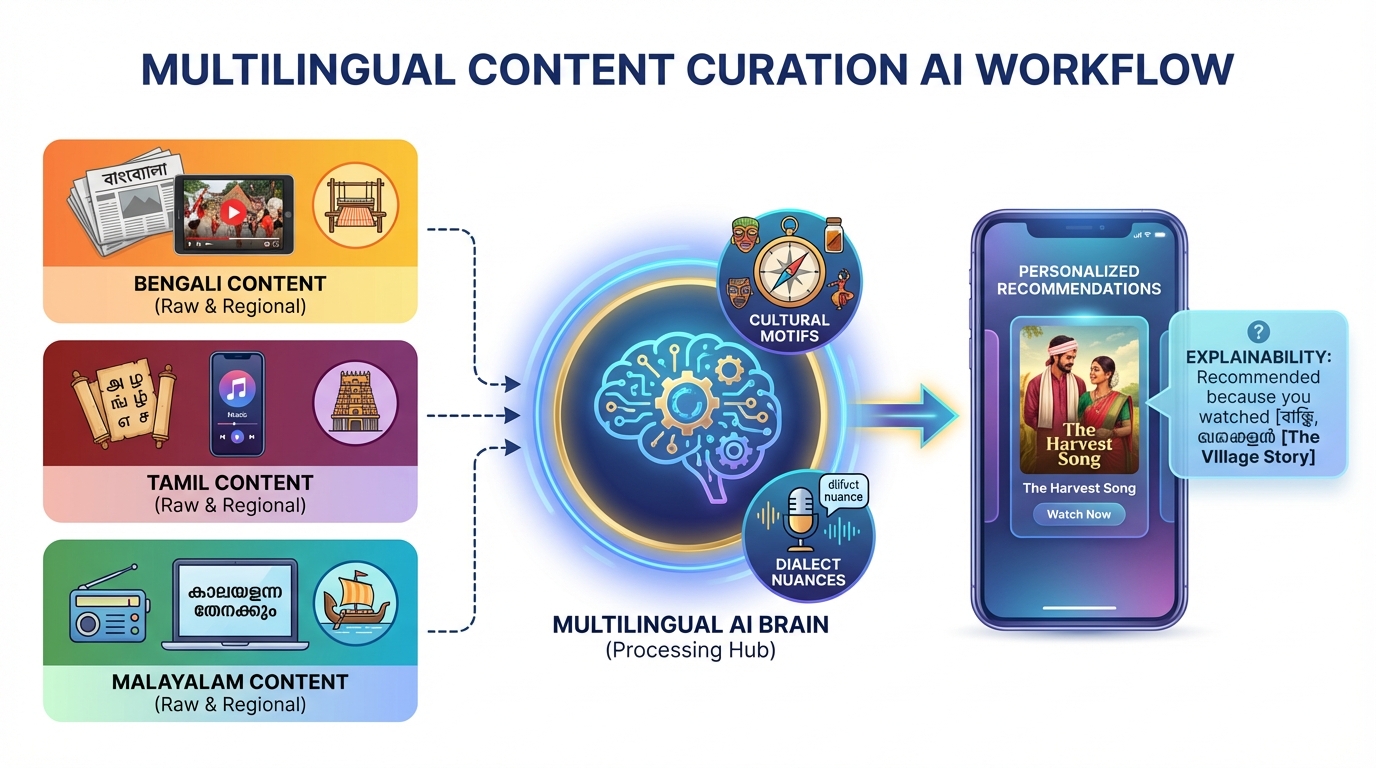
Operationalizing multilingual content curation AI is the first step toward hyper-personalization at scale. This AI layer does more than just suggest titles; it ingests complex metadata, including scene-level embeddings, transcripts, and cultural motifs, to generate micro-taste recommendations. In 2026, the standard for excellence is "explainability"—providing the user with a clear "why" behind every recommendation in their native tongue.
The technical blueprint for this system involves a hierarchical candidate generation model that re-ranks content based on household features and district-level signals. For instance, a user in Coimbatore should see Bengali Tamil Malayalam recommendations that are not just language-accurate but also reflect local trending topics. Explainability copy such as "Trending in Coimbatore households like yours" or "Picked because you binge-watched [Title] in Tamil" significantly increases click-through rates (CTR) on regional rails.
Platforms like TrueFan AI enable this level of personalization by allowing OTT providers to generate dynamic, celebrity-led video messages that explain these recommendations. By using AI to bridge the gap between data and human connection, platforms can transform a cold algorithm into a warm, localized guide. This approach ensures that the "Discovery" tab becomes a destination rather than a hurdle, directly impacting dwell time and long-term retention.
Furthermore, the data foundation must account for linguistic nuances, such as identifying Sylheti within Bengali or specific dialects of Marathi. By tagging content with these granular identifiers, the multilingual content curation AI can surface regional festival special content during local celebrations like Onam or Durga Puja. This level of precision ensures that the platform feels like a local service rather than a global giant trying to fit into a regional mold.
Sources:
3. Family Viewing Plan Personalization: Household-First Retention Strategies
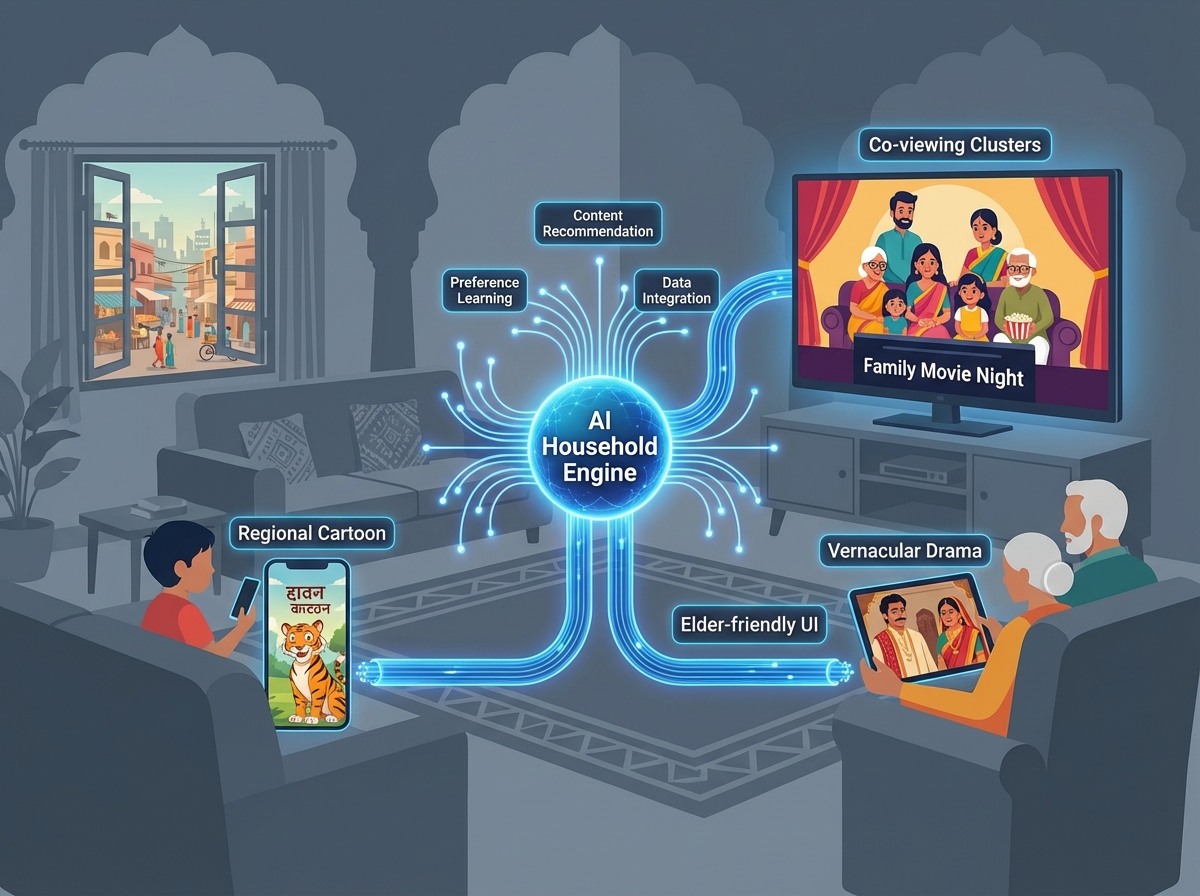
In Bharat, OTT consumption is rarely an individual activity; it is a collective family experience. Therefore, family viewing plan personalization is critical for reducing churn. Platforms must move beyond individual user profiles to "Household Graph Modeling," which maps multiple devices to a single home unit. This allows the AI to learn co-viewing clusters—such as the 8:00 PM window where kids and elders watch together—and suggest appropriate content.
Effective family entertainment packages India must include more than just multiple screens. They require elder-friendly UI with larger fonts, kids-safe profiles with strict age ratings, and regional audio defaults that persist across the household. Personalizing the upgrade path is equally important; short explainer videos in local languages can outline the cost-benefit of a family plan versus individual add-ons, reducing price sensitivity in tier-2 markets.
Safety guardrails are a non-negotiable component of this strategy. Features like "skip sensitive scenes" toggles and profanity-filtered dubs ensure that the platform remains a trusted source of entertainment for the entire family. When a platform respects the cultural values of a household, it moves from being a "discretionary expense" to an "essential utility," which is the ultimate goal of any retention strategy.
By orchestrating recommendations across devices—prioritizing TV-first content for evenings and mobile-first short discovery for commute hours—platforms can maximize the utility of the subscription. A family that finds value in the platform across all age groups is significantly less likely to cancel, especially when the content is curated to their specific linguistic and cultural preferences.
Sources:
4. Building Trust via Regional Celebrity Endorsements OTT and Creator Engines
Trust is the primary currency in India’s tier-2 and tier-3 markets. To build this trust, OTT platforms are increasingly leveraging regional celebrity endorsements OTT and local creator partnerships OTT. In 2026, the most effective way to validate a new show is not through a billboard, but through a 30-second review from a trusted local influencer on platforms like ShareChat or YouTube Shorts.
TrueFan AI's 175+ language support and Personalised Celebrity Videos allow platforms to scale these endorsements without the logistical nightmare of traditional shoots. Imagine a top Tamil film star personally inviting a user back to the platform to watch a new release, using the user's name and referencing their favorite genre. This level of "virtual reshooting" and AI-driven localization creates a sense of exclusivity and personal connection that is impossible to achieve with generic marketing.
Beyond celebrities, regional influencer show reviews provide the social proof necessary for users to commit their time to a new series. By seeding "first-episode watch parties" with local creators, platforms can generate UGC momentum that lives inside the app's discovery rails. This hyperlocal approach ensures that the content feels relevant to the user's specific social circle and geographic location.
Strategic partnerships with creators who speak in local dialects or use regional humor can further humanize the brand. These creators can co-create discovery clips that highlight regional festival special content, making the platform feel like a participant in the user's cultural life. When a user sees their favorite local creator endorsing a show, the perceived risk of "wasting time" on bad content vanishes, directly boosting completion rates and retention.
Sources:
5. Pricing, Offers, and Vernacular Binge-Watching Campaigns
Price sensitivity remains a hurdle in Bharat, but it can be mitigated through language-based subscription offers. Instead of a one-size-fits-all national pack, platforms in 2026 are finding success with "language-first" SKUs. For example, a "Tamil Essential" pack with optional "Pongal toppers" allows users to pay for only what they consume, lowering the barrier to entry while maintaining a path to ARPU growth through add-ons.
To build habit loops, platforms must deploy vernacular binge-watching campaigns. These are time-bound programming events that reward users for continuous episode completion. Using streaks, badges, and bonus content—all messaged in the user's primary language—platforms can gamify the viewing experience. City-wise leaderboards and "complete-the-season" rewards create a sense of community competition that keeps users engaged long after the initial hook.
The integration of AI into these loyalty programs is what makes them effective in 2026. Automated nudges can trigger a personalized video message when a user is one episode away from a milestone. These messages, delivered via WhatsApp or in-app notifications, use the power of celebrity or creator voices to encourage the user to "finish the journey." This reduces the likelihood of a user dropping off mid-season, which is a common precursor to churn.
Furthermore, aligning these offers with the cultural calendar is essential. A "Bengali + Durga Puja premium rail" offer during October is far more likely to convert than a generic discount. By tying subscription value to cultural relevance, platforms can justify their cost and build a loyal user base that views the subscription as a part of their festive celebrations.
Sources:
6. Cultural Content Marketing Automation and Measurement
The final pillar of the 2026 playbook is cultural content marketing automation. This involves an "always-on" system that maps the content library to a cultural calendar and geographic cohorts. The automation engine automatically assembles local language show trailers, banners, and landing pages based on the user's region and upcoming festivals. Whether it is Onam in Kerala or Ganesh Chaturthi in Maharashtra, the platform UI should reflect the local mood instantly.
Solutions like TrueFan AI demonstrate ROI through their ability to generate thousands of these localized video variants in minutes. By automating the creation of regional content discovery videos, OTT platforms can ensure that every user sees a trailer that feels bespoke to their city and dialect. This scale of personalization was previously impossible but is now a requirement for competing in a market with 600 million diverse viewers.
Measurement in this new era requires a shift from vanity metrics to causality frameworks. Platforms must track retention cohorts by city and language, completion rates of discovery videos, and the incrementality of language-based subscription offers. A/B testing "explainable" nudges—where the AI tells the user why it recommended a show—can provide deep insights into what actually drives a play start in different regions.
The 90-day roadmap for implementation should begin with a pilot in three key languages (e.g., Bengali, Tamil, Malayalam) before scaling. By focusing on foundational AI curation in the first 30 days, moving to habit-building campaigns in the next 30, and finally layering on celebrity and creator trust-builders, platforms can systematically reduce churn. The goal is a measurable uplift in watch-time and a double-digit decrease in voluntary cancellations.
Sources:
- India Digital Advertising 2026: Tier-2/3 Priorities
- RewardPort 2026: AI Personalization and Mobile-First Engagement
Recommended Internal Links
- Vernacular Entertainment Personalization: Trends for 2026
- Tier-2 Festival Commerce Automation: Local Growth Playbook
- Multilingual voice marketing automation: tactics for 2026
- Vernacular Voice SEO Strategies for India’s 2026 Commerce
- Voice Commerce Vernacular India 2026: Growth Playbook
Frequently Asked Questions
How does vernacular OTT retention marketing 2026 differ from previous years?
In 2026, the focus has shifted from simple translation to deep cultural localization. It involves using multilingual content curation AI to understand regional nuances and deploying regional content discovery videos that use local dialects and cultural motifs to drive engagement, rather than just dubbed trailers.
What are the most effective ways to reduce churn in tier-2 Indian cities?
The most effective strategies include family viewing plan personalization, which addresses the co-viewing habits of Indian households, and language-based subscription offers that reduce price sensitivity by allowing users to pay for specific regional content.
How can AI help in personalizing content for a multilingual audience?
AI can ingest title metadata and scene-level embeddings to create Bengali Tamil Malayalam recommendations that are tailored to micro-tastes. Tools like TrueFan AI can further enhance this by generating personalized celebrity videos in 175+ languages to explain these recommendations to the user.
Why is "explainability" important in OTT recommendations?
Explainability builds trust. When a platform tells a user, "We recommended this because you liked [Regional Hit]," it increases the likelihood of a click. In tier-2 markets, providing a reason in the local language helps overcome discovery fatigue and makes the AI feel more human.
What role do regional celebrities play in OTT retention?
Regional celebrity endorsements OTT act as a bridge of trust. In markets where users are skeptical of new digital services, seeing a familiar local star endorse a show or a subscription plan can significantly boost credibility and reduce the perceived risk of the purchase.
What is a "Household Graph" in the context of OTT?
A Household Graph is a data model that links different devices and profiles to a single family unit. It allows platforms to offer family entertainment packages India that are personalized for co-viewing, ensuring that the content suggested is appropriate for everyone from children to grandparents.



