Voice commerce vernacular India: A tier-2/3 blueprint for multilingual, personalized shopping at scale
Estimated reading time: ~11 minutes
Key Takeaways
- Tier-2/3 growth hinges on natural language commerce that understands Hinglish and regional dialects.
- Conversational AI personalization must be trained on code-mixed data and reinforced with trust cues and clarifying prompts.
- Hinglish AI video creation and regional dialect shopping videos reduce friction and lift conversion across PDPs and WhatsApp.
- Voice SEO optimization for long-tail, spoken queries and smart speaker intents is essential for discovery.
- At scale, a 175-language video platform with governance, consent, and security drives sustainable ROI.
Voice commerce vernacular India represents the strategic deployment of natural language commerce India experiences in Hinglish and regional dialects to drive discovery, consideration, and checkout for Bharat market AI videos. By 2026, the integration of voice-led journeys across smartphones and smart speakers will be the primary driver for e-commerce growth in India’s tier-2 and tier-3 cities.
The Indian e-commerce market is projected to grow by 12.4% in 2026, reaching a staggering Rs 19.7 trillion (approximately $226 billion). Within this expansion, the voice commerce sector is witnessing a meteoric rise, with revenue estimated to reach USD 7,469.5 million by 2030. This shift is fueled by the “Next Billion Users” who prioritize a “speak-not-type” interface to navigate digital storefronts.
For enterprise digital CX leaders, the challenge lies in moving beyond basic translation to true linguistic personalization. Implementing a robust blueprint for voice commerce vernacular India requires a sophisticated blend of Hinglish AI video creation, conversational shopping AI personalization, and voice SEO optimization. This guide provides the technical and strategic framework to capture the Bharat market at scale.
The Bharat shift to natural language commerce India
Natural language commerce India is defined by shopping experiences that allow users to speak or type in everyday, code-mixed language to discover products and complete transactions. In the Bharat market, users rarely stick to a single language, instead blending Hindi, Tamil, or Telugu with English idioms to create a unique “Hinglish” or regional hybrid.
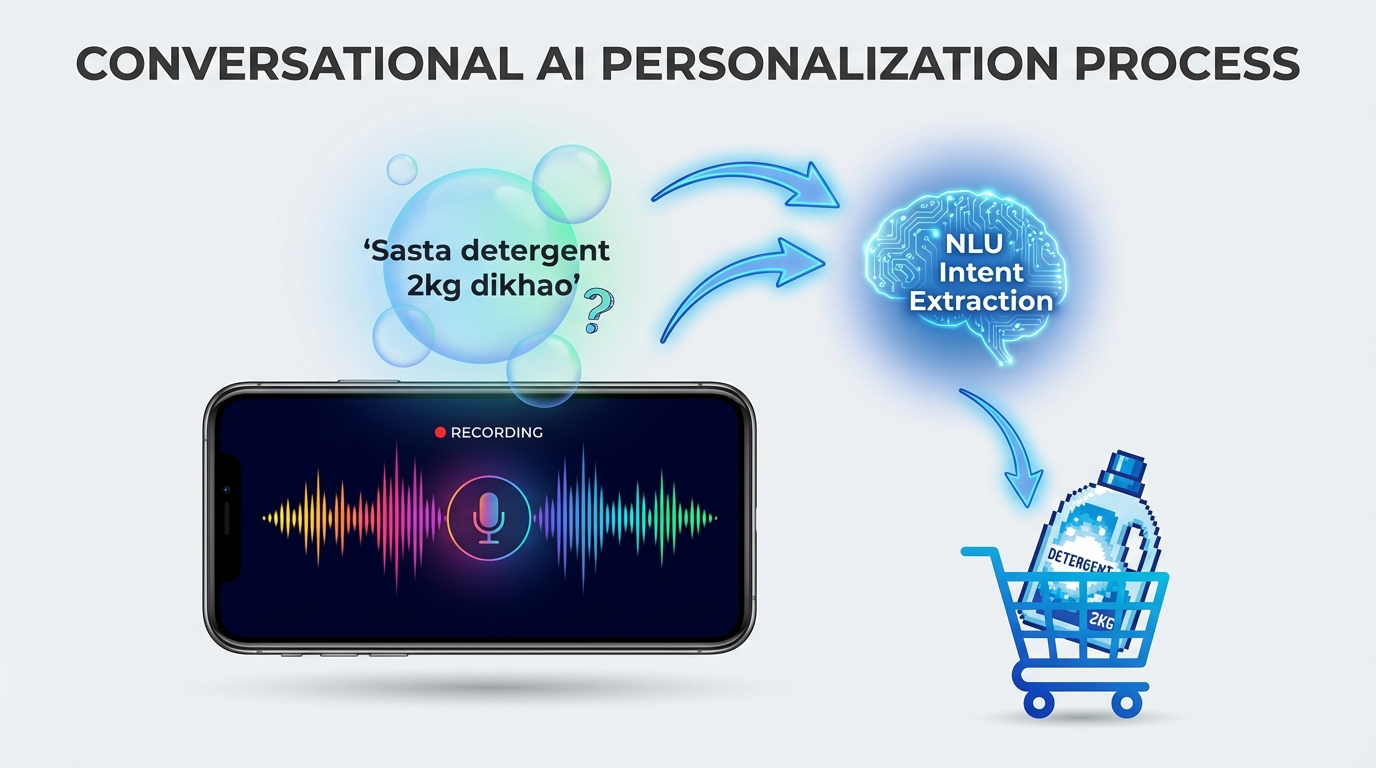
This code-mixed behavior is a response to the high typing friction associated with regional scripts on mobile keyboards. Voice interfaces reduce the cognitive load for first-time internet users, making high-frequency categories like grocery and pharmacy replenishment significantly more accessible. For instance, a user in a tier-2 city is more likely to say “Sasta detergent 2kg dikhao” than to type a formal search query.
Major players are already validating this shift, with Flipkart launching voice assistants for grocery discovery and Alexa expanding its multilingual support for Indian users. These signals indicate that natural language commerce India is no longer a peripheral feature but a core requirement for regional market penetration. By 2026, voice search and regional SEO will be the front-and-center themes for any brand targeting the Indian digital economy.
Sources:
- Grand View Research: India Voice Commerce Outlook
- Fashion Network: India E-commerce Growth 2026
- TechArc: Vernacular Voice Revolution
Designing conversational shopping AI personalization for India
Conversational shopping AI personalization involves tailoring the entire customer journey—from discovery to post-purchase—using real-time intent signals captured through voice and Natural Language Understanding (NLU). To succeed in India, intent models must be trained on massive code-mixed datasets that account for regional pronunciations and phonetic variations of brand names.
Effective personalization requires the extraction of entities from phrases like “Refill same wali masala” or “Haal ka offer shampoo.” These systems must go beyond simple keyword matching to understand the underlying intent, such as replenishment, price sensitivity, or brand loyalty. Disambiguation prompts play a crucial role here, ensuring the AI clarifies user needs before proceeding to checkout.
Voice flow patterns should also incorporate trust cues, such as readback confirmations and tap-to-confirm buttons within WhatsApp or mobile apps. In noisy environments common in tier-2 markets, providing an IVR fallback or a visual summary of the voice-initiated order is essential for maintaining high NPS. KPIs for these systems should focus on intent match rates and the compression of reorder intervals through proactive voice nudges.
Sources:
Content engine for conversion: Hinglish AI video creation and regional dialect shopping videos
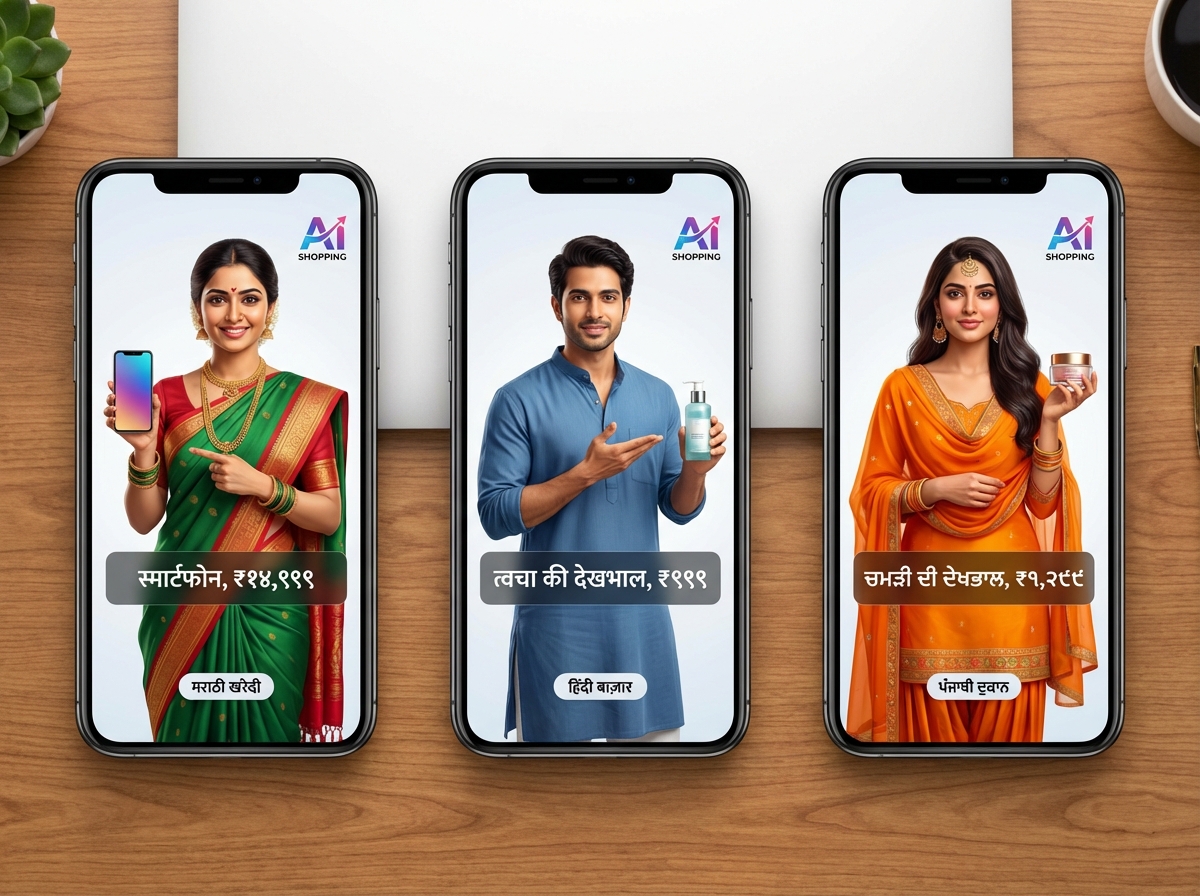
Hinglish AI video creation is the programmatic generation of short-form, code-mixed product explainers that resonate with the linguistic habits of India’s diverse regions. These Bharat market AI videos are optimized for low-data playback and localized to include district-level host voices and payment norms like COD and UPI.
Regional dialect shopping videos serve as a powerful tool for building trust, especially in categories like beauty and electronics where detailed guidance is required. A “shade finder” video in Marathi or a “how to choose” guide for smartphones in Telugu can significantly reduce the barrier to purchase. These assets should be distributed across PDPs, WhatsApp catalogs, and regional social platforms like Moj or Josh.
Platforms like TrueFan AI enable enterprises to produce these localized assets at a scale previously thought impossible. By automating the production of regional dialect shopping videos, brands can ensure that every product in their catalog has a vernacular voice, addressing the coverage gap often left by traditional creative agencies. This approach not only lowers CAC but also establishes a deeper emotional connection with the Bharat consumer.
Sources:
- Technavio: Global Voice Commerce Market Forecast
- Economic Times: Flipkart Voice Assistant for Grocery
Scale it right: From multilingual AI video generator to a 175 language video platform
A multilingual AI video generator allows enterprises to render thousands of localized videos simultaneously from a single master script. This system uses dynamic tokens for product names, prices, and regional offers, ensuring that the content remains relevant to the specific user viewing it. The goal is to move from manual localization to a fully automated 175 language video platform.
TrueFan AI's 175+ language support and Personalised Celebrity Videos provide the infrastructure needed to manage complex workflows involving script translation, voice cloning, and lip-syncing. The workflow typically begins with a master script, followed by the selection of a regional host or avatar. The system then ingests cloned voices to produce a high-fidelity, lip-synced render that is indistinguishable from a manually shot video.
Asset governance is a critical component of this scale, requiring robust versioning and regional compliance checks. Metadata for each video should include dialect tags and UTM parameters to enable omnichannel reuse and precise tracking of performance across different regions. By leveraging a 175 language video platform, enterprises can maintain a consistent brand voice while speaking the local language of every customer.
Sources:
Win discovery with voice SEO optimization
Voice SEO optimization is the process of structuring digital content and metadata to answer the spoken, long-tail queries that voice assistants read aloud. In the context of voice commerce vernacular India, this means optimizing for Hinglish phrases and regional idioms that users are likely to use when searching for products.
Tactics for voice SEO include creating comprehensive Hinglish FAQ sections and using FAQPage and HowTo schema to capture featured snippets. Metadata and alt text should include phonetic spellings for brand names to ensure that voice assistants can accurately identify and pronounce them. Local landing pages for specific districts, embedded with audio answers, can further enhance discoverability in the Bharat market.
Optimizing for smart speaker commerce integration is also vital, as devices like Alexa and Google Home become more prevalent in Indian households. Brands must define specific invocations and intents that allow users to link their accounts and complete purchases via voice. This level of voice SEO optimization ensures that your brand is the first answer provided when a user asks their device for a product recommendation.
Sources:
Tier-2 voice adoption strategies that actually move metrics
Implementing tier-2 voice adoption strategies requires a focus on low-data, high-clarity assets that function seamlessly on budget smartphones. Compressing video and voice files while maintaining high quality is essential for users in areas with inconsistent internet connectivity. Visual confirmation UIs should always accompany voice interactions to provide a sense of security during the transaction.
Another effective strategy is the use of micro-influencer hosts who speak the local dialect, which can be scaled using AI voice cloning Indian accents. This adds a layer of authenticity that generic voiceovers cannot match. Enterprises should also consider assisted commerce models, where voice-enabled kiosks or WhatsApp live agent escalations help bridge the gap for high-value purchases.
Solutions like TrueFan AI demonstrate ROI through increased watch-through rates and higher voice-to-cart conversions by delivering these hyper-localized experiences. A 90-180 day rollout plan should begin with a pilot in high-demand categories like grocery or beauty, followed by a phased expansion into 8-10 priority regions. By Phase 3, the focus should shift to full automation of the multilingual AI video generator pipeline.
Sources:
Governance, security, and the future of Bharat market AI videos
As enterprises scale their use of AI voice cloning Indian accents, governance and consent become paramount. Every cloned voice must be backed by explicit talent consent, with usage windows and regional restrictions strictly enforced. Watermarking and audio signatures should be used to prevent the misuse of synthetic media and maintain consumer trust.
Security certifications like ISO 27001 and SOC 2 are non-negotiable for platforms handling sensitive user data and brand assets. Cultural QA teams should be employed to audit content for regional biases and ensure that the language used is appropriate for the target demographic. This level of oversight ensures that the deployment of Bharat market AI videos remains ethical and compliant with evolving regulations.
The future of voice commerce vernacular India lies in the seamless integration of voice, video, and AI-driven personalization. By adopting a multilingual, voice-first approach today, enterprises can position themselves at the forefront of the Bharat market's digital transformation. The ability to speak the customer’s language—literally and figuratively—will be the ultimate competitive advantage in 2026 and beyond.
Glossary of Terms
- Hinglish: A code-mixed register combining Hindi and English, dominant in Indian digital communication.
- ASR/NLU: Automatic Speech Recognition (transcribing speech) and Natural Language Understanding (extracting intent).
- SSML: Speech Synthesis Markup Language, used to control the prosody, emphasis, and pronunciation of AI voices.
- Bharat Market AI Videos: Programmatically generated video content specifically tailored for the linguistic and cultural nuances of non-metro Indian users.
- 175 Language Video Platform: A scalable infrastructure capable of rendering localized video content across a vast array of global and regional languages.
Appendix: Enterprise RFP Checklist for Voice & Video Commerce
When selecting a partner for your voice commerce vernacular India initiatives, ensure they meet the following criteria:
- Linguistic Depth: Support for 175+ languages with specific focus on Indian regional dialects and code-mixed (Hinglish) capabilities.
- Technical Performance: Sub-30 second render times for AI videos and high-fidelity lip-sync benchmarks.
- Security & Compliance: ISO 27001/SOC 2 certification and a robust consent management framework for voice cloning.
- Integration: Deep API support for connecting with existing e-commerce catalogs, CRM systems, and WhatsApp Business API.
- Analytics: Granular reporting on regional watch-through rates, intent match accuracy, and conversion lift by dialect.
By following this blueprint, enterprises can successfully navigate the complexities of the Bharat market and build a sustainable, voice-first shopping ecosystem that resonates with the next billion users.
- Omnichannel Delivery: The video is pushed to the user via WhatsApp or the app inbox. Learn how WhatsApp catalog video marketing scales reach.
Frequently Asked Questions
What is the difference between voice commerce and natural language commerce India?
Voice commerce specifically refers to transactions initiated through spoken commands, whereas natural language commerce India is a broader term encompassing both voice and text-based shopping using everyday, code-mixed language (Hinglish). It focuses on the AI's ability to understand intent regardless of formal grammar.
How does Hinglish AI video creation improve conversion rates in tier-2 cities?
Hinglish AI video creation reduces the “trust deficit” by explaining products in a language the user is comfortable with. By using local idioms and addressing specific regional concerns like COD returns, these videos make the shopping experience feel more familiar and less intimidating.
Can I use TrueFan AI to scale my regional dialect shopping videos?
Yes, TrueFan AI is designed for enterprise-scale video generation, supporting over 175 languages and dialects. It allows you to ingest cloned voices and render thousands of personalized, lip-synced videos for your PDPs and WhatsApp marketing campaigns.
What are the key KPIs for measuring voice SEO optimization success?
Key metrics include voice search impressions, the number of featured snippets won for regional queries, and the “voice-to-cart” rate. You should also track the intent match rate to see how accurately your AI is understanding code-mixed user queries.
Is smart speaker commerce integration relevant for the Bharat market?
Absolutely. With the increasing adoption of Alexa and Google Home in Indian households, smart speaker commerce integration allows for frictionless reordering and discovery. Supporting bilingual modes (Hindi + English) is essential for capturing this growing segment of the market.