
Voice commerce vernacular India 2026: A CTO playbook for Hindi, Tamil, and Bengali shopping at scale
Estimated reading time: 11 minutes
Key Takeaways
- Vernacular voice commerce will dominate tier-2/3 growth by 2026, demanding Hindi, Tamil, and Bengali-first experiences.
- Implement voice SEO and Answer Engine Optimization (AEO) with speakable/FAQ schema and dialectal entity markup.
- Design resilient smart speaker integrations with secure payments, OTP verification, and multilingual analytics.
- Build language-specific workflows, personalization, and retention that reflect local colloquialisms and price sensibilities.
- Execute a 90-day adoption sprint and track ROI via intent resolution, add-to-cart by voice, and AEO wins.
Voice commerce vernacular India 2026 represents the definitive frontier for enterprise e-commerce leaders aiming to capture the “Bharat” market. Voice commerce vernacular India 2026 As we move into 2026, the shift from typed English queries to spoken regional dialects has moved from a peripheral trend to a core architectural requirement for tier-2/3 monetization. CTOs must now navigate the complexities of regional language voice shopping optimization, ensuring that Hindi, Tamil, and Bengali execution delivers measurable ROI through high-precision voice SEO regional languages and robust tier-2 voice adoption strategies.
The evolution of the Indian internet has reached a critical inflection point where vernacular-first users increasingly make buying decisions via voice. This behavior is driven by the removal of typing and English-language barriers, allowing users in tier-2 and tier-3 cities to interact with brands in their native tongue. Current market momentum suggests that India’s voice assistant adoption will exceed half of all internet users by 2026, making it imperative for brands to optimize for colloquial phrasing and code-switching behaviors like “Tanglish” or “Benglish.”
To succeed, enterprises must move beyond literal translation. True success in voice commerce vernacular India 2026 requires a deep understanding of vernacular long-tail voice keywords and the implementation of sophisticated multilingual voice marketing platforms. By anchoring strategies in data-backed insights and technical precision, digital innovation teams can unlock the next wave of growth in the Indian e-commerce landscape.
Source: IndiaMART: Talking Tech—How Voice and Vernacular Are Powering India’s Next Digital Wave
Source: ROI Hunt: Top Ecommerce Marketing Trends in 2026
Source: NextMSC: India Voice Assistant Market Outlook
Regional language voice shopping optimization: The SEO and AEO blueprint
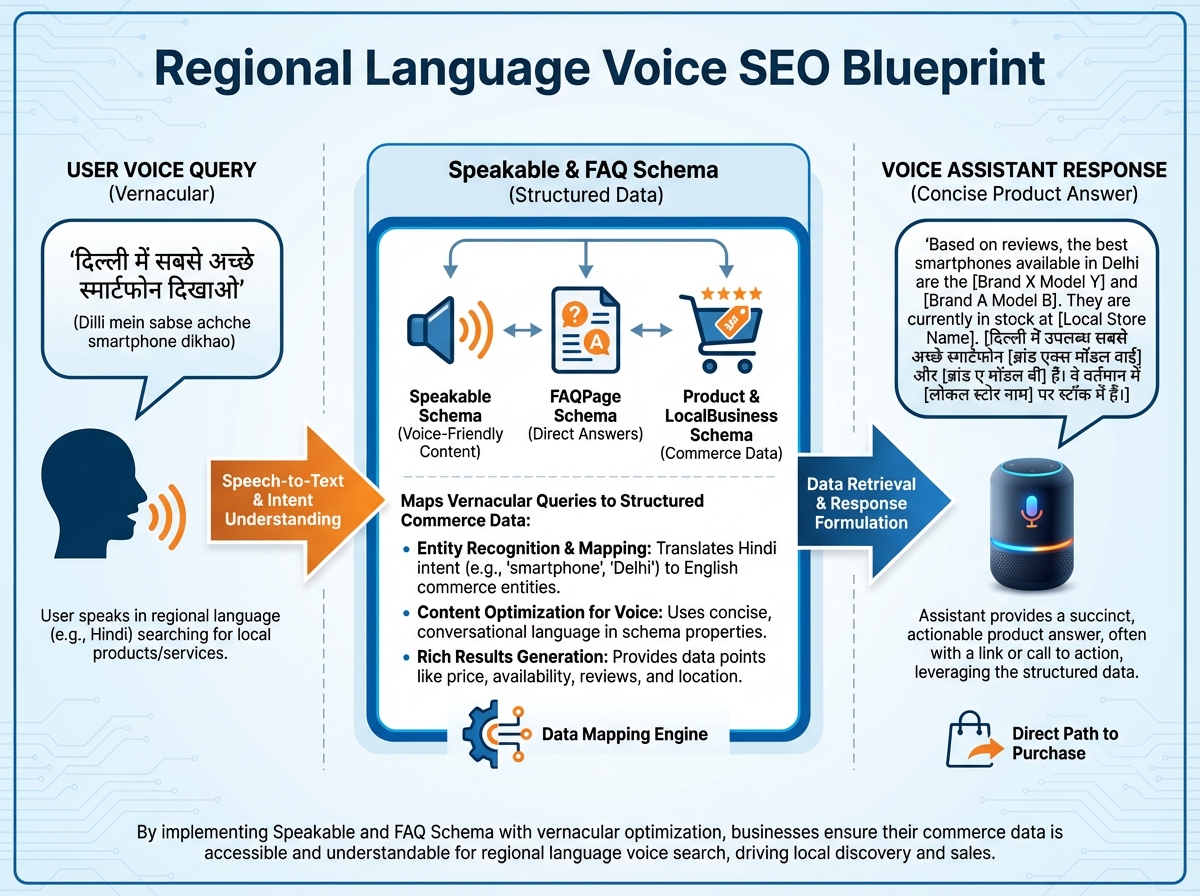
Regional language voice shopping optimization is the systematic process of structuring commerce content, FAQs, and product data so that voice assistants can understand and transact in regional Indian languages. This requires a fundamental shift in information architecture, moving away from static text to speakable, entity-rich data. CTOs must prioritize the creation of regional-language category pages and product summaries that are concise, typically between 20 to 30 words, to ensure they are easily read aloud by assistants.
The technical foundation of this blueprint rests on voice SEO regional languages. Implementing speakable schema for headlines and localized FAQ schema in Hindi, Tamil, and Bengali is non-negotiable. Furthermore, Product schema must be enriched with real-time data on price, availability, and delivery windows. A critical component often missed by competitors is the use of entity markup for dialectal expressions and transliteration variants. For example, a system must recognize both “chappal” and “sandal,” or price queries like “₹2000 se kam” and “do hazaar ke neeche.”
Voice commerce Answer Engine Optimization (AEO) further refines this by creating high-intent Q&A pairs. For each target language, brands should develop 25 to 30 specific pairs addressing discovery, returns, and payment methods like Cash on Delivery (COD). These answers must prioritize colloquial phrasing over literal translation. For instance, a Hindi query like “Agra mein next-day delivery wala air fryer” requires a declarative, fluff-free response that confirms availability and delivery timelines immediately.
Vernacular long-tail voice keywords examples:
- Hindi: “₹2000 se kam ke size 8 sports shoes dikhao”
- Tamil: “ரூ.1500 க்குள் சாம்சங் இயர்பட்ஸ் காட்டுங்க”
- Bengali: “৫০০ টাকার নিচে কটন টি-শার্ট দেখাও”
Source: BuildMyStore: Vernacular Voice Commerce Unlocking India’s Next Billion Shoppers
Source: Zuvy.store: Voice Search and Regional Language: The Next Big Wave
Source: India Digital Advertising: 2026 India Market Focus
Smart speaker commerce integration India: Architectural choices and payment flows
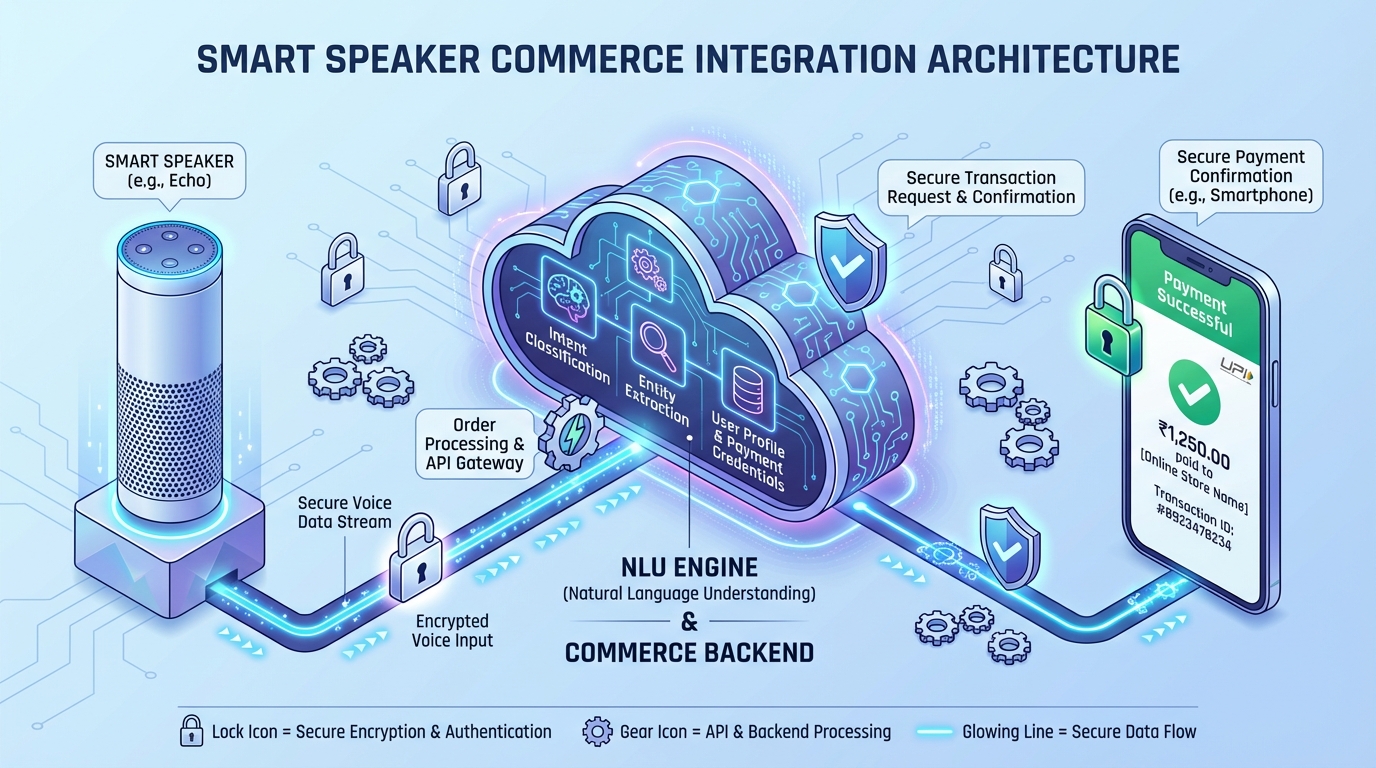
Smart speaker commerce integration India demands a robust architectural framework that connects voice assistants directly to the e-commerce backend. CTOs must decide between building custom Skills for Alexa or Actions for Google Assistant, mapping specific user intents—such as browsing, filtering, or checking order status—to internal APIs. A critical technical requirement is the inclusion of fallback prompts for low-confidence Natural Language Understanding (NLU) events, ensuring the user is never left in a dead-end conversation.
Payments remain a significant hurdle in voice journeys, requiring a seamless handoff to mobile apps or web views for UPI, NetBanking, or card transactions. For a frictionless experience, enterprises should explore pre-authorized tokens where permitted and ensure explicit consent capture for voice profiles. Identity verification is best handled through OTP-based logins triggered by voice prompts, followed by verification via SMS or WhatsApp. This multi-factor approach maintains security while respecting the voice-first nature of the interaction.
Selecting the right multilingual voice marketing platforms is essential for scaling these integrations. Selection criteria must include deep support for Hindi, Tamil, and Bengali dialectal variants, as well as comprehensive analytics for tracking intent success and no-match rates. Security posture, specifically ISO 27001 or SOC 2 compliance, is mandatory for handling PII in the Indian market. Platforms like TrueFan AI enable creative acceleration by plugging into these stacks, providing the multilingual personalization layer that enhances the core voice orchestration.
Source: ET Retail: Flipkart’s Voice Assistant for Grocery
Source: Microsoft Customer Story: Jio Haptik Multilingual Conversational Commerce
Language-specific workflows: Hindi, Tamil, and Bengali optimization
Hindi voice search marketing automation involves creating workflows that detect high-volume long-tail intents and trigger personalized responses. For example, if a user asks “Patna mein cash on delivery available?”, the system should automatically detect the price band and city, returning a localized delivery SLA. This level of automation ensures that the response is not just linguistically correct but contextually relevant to the user’s specific geography and intent.
Tamil conversational commerce AI requires a nuanced approach to NLU that accounts for locale-specific synonyms. The lexicon used in Madurai often differs from that in Chennai, and the system must handle “Tanglish” code-switching seamlessly. A query like “மதுரையில் same-day டெலிவரி mixer grinder இருக்கா?” necessitates a response design that considers tier-2 network constraints, providing concise Tamil audio with optional English brand names to ensure clarity even on low-bandwidth connections.
Bengali voice-activated offers should be driven by an engine that triggers specific promotions in response to price or delivery intents. This includes handling numeric expressions in Bangla digits and transliterated forms. If a user asks “১০,০০০ টাকার মধ্যে ফোনে অফার আছে?”, the system should trigger a time-bound coupon and a delivery promise from the nearest warehouse. Building dialect-specific shopping experiences across these languages requires maintaining extensive utterance libraries and running A/B tests by dialect clusters to ensure maximum engagement.
Source: Royalways: 13 Digital Marketing Trends for 2026
Source: IndiaMART: Talking Tech—Powering India’s Next Digital Wave
Natural language commerce personalization and conversational AI retention
Natural language commerce personalization is the art of adapting voice responses based on a user’s chosen language, dialect, and historical behavior. By integrating session context with previous purchase data and preferred price bands, brands can deliver highly relevant offers. For instance, a user who frequently searches for “budget smartphones” in Bengali should receive voice-activated offers that align with their price sensitivity and localized holiday calendars, such as Durga Puja promotions.
Conversational AI retention strategies are vital for maintaining long-term engagement in tier-2 and tier-3 markets. Vernacular re-engagement can be achieved through a combination of WhatsApp and voice assistant pings for back-in-stock alerts or abandoned cart nudges. It is crucial to always match the user’s last-used language to maintain trust. Solutions like TrueFan AI demonstrate ROI through their ability to generate personalized, multilingual creatives that can be triggered by these voice intents, bridging the gap between voice discovery and visual conversion.
Measuring voice assistant marketing ROI requires a sophisticated attribution model that tracks the journey from voice discovery to payment completion. Answer Engine Optimization (AEO) Key Performance Indicators (KPIs) should include intent resolution rates, add-to-cart via voice, and AEO answer wins. By tracking retention rates by language cohort, CTOs can compute the incremental lift of vernacular onboarding compared to traditional typed search. This data-driven approach allows for continuous optimization of answer phrasing and promotional wording through multi-armed bandit testing.
Source: ROI Hunt: Ecommerce Marketing Trends 2026
Source: NextMSC: India Voice Assistant Market 2026
Execution playbook for tier-2 voice adoption strategies: A 90-day sprint
Implementing tier-2 voice adoption strategies requires a disciplined 90-day sprint, divided into three distinct phases. The first 30 days focus on discovery and design, where brands select languages based on their business footprint—typically starting with Hindi, Tamil, and Bengali. During this phase, teams must build utterance libraries, map the top 100 intents, and author 30 AEO Q&As per language. This is also the time to define governance for voice logs and PII, ensuring compliance with Indian data privacy standards.
The second phase, spanning weeks 5 to 8, involves the pilot build and integration. This includes creating the assistant Skill or Action and wiring it to the product catalog, search engine, and offer engine. Technical teams must implement speakable and FAQ schema while testing the payment handoff flow with UPI. Crucially, QA must be conducted with native speakers on low-end Android devices and patchy networks to simulate real-world tier-2 conditions.
The final phase, from weeks 9 to 12, covers the soft launch and expansion. Brands should launch in 2 to 3 states per language, monitoring intent success and iterating on AEO snippets weekly. Once the baseline is established, the strategy can expand to include WhatsApp retention flows and more complex dialect-specific shopping experiences. TrueFan AI’s 175+ language support and Personalised Celebrity Videos can be integrated here to provide the creative layer that keeps vernacular content fresh and engaging across all regions.
Source: BuildMyStore: Unlocking India’s Next Billion Shoppers
Frequently Asked Questions
What is vernacular voice commerce and why does it matter in India?
Vernacular voice commerce enables users to discover and buy products using regional languages via assistants and smart speakers. In India’s tier-2/3 markets, it removes typing and English barriers, increasing conversion and market reach.
How is voice SEO different from traditional SEO for Hindi, Tamil, and Bengali?
Voice SEO emphasizes conversational queries, speakable/FAQ schema, entity markup for dialects, and concise answers. It optimizes for how people speak (colloquialisms, code-switching) rather than how they type.
What is AEO (Answer Engine Optimization) and how do I implement it?
AEO structures high-intent Q&A pairs that assistants can read aloud. Implement 25–30 Q&As per language, use localized phrasing, and track answer wins and intent resolution to keep refining content.
How should payments be handled in voice-led shopping journeys?
Use secure handoffs to app or web for UPI/cards, OTP-based identity verification, and consent for voice profiles. Support pre-authorized tokens where allowed and ensure strong analytics and fallbacks.
What KPIs should CTOs track to measure voice commerce ROI?
Focus on intent resolution, add-to-cart via voice, AEO answer wins, and retention by language cohort. Use these to quantify lift from vernacular onboarding versus traditional typed search.



