Post-Purchase Lifecycle Optimization 2026: The Enterprise Playbook for Lifetime Value Maximization
Estimated reading time: ~11 minutes
Key Takeaways
- Shift from acquisition-heavy tactics to AI-driven post-purchase orchestration to combat rising CAC and platform volatility
- Customer health scoring and retention cohorting power proactive churn prevention and LTV lift
- Predictive customer success videos on high-engagement channels like WhatsApp accelerate time-to-value and reduce support load
- A portfolio of revenue programs—cross-sell, replenishment, subscription save, loyalty/referrals—compounds value
- Use a 90-day enterprise roadmap to integrate data, launch core triggers, and scale with incrementality testing
In the rapidly evolving digital landscape of 2026, the traditional focus on customer acquisition has reached a point of diminishing returns for India-first enterprise brands. As customer acquisition costs (CAC) continue to inflate due to platform saturation and privacy-first data regulations, the strategic pivot toward post-purchase lifecycle optimization 2026 has become the primary driver of sustainable growth.
Post-purchase lifecycle optimization 2026 is defined as the enterprise-grade practice of orchestrating AI-driven, privacy-safe customer journeys that maximize retention and reduce churn. This approach moves beyond basic transactional updates, transforming the post-purchase phase into a sophisticated revenue system focused on lifetime value maximization across e-commerce and subscription models.
The macro-economic context in India for 2026 further necessitates this shift, as tighter capital cycles and a funding reset push operators to prioritize profitability over raw volume. According to recent industry analysis, the focus has moved from “growth at all costs” to building defensible retention moats that leverage first-party data to drive repeat purchase behavior.
Sources:
The 2026 Paradigm Shift: From Manual Campaigns to Behavioral Trigger Campaigns
The year 2026 marks the definitive end of manual campaign management in favor of autonomous decision orchestration. In this new era, AI serves as the central copilot for lifecycle marketing, determining the optimal timing, channel, and creative variant for every customer interaction based on real-time behavioral signals.
Modern orchestration shifts away from rigid, linear flows toward dynamic systems that govern messaging based on customer journey milestones. These systems utilize first-party data to predict when a customer is most likely to engage, ensuring that every touchpoint adds value rather than contributing to digital noise.
Furthermore, the rise of AI-powered pathways to purchase (AEO/AIO) has fundamentally changed how customers seek support and product information. Inclusion in these answer engines requires brands to maintain high-trust signals and transparent post-purchase support, making the quality of post-purchase engagement a critical factor in organic visibility.
Indian operators are increasingly doubling down on lifecycle depth to counter platform dependence. By utilizing behavioral trigger campaigns that span WhatsApp, SMS, and email, brands can maintain a direct line to the consumer that is immune to the volatility of third-party ad auctions.
Sources:
- Klaviyo — AI copilot and autonomous orchestration trends
- ZEPIC — 2026 lifecycle marketing trends and best practices
- Quad — AI-powered pathways to purchase in 2026
- Commerce Pundit — Zero-click optimization and digital marketing trends 2026
Data Foundations: Customer Health Scoring and Retention Cohort Segmentation
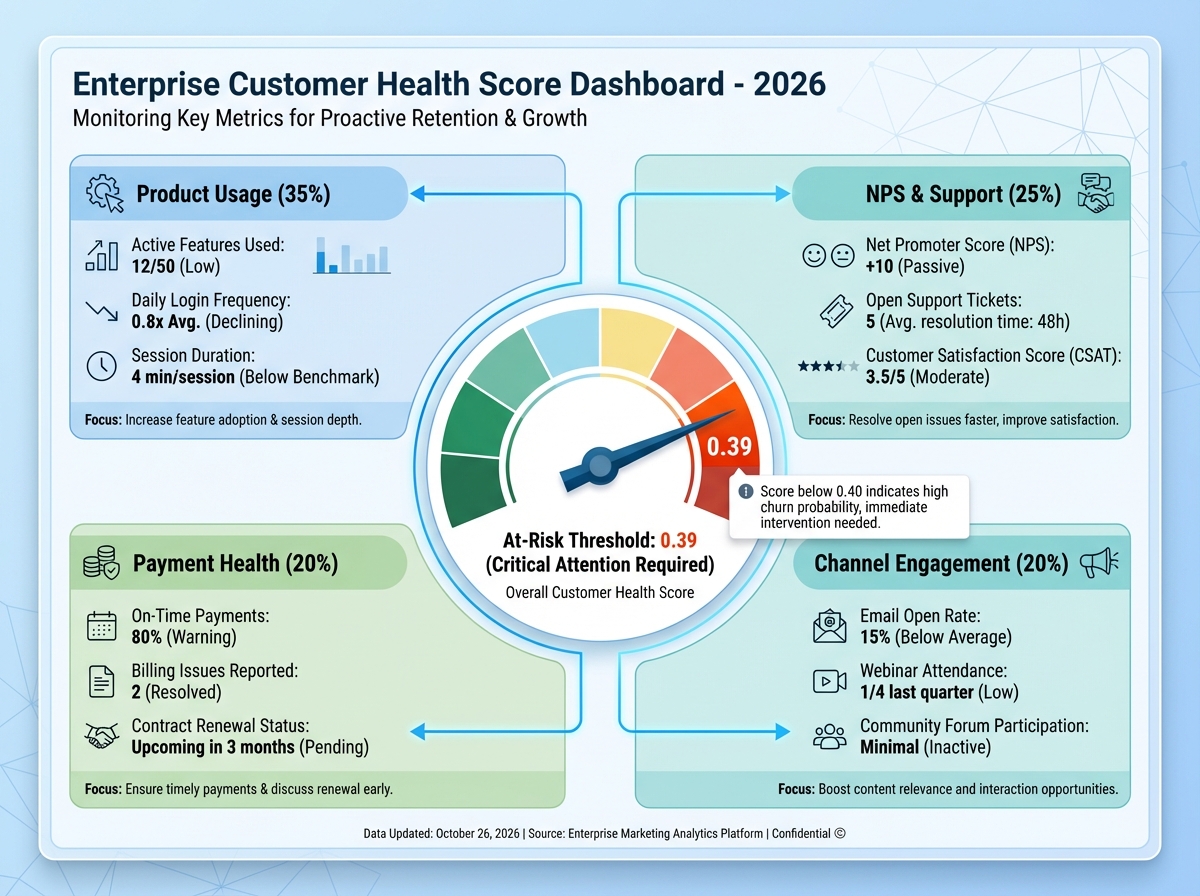
The bedrock of any successful post-purchase strategy in 2026 is a robust data foundation built on customer health scoring. This composite metric predicts the likelihood of a customer to stay, expand their spend, or churn by synthesizing behavioral, experiential, and financial data points.
An effective enterprise health score typically follows a weighted distribution: 35% based on product usage or reorder recency, 25% on support interactions and NPS/CSAT scores, 20% on payment health (including failed transactions), and 20% on channel engagement. These scores allow for automated alerting and the triggering of specific playbooks when a customer falls below defined thresholds, such as an “at-risk” score of 0.39 or lower.
Parallel to health scoring is retention cohort segmentation, which groups customers by their specific lifecycle stage, product affinity, and replenishment cycles. By segmenting customers into cohorts—such as “newly onboarded,” “active advocates,” or “lapsing subscribers”—enterprises can tailor the aggressiveness of their offers and the depth of their educational content.
This granular segmentation is essential for predictive churn prevention. By identifying the specific signals that precede a cancellation—such as a decay in app logins or a series of negative sentiment support tickets—brands can intervene with high-impact content before the customer reaches the point of no return.
Sources:
- Stripe — Churn prediction 101: Choosing the best model for your business
- Madgicx — Predictive analytics and omnichannel automation in 2026
Predictive Media: Leveraging Predictive Customer Success Videos for Engagement
In 2026, static communication is no longer sufficient to maintain customer attention. Predictive customer success videos have emerged as the gold standard for post-purchase engagement, offering personalized, auto-generated content that anticipates user needs based on their specific purchase history and observed friction points.
Platforms like TrueFan AI enable enterprise brands to bridge the gap between static automation and dynamic, human-centric engagement. These videos can be triggered by specific events, such as a product being marked as “delivered,” to provide a personalized unboxing experience or a “how-to” tutorial that reduces the initial learning curve and accelerates time-to-value.
TrueFan AI’s 175+ language support and Personalised Celebrity Videos allow for hyper-localized unboxing experiences that resonate across India’s diverse demographic landscape. By delivering these videos through high-engagement channels like WhatsApp, brands can achieve significantly higher watch-through rates compared to traditional email-based instructions.
The integration of predictive media into the post-purchase journey serves a dual purpose: it enhances the customer experience while providing a rich source of behavioral data. Tracking how a customer interacts with a personalized video—such as which segments they rewatch or where they drop off—provides invaluable insights that can further refine the customer health score and future messaging.
Sources:
Revenue Programs: The Engine of Lifetime Value Maximization
To achieve lifetime value maximization, enterprises must implement a suite of revenue-focused programs that target specific customer journey milestones. These programs are designed to compound value over time by encouraging repeat purchases, basket expansion, and brand advocacy.
Cross-sell and Upsell Timing
The success of cross-selling depends entirely on timing and relevance. AI-driven models now predict the “next-best-offer” window by analyzing the product graph and cohort performance. For example, a customer who purchases a high-end camera is most likely to need a specific lens or tripod within 14 days of delivery. Staggering these offers across WhatsApp and email ensures the message is seen without being intrusive (post-purchase loyalty automation guide).
Replenishment Reminder Automation
For CPG and consumable brands, replenishment reminder automation is the primary driver of retention. By learning the individual consumption patterns of each customer, the system can send a nudge exactly when the product is running low. In the Indian context, integrating these reminders with one-click UPI checkouts on WhatsApp has proven to significantly reduce friction and increase reorder rates (post-purchase loyalty automation guide).
Subscription Optimization
Subscription models in 2026 require proactive management to prevent “passive churn” caused by payment failures or “active churn” caused by perceived lack of value. Optimization strategies include pre-bill reminders that allow customers to skip or swap items, and automated recovery flows for failed payments. Predictive churn prevention playbooks can trigger a personalized save-offer or a concierge video if a subscriber shows signs of engagement decay.
Loyalty and Referral Activation
Loyalty program enrollment should be triggered by “moments of delight,” such as a positive NPS score or a milestone delivery. Once enrolled, customers can be incentivized to become advocates through referral activation videos. These are share-ready, personalized videos that thank the customer and provide a unique link for their network, turning satisfied users into a low-cost acquisition channel.
Sources:
Enterprise Implementation: A 90-Day Roadmap for Success
Implementing a comprehensive post-purchase lifecycle optimization 2026 strategy requires a structured approach that balances data integration with creative execution. For an enterprise, this rollout typically spans 90 days, divided into three distinct phases.
Weeks 0–2: Data and Infrastructure
The initial phase focuses on data mapping and infrastructure setup. This involves connecting the CDP, CRM, and commerce platforms to ensure a unified view of the customer. During this time, the customer health scoring model is defined, and retention cohort segmentation is established. Technical integrations for WhatsApp Business API and AI video rendering must also be finalized to support real-time triggers.
Weeks 3–6: Core Trigger Launch
In the second phase, the top-performing behavioral trigger campaigns are launched. This includes onboarding predictive customer success videos, replenishment reminders, and the initial predictive churn prevention flows. Solutions like TrueFan AI demonstrate ROI through significant lifts in watch-through rates and subsequent reorder frequency during this pilot phase. Brands should create multiple script variants to begin A/B testing the impact of different messaging angles.
Weeks 7–12: Expansion and Optimization
The final phase involves expanding the program to include purchase anniversary campaigns, loyalty enrollment nudges, and subscription optimization flows. This is also when incrementality testing becomes critical. By maintaining always-on holdout groups, enterprises can measure the true lift in LTV generated by the automated decisioning engine versus a control group receiving standard transactional updates.
Measurement in 2026 goes beyond open rates; it focuses on incremental LTV lift, save rates for at-risk customers, and the reduction in time-to-value. High-authority governance, including ISO 27001 and SOC 2 compliance, ensures that all customer data and AI-generated media meet the highest security standards.
Sources:
- IMPACT — Digital marketing trends and the move toward measurement-driven marketing
- Wheels Up Collective — Marketing trends 2026: Empathy at scale
Recommended Internal Links
- Post-purchase engagement automation guide
- Post-purchase loyalty automation in India (2024)
- Post-purchase loyalty automation guide
- Predictive analytics for customer retention
- Predictive churn prevention videos
- WhatsApp catalog video marketing
- WhatsApp catalog video marketing guide
- AI Overviews optimization in 2026
- Featured snippet video content
Frequently Asked Questions
How does post-purchase lifecycle optimization 2026 differ from standard email marketing?
Standard email marketing often relies on static, one-size-fits-all schedules. In contrast, 2026 optimization uses AI to orchestrate autonomous decisions across multiple channels (WhatsApp, SMS, Video) based on real-time behavioral triggers and customer health scores, ensuring every interaction is personalized to the individual's current lifecycle stage.
What are predictive customer success videos, and why are they effective?
These are personalized, AI-generated videos that anticipate a customer's needs—such as unboxing instructions or advanced feature tutorials—based on their specific purchase. They are effective because they provide a high-touch, human-like experience at scale, leading to higher engagement and lower support costs.
Can TrueFan AI integrate with my existing enterprise tech stack?
Yes, TrueFan AI is designed for enterprise environments, offering robust API integrations with leading CDPs, CRMs, and commerce platforms. This allows for the real-time triggering of personalized videos based on customer events like delivery, milestone achievement, or churn-risk flags.
How is customer health scoring calculated in an enterprise context?
It is a weighted composite score. Typically, it includes product usage recency (35%), customer sentiment/NPS (25%), payment and financial health (20%), and engagement with marketing channels (20%). This score allows the system to automatically trigger retention or save-offer playbooks.
What is the expected ROI of implementing these post-purchase programs?
Enterprises typically see a 15–25% reduction in early-stage churn and an 8–12% lift in ARPU through optimized cross-sell and replenishment programs. Additionally, using video-led engagement on WhatsApp often results in significantly higher conversion rates compared to traditional text-based channels.