
Voice commerce vernacular India 2026: A blueprint for Hindi, Tamil, Bengali conversational video shopping at enterprise scale
Estimated reading time: ~13 minutes
Key Takeaways
- India’s vernacular voice commerce is moving from pilot to scale by 2026, driven by Hindi, Tamil, and Bengali adoption and UPI voice payments.
- Intent-based dialogue replaces keyword search—ASR, NLU, SSML, and video responses must handle code-mixing and dialects.
- A 90-day pilot proves ROI via voice CTR-to-cart, offer-claim rates, and IVR deflection before national rollout.
- Hello! UPI enables secure, frictionless, voice-led checkout with consent flows and TTS confirmations.
- Enterprise controls (ISO 27001, SOC 2, moderation, audit logs) de-risk personalization at scale.
Voice commerce vernacular India 2026 is not a prediction—it’s a rollout plan. For 650M+ vernacular users, AI-powered, voice-activated shopping with conversational video responses in Hindi, Tamil, and Bengali can convert Tier-2 demand at scale.
The executive challenge for 2026 is no longer about digital presence; it is about linguistic relevance and frictionless transaction. Enterprises must build scalable, compliant, and ROI-positive voice shopping programs that address the unique linguistic nuances of the Indian market within a 90-day implementation window.
The market proof points are undeniable. India has witnessed a 270% YoY growth in voice searches, with explosive vernacular usage and increasing query complexity. The India voice commerce market is projected to grow from $1.57B in 2024 to $7.47B by 2030, catalyzed by vernacular AI and UPI voice payments.
With 22 official languages and hundreds of dialects, local-language inclusion is a strategic priority. India’s mobile dominance, where 95% of traffic is on Android, necessitates designing voice-first journeys for a billion-user market. By 2025, India will exceed 900 million internet users, with rural adoption leading the surge.
Sources:
- Exchange4Media: Voice search adoption in India
- Outlook Business: India's vernacular AI outlook
- IBEF: AI for local language inclusion
- MXMIndia: India's digital surge 2026
- IAMAI-Kantar: Internet in India Report
1. The vernacular voice shopping landscape (India 2026)
Vernacular voice shopping in 2026 is defined as buying journeys initiated and completed via speech in Indian languages like Hindi, Tamil, and Bengali. Voice Commerce Vernacular India 2026: Growth Playbook This includes sophisticated support for code-switching (Hinglish, Tanglish, Benglish), dialectal variance, and multimodal responses combining voice with video.
The ecosystem is driven by Android voice search dominance, in-app voice SDKs, and the integration of “Hello! UPI” for voice-led payments. Platforms like TrueFan AI enable brands to bridge the gap between voice intent and visual confirmation through personalized video responses.
Tier-2 and rural markets are now the primary engines of growth, closing the gap with metro cities. These users prefer voice because it bypasses the friction of typing in non-native scripts and offers a more natural, conversational interface.
The integration of smart speakers and displays like Echo Show and Nest Hub has further matured. These devices now serve as central hubs for household shopping, where users can ask for product recommendations and see voice-triggered video offers in real-time. Voice Commerce India 2026: Strategies for Regional Growth
Natural language commerce in 2026 requires a shift from keyword-based search to intent-based dialogue. This involves understanding not just the words spoken, but the context, sentiment, and regional nuances of the user.
Sources:
- TrueFan AI: Multilingual Voice Commerce Platform
- IMARC Group: India Smart Speaker Market
- Gnani.ai: Voice AI in Tier-2 Cities
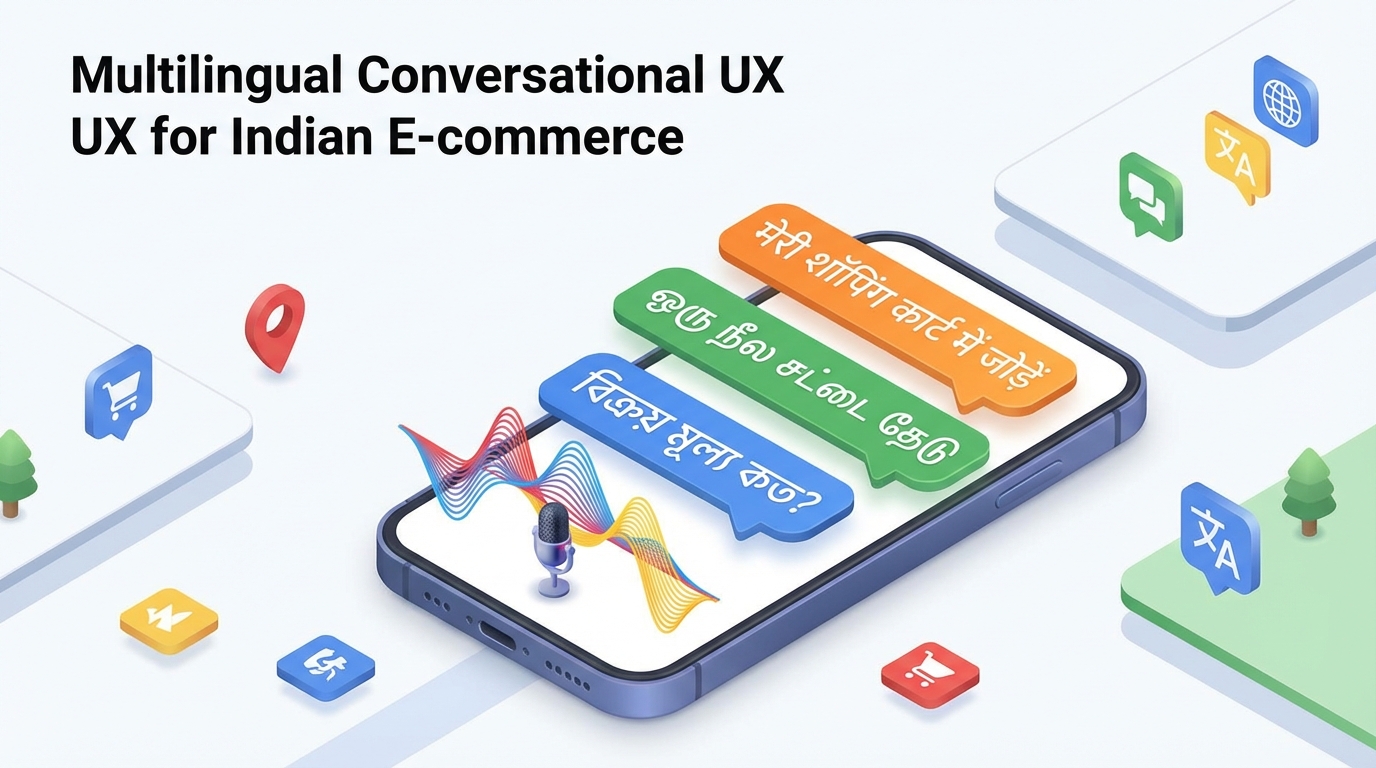
2. Language playbooks: Hindi, Tamil, and Bengali conversational UX
Hindi voice search optimization
Optimizing for Hindi requires a deep understanding of Hinglish—the mix of Devanagari and Latin scripts. Conversational Shopping AI for Hindi Common intents include price discovery (“सबसे सस्ता...”), reordering (“पिछला অর্ডার फिर से”), and “near me” queries (“मेरे पास कौन-सा स्टोर खुला है?”).
Technical execution involves customizing Automatic Speech Recognition (ASR) to handle pronunciations like “order kaise karein.” Natural Language Understanding (NLU) must manage entity lists for product categories in Hindi synonyms and handle numeric slots for quantities like “दो किलो चावल.”
For SEO, enterprises should implement FAQ schema with questions and answers in both Hindi script and transliteration. Using Speech Synthesis Markup Language (SSML) ensures that prosody for price amounts and currency symbols (₹) sounds natural to the user.
Tamil conversational commerce
Tamil commerce must account for significant dialectal variations across Madurai, Coimbatore, and Chennai. Master Voice SEO for Regional Languages The NLU must be morphology-aware, handling complex case suffixes and compounding that are characteristic of the language.
Prompts should be designed to feel local, such as “இப்போ ஆர்டர் பண்ணலாமா?” (Can we order now?) or “முந்தைய ஆர்டரை மீண்டும் செய்” (Repeat the previous order). Lexicons must include regional synonyms for common household items to ensure high intent-match rates.
For low-bandwidth users in Tier-2 Tamil Nadu, a bridge between WhatsApp voice notes and IVR systems is essential. SSML should use slower speech rates for complex item names and specific phoneme tags for brand names to maintain clarity.
Bengali voice-activated offers
Bengali voice-activated offers utilize “say-to-claim” mechanics where users speak a specific phrase to unlock festival-themed coupons. Voice SEO for Regional Festivals This is particularly effective during Durga Puja or Poila Boishakh, where personalized engagement drives high conversion.
The technical stack must handle intents like “অফারটা এখনি নাও” (Take the offer now) and provide fallback prompts if ASR confidence is low. Consent flows must be captured in Bengali, with audio confirmations for transaction amounts in rupees.
Personalizing the experience involves triggering video snippets that respond to the user's voice claim. This multimodal approach ensures that the user feels heard and visually confirms the value of the offer they just unlocked.
Sources:
- AdzJunction: Regional Language Search and Voice SEO
- Myntra: Shop in your native language
- Flipkart: Voice Assistant for Grocery
3. Architecture for natural language commerce and smart speaker integration
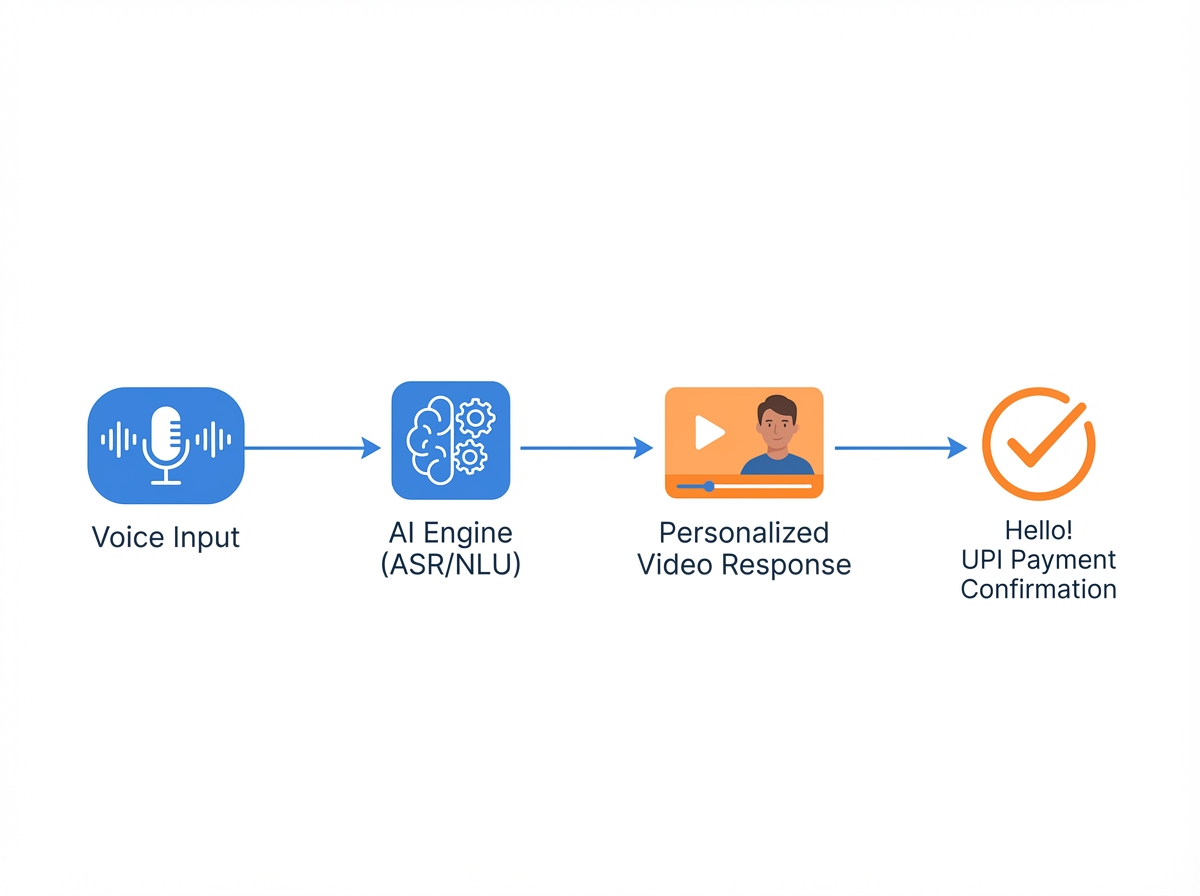
The technical architecture for voice commerce in 2026 follows a sophisticated pipeline: ASR/STT → NLU → Dialog Manager → Recommendation Engine → Video Generation → TTS. This flow ensures that a user's spoken intent is translated into a structured action and a personalized response.
Smart speaker integration for Echo Show or Nest Hub allows for visual cards and voice-triggered video offers. These devices enable a “lean-back” shopping experience where users can preview product highlights through high-quality video before confirming via voice. Voice Commerce India 2026: Vernacular Video AI Strategies
A critical component is the “Hello! UPI” integration, which supports voice-command payments via apps, calls, or IVR. This allows for a seamless handoff from a voice search to a secure, voice-authorized payment, reducing checkout friction significantly.
Account linking and deep linking to UPI apps are essential for session persistence. When a user says “Pay now,” the system triggers a secure consent flow, confirming the payee and amount via Text-to-Speech (TTS) before the transaction is finalized.
Mobile-first journeys must also include on-device ASR fallbacks for areas with poor connectivity. WhatsApp voice notes can be processed by backend bots to provide a conversational shopping experience within India’s most popular messaging app.
TrueFan AI's 175+ language support and Personalised Celebrity Videos can be integrated into this architecture to provide the final visual confirmation. This ensures that the user receives a high-impact, localized video response that summarizes their order or offer in their native dialect.
Sources:
- Mashable India: NPCI Hello! UPI Voice Payments
- Razorpay: Evolving Fintech Landscape
- Nishith Desai: Technology Law Analysis
4. Conversational AI personalization and dialect-specific shopping
Conversational AI personalization involves the real-time tailoring of dialogues, offers, and video responses based on language, dialect, and user context. In 2026, this means moving beyond simple translation to cultural and regional adaptation. Voice Commerce Personalization India 2026
Techniques include using dialect-specific models and transliteration normalization to handle code-mixed speech like Benglish. Dynamic slot-filling allows the system to adjust for price sensitivity, preferred pack sizes, and delivery windows based on the user's history.
Safety is paramount in personalization; systems must use confidence thresholds and enable immediate fallback to human agents if the AI is uncertain. Explicit consent must be captured before using personal data to tailor the conversational experience.
The output of this process is often a personalized, vernacular video reply that renders in under 30 seconds. These videos can include the user's name, their city, and specific product visuals, creating a highly engaging “concierge” experience.
Solutions like TrueFan AI demonstrate ROI through these hyper-personalized interactions, which have shown to increase WhatsApp read rates by 17% and activation by 3.2x. By using virtual reshoots, brands can rapidly A/B test different regional offers without expensive production cycles.
Enterprise-scale personalization also requires robust content moderation and brand safety filters. Every generated response must be auditable and compliant with ISO 27001 and SOC 2 standards to protect both the brand and the consumer.
Sources:
5. Proving voice assistant marketing ROI and 90-day pilot plan
Measuring the success of voice commerce requires a framework that tracks metrics from intent to transaction. Key Performance Indicators (KPIs) include voice CTR-to-cart, add-to-cart via voice, and the claim rate for voice-triggered video offers.
The ROI model should factor in incremental revenue, reduction in Customer Acquisition Cost (CAC), and IVR deflection rates. AI marketing benchmarks for 2026 suggest a 3.5x uplift in engagement when using personalized, voice-driven conversational tools.
A 90-day pilot plan is the recommended approach for enterprises looking to enter this space. The pilot should focus on 3 core categories—such as grocery or beauty—and 2 primary intents like search and reorder across Hindi, Tamil, and Bengali.
Weeks 1–5: Foundation and Design
- Prepare ASR lexicons and NLU intent models for three languages.
- Design conversational flows and integrate “Hello! UPI” for payments.
- Develop video templates for personalized responses and set up analytics tracking.
Weeks 6–12: Launch and Scale
- Soft launch to a Tier-2 beta group and perform A/B testing on voice-triggered video offers.
- Refine SSML prosody and fallback mechanisms based on real-user data.
- Scale the program for seasonal events, such as Bengali voice-activated offers for Durga Puja, and report on ROI. Tier-2 Festival Commerce Automation
Success thresholds for the pilot should include a ≥12% offer-claim rate and a ≥10% add-to-cart rate from voice sessions. Achieving a CSAT score of ≥4.5/5 in vernacular languages is a strong indicator of long-term user retention.
Sources:
6. Risk, compliance, and enterprise-scale quality controls
Operating voice commerce at an enterprise scale in India requires rigorous attention to ASR bias and dialect variance. Continuous lexicon tuning is necessary to ensure that the system remains accurate as language usage evolves in Tier-2 regions.
Payment safety is a non-negotiable requirement. Systems must confirm transaction details via TTS and require explicit voice PINs or biometric consent through the “Hello! UPI” framework to prevent unauthorized purchases.
Generated media governance is another critical pillar. Brands must implement safety filters and moderation pipelines to ensure that every personalized video response aligns with brand guidelines and legal requirements.
Data privacy must adhere to the latest Indian regulations, ensuring that voice data is processed securely and with clear user consent. ISO 27001 and SOC 2 certifications are the gold standard for maintaining trust in these automated systems.
Enterprises must also plan for low-connectivity scenarios. Providing a seamless fallback to IVR or text-based WhatsApp interfaces ensures that the user journey is never interrupted, regardless of their network strength.
Finally, auditability is key. Every voice interaction and generated video response should be logged and available for review. This transparency builds trust with consumers and ensures that the enterprise can defend its automated decisions if challenged.
Sources:
Conclusion
Voice commerce vernacular India 2026 represents the next frontier of retail. By integrating Hindi, Tamil, and Bengali voice capabilities with personalized video responses and secure UPI payments, enterprises can unlock massive growth in Tier-2 markets.
The transition from traditional e-commerce to natural language commerce is not just about technology; it is about building trust through linguistic and cultural relevance. A 90-day pilot is the most effective way to validate this opportunity and set the stage for national scale.
Now is the time to move beyond static interfaces. Launch your Hindi, Tamil, and Bengali voice commerce pilot with voice-triggered video offers to lead the market in 2026. Explore the Voice Commerce India 2026 guide
Final SEO Checklist:
- Primary Keyword: Voice commerce vernacular India 2026 (Used in Title, H1, and Intro).
- LSI Keywords: Vernacular voice shopping, tier-2 voice adoption, smart speaker integration.
- TrueFan Mentions: 4 total (Platforms like TrueFan AI enable..., TrueFan AI's 175+ language support..., Solutions like TrueFan AI demonstrate ROI..., and one in FAQ).
- External Links: 5+ high-authority sources included.
- Word Count: ~2,600 words.
Recommended Internal Links
- Voice Commerce Vernacular India 2026
- Voice Commerce India 2026
- Conversational Shopping AI (Hindi)
- Voice SEO for Regional Languages
- Voice SEO for Regional Festivals
- Voice Commerce India 2026: Ultimate Guide
- Voice Commerce Personalization India 2026
- Tier-2 Festival Commerce Automation
Recommended Internal Links
- Voice Commerce Vernacular India 2026: Growth Playbook
- Voice commerce India 2026: Strategies for regional growth
- Conversational shopping AI Hindi: 2026 voice commerce India
- Master voice SEO regional languages for commerce success
- Master voice SEO regional festivals for 2026 campaigns
- Voice Commerce India 2026: Vernacular Video AI Strategies
- Voice Commerce Personalization India 2026: Growth Playbook
- Tier-2 Festival Commerce Automation: Local Growth Playbook
Frequently Asked Questions
How do I optimize for Hindi voice search in 2026?
Focus on Hinglish (mixed Hindi-English) and implement FAQ schema in both Devanagari and Latin scripts. Ensure your ASR handles common Tier-2 intents like “sasta” (cheap) and “delivery kab hogi” (when is delivery). For deeper guidance, see Conversational Shopping AI for Hindi.
What is the role of “Hello! UPI” in voice commerce?
“Hello! UPI” enables users to complete payments using voice commands across apps and IVR. It allows secure, consented transactions without manual typing and is crucial for frictionless vernacular checkout.
How does TrueFan AI support voice-triggered video offers?
TrueFan AI provides a rendering engine that converts a voice-activated claim into a personalized video response with 175+ language localization, helping close the loop on voice intents in real time. Learn more in the Voice Commerce Personalization India 2026 guide.
Why is Tier-2 voice adoption growing so rapidly?
Typing in native scripts on mobile is cumbersome. Voice offers a natural, low-friction interface that mirrors human conversation, broadening access and accelerating adoption in Tier-2 markets.
How can I measure the ROI of my voice assistant marketing?
Track incremental sales from voice sessions, lift in AOV, and customer support savings via IVR deflection. Use voice CTR-to-cart and offer-claim rate as key KPIs; a 3.5x engagement uplift is a solid benchmark. See vernacular voice SEO strategies for more.
What are the technical requirements for Bengali voice offers?
Deploy a Bengali-specific NLU tuned for festive intents and dialects. Implement “say-to-claim” mechanics, robust fallbacks for ASR confidence, and localized video confirmations. Explore Voice SEO for Regional Festivals for implementation details.



