Vernacular video automation India: The enterprise CMO playbook for Tier-2/3 growth
Estimated reading time: ~10 minutes
Key Takeaways
- Tier-2/3 growth in India demands vernacular-first video powered by multilingual AI, not just translated subtitles.
- Hinglish/code-mixed videos and AI voice cloning with Indian accents drive trust, comprehension, and conversions.
- An enterprise-ready stack requires DPDP compliance, security certifications, and CRM/CDP integrations for scale.
- WhatsApp-first conversational commerce with personalized video boosts ROI across Hindi, Tamil, and Bengali.
- CMOs should execute via a phased roadmap and measure a full-funnel KPI tree from attention to LTV uplift.
The Bharat Opportunity: Why Vernacular Video Automation India is the 2026 Growth Engine
Vernacular video automation India has evolved from a peripheral marketing experiment into the primary engine for enterprise growth in the "Bharat" market. For the modern CMO, the mandate is clear: unlocking the next 500 million users requires more than just translated text; it demands high-fidelity, culturally resonant video content delivered at a scale previously thought impossible. By 2026, the ability to operationalize a multilingual AI video generator across every customer touchpoint will distinguish market leaders from those losing relevance in Tier-2 and Tier-3 cities.
The business outcome of this shift is measurable and profound. When brands transition from generic English assets to regional language personalization, they see a direct correlation in trust, comprehension, and conversion rates. In the context of the Bharat market AI videos, the goal is to move beyond simple subtitles and embrace a holistic strategy that includes Hinglish AI video creation and AI voice cloning Indian accents to mirror the way users actually speak.
Defining the Bharat Market Momentum
Bharat represents India’s mass market beyond the metropolitan bubbles, where the majority of new digital adoption is concentrated. These users are not just "online"; they are "video-first" and "vernacular-first." According to the IAMAI–Kantar Internet in India 2023 report, there were 820 million active internet users in 2023, with a staggering 45% of the population still to come online, signaling massive headroom for growth in rural and Tier-2/3 sectors.
By 2026, the landscape will be dominated by voice-first vernacular interfaces, which are projected to be the default for over 650 million users. Brands that fail to integrate code-mix aware ASR (Automatic Speech Recognition) and localized TTS (Text-to-Speech) into their commerce flows risk total alienation from this demographic. Research indicates that Tier-2/3 vernacular AI content growth is currently 156% faster than English content, making Tier-2 city video marketing the most critical frontier for market share retention.
Sources:
Defining the Stack: Multilingual AI Video Generator and Core Components
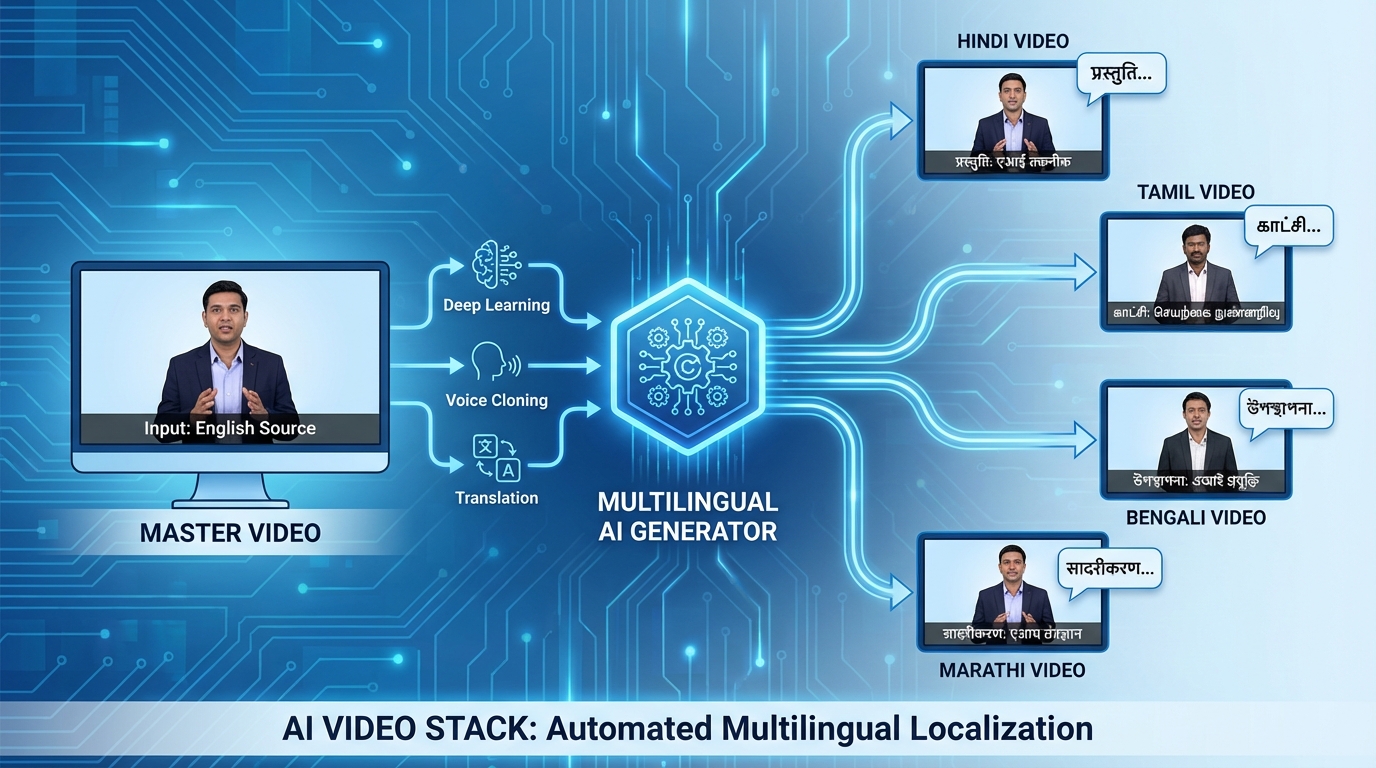
To execute at an enterprise level, CMOs must understand the technical architecture of vernacular video automation India. This is not merely about "making videos"; it is about the programmatic creation, localization, and distribution of assets across hundreds of dialects using a sophisticated multilingual AI video generator.
The 175 Language Video Platform
An enterprise-grade 175 language video platform provides the breadth necessary to cover the linguistic diversity of India—from major languages like Hindi, Tamil, Bengali, and Marathi to specific regional dialects. Platforms like TrueFan AI enable brands to take a single master shoot or a digital avatar and render millions of personalized variants (see the Vernacular Video Automation India overview and the detailed implementation guide), ensuring a consistent brand voice while maintaining perfect lip-sync reanimation across every language.
Hinglish AI Video Creation and Code-Switching
In Tier-2 and Tier-3 cities, "pure" language is often less effective than code-mixed formats. Hinglish AI video creation supports the natural blend of Hindi and English at the sentence or phrase level (see Hinglish AI video creation, the Hinglish AI creation guide, and Hindi AI video marketing). This mirrors real-world speech patterns, significantly improving user trust and comprehension. By 2026, the ability to handle "Tamlish" or "Benglish" will be just as critical for regional language personalization.
AI Voice Cloning Indian Accents
The "uncanny valley" of AI video often lies in the audio. AI voice cloning Indian accents allows for voice conversion that preserves the identity of a brand ambassador or talent while adapting their intonation to specific regions (see Voice commerce personalization in India 2026). For instance, a Hindi video for a user in Lucknow should feature different phonetics than one for a user in Mumbai. This level of detail improves watch-through rates and CTR by making the content feel local rather than "translated."
The Indian AI Avatar
The Indian AI avatar represents the next phase of digital spokespersons. These are rights-cleared, diffusion-based digital personas—often based on celebrities or brand-specific characters—that can be rendered with accurate lip-sync for "virtual reshoots." This eliminates the need for expensive physical production every time a price point or offer changes, allowing for agile, data-driven creative iterations.
Sources:
Enterprise-Grade Infrastructure: Security, DPDP Compliance, and Scale
For an enterprise CMO, the "cool factor" of AI is secondary to security, scalability, and legal compliance. Deploying vernacular video automation India at scale requires a stack that integrates seamlessly with existing CRM/CDP systems while adhering to the stringent requirements of the Digital Personal Data Protection (DPDP) Act 2023.
Security and Integration Non-Negotiables
An enterprise rollout must be API-first, supporting real-time rendering (with a target of under 30 seconds) and batch processing for millions of unique assets. Integration with CRMs like Salesforce or HubSpot is essential to auto-trigger personalization based on lifecycle events, such as an abandoned cart or an EMI reminder.
Furthermore, the platform must support SSO (SAML/OIDC) and maintain certifications like ISO 27001 and SOC 2. Content moderation guardrails are also vital to ensure that AI-generated content remains brand-safe and free from hallucinations or inappropriate regional nuances.
Navigating the DPDP Act 2023
The DPDP Act 2023 introduces strict mandates on consent, purpose limitation, and data principal rights. When using personal data (like a name or purchase history) to generate a personalized video, brands must:
- Obtain clear, affirmative consent via language-specific notices.
- Implement robust consent management systems.
- Ensure PII (Personally Identifiable Information) minimization in creative logs.
- Adhere to data retention and deletion SLAs.
(Related reading: Interactive video data capture; DPDP-compliant personalization strategies)
Channel Connectors and WhatsApp ROI
The primary delivery vehicle for Bharat market AI videos is the WhatsApp Business Platform. However, managing ROI requires a deep understanding of WhatsApp’s 2026 pricing tiers in India. Marketing messages, utility messages, and service messages each have different cost structures that impact the overall CPA (Cost Per Acquisition) modeling (further reading: WhatsApp business commerce automation 2026; WhatsApp catalog video marketing; WhatsApp catalog video marketing guide).
Sources:
Channel Blueprint: Conversational Commerce Hindi Tamil Bengali
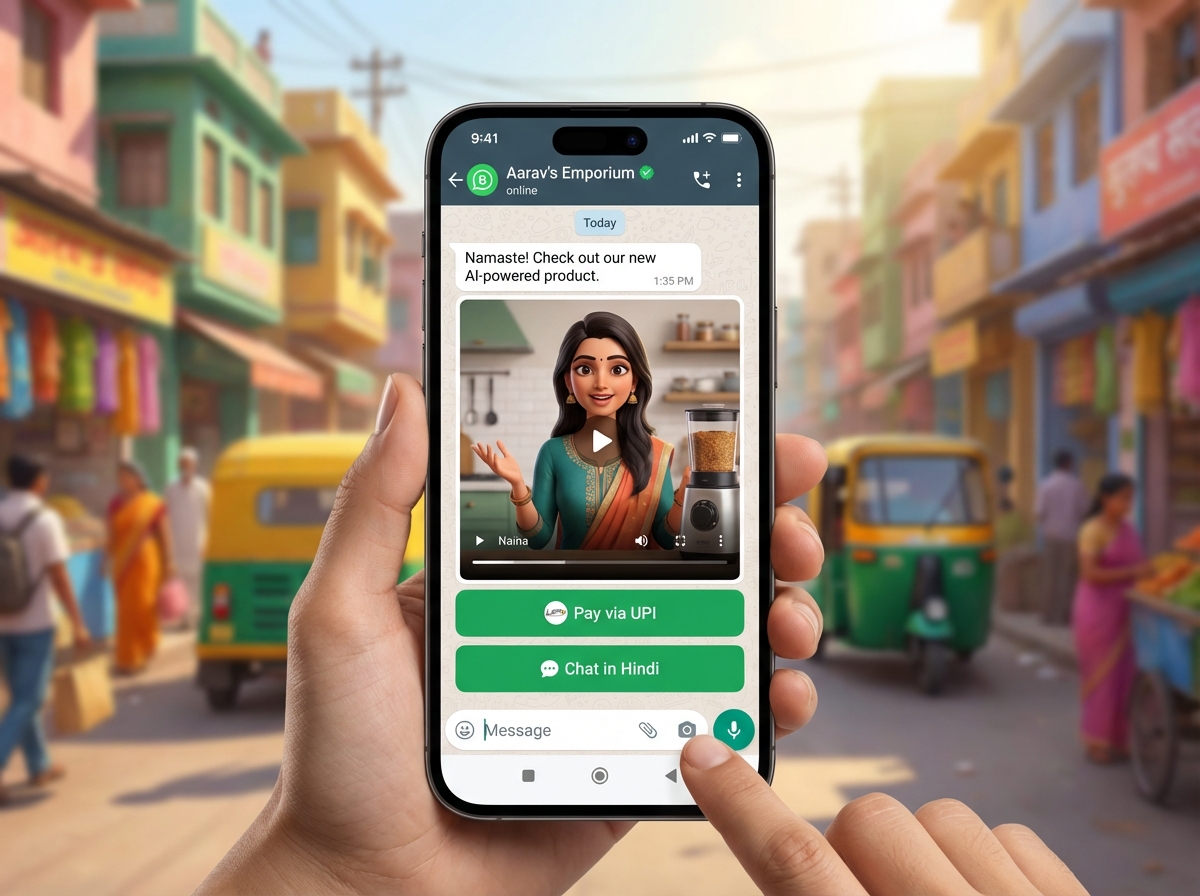
The most effective distribution strategy for vernacular video automation India is a "WhatsApp-first" approach, integrated into a broader conversational commerce framework. This involves creating end-to-end purchase journeys facilitated through dialogue in Hindi, Tamil, or Bengali, augmented by personalized video (see voice commerce for vernacular India 2026 and the ultimate voice commerce guide for India 2026).
The Conversational Commerce Flow
Conversational commerce Hindi Tamil Bengali allows a user to interact with a brand in their preferred tongue. A typical flow might look like this:
- Intent Capture: A user asks, “EMI details chahiye?” (Hinglish) or “எம்ஐ விபரங்கள் வேண்டும்?” (Tamil).
- Language Detection: The system auto-detects the preference or provides a language selector.
- Video Response: A 20-40 second explainer video is generated using an Indian AI avatar, explaining the localized pricing and city-specific branch details.
- Commerce Step: The user is presented with a UPI deep link or a checkout URL within the chat.
- Service Loop: Post-purchase, a confirmation video in the local language provides delivery updates or a "how-to" guide.
Regional Social and Short Video
Beyond WhatsApp, Tier-2 city video marketing must leverage platforms like ShareChat, Moj, and YouTube Shorts. These 9:16 videos should be 10-20 seconds long, with the core offer or price front-loaded within the first 3-5 seconds. Large, legible fonts in local scripts (Devanagari, Tamil, Bengali) are essential for users on low-end devices or in areas with limited bandwidth.
Programmatic DOOH in Tier-2/3
Programmatic Digital Out-of-Home (DOOH) is expanding rapidly in India, with a projected footprint of over ₹1,500 crore by 2026. Vernacular creatives can now be localized by city, route, or even local festival moments (see Tier-2 festival commerce automation). Using a multilingual AI video generator, a brand can deploy thousands of city-specific DOOH ads that speak the local dialect, significantly increasing brand recall in non-metro markets.
Sources:
Vertical Playbooks: Operationalizing Vernacular Video Automation India
To move from strategy to execution, enterprise teams need vertical-specific playbooks. These use cases demonstrate how regional language personalization and Indian AI avatars can be deployed to solve specific business challenges.
BFSI (Banking, Financial Services, and Insurance)
In the BFSI sector, trust is the primary currency. Vernacular video automation India can be used for:
- KYC Explainers: Step-by-step videos in Hindi, Tamil, or Bengali to reduce drop-offs in the onboarding funnel.
- EMI Reminders: Personalized videos featuring the user's name, due date, and a "pay now" button, delivered via WhatsApp.
- Collections: Empathy-based scripts in local dialects that explain repayment options, reducing defaults through better clarity.
E-commerce and Retail
For retail brands targeting the Bharat market, video is the ultimate tool for reducing RTO (Return to Origin):
- COD Confirmation: A video sent immediately after a Cash-on-Delivery order, confirming the address and delivery time in the user's language.
- Size/Fit FAQs: Personalized videos based on the user's previous purchases to help them choose the right size.
- Post-Purchase Upsell: Using an Indian AI avatar to recommend complementary products in a localized, conversational tone.
Edtech and Fintech
- Trial-to-Paid Nudges: Personalized videos for parents in Tier-2 cities, highlighting local scholarship opportunities or student success stories from their specific region.
- Plan Explainers: Complex fintech products or telecom plans explained through Hinglish AI video creation, making the benefits clear to a non-technical audience.
Mobility and Travel
- Trip Updates: Real-time video updates about bus or train routes in the local language.
- Festival Travel: Localized travel advisories and offers during regional festivals like Durga Puja or Pongal, using city-specific B-roll and accents.
Sources:
Measurement, ROI, and the Implementation Roadmap
TrueFan AI's 175+ language support and Personalised Celebrity Videos provide the foundation for a high-ROI vernacular strategy, but measurement is what sustains it. Enterprise CMOs must move beyond vanity metrics to a full-funnel KPI tree.
The KPI Tree for Vernacular Video
- Attention: 3s and 10s view-through rates; completion rates across different languages.
- Engagement: CTR to WhatsApp chat; quick-reply interaction rates.
- Conversion: Add-to-cart rates; lead submission CVR; LTV (Lifetime Value) uplift from vernacular cohorts.
- Operational: Render latency; cost per video; agent deflection rates (how many users self-served after watching a video). (see Vernacular voice SEO strategies and Voice commerce India 2026 ultimate guide)
A/B Testing Matrix
To optimize performance, brands should run structured experiments:
- Hinglish vs. Pure Language: Which drives better trust in urban vs. rural Tier-2 segments?
- Accent Variants: Does a Madurai accent outperform a Chennai accent for users in Southern Tamil Nadu?
- Avatar vs. Voiceover: Does the presence of an Indian AI avatar increase conversion compared to a static image with a voiceover?
Implementation Roadmap
- Phase 1: Pilot (4-6 Weeks): Select 2 regions and 3 languages. Define 5 core intents. Secure talent/avatar rights and set up DPDP-compliant data mapping.
- Phase 2: Scale (8-16 Weeks): Expand to 12+ languages. Automate CRM triggers for lifecycle events. Integrate WhatsApp catalog flows.
- Phase 3: Optimize (Ongoing): Implement Linguistic Quality Assurance (LQA) loops. Fine-tune accents and monitor for creative fatigue.
Solutions like TrueFan AI demonstrate ROI through their ability to handle this entire pipeline—from creative generation to secure, multi-channel distribution—at a fraction of the cost of traditional production.
Conclusion: The Future of Bharat Market AI Videos
The transition to vernacular video automation India is a strategic imperative for any enterprise looking to dominate the 2026 landscape. By leveraging a multilingual AI video generator, mastering Hinglish AI video creation, and deploying Indian AI avatars, CMOs can finally bridge the gap between metro-centric marketing and the vast potential of the Bharat market.
The roadmap is clear: prioritize regional language personalization, ensure DPDP compliance, and integrate video into the heart of your conversational commerce Hindi Tamil Bengali strategy. As the digital divide closes, the brands that speak the language of the people—literally and culturally—will be the ones that win.
Sources:
Recommended Internal Links
- Vernacular Video Automation India: Overview
- Vernacular Video Automation India: Step-by-step Guide
- Hinglish AI Video Creation: Strategy and Examples
- Hinglish AI Video Creation: Implementation Guide
- Hindi AI Video Marketing: Tactics for Growth
- Voice Commerce for Vernacular India 2026
- Voice Commerce India 2026: Ultimate Guide
- WhatsApp Business Commerce Automation 2026
- WhatsApp Catalog Video Marketing
- WhatsApp Catalog Video Marketing: Guide
- Tier-2 Festival Commerce Automation
- Interactive Video: Data Capture
- DPDP-Compliant Personalization Strategies
- Voice Commerce Personalization in India 2026
- Vernacular Voice SEO Strategies
Frequently Asked Questions
How does vernacular video automation India differ from simple video translation?
Translation is the literal conversion of text. Vernacular video automation involves "transcreation"—adapting the script, cultural cues, accents, and even the lip-sync of the speaker to match regional nuances. It uses a multilingual AI video generator to ensure the content feels native to the target audience.
Is Hinglish AI video creation effective for professional BFSI communications?
Yes. In fact, research shows that Hinglish often increases trust in Tier-2 cities because it mirrors the aspirational yet relatable way people communicate. For technical terms or T&Cs, brands often switch to pure Hindi or Tamil for absolute clarity, a technique known as intentional code-switching.
How does the DPDP Act affect the use of Indian AI avatars?
The DPDP Act requires explicit consent for processing personal data used in personalization. Furthermore, when using an Indian AI avatar based on a real person, brands must have consent-first licensing and clear moderation guardrails to prevent misuse or deepfake risks.
Can a 175 language video platform handle specific dialects like Bhojpuri or Marwari?
Advanced platforms like TrueFan AI are designed to support not just major constitutional languages but also significant regional dialects. This is achieved through AI voice cloning for Indian accents, which can be tuned to specific regional prosody and intonation.
How do platforms like TrueFan AI enable enterprise-scale personalization?
TrueFan AI provides an API-first architecture that connects directly to enterprise CRMs. This allows for the real-time generation of millions of personalized videos, each featuring unique user data, delivered instantly via channels like WhatsApp or SMS.
What is the expected ROI for conversational commerce in Hindi, Tamil, and Bengali?
Brands typically see a 2x to 3x increase in engagement rates and a significant reduction in CAC when moving from English-only static ads to vernacular, video-led conversational flows in the Bharat market.